- The paper presents a modular, hardware-aware simulator that models essential RF non-idealities in sub-THz radio-stripe networks using measurement-driven parameters.
- Key methodology includes a YAML-configurable, four-layer architecture covering scenario setup, waveform composition, hardware impairment chains, and wireless channel models.
- The simulator enables detailed system-level analysis such as NMSE, BER evaluation, and design trade-off studies for RU activation and beamforming in 6G systems.
Open-Source Hardware-Aware Simulation of Sub-THz Radio-Stripes
Introduction
Sub-THz radio-stripe architectures are central candidates for supporting 6G services requiring extreme spatial reuse and multi-GHz bandwidths. These architectures leverage distributed MIMO by connecting multiple low-complexity radio units (RUs) along a physical medium such as polymer microwave fiber (PMF), while system-level signal flow is tightly coupled to multifaceted hardware impairments including insertion loss, component nonlinearities, phase noise, and fiber-induced frequency selectivity. There is a clear need for end-to-end simulation tools reflecting these critical non-idealities with waveform-level fidelity. "An Open-Source Hardware-Aware Sub-THz Radio-Stripe Simulator" (2604.14869) provides a comprehensive, extendable Python-based toolchain explicitly targeting this gap using modular configuration and measurement-driven models.
Simulator Architecture and Signal Flow
The simulator embodies a four-layer structure: scenario definition, waveform composition, a hardware-aware component chain, and flexible wireless propagation models. Scenario parameters (node topologies, carrier/bandwidth, positions) are specified in YAML files, fostering easy reproducibility and parameter sweep experiments. The waveform layer is primarily CP-OFDM with flexible pilots and oversampling. Hardware chain modeling is especially detailed, with parameterized representations of DAC quantization, IQ imbalance, phase/frequency noise, nonlinear power amplifiers, PMF/coupler S-parameters, splitters, phase shifters, and antenna patterns. Wireless propagation can operate via stochastic fading, lightweight deterministic LOS, or precomputed ray-tracing datasets, carefully aligned with hardware geometry and RF numerology.
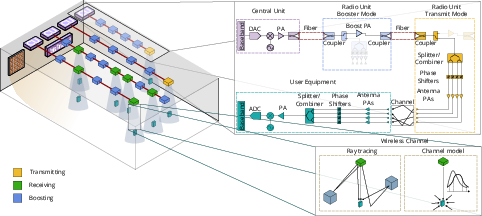
Figure 1: A deployment of distributed low-complexity sub-THz RUs within a stripe topology—each RU can transmit, receive, or amplify signals, showing full fiber-based infrastructure and system blockflow.
Component interactions model realistic RU operation (active wireless interfacing or signal boosting) and can incorporate measured hardware characterizations at each signal chain stage, supporting both reference (idealized) and impairment-rich paths. Each simulation instance outputs waveforms and relevant system-level metrics (e.g., NMSE, SNDR, BER) at intermediate and final nodes, enabling fine-grained diagnosis of distortion accumulation and calibration efficacy.
Detailed Hardware and Channel Models
Hardware Component Flexibility
Every physical block is abstracted as a Python class supporting various impairment modes and parameterization via YAML. Coupler and fiber frequency responses, amplifier soft limiting characteristics, IQ modulator imbalance, DAC bit resolution, oscillator phase noise, and DC offset are readily configured—models can be switched between ideal and measurement-derived operational characteristics. Notably, amplifier models include support for measured AM/AM and AM/PM profiles with noise figures, and future integration of memory-based nonlinear representations is anticipated.
(Figure 2)
Figure 2: PMF amplitude response curves exhibited for different fiber lengths, used for parameterizing simulation S-parameters.
(Figure 3)
Figure 3: Coupler amplitude response curves showing measured insertion-loss and spectral shaping, critical for system calibration and gain allocation.
RUs employ both boosting and active transmission chains. Booster chains compensate for fiber/coupler loss via programmable gain amplifiers, while active chains handle splitting, phase manipulations, and front-end gain. Configuration files directly control which stages are enabled, allowing examination of cascading nonlinearity in multistage boost scenarios.
Wireless Channel Models
Channel modeling supports a spectrum of abstraction. When no specific capture data is available, the tool can instantiate classical Rayleigh fading, exponential power-delay taps, or deterministic LOS with full OFDM per-subcarrier granularity. This supports both algorithm prototyping and debugging.
(Figure 4)
Figure 4: Comparison of deterministic LOS model and ray-tracing channels at sub-THz frequencies, validating lightweight model efficacy for specific conditions.
When higher-fidelity is required, precomputed MIMO channel responses from NVIDIA Sionna's ray-tracing engine are loaded per scenario. The ray tracer incorporates detailed material models (frequency-dependent permittivity/conductivity), antenna patterns, and full scene geometry, capturing realistic spatial characteristics for both communication and positioning. This decouples time-consuming environment channel estimation from simulator run, enabling rapid iteration while still supporting site-specific performance studies.
(Figure 5)
Figure 5: Example power-delay profiles for exponential TDL and LOS channel models at 158 GHz, 2.24 m distance, with Gtx=Grx=20 dBi.
Simulation Output and Model Validation
Every modeled stage can export its input and output baseband waveforms, allowing empirical AM/AM, EVM, and BER calculations. Both ideal and hardware-impaired paths can be analyzed side-by-side, enabling detailed sensitivity and compensation studies. For example, stagewise degradation of amplitude characteristics under nonlinear saturation is easily visualized.
(Figure 6)
Figure 6: AM/AM curves for consecutive chain stages illustrating cumulative nonlinear effects across the stripe.
Furthermore, comprehensive system heatmaps (e.g., NMSE distributions per active RU) provide insight into activation, beamforming, and handover strategies, essential for distributed deployment studies.
(Figure 7)
Figure 7: Heatmap of NMSE at the central unit per active RU selection, supporting end-to-end beam management/selection algorithm evaluation.
Implications and Research Opportunities
The simulator's primary contribution is an open-source testbed bridging the algorithm-hardware divide in distributed sub-THz MIMO and radio-stripe systems. It is the first such framework that can test the end-to-end impact of (for instance) hardware impairments, fiber and coupler insertion loss, and realistic channel fading on beamforming, RU selection, distributed positioning, and calibration. This enables not only validation of physical layer techniques but also practical evaluation of design trade-offs, such as the cost of improved PA linearity or the value of dual-frequency, hardware-constrained side information for resource allocation (2604.14869).
Theoretical developments are enhanced by the tool’s reproducibility and extensibility—frontend/circuit improvements can be traced to system-level metrics, while waveform, pilot, and calibration designs can be directly assessed in hardware-representative environments. The modular YAML-driven workflow ensures that new measurement data or alternative topologies can be rapidly integrated.
Importantly, the simulator supports direct quantification of theoretical conjectures regarding calibration, compensation, and packaging constraints, while offering a platform for benchmarking machine learning algorithms for RU activation, transmit/receive beamforming, and federated localization in cascaded hardware contexts. As such, it serves as an important intermediary between hardware prototyping and full-scale network simulations.
Conclusion
This paper delivers an extensible, open-source, configuration-driven simulator for evaluating hardware-aware distributed sub-THz radio-stripe networks. The tool's fidelity in mirroring end-to-end nonidealities—rooted in measurement data and parametrizable models—establishes it as a valuable asset for both academic research and early industrial design. By encompassing the interplay between RF/circuit effects, algorithmic strategies, and stochastic or geometry-based propagation, it enables reproducible studies crucial for practical 6G deployment and optimization. Further work will expand the suite of measurement-derived models, enhance real-time ray-tracing integration, and further bridge the algorithm-circuit-system divide for next-generation wireless infrastructure.