- The paper presents a self-consistent DFT+DMFT approach to capture strong correlation effects in Sr2RuO4, elucidating pronounced shifts and broadening in plasmon dynamics.
- It demonstrates that the optical plasmon at approximately 1.47 eV emerges from the full correlated response, with damping and effective mass renormalization critical to its dispersion.
- Experimental comparisons with EELS data validate the method, underscoring the inadequacy of conventional DFT in capturing both high-energy and low-energy plasmon features.
Unconventional Plasmon Dynamics Due to Strong Correlations in Sr2RuO4
Introduction
The interplay of strong electronic correlations and collective excitations in transition metal oxides is a central topic in condensed matter physics. In the context of Sr2RuO4, a prototypical layered perovskite, the nature and dynamics of plasmons provide acute sensitivity to correlation effects that go beyond single-particle band structure. This paper presents a detailed study of plasmon dynamics using a combination of DFT and DMFT, contrasting with predictions from bare DFT and connecting directly to optical and EELS data.
The authors construct the dynamical density-density correlation function χ00(q,ω) via the current-dipole correlation function, properly accounting for strong local correlations through the DMFT-derived self-energy. This approach, leveraging the continuity equation, guarantees charge conservation and correct long-wavelength behavior, as evidenced by the observed ∣q∥∣2/ω2 scaling in the real part of the correlation function.
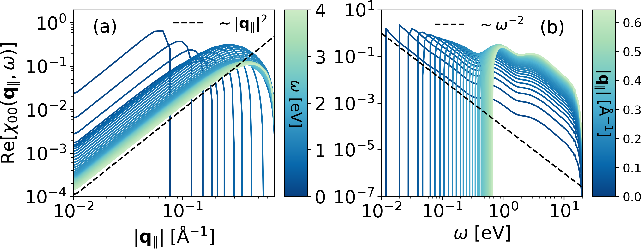
Figure 1: Real part of the DFT+DMFT density-density correlation function χ00, demonstrating ∣q∥∣2/ω2 scaling.
Notably, the correlation function is computed with the DMFT self-energy but omits vertex corrections, with validation via the optical sum rule showing ∼90\% accuracy relative to the restricted f-sum rule. This result substantiates the neglect of vertex corrections except for specific two-particle observables in this system.
Optical conductivity computed with DFT+DMFT shows robust agreement with experiment, substantiating the importance of correlation effects in the intraband region and in redistributing spectral weight. The memory function M(ω) is employed to interpret energy-resolved effective mass 40 and scattering rate 41, as well as their consequences for plasmon broadening and dispersion.
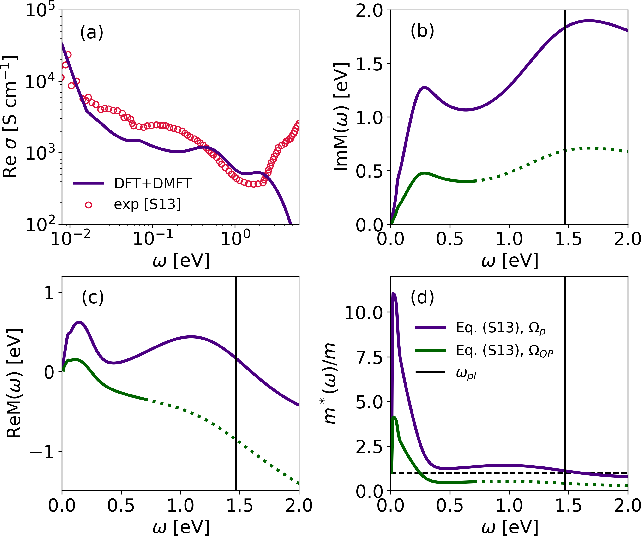
Figure 2: (a) Optical conductivity via DFT+DMFT aligns well with experiment; (b) and (c) show the imaginary and real parts of the memory function; (d) displays the optical effective mass 42.
A central finding is that the optical plasmon at 43 eV in Sr44RuO45 arises from the full, correlated response and that the plasmon width reaches approximately 1 eV only in the presence of strong correlations, in stark contrast to DFT predictions.
Plasmon Dispersion and the Role of Correlations
The full plasmon dispersion is determined from the zero of the real part of the dielectric function, 46. The analysis reveals that damping (via 47), renormalized mass (48), total spectral weight (49), and background dielectric constant (20) all exert comparable influence on the plasmon energy. The momentum-dependent analysis highlights a prominent negative plasmon dispersion at large 21, captured only when correlations and damping are properly included.
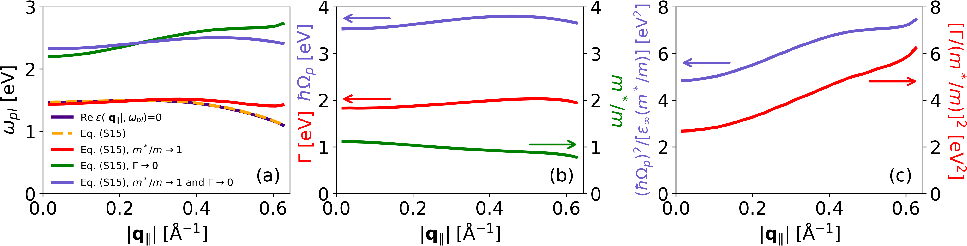
Figure 3: (a) Plasmon dispersion from 22 and memory function analysis; (b) momentum dependence of 23, 24, and 25; (c) interplay of energy scales.
Finite 26 results show that the out-of-plane plasmon energy in the DFT+DMFT framework is substantially reduced—by an order of magnitude—compared to the full DFT case, underlining that renormalization and damping are essential to describe the layered acoustic plasmon and its gap.
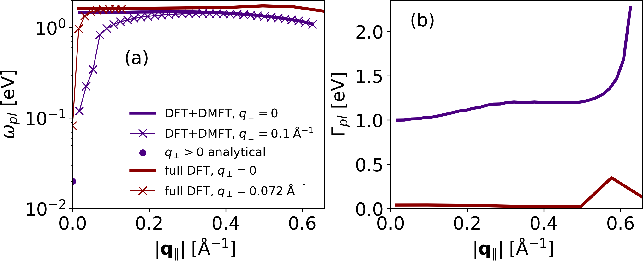
Figure 4: (a) DFT+DMFT plasmon dispersion for different 27, contrasting with full DFT results; (b) Plasmon broadening due to correlations.
Experimental Signatures and EELS: High-Energy and Low-Energy Modes
Comparison to EELS spectra shows that while the full DFT loss captures the optical plasmon, it completely misses the measured high-energy peak (HEP), which lies within the interband gap in DFT and thus cannot originate from independent electron transitions. DFT+DMFT, in contrast, reproduces this feature, directly connecting it to correlation-induced structures in the spectral function.
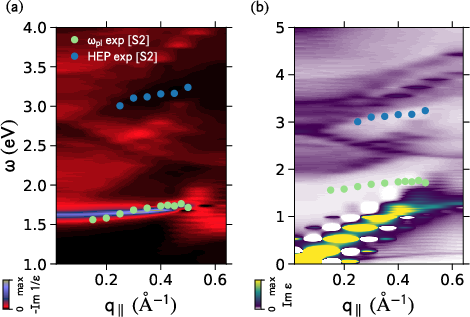
Figure 5: (a) EELS spectrum and (b) imaginary part of 28 computed with full DFT; only the optical plasmon is captured, not the high-energy peak.
At low energies, the DFT+DMFT dielectric function and loss exhibit a broad, strongly damped low-energy peak (LEP), corresponding in energy and position with the so-called acoustic "demon" mode observed in experiment. Decomposition into intraband and interband contributions confirms that the LEP is a heavily broadened feature, not a true pole, driven by the interplay of incoherent correlations and low-energy transitions.
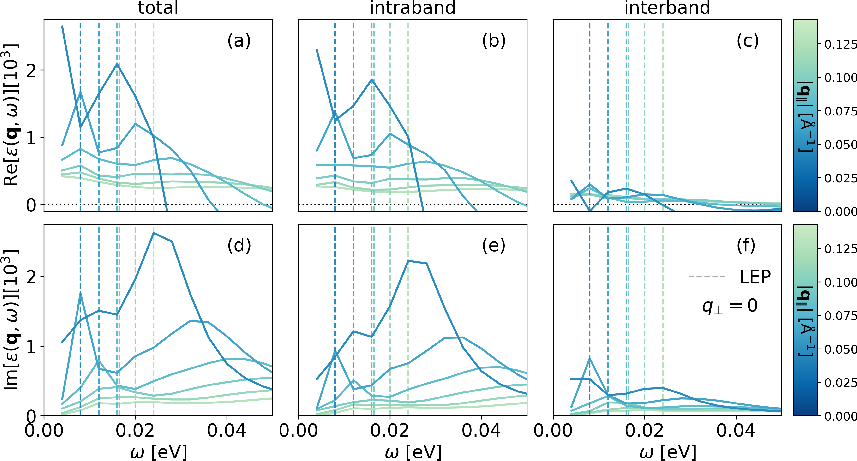
Figure 6: Real and imaginary parts of the DFT+DMFT dielectric function at low energies, with intraband and interband decompositions highlighting the broad nature of the LEP.
Similar features, albeit shifted in energy and with less broadening, are also present in the full DFT calculation, evidencing that while correlations enhance and shift the LEP, its origin is not purely due to strong correlation.
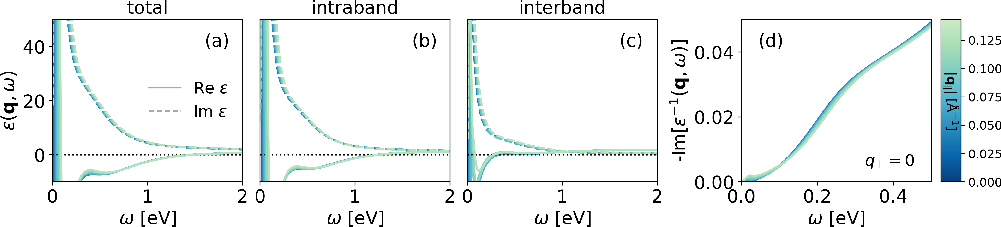
Figure 7: Decomposition of the dielectric function at higher energies; the interband zero crossing is outweighed by intraband dominance—yielding only a knee in the loss.
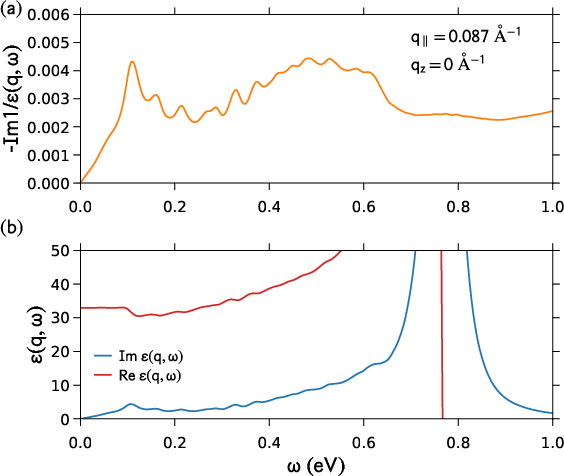
Figure 8: Full DFT loss function exhibiting LEP and broad maxima, confirming these are not unique to correlated calculations.
Implications and Future Directions
The present work establishes that accurate modeling of plasmon dynamics in Sr29RuO40 requires simultaneous and consistent inclusion of all relevant energy scales: spectral weight, effective mass, electronic damping, and background permittivity. The failure of effective, parameter-tuned Drude or RPA approaches—especially for the layered and high-energy modes—indicates that the complex plasmon spectra in ruthenates and related correlated materials are emergent features of strong, momentum- and energy-dependent correlations.
The identification of the correlation-driven high-energy peak as inaccessible to conventional DFT highlights the utility of EELS and optical probes as diagnostics of novel correlation effects. The observation that the LEP exists also in "uncorrelated" theory, but is strongly renormalized and broadened by correlations, suggests a landscape where some collective modes are fundamentally correlation-enabled while others are correlation-modified.
Future research should address the inclusion of nonlocal correlations, the interplay with superconductivity, temperature and doping dependencies, and explore whether similar correlation-driven plasmon phenomena occur in other ruthenates and 441/542 oxides. Integration with time-resolved probes could further reveal the dynamics of plasmon-electron and plasmon-boson coupling in strongly correlated metals.
Conclusion
A comprehensive, self-consistent DFT+DMFT investigation of Sr43RuO44 unveils the profound impact of strong local electron correlations on plasmon excitations and their spectral features. Both high-energy and low-energy collective modes investigated here reveal signatures—broadening, shifting, and the occurrence of additional peaks—not accessible without explicit treatment of correlations beyond DFT. The theoretical framework, validated against sum rules and experiment, provides a foundation for future study of correlated plasmonics and collective excitations in multiorbital systems.