One-shot Compositional 3D Head Avatars with Deformable Hair
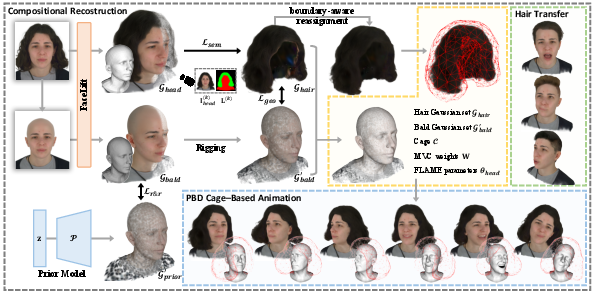
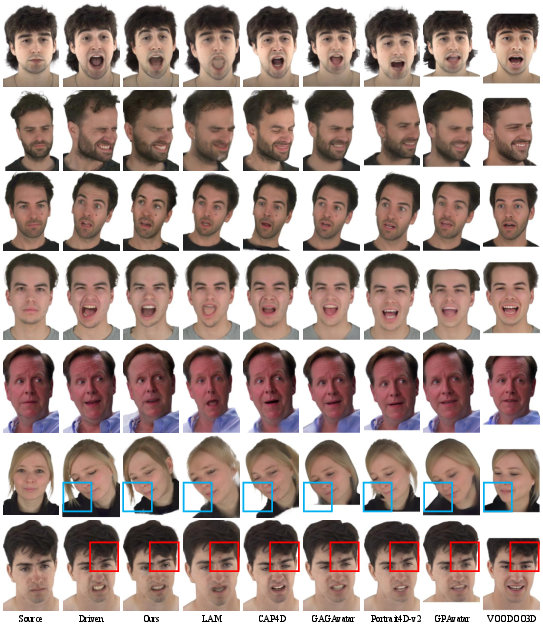
Abstract: We propose a compositional method for constructing a complete 3D head avatar from a single image. Prior one-shot holistic approaches frequently fail to produce realistic hair dynamics during animation, largely due to inadequate decoupling of hair from the facial region, resulting in entangled geometry and unnatural deformations. Our method explicitly decouples hair from the face, modeling these components using distinct deformation paradigms while integrating them into a unified rendering pipeline. Furthermore, by leveraging image-to-3D lifting techniques, we preserve fine-grained textures from the input image to the greatest extent possible, effectively mitigating the common issue of high-frequency information loss in generalized models. Specifically, given a frontal portrait image, we first perform hair removal to obtain a bald image. Both the original image and the bald image are then lifted to dense, detail-rich 3D Gaussian Splatting (3DGS) representations. For the bald 3DGS, we rig it to a FLAME mesh via non-rigid registration with a prior model, enabling natural deformation that follows the mesh triangles during animation. For the hair component, we employ semantic label supervision combined with a boundary-aware reassignment strategy to extract a clean and isolated set of hair Gaussians. To control hair deformation, we introduce a cage structure that supports Position-Based Dynamics (PBD) simulation, allowing realistic and physically plausible transformations of the hair Gaussian primitives under head motion, gravity, and inertial effects. Striking qualitative results, including dynamic animations under diverse head motions, gravity effects, and expressions, showcase substantially more realistic hair behavior alongside faithfully preserved facial details, outperforming state-of-the-art one-shot methods in perceptual realism.
Paper Prompts
Sign up for free to create and run prompts on this paper using GPT-5.
Top Community Prompts
Explain it Like I'm 14
What is this paper about?
This paper shows how to build a realistic, 3D, animated head avatar from just one photo. The big idea is to treat the face and the hair as two different parts: the face moves with expressions (smile, frown, talk), while the hair moves with physics (swinging with head turns, reacting to gravity). By separating them, the hair looks much more natural instead of sticking to the face.
What questions are they trying to answer?
- Can we create a full 3D head avatar from a single image that still looks like the person?
- Can we make the face move naturally (expressions, jaw, eyes) and the hair move realistically (bounce, sway) at the same time?
- Can this run fast enough for real-time use in games, video calls, or VR?
How does their method work?
Imagine building a puppet head where the face and the hair are separate, so each can move the way it should. The method has a few key steps.
Turning one photo into two 3D parts
- They first make a “bald” version of the input photo using an image editor. Now they have:
- The original photo (with hair).
- A bald photo (without hair).
- For each photo, they create a 3D model using a technique called 3D Gaussian Splatting (3DGS). Think of 3DGS as making the head out of thousands of tiny, soft, colored blobs. This is fast to render and keeps fine details like skin texture and beard stubble.
Building a face that can animate
- The bald 3D model is “rigged” to a standard face model called FLAME. You can think of FLAME like a digital mask with built-in controls (sliders) for expressions and jaw movement.
- “Rigging” means attaching the tiny 3D blobs to parts of the face mesh, so when the mouth opens or eyebrows move, the skin and features follow naturally.
- They also fill in hidden parts (like teeth and eyeballs) using a prior model so the mouth looks right when it opens.
Finding and cleaning the hair
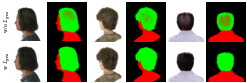
- From the original (with-hair) 3D model, the method separates the hair from the rest by using smart image segmentation (a tool similar to SAM2). This labels which pixels are hair in many viewpoints and helps collect the hair blobs into a clean hair set.
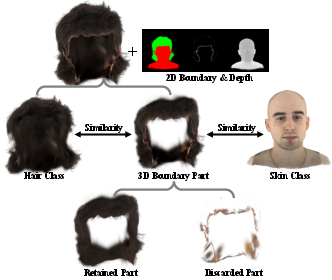
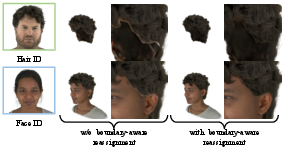
- Segmentation isn’t perfect at the edges, so they do a “boundary-aware reassignment.” In simple terms: they double-check blobs near the hairline using color, size, and depth to move any skin blobs back to the face, and keep only true hair blobs with the hair. This makes the hairline look natural instead of jagged.
Making hair move naturally
- Hair is controlled by a simple “cage,” like an invisible net wrapped around the hair volume. Moving the cage moves all the hair inside it smoothly.
- To move the cage, they use Position-Based Dynamics (PBD), a fast physics method often used in games. It adjusts positions directly so hair reacts to head motion, gravity, and inertia (swinging when you turn, then settling).
- They use Mean Value Coordinates (MVC) to smoothly translate cage motion into hair motion. Think of each hair blob as a weighted mix of the cage’s corner points—when the cage moves, each blob moves according to its weights.
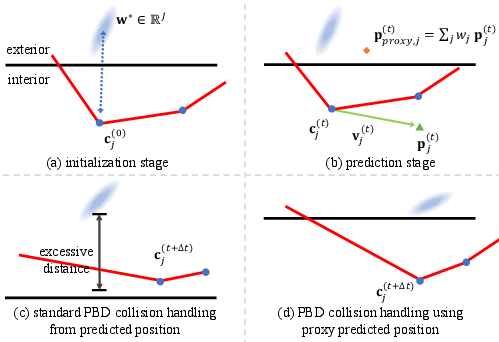
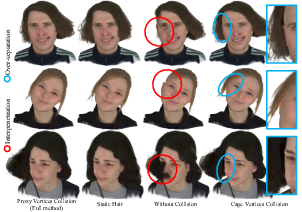
- They add a clever “proxy-based” collision trick so hair doesn’t sink into the head or float too far away. Because the cage isn’t perfectly tight, they check collisions at proxy points that better represent where the hair would actually be, preventing hair/skin interpenetration or unnatural gaps.
Putting it all together
- The “bald” face part is driven by facial expressions (via FLAME).
- The hair part is driven by the cage and physics (via PBD and MVC).
- Both parts render together in real time, so you can change the camera view, pose, or expression and see everything move naturally.
What did they find?
- The avatars look more like the real person because the method preserves fine details from the input photo.
- The hair behaves realistically during head motion and expressions: bangs don’t stretch with the forehead, and long hair sways and settles like it should.
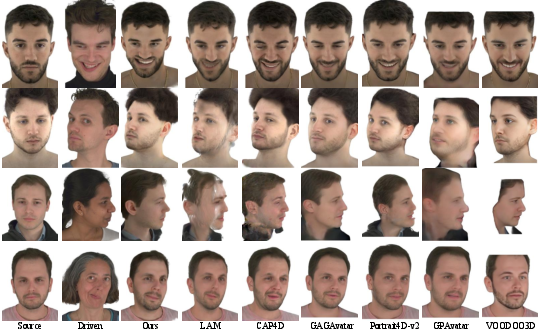
- In tests (against several recent methods), their results scored higher on image quality and identity similarity, and looked better in videos—especially for hair movement and side views.
- The system runs in real time and supports things like hairstyle transfer between different heads.
Why does this matter?
- More lifelike avatars: Games, social apps, and VR can have characters that look and move more naturally—especially hair, which is hard to get right.
- Easy creation: You only need one photo to make a complete, animatable 3D avatar, making this more accessible to everyday users.
- Flexible and fast: Because the face and hair are handled separately, the system is easier to control and works in real time.
In short
By treating hair and face separately—face driven by expression controls and hair driven by simple, fast physics—this method makes single-photo 3D avatars that look more realistic and move more naturally than before. It’s a practical step toward better, more believable digital humans.
Knowledge Gaps
Knowledge gaps, limitations, and open questions
Below is a consolidated list of what remains missing, uncertain, or unexplored in the paper, written to guide follow-up research.
- Single-view ambiguity for back-of-head geometry: How to recover accurate posterior hair volume, shape, and structure from only a frontal image, especially for long hair, ponytails, buns, or hairstyles with significant rear geometry that the lifting model must hallucinate.
- Robustness to occlusions and accessories: The method struggles with strong occlusions (e.g., microphones, hats, hands). How to jointly reconstruct and animate when parts of hair/face are occluded or when accessories should deform or collide with hair.
- Facial hair and eyebrow handling: Hair segmentation treats “hair” as one class; beards, mustaches, and eyebrows likely need distinct deformation paradigms (rigid with jaw for beards, near-rigid for eyebrows). How to automatically disentangle and assign appropriate dynamics per hair subtype.
- Lighting and hair appearance modeling: Current 3DGS color/opacity does not capture anisotropic hair reflectance, view-dependent glints, or relighting. How to introduce physically-based or learned anisotropic shading for hair strands while retaining real-time performance.
- Dynamics fidelity beyond coarse cage: The cage-driven PBD controls only a coarse envelope, and Gaussian updates use a principal-axis approximation (no full SVD). How to capture shear, twist, torsion, and secondary motion at finer scales without prohibitive costs.
- No hair–hair self-collision: The method enforces hair–scalp (and proxy) collisions but not hair–hair interactions, leading to potential interpenetration within the hair mass. How to introduce efficient self-collision for volumetric Gaussian hair without sacrificing real-time speed.
- Limited collision set and realism: Collisions with shoulders, clothing, hands, or accessories are not modeled; friction and sticking are also absent. How to add multi-body collisions (with friction, restitution) robustly and efficiently in the cage-PBD framework.
- Aerodynamics and external forces: Only gravity and inertial effects are simulated. How to incorporate wind fields or user-driven force controls in a stable, real-time manner consistent with hair style and length.
- Material parameter estimation: PBD stiffness/compliance is not estimated from the input; all identities share hand-tuned parameters. How to infer per-identity, per-region dynamic properties (stiffness, damping, mass) from a single image (appearance cues) or short video.
- Automatic decision between rigid vs dynamic hair: For “short hair,” the method applies rigid transformations; this threshold and decision process are unspecified. How to robustly and automatically choose or blend rigid and dynamic behaviors based on inferred hairstyle properties.
- Cage construction robustness: The voxelization-based watertight cage may omit thin wisps or detached tufts. How to build topology-aware cages that better follow sparse or fine hair structures while remaining low-DOF and stable.
- Proxy-based collision limitations: The proxy interpolation relies on nearest-neighbor Gaussian associations and fixed weights; it may fail under large deformations or topology changes. How to adaptively update proxy mappings or use volumetric signed-distance proxies for more reliable collisions.
- Segmentation accuracy and domain gaps: Hair masks come from SAM2 applied to self-rendered multi-views of the lifted model, not real multi-view images; errors can propagate, especially for dark hair/backgrounds or transparent wisps. How to obtain robust multi-view-consistent hair labels from a single view or leverage text/image priors to refine uncertain regions.
- Boundary-aware reassignment scope: The reassignment cleans residual skin near boundaries but does not address temporally consistent boundary refinement during animation. How to ensure temporal stability and prevent flicker at hair–skin borders as poses and expressions change.
- Registration and identity consistency: The dual lifting (bald vs original) can yield shape mismatch; current optimization aligns them but may leave residual artifacts. How to jointly lift both views with shared identity constraints to ensure consistent geometry and texture without post-hoc registration.
- Mouth–teeth–lip interactions: Teeth and eyeballs are copied from the prior; lip–teeth collisions and tongue dynamics are not handled. How to integrate intra-oral geometry and soft-tissue interactions into the compositional pipeline.
- Evaluation of hair dynamics: Metrics reported focus on face image quality and identity/expression transfer; there are no objective metrics or user studies for hair motion realism, stability, or collision plausibility. What standardized metrics or perceptual protocols can evaluate hair dynamics quality.
- Generalization to extreme hairstyles: Braids, tight curls, locs, updos, and highly structured styles may not be well-represented by a coarse cage and Gaussian ellipsoids. How to extend the representation and dynamics to structured, topologically complex hairstyles.
- Real-time performance characterization: The paper claims real-time operation but does not report frame rates, Gaussian counts, substeps, or hardware. How to systematically characterize latency/throughput and provide trade-off guidelines between quality and speed.
- Stability under varying timesteps and motions: Solver stability and parameter sensitivity (substeps, damping, compliance) are not analyzed, especially under rapid head accelerations. How to guarantee stability and temporal coherence across diverse motion profiles and frame rates.
- Hairstyle transfer robustness: The method enables hairstyle transfer via local binding, but large morphological differences across identities can cause misalignment and collisions. How to retarget hair (and cage) robustly across different head shapes with automatic scaling, attachment, and collision-aware fitting.
- Integration with relightable avatars: The method is not relightable; hair and skin do not respond to novel lighting. How to couple the compositional avatar with relighting models while preserving hair dynamics and identity-specific reflectance.
- Data and method dependencies: The approach depends on FaceLift (lifting), SAM2 (segmentation), and VHAP/FLAME (driving). How to reduce reliance on specific components, handle their failure cases, or provide end-to-end alternatives with uncertainty estimation.
- Reproducibility/notation clarity: Several equations and operators in the text contain typos or ambiguous notation (e.g., proxy interpolation indices, rendering subscripts, loss expression). A clearer mathematical specification and implementation details (e.g., exact constraints, solver parameters, cage generation) are needed for faithful reproduction.
- Ethical and misuse considerations: Highly realistic one-shot avatars raise impersonation risks. What safeguards (watermarking, provenance tracking, consent protocols) can be integrated without degrading quality or performance.
Practical Applications
Overview
The paper introduces a one-shot pipeline to build a photorealistic, fully animatable 3D head avatar from a single frontal image with realistic, physically plausible hair dynamics. Key innovations include: (1) explicit decoupling of face and hair, (2) face rigging to a FLAME mesh for expression control, (3) hair isolation via multi-view semantic supervision with a boundary-aware cleanup, and (4) a lightweight cage-based Position-Based Dynamics (PBD) system that deforms hair Gaussians via Mean Value Coordinates (MVC), including a proxy-based collision constraint for stable hair–head contact. The avatar renders in real time using 3D Gaussian Splatting (3DGS), supports hairstyle transfer, and preserves fine image details via image-to-3D lifting.
Below are practical applications organized by immediacy, with sectors, prospective tools/workflows, and assumptions/dependencies.
Immediate Applications
These can be prototyped or deployed now using the described pipeline and readily available components (FaceLift, FLAME, SAM2-like segmentation, Taichi-based PBD, 3DGS renderers).
- Real-time VTubing and livestream avatars with realistic hair
- Sector: Entertainment, Creator economy, Software
- Tools/workflows: OBS/VCam plugin; Unity/Unreal plugin that ingests a selfie, runs hair removal + FaceLift, rigs to FLAME, auto-builds a hair cage, runs PBD for hair, and renders 3DGS in real time; avatar driven by standard face-tracking (e.g., ARKit, MediaPipe) mapped to FLAME parameters
- Assumptions/dependencies: Desktop/laptop GPU for real-time 3DGS; single frontal selfie without major occlusions; availability of FLAME parameter extraction for live driving; proper licensing for pre-trained components
- Video conferencing “real-person” avatars with privacy-preserving realism
- Sector: Enterprise collaboration, Education
- Tools/workflows: Zoom/Teams plugin replacing webcam with an animatable avatar that reflects expressions and head motion; adjustable hair dynamics (gravity/inertia) for realism
- Assumptions/dependencies: Stable face-tracking; moderate compute on client or lightweight server-side rendering with low-latency streaming; frontal photo capture step by user
- AR/VR hairstyle try-on and wig/e-commerce previews with motion-aware hair
- Sector: Retail/e-commerce (wigs, hair salons), AR/VR
- Tools/workflows: Mobile/desktop app where users upload a selfie; generate avatar and swap hairstyles from a library (cross-identity hair transfer); hair reacts to head motion and gravity during preview
- Assumptions/dependencies: Accurate initial hair segmentation and boundary cleanup; collisions modeled with scalp (not hats/clothes); mobile performance may require server offload
- Fast character onboarding for games and social apps
- Sector: Gaming, Social platforms
- Tools/workflows: In-game selfie capture → automatic avatar creation with decoupled hair; import into Unity/Unreal; cage-based PBD for hair dynamics; supports hairstyle marketplace and cross-identity swap
- Assumptions/dependencies: Game engine integration for 3DGS (or rasterization bridges); player consent for likeness; GPU budget for real-time splatting and PBD
- Rapid previz/digital doubles for virtual production and advertising
- Sector: Media/Advertising, Virtual production
- Tools/workflows: Build digital doubles from stills for storyboards or animatics; quick turnaround without multi-view scans; hair motion looks natural under basic gravity/inertia
- Assumptions/dependencies: Not film-grade strand physics; works best for clean, frontal images; may need further refinement for close-ups
- Cross-identity hairstyle asset creation (hair libraries)
- Sector: CG asset pipelines, Digital fashion
- Tools/workflows: Isolate and package hair Gaussians with a cage and PBD parameters; reuse on different faces by binding to their scalp; create a deployable hair asset catalog
- Assumptions/dependencies: Asset standardization around 3DGS or conversion bridges; style transfer works best when scalp alignment is accurate
- Research and teaching platform for deformable 3DGS and hair–face decoupling
- Sector: Academia (Graphics, Vision)
- Tools/workflows: Reproduce the pipeline to study: rigged 3DGS, cage-based PBD, proxy-based collisions; generate synthetic datasets for segmentation, reenactment, or perception studies
- Assumptions/dependencies: Access to FaceLift/FLAME/SAM2-like tools; compute for training/evaluation; clean portrait inputs
- Social media filters and avatar stickers with dynamic hair
- Sector: Social media, Mobile apps
- Tools/workflows: In-app avatar generation from selfies; dynamic hair reactions for short videos and stories; hairstyle swapping for creative effects
- Assumptions/dependencies: On-device optimization or server rendering; segmentation robustness on casual selfies
- Telepresence for robotics/HRI using expressive digital avatars
- Sector: Robotics, Telepresence
- Tools/workflows: Operator’s avatar mapped onto telepresence robot displays; realistic hair movement increases lifelike presence
- Assumptions/dependencies: Real-time FLAME driving from operator; network latency and GPU constraints
- Responsible-AI/forensics support: synthetic datasets and watermarked content
- Sector: Policy, Trust & Safety, Forensics
- Tools/workflows: Generate labeled, photorealistic avatar videos to train deepfake detectors; embed provenance/watermarks at render or asset level (e.g., in Gaussian attributes or frame embeddings)
- Assumptions/dependencies: Governance frameworks for consent and dataset usage; watermark robustness research; access control to avatar creation
- DCC/DAM integration for 3D asset workflows
- Sector: VFX/CG pipelines, Software
- Tools/workflows: Plugins for Blender/Maya to import/export 3DGS avatar assets, edit cage, tweak PBD parameters; export proxy meshes for pipeline compatibility
- Assumptions/dependencies: Interchange bridges (3DGS ↔ USD/glTF); tooling maturity for Gaussian-based assets
Long-Term Applications
These require further research, engineering, or ecosystem maturation (e.g., broader occlusion handling, mobile optimization, asset standardization, richer physics).
- Film/VFX-grade strand-level hair simulation on top of Gaussian avatars
- Sector: Film/VFX, High-end games
- Tools/workflows: Hybrid pipelines that convert coarse Gaussian hair to guide strands and run advanced solvers (XPBD, FEM-based, or rod models) with full hair–skin–cloth collision
- Assumptions/dependencies: Robust conversion or hybrid rendering; significantly higher compute; artist controls and grooming tools
- In-the-wild robustness: occlusions, accessories, extreme poses, multi-ethnic hair
- Sector: Consumer apps, AR/VR
- Tools/workflows: Enhanced segmentation and lifting with occlusion reasoning; learned or rule-based cage initialization under hats, headphones, braids
- Assumptions/dependencies: More data and training; better 2D-to-3D priors beyond frontal images; accessory-aware collision models
- Full-body digital humans with hair–cloth–body interactions
- Sector: XR training, Simulation, Games
- Tools/workflows: Extend cage/PBD to upper body and garments; unified collision and constraints across head, shoulders, and clothing; wind and environment forces
- Assumptions/dependencies: Expanded proxy-based collisions; performance budgets; standardized skeletal and material models
- Mobile and web deployment (on-device, low-latency)
- Sector: Mobile apps, Web/XR
- Tools/workflows: WebGPU/Metal back ends for 3DGS; model quantization; edge rendering and 5G/low-latency streaming; scalable microservices for batch avatar creation
- Assumptions/dependencies: Hardware acceleration support for 3DGS; efficient Taichi alternatives or compiled kernels; bandwidth constraints
- Standards and interoperability for Gaussian-based avatars
- Sector: Software standards, Ecosystem
- Tools/workflows: glTF/USD extensions for 3DGS, PBD cages, and FLAME bindings; cross-engine runtime libraries; content provenance metadata for avatars
- Assumptions/dependencies: Community adoption; reference implementations; alignment with DCC and game engine conventions
- Text- and multimodal-driven hair editing and personalization
- Sector: E-commerce, Creator tools
- Tools/workflows: Integrate diffusion/LLM controls to describe hair edits (e.g., “short wavy bob with bangs”) with guaranteed geometry consistency and PBD-ready cages
- Assumptions/dependencies: Reliable text-to-geometry alignment; safety filters; training data breadth
- Healthcare decision support (e.g., hair restoration planning)
- Sector: Healthcare
- Tools/workflows: Clinician-oriented tools to visualize likely outcomes under different graft densities/placement; patient-specific hair growth and density models
- Assumptions/dependencies: Clinical validation; regulatory approvals; addition of scalp biophysics and long-term change modeling
- Behavioral and perception research using controllable avatars
- Sector: Academia (Psychology, HCI)
- Tools/workflows: Controlled stimulus generation varying hair style, motion, and expressions to study social perception, bias, or UX
- Assumptions/dependencies: IRB/ethics approvals; robust control over confounders; standardized rendering setups
- Security and identity governance for avatarizable faces
- Sector: Policy, Cybersecurity
- Tools/workflows: Liveness checks resilient to 3D avatar substitution; consent logs and cryptographic provenance for avatar creation/use; watermarking standards for rendered outputs
- Assumptions/dependencies: Cross-platform adoption; interoperability with content authenticity initiatives (e.g., C2PA)
- Synthetic data and benchmarking for CV/AR
- Sector: Computer vision, AR
- Tools/workflows: Large-scale generation of labeled sequences for landmarking, head pose, hair segmentation, and expression transfer benchmarks with controllable variables
- Assumptions/dependencies: Domain gap minimization; community benchmarks; licensing/consent policies
Cross-cutting Assumptions and Dependencies
- Input quality and scope: Best with clean, frontal portraits; current limitations with heavy occlusions (e.g., microphones, hats) and very complex hairstyles.
- Runtime and hardware: Real-time 3DGS and PBD are practical on desktop GPUs; mobile/web require optimization or server-based rendering.
- Third-party components: Relies on FaceLift (image-to-3D), FLAME (expressions), and segmentation (e.g., SAM2) to achieve reported fidelity.
- Physics scope: Current PBD simulates primarily gravity/inertia and head-driven motion; external forces (wind), strand-level effects, and hair–cloth collisions need further development.
- Ethics and compliance: Any application that clones identity must include consent management, watermarking/provenance, and mitigation against misuse (e.g., deepfakes).
Glossary
- 3D Gaussian Splatting (3DGS): A real-time, differentiable point-based scene representation using anisotropic 3D Gaussians for rendering. "Both the original image and the bald image are then lifted to dense, detail-rich 3D Gaussian Splatting (3DGS) representations."
- 3DMM: A 3D Morphable Model that parameterizes facial identity, expression, and pose for analysis/synthesis. "often conditioned on 3DMM \cite{blanz2023morphable,li2017learning} expression latents"
- Average Expression Distance (AED): A metric measuring how well facial expressions are transferred between sequences. "Expression and pose transfer faithfulness are measured by Average Expression Distance (AED) and Average Pose Distance (APD)"
- Average Keypoint Distance (AKD): The mean Euclidean distance between corresponding facial landmarks, assessing geometric accuracy. "Geometric accuracy of facial motion is evaluated with Average Keypoint Distance (AKD) \cite{bulat2017far}, the mean Euclidean distance between corresponding 2D facial landmarks."
- Average Pose Distance (APD): A metric quantifying pose transfer accuracy between sequences. "Expression and pose transfer faithfulness are measured by Average Expression Distance (AED) and Average Pose Distance (APD)"
- Boundary-aware reassignment: A post-processing step that reclassifies ambiguous Gaussians near hair–skin borders to clean segmentation. "followed by a boundary-aware reassignment strategy for refinement."
- Cage-based deformation: Controlling deformations via a coarse control mesh (cage) whose motion propagates to enclosed geometry. "we adopt a coarse cage-based deformation approach."
- Chamfer distance: A bidirectional distance between two point sets used to enforce geometric consistency. "The Chamfer distance term \cite{li2022non} encourages structural similarity between the two Gaussian point sets ."
- Differentiable rasterization: Rendering that supports gradient backpropagation from images to 3D parameters. "The rendering is performed by differentiable rasterization: $\mathbf{I} = \mathcal{R}_{\mathbf{c}(\mathcal{G}, \mathbf{T})$"
- Differentiable rendering: End-to-end render-and-optimize pipelines where image formation is differentiable. "seamlessly integrated into a unified differentiable rendering pipeline"
- Extended Position-Based Dynamics (XPBD): A PBD variant introducing compliance to decouple stiffness from solver iterations and timestep. "Extended Position-Based Dynamics (XPBD) further improves this framework by enabling compliance parameters that control stiffness independently of solver iterations and time steps \cite{macklin2016xpbd}."
- FLAME: A parametric head model providing a deformable mesh for facial animation. "rig it to a FLAME mesh via non-rigid registration with a prior model"
- Gaussian primitive: An individual anisotropic 3D Gaussian element defining position, rotation, scale, opacity, and color. "Each Gaussian primitive is defined in the local coordinate system of its parent mesh triangle"
- Identity latent code: A learned vector capturing person-specific identity used to decode personalized geometry/appearance. "by decoding an identity latent code "
- Image-to-3D lifting: Inferring a detailed 3D representation directly from a single 2D image. "by leveraging image-to-3D lifting techniques"
- Kinematic particles: Simulation particles with zero inverse mass that are directly driven (not integrated) by external motion. "Vertices near the scalp (hair roots) are designated as kinematic particles with zero inverse mass"
- Linear Blend Skinning (LBS): A skeletal skinning method blending transformations by joint weights for mesh deformation. "their positions are directly prescribed by Linear Blend Skinning (LBS) driven by head motion at each time step."
- Mean Value Coordinates (MVC): Barycentric weights enabling smooth, cage-driven deformation of enclosed points. "Mean Value Coordinates (MVC) allow robust deformation of points inside a coarse control cage~\cite{ju2023mean}."
- Morphable Multi-View Diffusion Model (MMDM): A diffusion-based model that augments multi-view training data for avatars. "CAP4D \cite{taubner2025cap4d}, which leverages a Morphable Multi-View Diffusion Model (MMDM) for training data augmentation;"
- NeRFs: Neural Radiance Fields for view-synthesizing neural scene representations. "or NeRFs \cite{zhuang2022mofanerf,rebain2022lolnerf,yu2023nofa}"
- Non-rigid registration: Aligning deformable shapes by estimating non-linear correspondences/transforms. "via non-rigid registration with a prior model"
- Position-Based Dynamics (PBD): A real-time physics method that enforces constraints directly on positions via iterative projections. "PBD achieves real-time physical simulation by iteratively enforcing geometric constraints directly on vertex positions"
- Proxy-based collision constraint: A collision handling scheme using proxy points tied to geometry to avoid over-separation. "we introduce a proxy-based collision constraint strategy, as illustrated in Fig. \ref{fig:pbd_collision}."
- Rigging: Binding a geometry to a deformation skeleton/mesh so it follows articulated motion. "we leverage a rigging information prior and perform joint reconstruction and registration to rig it onto the FLAME parametric mesh"
- Semantic segmentation: Pixel-wise classification into semantic categories used for supervision of 3D parts. "we utilize semantic segmentation from multi-view images"
- Semi-implicit Euler integration: A time integration scheme updating velocities before positions for improved stability. "we first perform a semi-implicit Euler integration to obtain predicted positions"
- Softmax: A normalization operation converting scores to probabilities for classification. "via a softmax operation applied to the learned feature \mathbf{f} ."
- Taichi framework: A high-performance parallel programming framework for simulation and graphics. "running everything in the high-performance Taichi framework \cite{hu2019taichi,hu2021quantaichi,hu2019difftaichi}"
- Volume preservation: A constraint in deformable simulation that keeps local volumes constant during deformation. "including stretch (length), bending, volume preservation, and collision handling"
- Voxelizing: Converting point clouds/geometry into a voxel grid representation. "by voxelizing the dense point cloud {\boldsymbol{\mu}{hair}}{N}{n=1} ."
- Watertight source cage: A closed (hole-free) control mesh enclosing geometry for cage-based deformation. "to construct a watertight source cage "
Collections
Sign up for free to add this paper to one or more collections.