- The paper introduces a generalized spin-polarization framework for predicting giant tunneling magnetoresistance in MTJs with nearly 100% effective spin polarization.
- It employs first-principles transport calculations, revealing a difference of over seven orders of magnitude between parallel and antiparallel configurations.
- The study validates the robustness of MR across various MgO thicknesses and alternative barrier materials, guiding next-generation spintronic device design.
Spin-Valley-Mismatched Altermagnetism for Extreme Tunneling Magnetoresistance
Introduction
The study addresses the theoretical foundation and computational verification of giant tunneling magnetoresistance (TMR) in magnetic tunnel junctions (MTJs) composed of the metallic altermagnet KV2Se2O with an MgO spacer. The work revisits the requirements for MR in singlet or collinear antiferromagnets and establishes a generalized spin-polarization framework for the prediction of MR in MTJ systems. A critical advance is the identification and analysis of spin-valley-mismatched (SVM) altermagnets, where spin-up and spin-down conduction channels are separated in momentum space, enabling nearly perfect effective spin polarization (⟨p⟩∼100%) without breaking antiferromagnetic symmetry.
Spin-Valley-Mismatched Magnetoresistive Transport: Theory
The spin-valley-mismatched formalism is introduced by revisiting the Julliere model of TMR, traditionally limited to ferromagnetic systems. The authors generalize the formula using the k-space resolved spin polarization of transport channels, accommodating both ferromagnetic and antiferromagnetic leads:
MRo/p=1∓⟨p⟩22⟨p⟩2,
where ⟨p⟩ is an effective spin polarization, precisely defined as a weighted sum over k∥-resolved spin polarizations of the electrode materials.
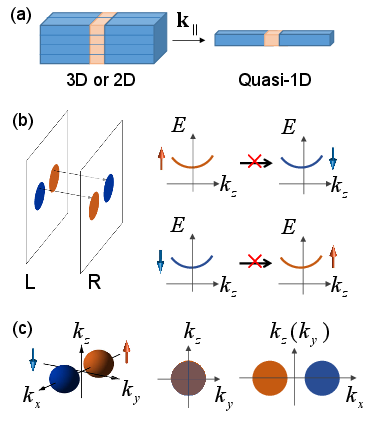
Figure 1: Schematic of transport in SVM heterojunctions; (b) demonstrates transport blockade under antiparallel (AP) configuration due to perfect spin-valley mismatch.
This formalism reveals that systems in which spin-up and spin-down transport channels are fully separated in k-space (i.e., p(k∥)=±1 with no spatial overlap) can achieve extreme-limit MR, regardless of their macroscopic magnetization.
Electronic and Transport Structure of KV2Se20O
KV21Se22O is characterized as a room-temperature metallic altermagnet. The paper presents a comprehensive characterization of its crystallography, spin-resolved charge density, and band structure:
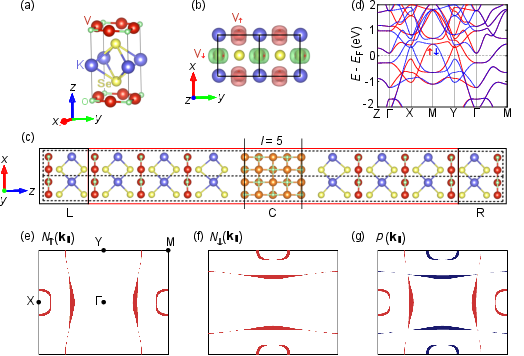
Figure 2: Crystal and electronic structure of KV23Se24O/MgO/KV25Se26O MTJs, illustrating full spin-valley mismatch and an almost perfect (99.93\%) effective spin polarization.
- Bulk KV27Se28O exhibits a tetragonal layered structure; the magnetic structure leads to a horizontal (29-plane) spin group symmetry.
- Spin-resolved conducting channels at the Fermi energy (⟨p⟩∼100%0) display a clear C⟨p⟩∼100%1 group operation and negligible overlap between spin species in momentum space.
- First-principles analysis yields an effective spin polarization ⟨p⟩∼100%2, contrasting with the vanishing net spin polarization (⟨p⟩∼100%3 due to spin degeneracy) from conventional definitions.
First-Principles Transport in KV⟨p⟩∼100%4Se⟨p⟩∼100%5O/MgO/KV⟨p⟩∼100%6Se⟨p⟩∼100%7O MTJs
Transport calculations using nonequilibrium Green's function-DFT for KV⟨p⟩∼100%8Se⟨p⟩∼100%9O/k0-MgO/KVk1Sek2O heterojunctions (with k3) demonstrate the consequences of SVM:
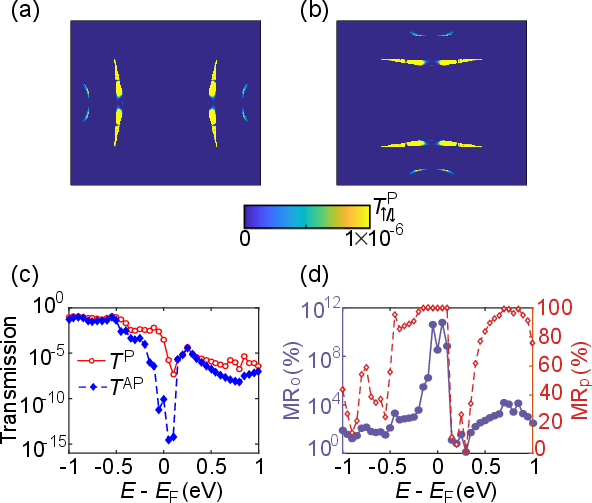
Figure 3: Zero-bias spin-filtered transmission spectra and MR vs. energy for KVk4Sek5O/5-MgO/KVk6Sek7O MTJ, featuring seven orders of magnitude difference between P and AP configurations.
- The distinction between the parallel (P) and antiparallel (AP) configurations leads to transmission differences of more than seven orders of magnitude at k8.
- The zero-bias optimistic MR exceeds k9, with the pessimistic definition reaching MRo/p=1∓⟨p⟩22⟨p⟩2,0, both robust for finite energy/bias ranges.
Bias-dependent MR is also computed:
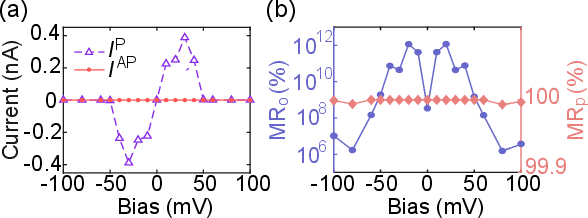
Figure 4: Current-voltage characteristics and MR under finite bias, showing robust high MR and NDR effects in the P configuration.
- MR remains robust up to biases of 0.1 V, with a peak MR of MRo/p=1∓⟨p⟩22⟨p⟩2,1 at 20 mV, maintaining at least MRo/p=1∓⟨p⟩22⟨p⟩2,2 up to 80 mV.
- The P-configuration current features negative differential resistance due to electronic structure matching.
Spacer Thickness Dependence and Generality of Barrier Selection
The MR is studied as a function of barrier thickness (3–9 layers of MgO):
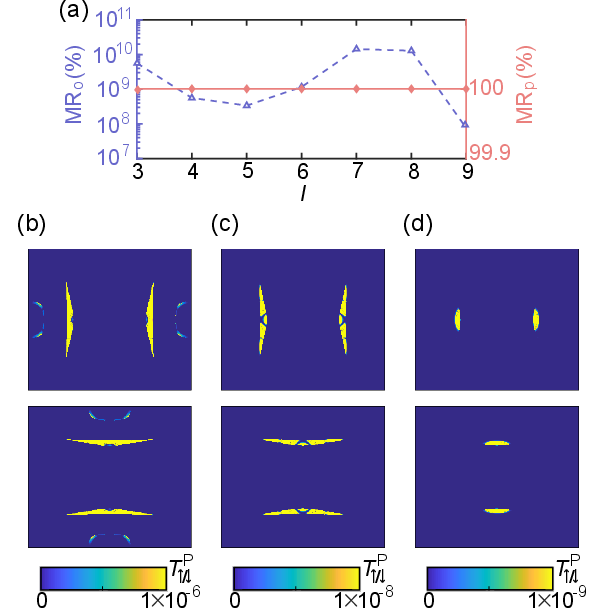
Figure 5: MR as a function of MgO thickness and MRo/p=1∓⟨p⟩22⟨p⟩2,3-resolved transmission for MRo/p=1∓⟨p⟩22⟨p⟩2,4 = 3, 7, and 9; all remain above MRo/p=1∓⟨p⟩22⟨p⟩2,5 MR, confirming the theoretical robustness.
- The MR varies non-monotonically with the barrier thickness, peaking at MRo/p=1∓⟨p⟩22⟨p⟩2,6 for 7-layer MgO and always maintaining extremely high values.
- The MRo/p=1∓⟨p⟩22⟨p⟩2,7-resolved spectra confirm strong suppression of transmission in the AP state, with the distribution of transmitting channels focusing as the barrier thickens.
The authors validate the independence of MR from the specific spacer material by showing that replacing MgO with vacuum, CaTiOMRo/p=1∓⟨p⟩22⟨p⟩2,8, or BaTiOMRo/p=1∓⟨p⟩22⟨p⟩2,9 maintains MR ⟨p⟩0 (optimistic) and ⟨p⟩1 (pessimistic), illustrating the intrinsic, band-structure-driven origin of the SVM-induced MR.
Implications, Limitations, and Future Outlook
The quantification of MR via effective spin polarization in ⟨p⟩2-space provides a predictive and intuitive design principle for antiferromagnetic and ferrimagnetic spintronic devices. The key insight—that MR is controlled not by net spin polarization but by the absence of ⟨p⟩3-space overlap between spin-resolved conduction channels—extends the domain of high-efficiency MR devices into previously overlooked altermagnetic and antiferromagnetic systems.
Practical implications include the realization of room-temperature, ultra-high-density, non-volatile memory elements, as high MR persists at realistic temperatures and under structural perturbations (with the caveats that interfacial disorder and chemical imperfections, particularly at interfaces, may reduce performance). The results indicate that SVM altermagnets form a general materials platform for spintronic applications and motivate high-throughput or symmetry-based materials searches for further SVM candidates.
Conclusion
This work establishes that giant TMR, far exceeding values attainable in conventional metallic and even altermagnetic ferromagnet-based MTJs, is achievable via spin-valley-mismatched antiferromagnets such as KV⟨p⟩4Se⟨p⟩5O, exploiting nearly ideal ⟨p⟩6-space spin channel separation. The formalism unifies ferromagnetic and antiferromagnetic MR theory and underpins a materials-by-design rationale for next-generation spintronic devices. KV⟨p⟩7Se⟨p⟩8O/MgO/KV⟨p⟩9Sek∥0O emerges as a top candidate system for functional memory applications and as a paradigm for exploiting altermagnetic order in devices (2604.14776).