- The paper presents an explicit construction of singly periodic maximal graphs with cone-like singularities using a Weierstrass-type representation.
- It leverages embedded doubly periodic minimal surfaces to translate geometric features into controlled singular configurations and moduli space parameters.
- The work rigorously establishes the embeddedness and classifies diverse (m, n) configurations, providing detailed insights into singularity structure in Lorentz-Minkowski space.
Singly Periodic Maximal Graphs with Isolated Singularities in Lorentz-Minkowski 3-Space
Introduction and Motivation
The paper addresses the construction and analysis of entire singly periodic graphs of spacelike maximal surfaces with isolated cone-like singularities in the Lorentz-Minkowski 3-space L3 (2604.14675). This situates the research at the intersection of differential geometry and Lorentzian geometry, focusing on surfaces that, unlike in Euclidean space, have rich structures due to singularities arising in the Lorentz-Minkowski context. The familiar Bernstein theorem and completeness constraints in minimal surface theory are contrasted with the existence of whole maximal graphs exhibiting isolated singularities in L3, which have been characteristically difficult to enumerate and classify.
Maximal Surface Theory and Representation
A maximal surface in L3 is defined by its spacelike property and vanishing mean curvature. Such surfaces cannot exist globally without singularities—complete maximal surfaces in L3 are restricted to spacelike planes. To overcome this, a notion of maxface is introduced, allowing surfaces with well-characterized singularities. The Weierstrass-type representation for maxfaces is utilized, connecting holomorphic 1-forms (ϕ1,ϕ2,ϕ3) satisfying specific conformality and completeness conditions to the embedding f:M→L3. This framework enables rigorous construction and analysis of surfaces with isolated singularities (cone-like singular points).
Construction via Embedded Doubly Periodic Minimal Surfaces
The methodology leverages embedded doubly periodic minimal surfaces with parallel ends, particularly the Connor-Weber models. The process translates the topological and geometric features such as catenoidal necks in Euclidean minimal surfaces (which become cone-like singularities in Lorentzian maximal surfaces) into singularities in L3. Dominant symmetry constraints are imposed, allowing explicit assignment and enumeration of singularities.
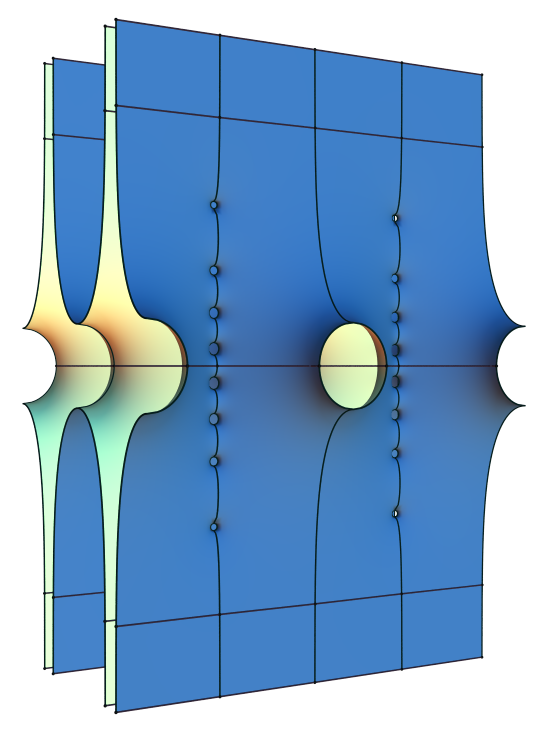
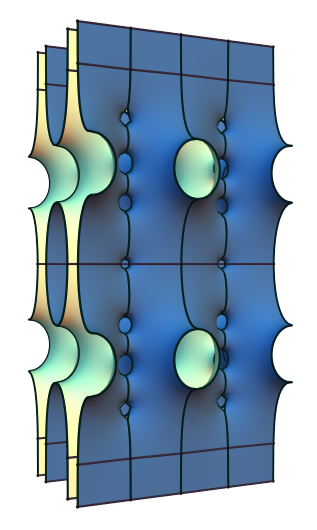
Figure 1: Connor-Weber examples of genus eight doubly periodic minimal surfaces.
A general Weierstrass data (M,G,dh) is defined, where M is a punctured Riemann surface, dh a meromorphic differential, and L30 a meromorphic function representing the Gauss map. The period problem is addressed and solved in the doubly periodic minimal context for horizontal periods and Scherk ends, with parameters encoding the location and multiplicities of necks, and thus cone-like singularities.
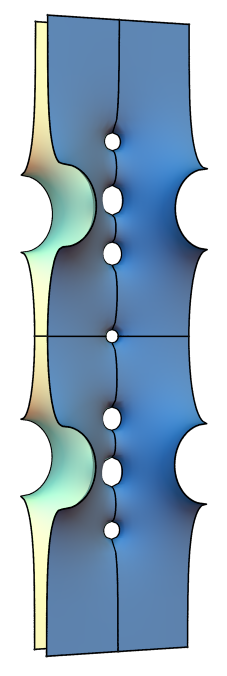
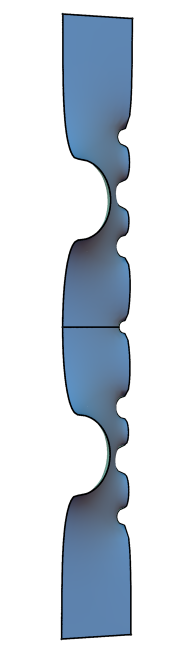
Figure 2: Quotient (left) and fundamental piece (right) of a Connor-Weber genus eight doubly periodic minimal surface.
Singly Periodic Maximal Graphs: Main Results
By rotating the doubly periodic minimal surfaces appropriately, the construction produces singly periodic maximal graphs in L31 with two Scherk ends (horizontal) and an arbitrary number of cone-like isolated singularities. The main theorem asserts that for any L32 and L33 (positive integers), one can construct a singly periodic maximal graph with L34 cone-like singularities in the quotient and with explicitly controlled directions (up/down) determined by parameters L35 and L36. The graphs have well-defined periods at the ends, and the moduli space dimension is characterized as L37 under imposed symmetry constraints.
Strong numerical results include explicit construction of surface types with up to nine cone-like singularities and categorical enumeration of all possible configurations for small L38 and L39, e.g., seventeen distinct four-cone graphs. The moduli space analysis confirms broad parametric flexibility, with up to L30 distinct types for each L31 class, barring rotational/reflection equivalencies.
Singularities and Embeddedness
The paper rigorously proves properties of the cone-like singularities, notably their location and orientation (up/down) based on the input parameters and the behavior of the Gauss map. The embeddedness (graphical property) over the L32-plane is formally established, showing that these surfaces are globally entire graphs except at isolated singularities, where the tangent plane cannot be defined. These singularities correspond directly to critical configurations in the Weierstrass data, reinforced by symmetry-induced constraints in the domain.
Examples and Moduli Space Characterization
Examples are systematically constructed across several L33 configurations, providing explicit visualizations and detailed classification. The moduli space is shown to be rich, with precise parameter control translating to geometric features—locations, sizes, and angles of cone-like singularities and asymptotic behavior at the Scherk ends.
Implications and Future Directions
The construction of singly periodic maximal graphs with arbitrary numbers of cone-like singularities substantially advances the enumeration of maximal surfaces with isolated singularities in Lorentz-Minkowski 3-space. The explicit parameterization and moduli space analysis provide a geometric toolkit for future studies on global properties and singularity behavior in Lorentzian geometry. These graphs can inform both theoretical investigations, such as classification and rigidity phenomena, and practical analysis of spacelike hypersurfaces with prescribed singularities.
The theoretical implications extend to the understanding of the global moduli spaces of maximal surfaces, enriching classifications beyond previous constructions. Given the explicit symmetry and parameter assignment, future work could pursue moduli space metrics, deformation theory, and connection to generalized geodesic flows in Lorentzian manifolds.
Conclusion
The paper delivers an explicit, parameter-controlled construction of singly periodic maximal graphs with arbitrary isolated cone-like singularities in L34. The analytic translation from doubly periodic minimal surfaces to maximal surfaces, combined with symmetry constraints, achieves detailed classification and visualization of surfaces previously inaccessible. The theoretical and practical ramifications include enhanced moduli space characterizations and prospects for comprehensive singularity analysis in 3-dimensional Lorentz-Minkowski geometry.