- The paper shows that non‐quadratic inflaton potentials (k≥4) let the effective inflaton mass vanish post-reheating, allowing thermal regeneration.
- It employs a scalar portal framework with cubic and quartic couplings to map reheating dynamics, relic overproduction, and dark matter constraints.
- The study highlights that Higgs portal scenarios impose strict experimental bounds, narrowing viable regions for inflaton dark matter production.
Inflaton Regeneration via Non-Quadratic Potentials and Scalar Portal Couplings
Introduction: Revisiting Inflaton Dynamics Beyond Standard Paradigms
The investigation conducted in "Inflaton Regeneration via Scalar Couplings: Generic Models and the Higgs Portal" (2604.14620) systematically challenges the standard cosmological assumption that the inflaton field is dynamically irrelevant after reheating. The central result is that for inflationary potentials exhibiting monomial behavior V(ϕ)∝ϕk with k≥4 near the origin, the effective inflaton mass rapidly decreases with the amplitude of the field as the Universe expands. This, in turn, allows the inflaton to become kinematically accessible to the thermal plasma after reheating is complete. The authors demonstrate that the process of inflaton regeneration—via thermal scatterings and decays—can have substantial phenomenological consequences, including the possibility of significant relic inflaton abundances or even the production of stable dark matter. This work establishes new constraints on models of reheating and the inflation–dark matter connection.
Inflaton Potentials, Reheating, and the Vanishing Mass Mechanism
The paper focuses on inflationary scenarios where the post-inflationary inflaton potential is a monomial with k≥4 (e.g., ϕ4, ϕ6, etc.), as preferred by CMB observations. In such models, the effective mass of the inflaton condensate is mϕ2∝ϕk−2: after the oscillating field decays, the inflaton mass approaches zero. This is in stark contrast to the standard quadratic scenario, where mϕ is a constant and typically kinematically blocks regeneration from the thermal bath. For these non-quadratic cases, after reheating and thermalization, the inflaton mass is sufficiently light that standard processes (decays, scatterings) in the plasma can regenerate inflaton quanta.
The framework is built with a generic scalar portal scenario, extending the model to incorporate both cubic (trilinear) and quartic (bilinear) couplings between the inflaton and a generic singlet scalar χ. The analysis of reheating dynamics is performed for both the symmetric and broken phases of the χ field and includes a full treatment of the thermal and radiative corrections to the inflaton mass. The phase structure and consequence for reheating and N∗ dependence as inferred from the latest CMB constraints are detailed.
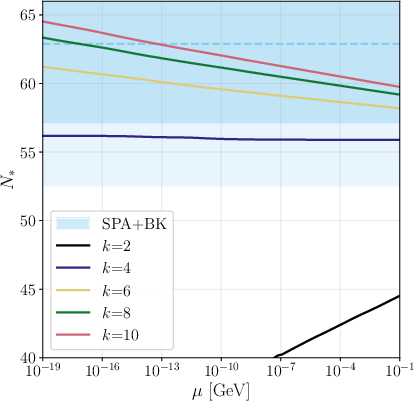
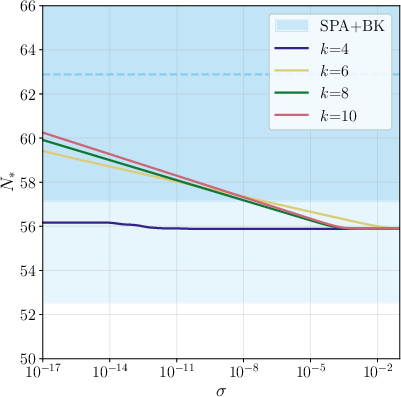
Figure 1: k≥40 as a function of k≥41 or k≥42 for various monomial powers k≥43, consistent with observationally allowed k≥44 values.
The explicit mapping of reheating dynamics and number of e-folds k≥45 is presented in (Figure 1), demonstrating that only k≥46 is consistent with modern CMB limits at k≥47 CL.
Reheating Dynamics in the Presence of Multiple Portal Couplings
The authors compute the reheating temperature for different coupling choices, including decay via the cubic portal (k≥48) and quartic (k≥49). In the presence of both, the dominant coupling determines the reheating temperature. The analysis incorporates kinetic blocking effects, properly accounting for the VEV-induced scalar mass thresholds during the oscillatory phase. The interplay and maximal reheating temperature achieved through either coupling is mapped (see Figure 2).
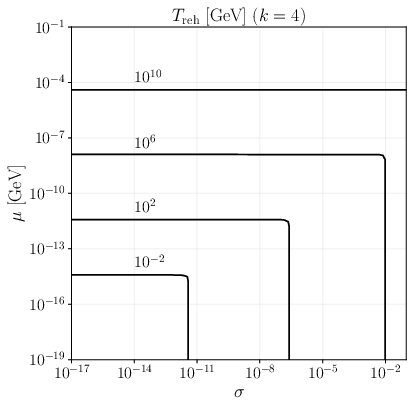
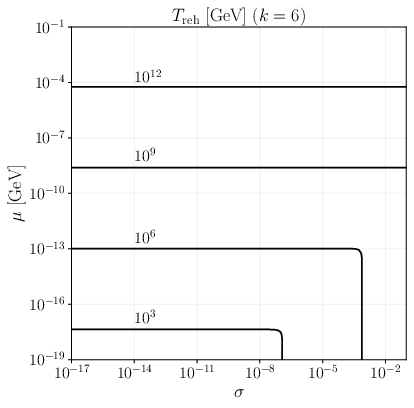
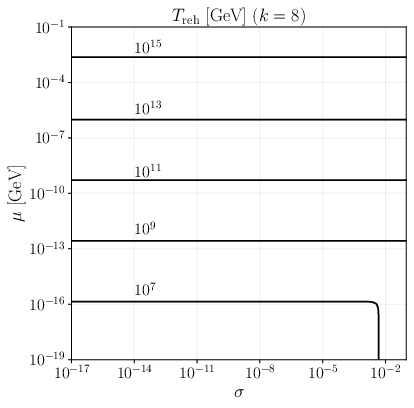
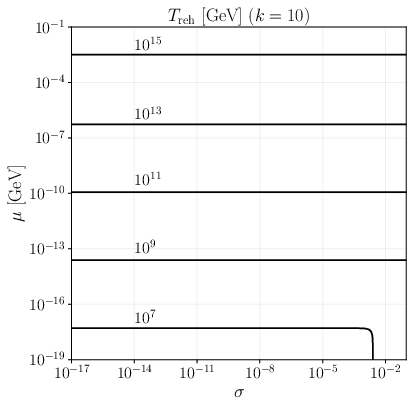
Figure 2: Reheating temperature for various combinations of k≥40 and k≥41 for k≥42, showing the dominant reheating regime in each plane.
Inflaton Regeneration and the Abundance Calculation
Upon completion of reheating and spontaneous symmetry breaking in the k≥43 sector, the inflaton is (nearly) massless, and its regeneration is studied via the thermal production from the plasma. The full coupled Boltzmann equations—including both 1-to-2 decays (e.g., k≥44) and 2-to-2 scatterings (such as k≥45)—are solved, with proper matching to non-perturbative and kinematic blocking regimes. The calculation accounts for freeze-in and freeze-out scenarios.
The analysis elucidates the regions corresponding to the usual WIMP (large coupling, thermal equilibrium, freeze-out) and FIMP (small coupling, out-of-equilibrium, freeze-in) regimes for inflaton production. Significantly, for intermediate couplings, the relic inflaton abundance vastly exceeds the observed dark matter abundance, robustly excluding the corresponding parameter space.
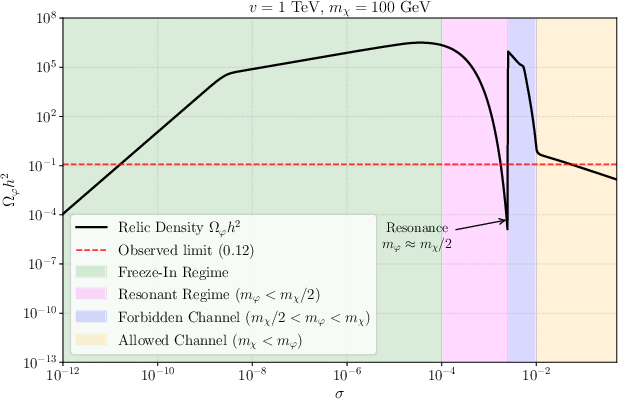
Figure 3: Relic abundance of k≥46 versus k≥47 for a generic scalar case; the FIMP regime is indicated in green; excluded overproduction regions (non-viable relic density) are clearly delineated.
The paper provides a comprehensive classification of the possible scenarios based on couplings and mass relations—such as the forbidden region (k≥48), resonance, and enhanced freeze-in via decay and annihilation channels.
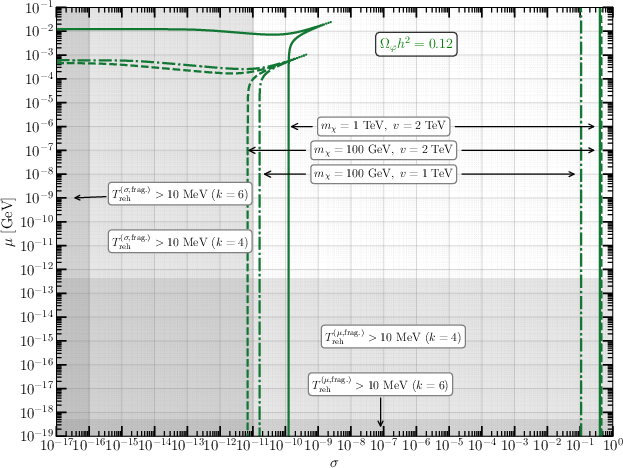
Figure 4: Exclusion plot as a function of k≥49 and ϕ40; the area between the lines yields excessive relic density. Fragmentation and reheating considerations are included (gray shading).
The Higgs Portal Scenario: Phenomenological Implications and Constraints
When the generic scalar is identified with the SM Higgs boson, the phenomenology is substantially richer and experimental constraints are much sharper. The inflaton-Higgs mixing induced by the ϕ41-type portal coupling gives the inflaton a prompt decay channel to SM species; this is thoroughly mapped for the full mass range using precision Higgs and low-energy data.
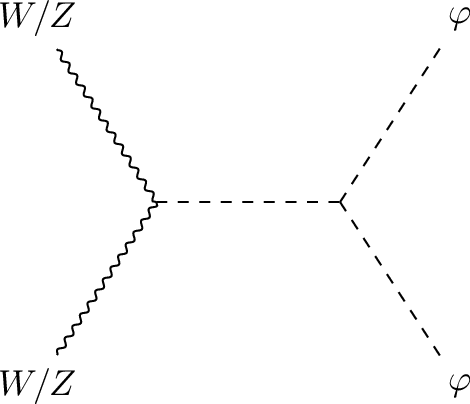
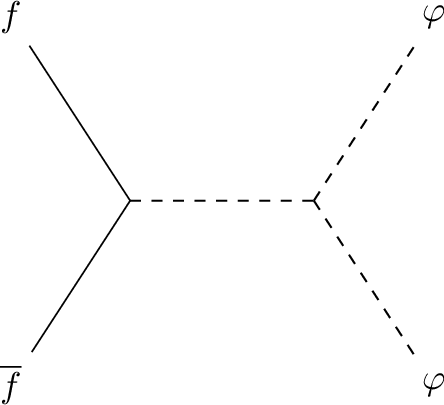
Figure 5: Relevant diagrams for vector and fermion-initiated scattering producing inflaton pairs via ϕ42-exchange.
There are strong experimental constraints from:
- Invisible Higgs decay limits for ϕ43,
- Direct detection bounds in the WIMP regime,
- Fixed-target and flavor constraints for light scalars,
- Cosmological BBN and CMB constraints from late inflaton decay (energy injection and spectral distortions).
The allowed region is hence tightly localized. The parameter space supporting the Higgs portal inflaton as all of DM (i.e., ϕ44 and ϕ45) is limited to a narrow FIMP strip, requiring extremely small portal couplings and, crucially, is sensitive to the initial condition for inflaton abundance post-fragmentation.
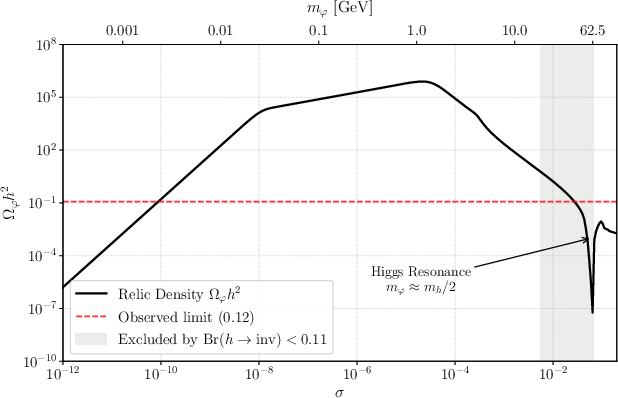
Figure 6: Higgs portal relic abundance ϕ46 as a function of ϕ47 for vanishing ϕ48. Gray region is excluded by invisible Higgs decay searches.
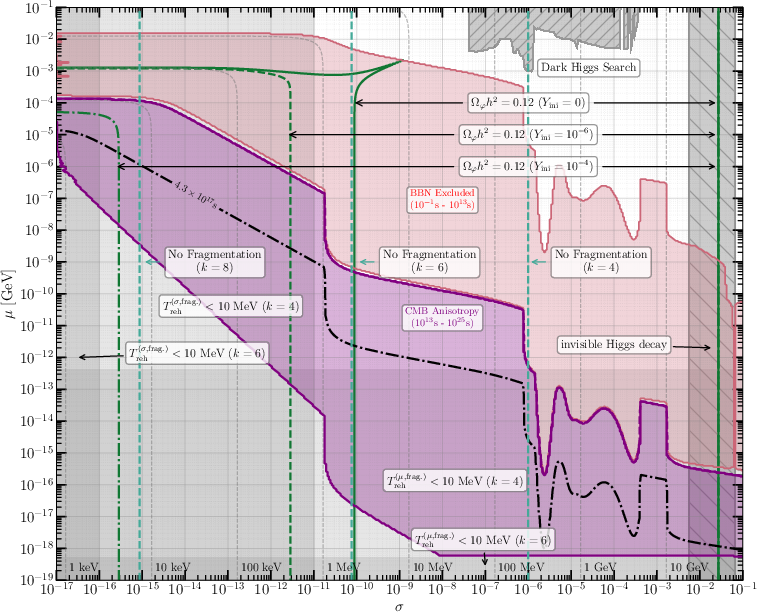
Figure 7: Complete constraint overlay for the Higgs portal: collider, cosmological, overproduction, and BBN/CMB bounds. The allowed parameter space is highly restricted to the "survival corridor".
The analysis includes a thorough computation of inflaton decay rates for all possible SM final states.
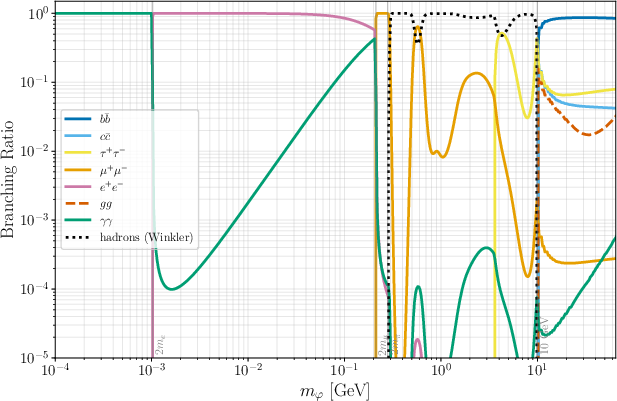
Figure 8: Branching ratios of inflaton decay for varying masses, evidencing the transition from hadronic to leptonic to diphoton modes as ϕ49 decreases.
Theoretical and Experimental Implications
A key finding is that the possibility of inflaton relic overproduction provides a probe of reheating couplings and mechanisms that is independent and complementary to CMB power spectrum and non-Gaussianity constraints. The parameter regimes excluded by overproduction coincide with those that would naively appear viable in traditional WIMP, forbidden, or resonance channels. For the Higgs portal, the viable relic abundance region is strongly constrained by colliders (especially invisible Higgs decay and direct detection bounds) and is generically pushed into ultra-feeble coupling regimes.
From a cosmological standpoint, the presence of a post-reheating stiff EoS phase (ϕ60) has further consequences for the gravitational wave (GW) background, as discussed. The occurrence of a "kination" regime generically leads to a blue-tilted GW spectrum, potentially producing observational signatures at high-frequency GW observatories. The model also emphasizes the need for careful treatment of any initial inflaton abundance produced by fragmentation—both for dark matter and cosmological signals.
Conclusion
This work establishes that the assumption of inflaton irrelevance post-reheating breaks down in non-quadratic models. The analysis firmly demonstrates that for ϕ61 monomial inflaton potentials, the Universe generically repopulates inflaton quanta after reheating. The resulting inflaton relic abundance, controlled by scalar portal couplings (including the Higgs), allows the Universe to probe inflation-matter couplings via cosmological and experimental observables. For generic scalar portals, the relic inflaton density restricts the allowed coupling space to disjoint WIMP and FIMP regimes, with the remaining space excluded by overproduction. For the Higgs portal, viable dark matter is limited to a narrow region consistent with collider, direct detection, and cosmological limits.
The theoretical framework presented provides both a new probe for post-inflation reheating models and informs ongoing and future searches for new scalar degrees of freedom at colliders and cosmology. Future GW experiments and improved cosmological and collider constraints are expected to further reduce the remaining viable parameter space and clarify the possible role of the inflaton in the late Universe.