- The paper presents an algorithm with runtime 2^(O(sqrt(n log(1/ρ) log(kε⁻¹)))) that overcomes previous exponential-time limits for learning polyhedral intersections.
- It leverages a novel sampling-based weak learning subroutine combined with region covering boosting to maintain low error in agnostic settings.
- The work matches established SQ and cryptographic lower bounds, offering tight complexity tradeoffs for high-dimensional geometric learning.
Tight Bounds for PAC Learning Intersections of Halfspaces with a Margin
Introduction and Motivation
The paper "Tight Bounds for Learning Polyhedra with a Margin" (2604.14614) tackles the longstanding problem of PAC learning intersections of k halfspaces in Rn with margin ρ, focusing on the case where k and ρ−1 are polynomially bounded in n. Intersections of halfspaces encapsulate key classes such as polyhedra, DNFs, and generalize the well-studied single halfspace (LTF) setting. Unlike the single halfspace case—where efficient (polynomial-time) algorithms are known under minimal assumptions—learning their intersection, even with generous geometric separation, resisted efficient learning guarantees due to known exponential lower bounds from both Statistical Query (SQ) and cryptography-based frameworks.
Previous algorithms for this problem suffered from exponential dependence either on k or ρ−1, resulting in exponential-time even for the regime of k=poly(n) and ρ=1/poly(n). The main contribution of this work is an essentially tight algorithm whose runtime is Rn0, overcoming previous limitations and matching known lower bounds up to logarithmic factors.
The main object of study is the class of intersections of Rn1 halfspaces
Rn2
where Rn3, each Rn4, and corresponding thresholds Rn5. The learning setting is agnostic, allowing Rn6 to be any distribution over Rn7. The margin Rn8 specifies that every point Rn9 labeled negative lies at least ρ0 away from all boundary hyperplanes (see Definition 1 in the paper).
Main Algorithmic Contributions
The paper presents an algorithm with the following key performance guarantee:
Theorem (Informal). There is an algorithm for PAC learning intersections of ρ1 halfspaces with margin ρ2 to error ρ3 over arbitrary distributions, running in
ρ4
time. The guarantee holds even under a soft margin assumption (i.e., if all but an ρ5 fraction of points have distance at least ρ6 to the polyhedron's boundary).
This runtime is strictly subexponential in ρ7 for polynomial ρ8 and ρ9. Notably, the dependence on k0 and k1 is moved inside the square root in the exponent, outperforming prior work where these appeared linearly or polynomially in the exponent.
Technical Overview
The core algorithm employs a novel weak learning subroutine combined with boosting by region covering. Unlike the classical paradigm, which leverages polynomial threshold function approximations (PTF) and faces degree-based exponential lower bounds, their method constructs a distribution over halfspaces by sampling from a convex body determined by classifying random positive and negative samples correctly.
The key insight is to find a halfspace k2 such that:
- The region k3 contains a nontrivial (exponentially small in k4 but adequate for boosting) fraction of negative points, but few positives.
- k5 is significantly biased towards k6 on the region defined by k7.
The polyhedral region is defined by taking random samples of positive and negative points and considering all halfspaces that agree with these on all samples. By careful volume analysis, most halfspaces in this region are shown to have the required property, provided the sample sizes are sufficiently large—crucially tuned so that the resulting advantage is roughly k8. This suffices for boosting, ultimately yielding a strong hypothesis.
When relaxing from the hard margin setting to a soft margin (where an k9 fraction of the probability mass can be arbitrarily close to the boundary), the authors show that their algorithm maintains identical performance guarantees for almost all points, only accruing an additive error of ρ−10. This soft margin scenario captures continuous distributions, including mixtures of Gaussians for which classical hard margin-based methods fail.
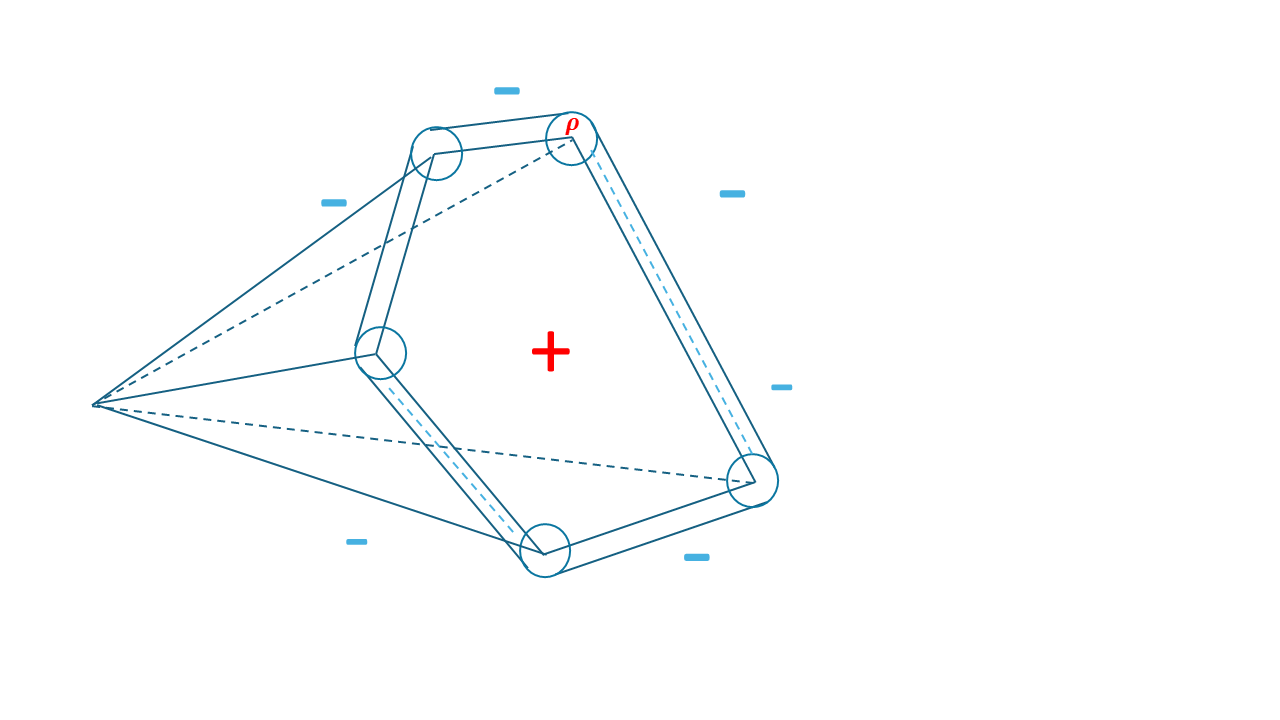
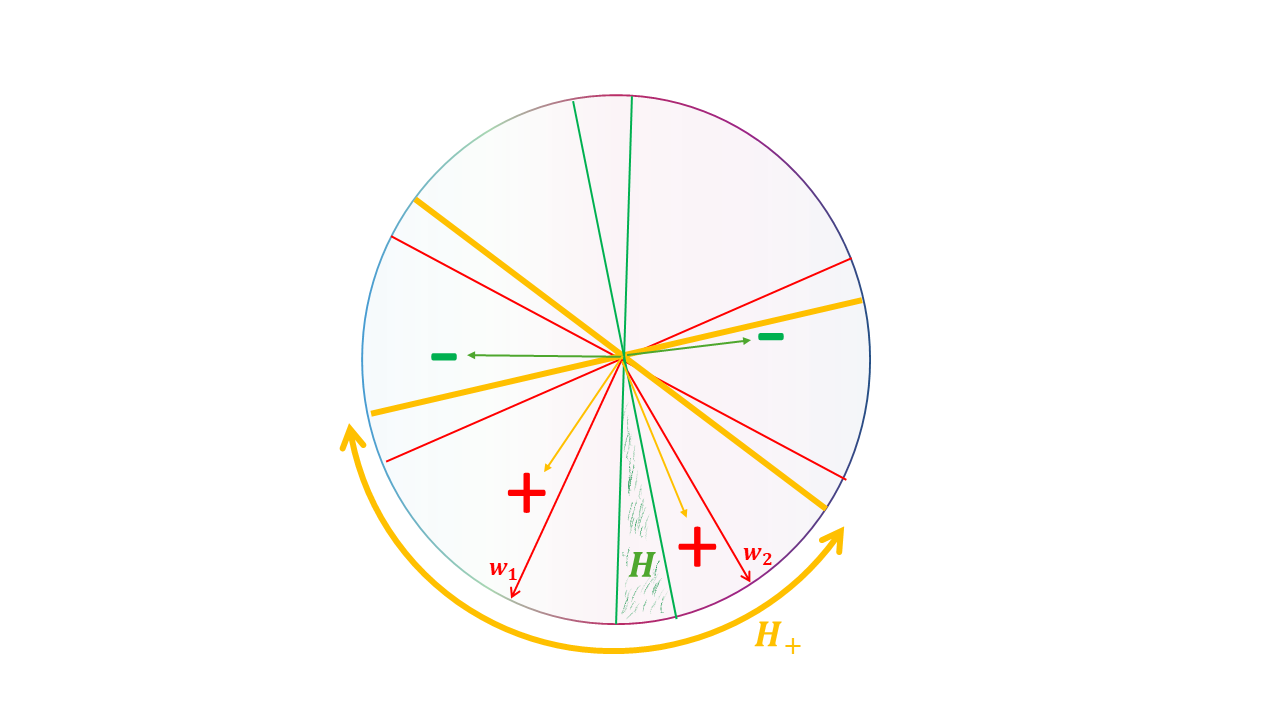
Figure 1: The soft margin setting (left) permits an ρ−11 fraction of negative points within ρ−12 of the positive region; the construction of the good region (right) for random positive and negative samples is central to the algorithm.
Lower Bounds & Optimality
The algorithm matches (up to logarithmic factors) both:
- The ρ−13 SQ lower bound for learning the intersection of ρ−14 low-weight halfspaces with inverse polynomial margin [klivans2007unconditional].
- The cryptographic lower bound based on the hardness of SVP in lattices [klivans2009cryptographic, tiegel2024improved], dictating the (conditional) best-possible efficiency for algorithms not exploiting non-SQ structure.
Proof and Analysis Highlights
The theoretical analysis relies on geometric probability, volumetric estimates, and VC theory:
- Sampling-based construction ensures with high probability that any sampled halfspace correctly classifies nearly all the positive (negative) samples.
- Good halfspaces dominate in measure, while bad regions shrink exponentially fast with the number of negative samples.
- The overall error is controlled via a region-based boosting procedure, which recursively restricts the instance space while accumulating minimal positive classification error at each step.
Notably, the covering-based boosting carefully ensures the cumulative hypothesis is a proper intersection of halfspaces, which is necessary for distribution-independent PAC learning with a proper hypothesis class.
Implications and Future Directions
This work closes the gap for learning polyhedral classes in the high-dimensional margin regime:
- Establishes essentially tight complexity tradeoffs for the intersection class in the (soft/hard) margin scenario.
- Provides constructive learning methods in instances previously seen as hard on both statistical and cryptographic grounds.
- The sampling-from-convex-region method and covering-based boosting strategy may find application in other geometric learning contexts where analogous sample complexity and volumetric bottlenecks appear.
Further investigation may address extensions to richer concept classes (e.g., unions of polyhedra), agnostic settings with arbitrary label noise, or tightening the logarithmic factor dependencies under various distributional constraints.
Conclusion
The paper provides an optimal (up to logarithmic factors) algorithm for PAC learning intersections of ρ−15 halfspaces with margin, generalizing to soft margins and arbitrary input distributions. The combination of sample-based polytope construction, geometric analysis, and region-based boosting achieves provable learning efficiency matching both information-theoretic statistical query and cryptographic lower bounds for this class, resolving a major open question in high-dimensional computational learning theory.

