- The paper introduces a novel low-dimensional reduction framework via OPUC theory that captures the collective behavior of oscillators with multiharmonic coupling.
- It constructs a reduced model using truncated Verblunsky coefficients, ensuring analytical tractability and preservation of the phase density.
- Numerical validations demonstrate that the OPUC-based reduction accurately reproduces stationary, periodic, and chaotic dynamics in complex oscillator systems.
Low-Dimensional Reduction for Multiharmonic Globally Coupled Oscillator Populations via OPUC Theory
Introduction
Classical low-dimensional reduction methods such as the Ott–Antonsen (OA) ansatz have been foundational for describing the collective dynamics of large or infinite populations of globally coupled phase oscillators, particularly in the presence of single-harmonic coupling. However, for realistic systems where the coupling function incorporates multiple harmonic components, these methods are generally inapplicable, limiting analytical tractability of such models. The paper "Low-Dimensional Reduction Theory for Populations of Globally Coupled Phase Oscillators with Multiharmonic Coupling: A Method Based on OPUC Theory" (2604.14611) establishes a rigorous framework for low-dimensional reduction in the multiharmonic case by leveraging the theory of orthogonal polynomials on the unit circle (OPUC), specifically through the Bernstein–Szegő measure and Verblunsky coefficients.
General Framework and OPUC-Based Reduction
The authors consider populations of globally coupled identical phase oscillators with multiharmonic interactions and Cauchy noise: θ˙i=ω+l=1∑L[hl(t)eilθi+hl(t)e−ilθi]+γξi
and derive, in the continuum limit, a hierarchy of moment ODEs for the order parameters Zn=∫02πe−inθρ(θ,t)dθ. In the presence of a single harmonic (L=1) and for Cauchy noise, the OA ansatz Zn=Z1n produces a closed finite-dimensional ODE for Z1. For L≥2, no such closed system exists, and prior work has not provided an adequate low-dimensional description.
The central technical advance is the construction of a low-dimensional manifold using the first N Verblunsky coefficients corresponding to the probability measure on the circle, where truncation at order N yields the N-th order Bernstein–Szegő measure. The reversed monic orthogonal polynomials Φn∗(z) (determined via the Gram–Schmidt process on the monomials in Zn=∫02πe−inθρ(θ,t)dθ0 with respect to the phase density) satisfy the Szegő recurrences governed by these Verblunsky coefficients. By Verblunsky's theorem, any truncated sequence Zn=∫02πe−inθρ(θ,t)dθ1 with Zn=∫02πe−inθρ(θ,t)dθ2 defines a unique probability measure on the circle, thus ensuring that the reduced system remains physically well-posed.
For uniformly rotating solutions, the recurrence relations for the moments collapse to the Zn=∫02πe−inθρ(θ,t)dθ3-th order Bernstein–Szegő measure, confirming that the dynamics are exactly captured by a finite set of parameters: Zn=∫02πe−inθρ(θ,t)dθ4
with Zn=∫02πe−inθρ(θ,t)dθ5 inside the unit disk. For nonequilibrium solutions, a quasistationary approximation reveals that Verblunsky coefficients of order Zn=∫02πe−inθρ(θ,t)dθ6 decay rapidly, with an upper bound
Zn=∫02πe−inθρ(θ,t)dθ7
where Zn=∫02πe−inθρ(θ,t)dθ8 is the maximal modulus of the relevant roots and Zn=∫02πe−inθρ(θ,t)dθ9 captures the timescale of slow dynamics Figure 1.
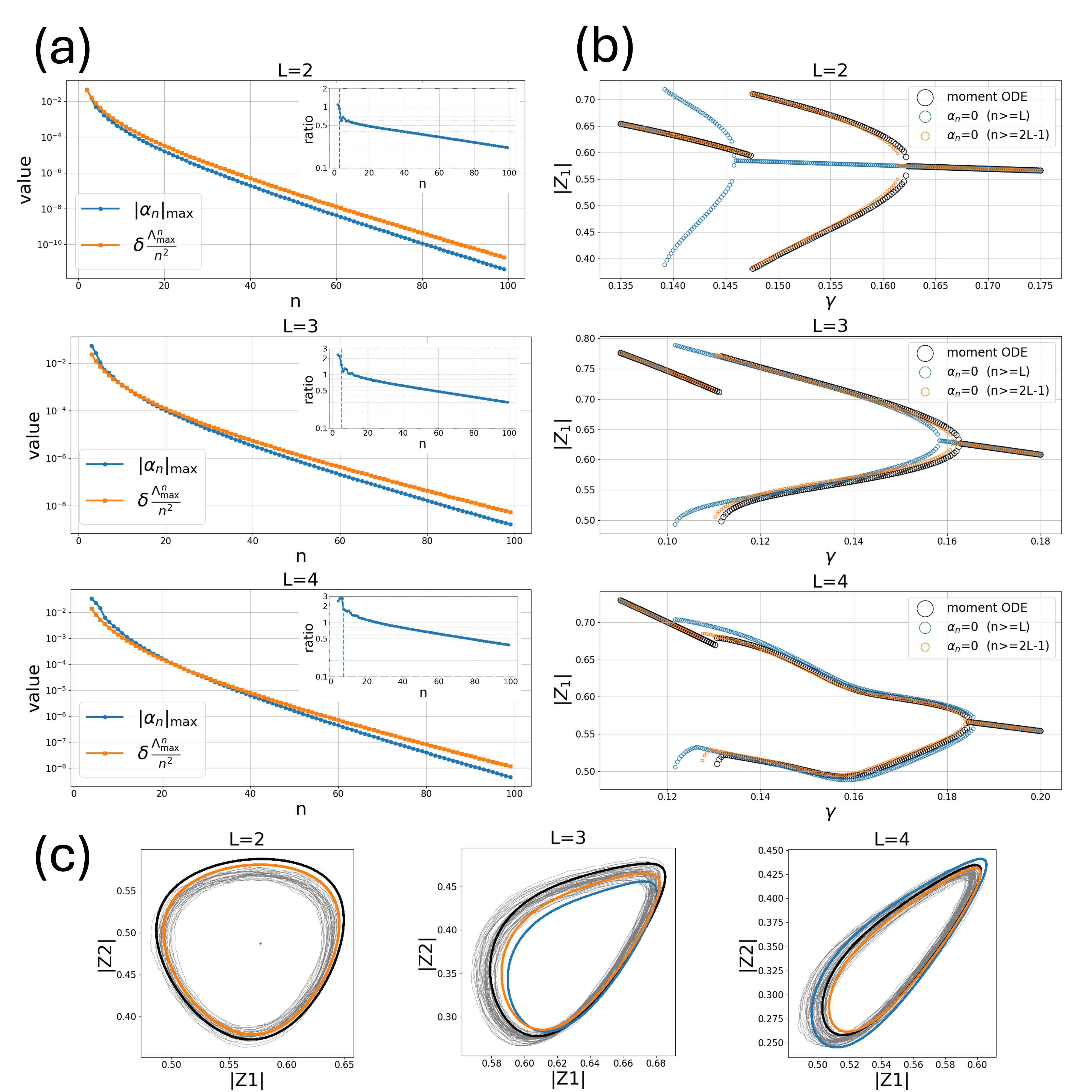
Figure 1: Order estimate for the Verblunsky coefficients, showing rapid decay beyond the truncation threshold and the efficacy of different reductions for periodic attractors.
Analytically and numerically, this ensures that truncating the Verblunsky coefficient sequence at order (L=1)0—in practice, (L=1)1 yields major improvements—results in a finite-dimensional ODE that accurately captures both stationary and periodic/chaotic collective dynamics (Figures 1, 2).
Numerical Validation: Chaos, Period-Doubling, and Irregular Regimes
Numerical integration of the reduced system and the original infinite-dimensional ODEs for the moments reveals excellent agreement, not only for stationary and periodic dynamics but also in regimes displaying period-doubling cascades to chaos. The reduced systems ((L=1)2) match peak order parameter fluctuations, Lyapunov spectra, and even chaotic dynamics over a broad parameter range Figure 2.
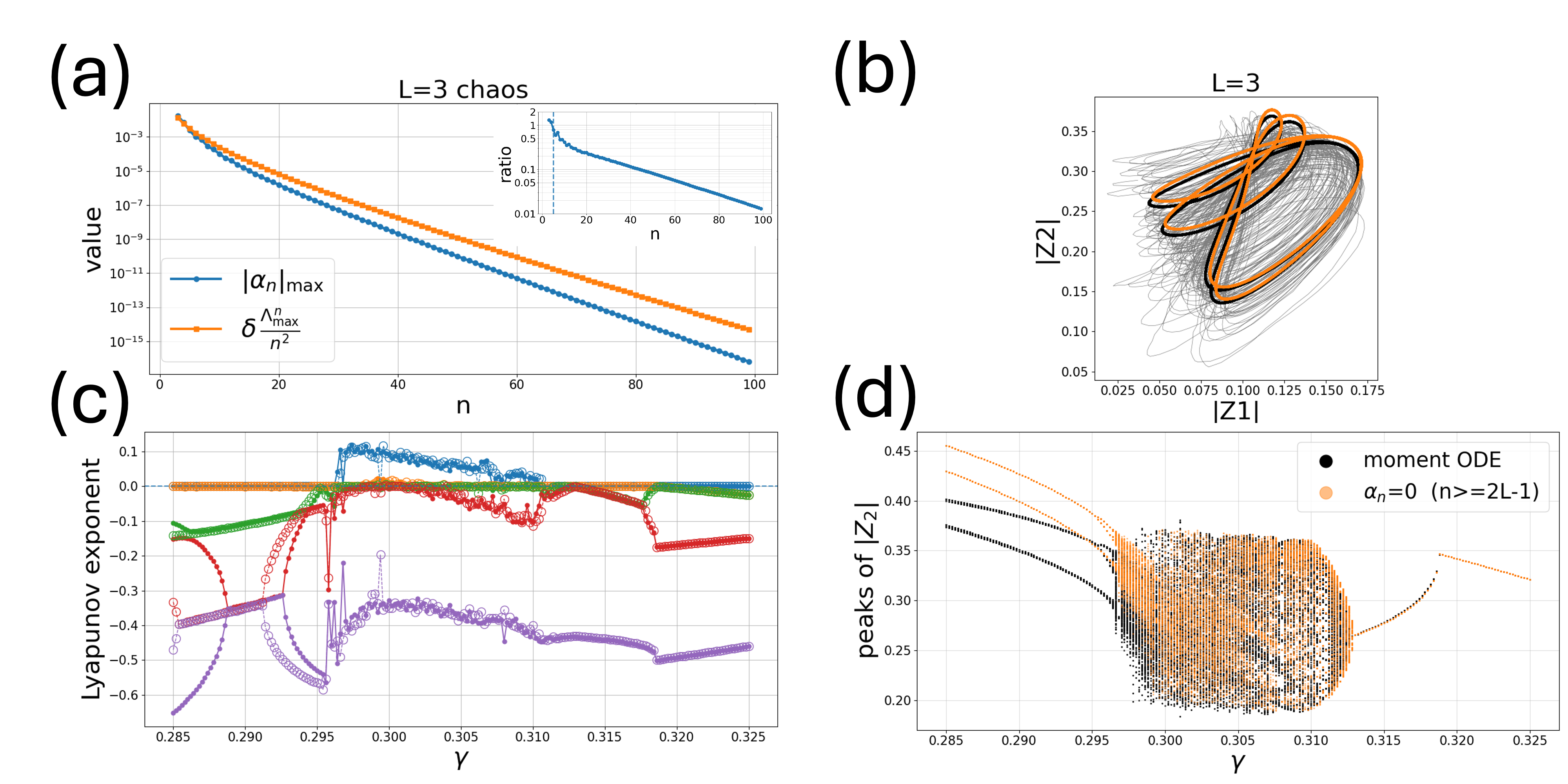
Figure 2: (a) Order estimate for Verblunsky coefficients in collective chaos; (b) period-4 orbit; (c) Lyapunov exponents and (d) (L=1)3 peaks for different gamma values, all demonstrating fidelity of the low-dimensional reduction.
Importantly, the truncation maintains the probability measure structure of the phase density, which remedies known inconsistencies in cumulant-based reductions (e.g., negative densities) for multiharmonic coupling.
Connection to Previous and Future Theoretical Developments
This work generalizes and unifies earlier results in both the OA framework and Cauchy-noise-reduced models [Tonjes2020, Cestnik2022, Tyulkina2018]. For (L=1)4, the approach reproduces the OA manifold. The introduction of the OPUC formalism and explicit ODEs for the Verblunsky coefficients (derived in the supplement) paves the way for systematic and controllable low-dimensional descriptions as the number of significant harmonics increases. The method ensures that for uniformly rotating solutions, the reduction is exact, while for nonequilibrium attractors the truncation error is quantifiable and rapidly decaying.
Potential extensions include application to the Winfree model, networks of theta neurons, and other classes of globally coupled oscillators where phase reduction yields multiharmonic coupling—crucial for modeling higher-order interactions in complex systems. The formalism has not yet been extensively explored in dynamical systems and may offer significant analytical advantages. The rigorous probabilistic structure (due to OPUC) is an intrinsic advantage not matched by cumulant expansions.
Implications and Future Directions
The theoretical and practical implications are substantial:
- Model Reduction: Enables computational and analytical tractability for multiharmonic oscillator populations which are prevalent in biology, neuroscience, and physics.
- Bifurcation Analysis: Captures transition scenarios (e.g., Hopf, SNIC, period-doubling) with high fidelity.
- Extension to Other Noise and Coupling Forms: While developed for Cauchy noise, the methodological structure suggests possible generalization to other forms of noise and coupling heterogeneities.
- Structural Consistency: Maintains the rigorous probabilistic meaning of the reduced phase density, opening the door to rigorous control and inference approaches in real high-dimensional oscillator populations.
- Connection to Mathematical Physics: Offers a path for cross-fertilization between modern spectral theory/OPUC and nonlinear dynamics.
Conclusion
This work provides a robust, rigorous, and numerically validated framework for low-dimensional reduction of populations of globally coupled phase oscillators with multiharmonic coupling via OPUC theory. The approach extends the theoretical landscape beyond the Ott–Antonsen ansatz and allows for both precise control of truncation error and a guarantee of phase distribution positivity. Application to general limit-cycle oscillator populations is immediately feasible, and the OPUC-based perspective is likely to inform future developments in both directionally coupled oscillator theory and the mathematical analysis of large-scale collective dynamics.