- The paper establishes the analytic characterization of meronic spin defects, unifying point singularities with meron-like spin textures in vortex beams.
- The paper demonstrates that these defects maintain a constant subwavelength localization through diffraction-free propagation by balancing transverse and longitudinal field components.
- The paper rigorously derives the quantization and fractional solid angles of the spin textures, highlighting their potential impact on nanophotonic and topological applications.
Non-diffracting Meronic Spin Defects of Light
Introduction: Topological Singularities in Structured Light
The study investigates the emergence, geometry, and propagation of non-diffracting meronic spin defects in the core of optical vortex beams. While singular optics has cataloged various topological configurations such as optical vortices, polarization singularities, and skyrmionic textures, this work exposes a new class of topological texture around the phase singularity of a vortex. Specifically, it reports and analyzes spin textures that unify characteristics of both topological defects (point singularity of vanishing spin) and textures (meron-like spin distributions covering fractional portions of the spin unit sphere), with the distinctive property that these structures do not experience diffraction-induced broadening and remain subwavelength-localized throughout propagation.
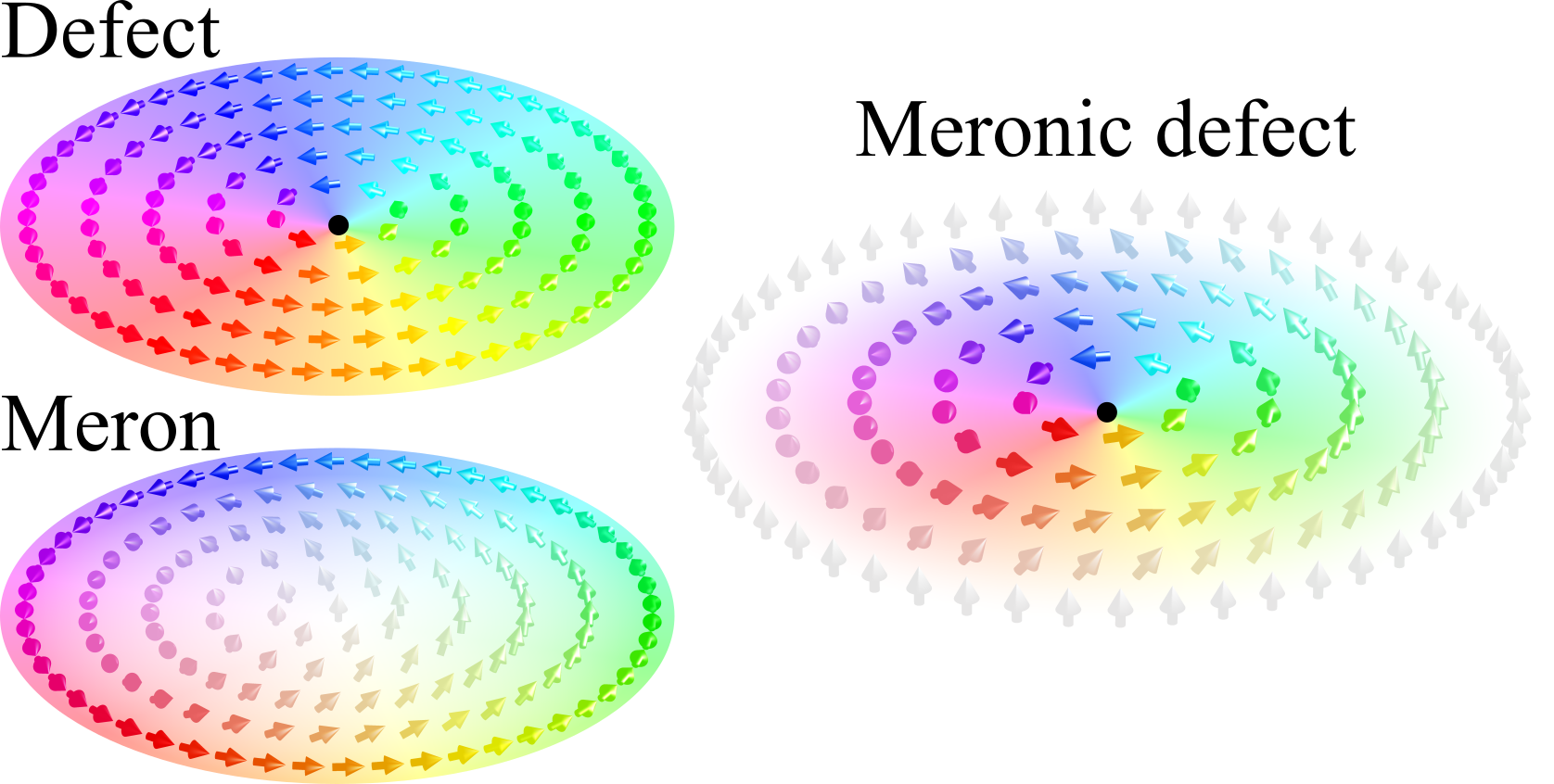
Figure 1: Conceptual depiction of point defect, meron texture, and their combination into the meronic spin defect structure in a vector field.
Theoretical Framework: Topological Classification and Vectorial Structure
The work begins by revisiting the classification of topological structures as either defects (e.g., phase singularities, polarization disclinations) or textures (e.g., skyrmions, merons) and demonstrates that the spin field in a scalar vortex beam naturally forms a hybrid entity: a meronic defect. The optical field is represented in terms of its transverse and longitudinal components, ψ=ψ⊥u⊥+ψzuz, where Gauss’s law couples the structure of ψz to the spatial variation and polarization of ψ⊥. The critical locus is the vortex core, where transverse field intensity vanishes but the longitudinal component dominates, enforcing a transition from transverse to longitudinal polarization and inducing complex spin morphologies.
A crucial construction is the transverse-axial Poincaré sphere (TA-PS), parameterized by the ratio of ψz/ψ⊥. In the vicinity of the vortex line, non-trivial spin textures arise: the polarization state smoothly maps the transverse vortex-plane to a surface on the TA-PS, yielding integer or fractional skyrmion number depending on the local field topology.
Meronic Spin Defects: Structure, Geometry, and Topology
The central result is the explicit analytic characterization of meronic spin defects. Around a simple vortex (charge ℓ=±1) with uniform circular polarization, the local spin angular momentum (SAM) S forms an azimuthal vector field with a central point of vanishing spin and a surrounding texture that covers a hemisphere of the SAM unit sphere (excluding the equator). For higher-order fields, the geometry and anisotropy of the spin texture are controlled by the polarization ellipticity and the relative orientation of spin and orbital angular momentum.
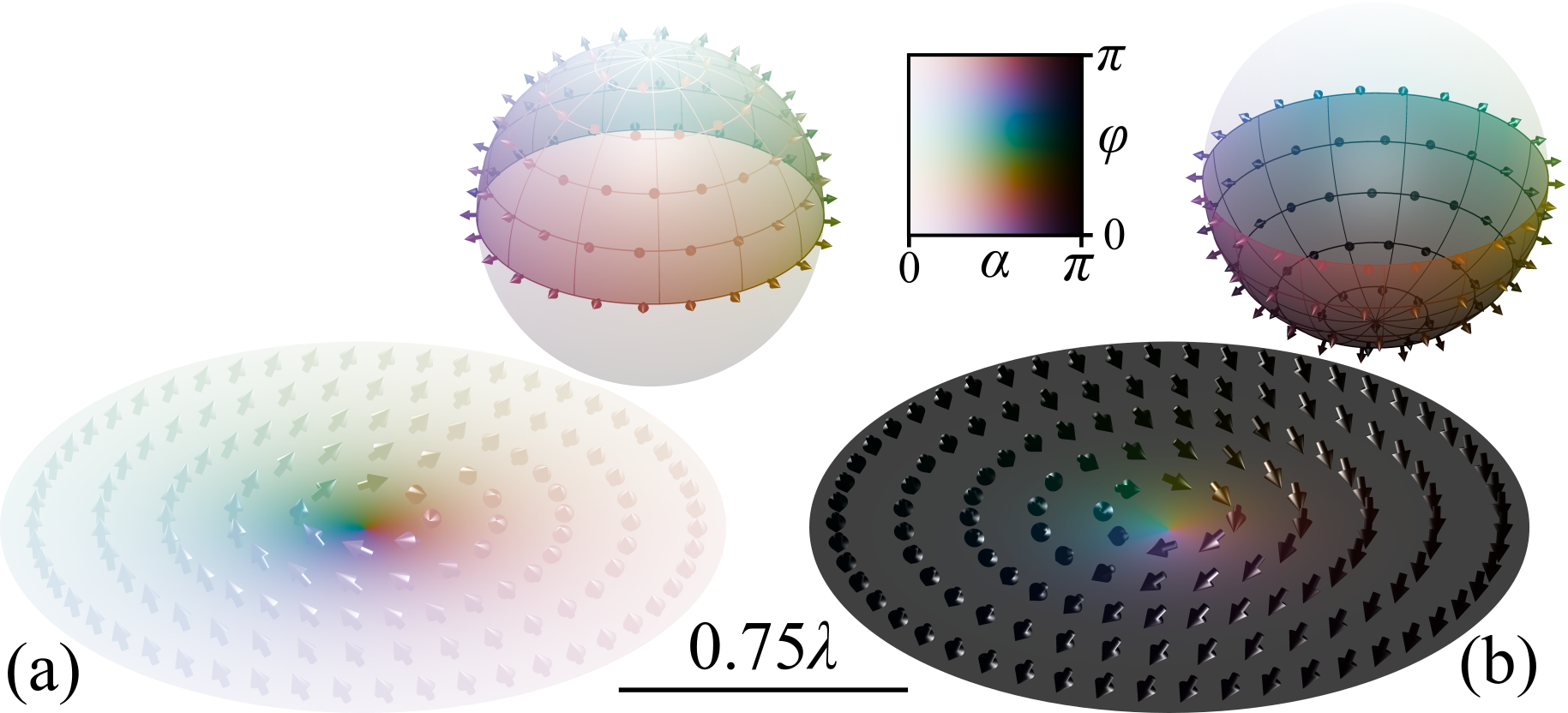
Figure 2: Local distribution of SAM around the core of vortex beams with ℓ=1, RCP (a) and ℓ=−1, LCP (b); inset highlights the area covered on the SAM unit sphere.
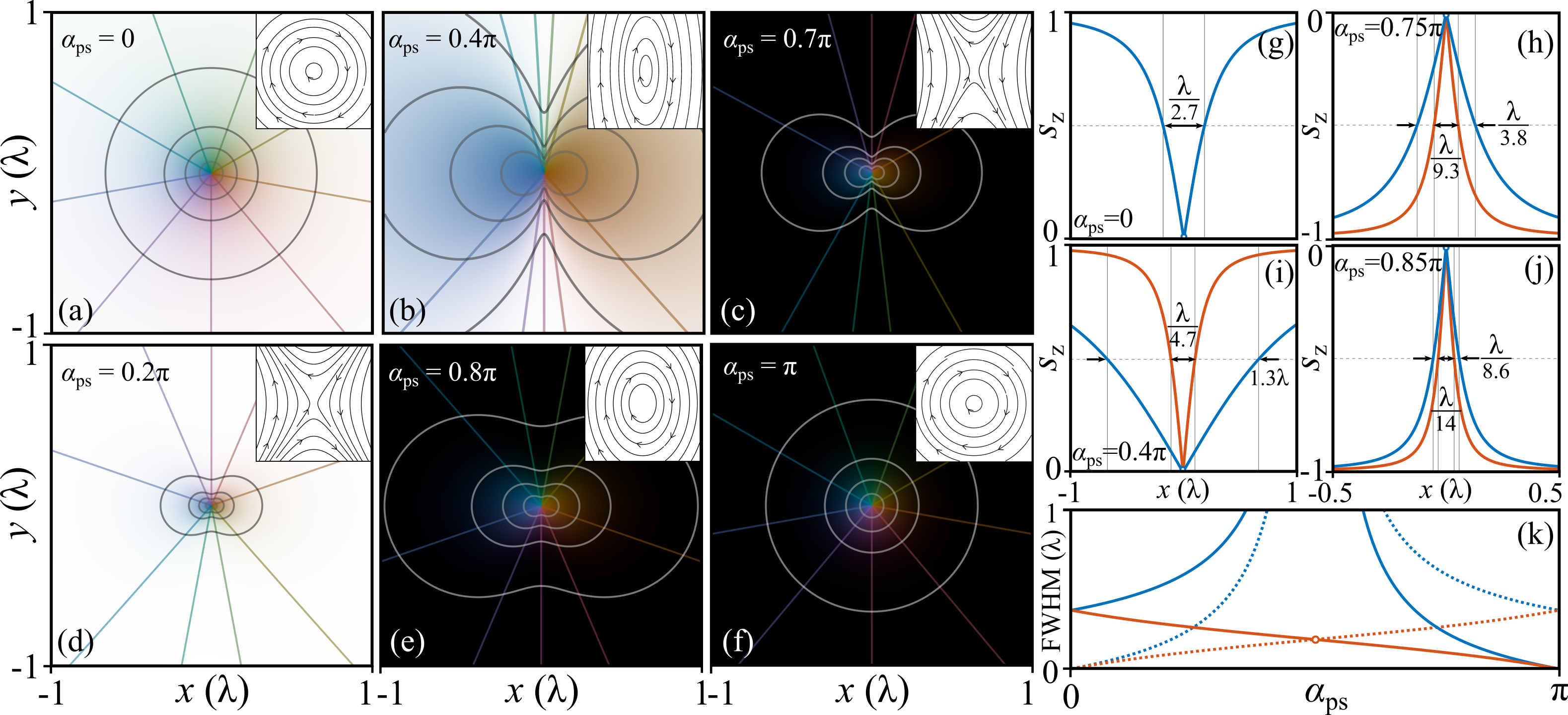
Figure 3: Variation of meronic spin defect geometry and anisotropy as a function of polarization state and vortex charge, showing distortions of αspin and φspin contours.
The spin texture may exhibit pronounced anisotropy—lobe-like or saddle-like distributions—depending on the underlying polarization. The work rigorously derives the quantization and fractionalization of the associated solid angles, demonstrating that a meronic defect carries a fractional solid angle on the spin unit sphere, controllable by the beam parameters.
Diffraction-Free Propagation and Subwavelength Localization
A salient and nontrivial result is that these meronic spin defects do not undergo diffraction-driven expansion, in marked contrast with Stokes skyrmionic textures and other paraxial polarization structures. The ratio ψz0 remains invariant upon propagation, which implies that both the geometric and topological properties of the polarization and spin textures are fixed as the beam evolves, independent of the underlying beam waist or focusing conditions.
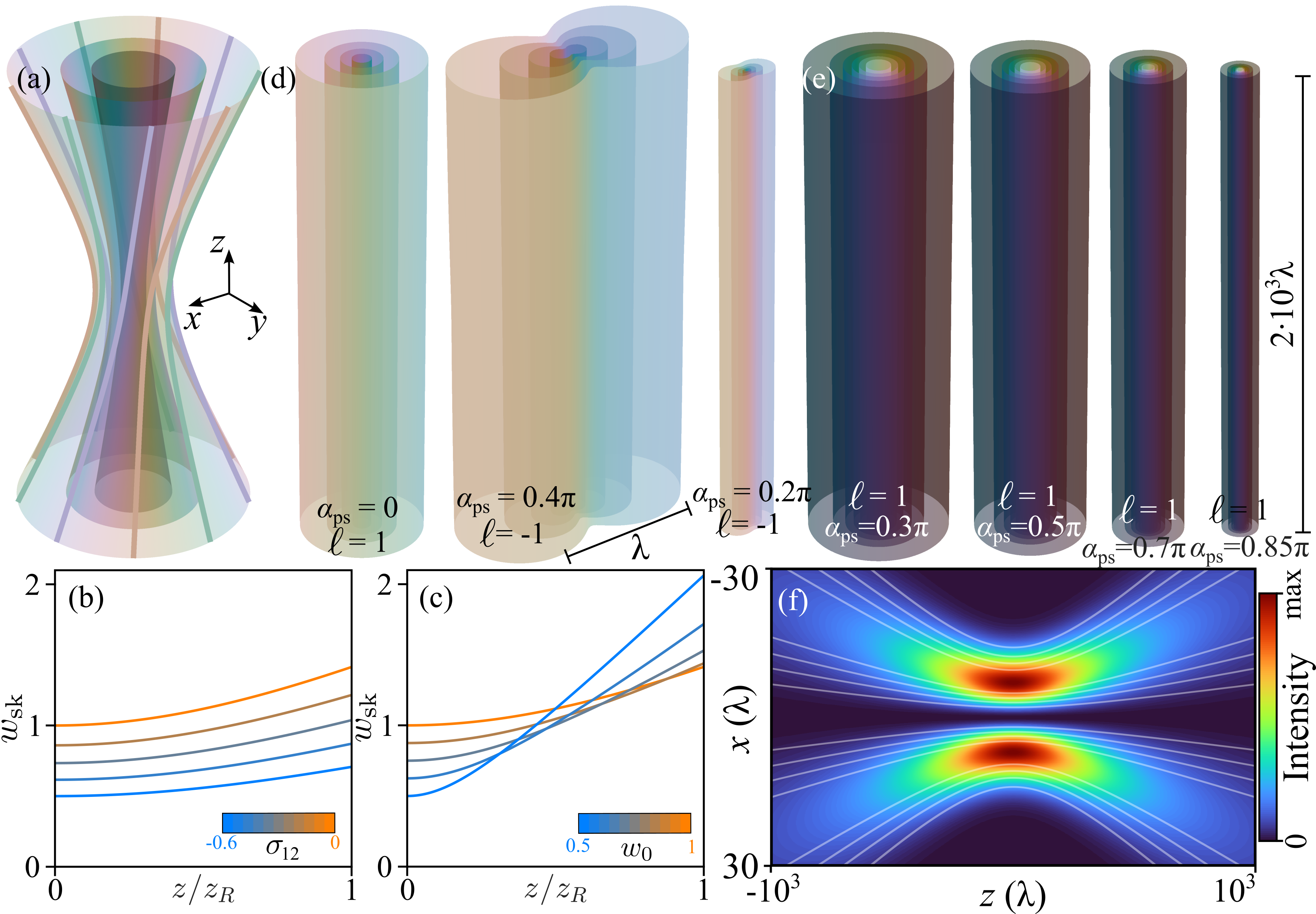
Figure 4: (a) Polarization contour evolution for skyrmionic beams; (b, c) evolution of skyrmion width ψz1 with propagation and spin ellipticity. (d, e) Diffraction-free propagation of the nondiffracting SAM and TA-PS textures over thousands of wavelengths.
The characteristic size of the meronic defect can be tuned arbitrarily below the wavelength by adjusting the balance of transverse and longitudinal field components. This subwavelength localization is fundamentally enforced by the constituent coupling through Maxwell’s equations and is robust under both ideal and perturbed evolution.
Singularities, High-Order Vortex Cores, and Robustness under Perturbation
The paper extends the analysis to higher-order vortex beams and their structural stability. In physically relevant scenarios, high-order singularities (ψz2) are unstable and unfold into arrays of first-order singularities, each bearing an independent non-diffracting meronic defect. The conservation and additivity of the associated topological charges are consistent with the established theory of wave dislocation splitting.
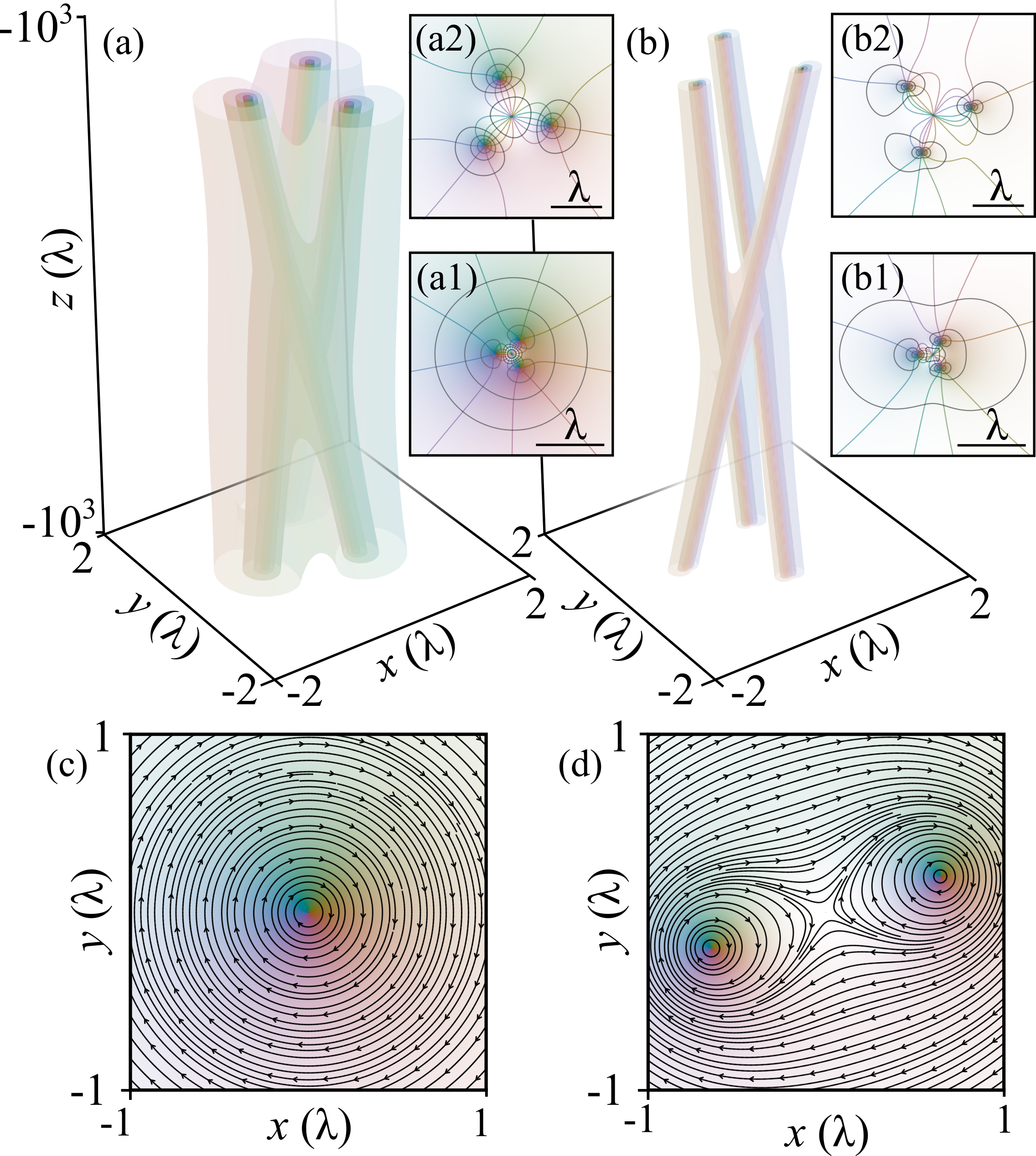
Figure 5: (a, a1, a2) Propagation of a spin meronic defect for ψz3, RCP; (b, b1, b2) same with elliptical polarization (ψz4). (c, d) Unfolding of a higher-order defect (ψz5) into two first-order defects under perturbation.
This splitting occurs over subwavelength regions, so the mutual independence of the constituent defects is retained unless they are tightly packed. The theory is complemented by expansions for arbitrary vortex beams and field profiles, confirming the mode- and propagation-invariance of the effect.
Implications and Outlook
The identification and analytic construction of non-diffracting, strongly localized meronic spin defects around vortex singularities generalize the known classes of topological structures in optical fields. The work exposes that, in paraxial and weakly nonparaxial regimes, the boundary conditions imposed by Maxwell’s equations guarantee robust, quantized, and stable localization and propagation of topological spin features—not present in generic skyrmionic beams.
These structures bridge previous gaps between topological point defects and extended skyrmionic textures, unify fractional spin-character with robust paraxial propagation, and highlight the essential interplay of polarization, phase, and field longitudinality. Their subwavelength confinement and immunity to diffraction suggest practical applications in field localization, superresolution metrology (down to picometric scales), nanoscale manipulation, and potentially robust topological photonic information channels. There is a clear theoretical motivation to assess their resilience in the presence of non-paraxial corrections, strong field gradients, or external perturbations, as well as their generalization to other wave systems (e.g., acoustics, quantum fluids, or beyond) and higher-dimensional topological structures.
Conclusion
This work establishes the existence and analytic form of non-diffracting meronic spin defects bound to the cores of optical vortex beams. It provides a unified framework for classifying and understanding these hybrid topological structures, rigorously derives their geometry, subwavelength scale, and fractional topology, and elucidates their unique robustness and propagation-invariance. The results pave the way for deeper investigations into the intrinsic topological organization of vectorial wave fields, their manipulation, and application in nanophotonics, quantum information, and beyond.
(2604.14577)

