- The paper introduces CI-CBM, a framework that integrates incremental concept set expansion, concept drift regularization, and pseudo-concept generation to effectively counter catastrophic forgetting.
- It achieves robust performance with up to 36% accuracy gains over interpretable baselines, maintaining near-parity with black-box rehearsal-free models.
- The model leverages a sparse prediction layer for global interpretability, enabling transparent reasoning and post-hoc auditing in continual learning scenarios.
CI-CBM: Interpretable and Accurate Class-Incremental Learning via Concept Bottleneck Models
Introduction
Continual learning under the class-incremental learning (CIL) paradigm presents significant challenges, notably catastrophic forgetting, where models degrade rapidly on old classes when learning new ones, especially in the exemplar-free setting where rehearsal is not permitted. Although efforts have been made to mitigate forgetting, most state-of-the-art (SOTA) methods sacrifice interpretability for performance and rely on black-box architectures. The CI-CBM framework addresses this by introducing an interpretable mechanism for CIL that leverages concept bottleneck models (CBMs) augmented with concept set expansion, concept drift regularization, and pseudo-concept generation. This enables the preservation of stable, human-interpretable concepts across incremental phases, mitigating catastrophic forgetting without reliance on exemplar replay or heavy pretraining, while approaching unrestricted model performance.
Methodology
The Class-Incremental Concept Bottleneck Model (CI-CBM) extends label-free CBMs to the exemplar-free CIL setting. The method incorporates three key modules:
- Incremental Concept Set Expansion: For each new phase, candidate concepts relevant to the introduced classes are generated using an LLM (GPT-3), followed by deduplication and filtering based on semantic similarity in joint text embedding spaces. Only unique, non-redundant concepts are incorporated, resulting in efficient model expansion and superior interpretability.
- Knowledge-Preserving Concept Bottleneck Layer Learning: The concept bottleneck weights are updated using an objective that blends alignment with image-concept activations (measured by multimodal models such as SigLIP) and a distillation term that penalizes drift in previously learned concepts. This regularizer ensures that neuron semantics are preserved as new concepts are added. The loss formulation combines cosine-cubed similarity and inter-phase distillation.
- Dynamic Prediction Layer Adaptation with Pseudo-Concept Generation: Catastrophic forgetting is tackled by generating pseudo-features for previous classes based on centroid shifts in the feature space, a mechanism inspired by geometric translations. These pseudo-features are then projected through the up-to-date concept bottleneck to produce pseudo-concept activations, allowing the model to update the sparse prediction layer using real concepts for new classes and pseudo-concepts for old classes, all without accessing prior exemplars.
These modules are orchestrated as outlined in the paper’s algorithm, resulting in a robust and scalable CIL pipeline capable of adapting to both pretrained and non-pretrained backbone regimes.

Figure 1: Pipeline overview for CI-CBM showing incremental phase processing, concept set expansion, bottleneck adaptation with distillation, and pseudo-feature generation.
Pseudo-Feature Generation and Geometric Analysis
The pseudo-feature mechanism aligns the distribution of old class representations with that of new classes by shifting the nearest new class centroid to the old class centroid. This ensures continued separability without overwriting old representations, and the induced decision boundaries closely approximate the Bayes-optimal surfaces, especially under nearly isotropic or well-behaved feature spaces.
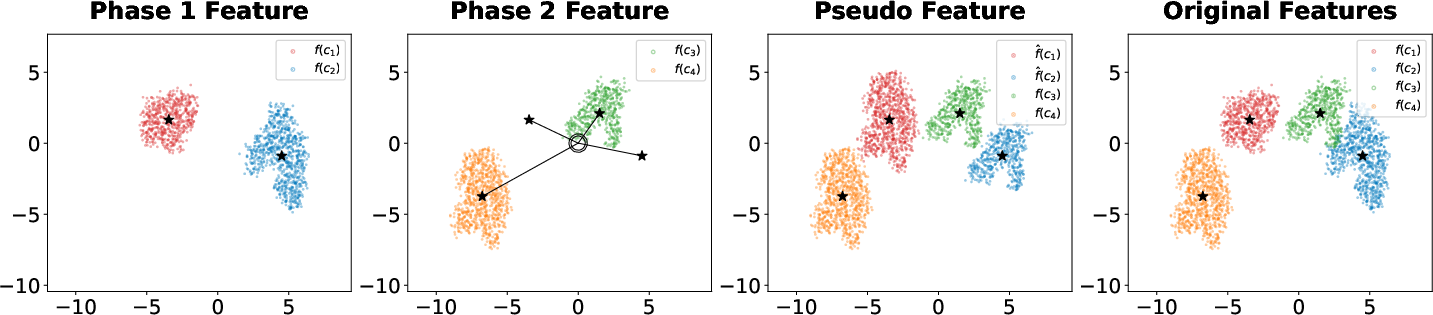
Figure 2: Toy illustration of pseudo-feature generation. Pseudo-features allow the classifier to maintain distinction between old and new classes without real exemplars.
A controlled geometric analysis demonstrates that pseudo-feature variance matching promotes linear decision surfaces, improving the faithfulness of incremental adaptation.
Empirical Results
Accuracy and Forgetting
CI-CBM was evaluated on seven datasets (including CIFAR-10/100, CUB, ImageNet-Subset, and Places365) using both pretrained (ImageNet, Places365) and from-scratch backbones (ResNet, DeiT, ViT). It demonstrates the following:
Interpretability
Global interpretability is realized through the sparse prediction layer, where associations between concepts and classes are visualized as weighted edges. Crucially, concept contributions remain stable and human-interpretable, with negative concepts denoted as "NOT" and phase-wise color coding reflecting the temporal introduction of concepts.
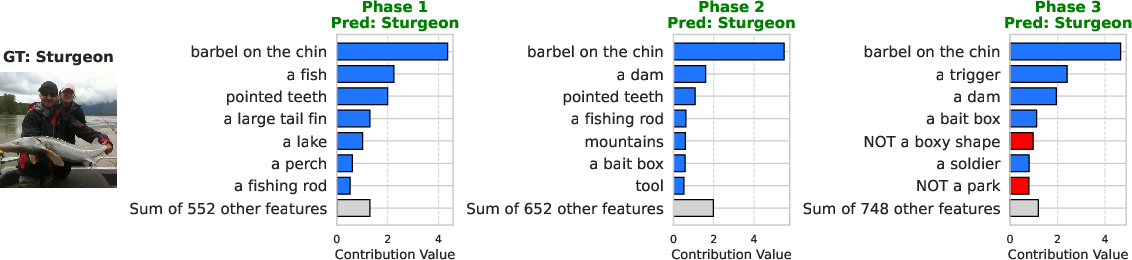
Figure 4: Per-instance reasoning for a Sturgeon image as new classes are introduced. CI-CBM’s salient concepts adapt to maintain correct classification, shifting importance from generic to discriminative features.
Ablation studies underscore that omission of pseudo-concept generation induces catastrophic forgetting, while concept drift regularization and pseudo-concept usage are both necessary for stable incremental performance and interpretability. Unique concept expansion and sparsity constraints further enhance attribution conciseness and model parsimony.
Implications and Future Directions
CI-CBM introduces a practical avenue for inherently interpretable, data-efficient, and privacy-preserving class-incremental learning. Its design enables precise post-hoc analysis of model failures, robust auditing for bias, and transparent deployment in high-stakes scenarios, addressing growing calls for explainable AI. The ability to maintain semantic alignment of concept units under severe distributional shift demonstrates the viability of hybrid semantic-geometric strategies in continual learning.
On the theoretical front, the blend of geometric pseudo-feature translation with semantic regularization suggests future research into more expressive or adaptive pseudo-sample distributions, leveraging generative priors or adversarial mechanisms. Further refinements to automated concept discovery—such as integration with structured knowledge bases or additional vision-LLMs—may improve applicability on fine-grained domains. Ongoing investigation into architectural scalability and efficiency will be critical as the number of classes and concepts grows.
Conclusion
CI-CBM establishes a new benchmark for interpretable, rehearsal-free class-incremental learning. The model's strong empirical results, minimal accuracy-interpretability trade-off, and capacity for reasoning visualization offer a compelling foundation for future continual learning systems that must be both high-performing and auditable in dynamic, privacy-sensitive environments.


