- The paper introduces a modular, learner-focused toolkit that simplifies neural news recommendation research with a decoupled architecture featuring unified dataset and model management.
- The paper details integrated support for popular datasets, multi-GPU training, and advanced experiment tracking, facilitating reproducible and fair benchmarking.
- The toolkit's learner-oriented design, including a user-friendly GUI, encourages educational use and rapid prototyping in state-of-the-art neural news recommendation.
Motivation and Context
News recommendation is a critical subdomain in recommender systems, addressing user information overload by tailoring news delivery to individual interests. Progress in deep learning, including Transformer architectures, GNNs, and LLMs, has fueled rapid advancements in neural news recommendation models (2604.14510). Despite this surge, barriers to entry persist, primarily due to heterogeneity in data formats, disparate implementations, inconsistent evaluation protocols, and limited support for educational exploration. While existing frameworks (e.g., NewsRecLib, RecBole) provide comprehensive research platforms, they prioritize advanced configurations over accessible, learner-focused environments.
Core Framework and Architecture
NewsTorch is designed as a PyTorch-based, open-source toolkit with a primary emphasis on accessibility, reproducibility, and extensibility, targeting learners and early-stage researchers. The framework features a modular, decoupled architecture that abstracts all essential functionalities of a modern neural news recommender system. Figure 1 illustrates the systemic organization of NewsTorch.
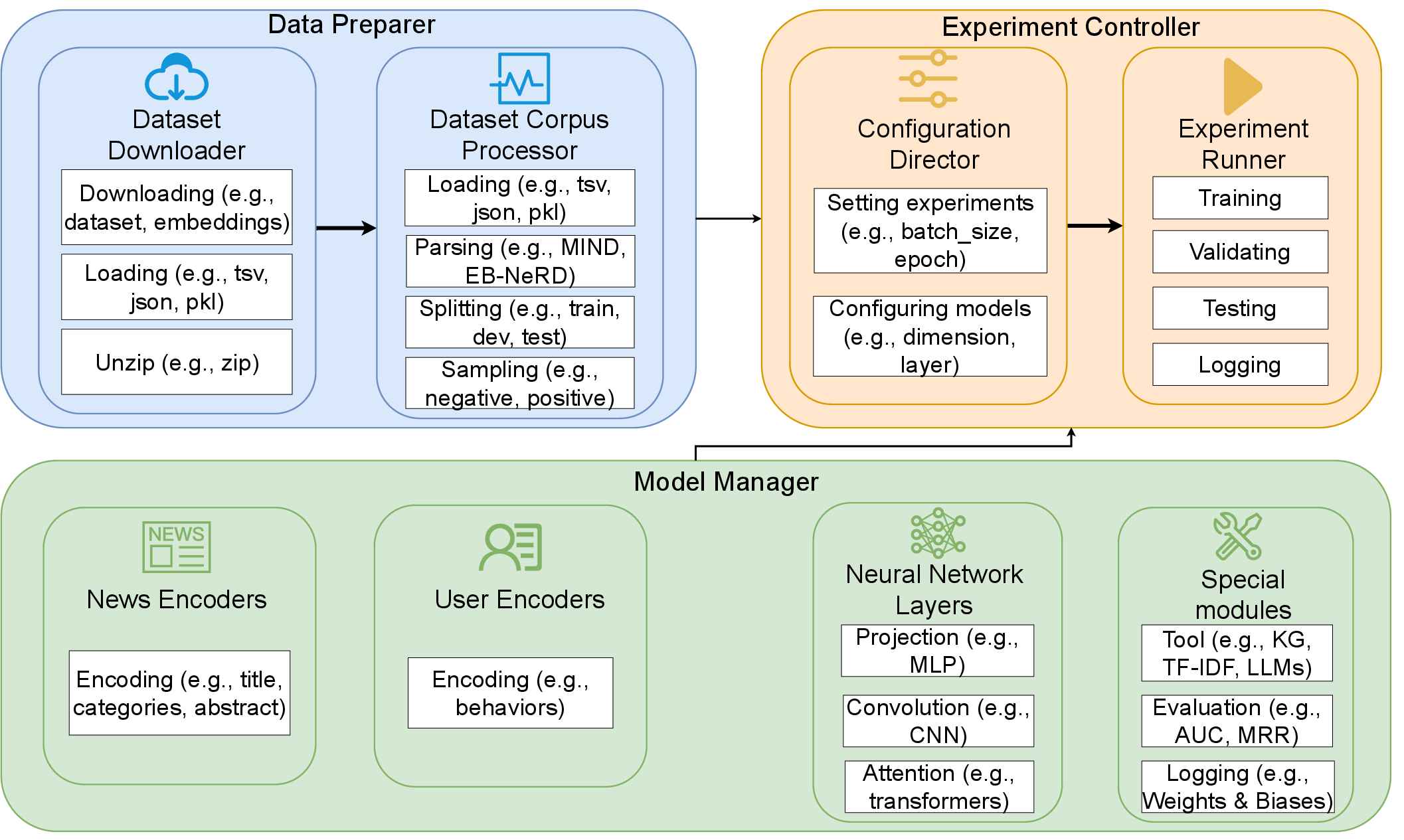
Figure 1: The framework of the NewsTorch toolkit.
The modular components include:
- Dataset Preparer: Fully automates acquisition and preprocessing of benchmark datasets (e.g., MIND, EB-NeRD), providing a unified corpus format to facilitate experimentation and comparison across models.
- Experiment Controller: Enables experiment orchestration and parameter customization via YAML-configurations, with seamless execution management using integrated experiment tracking (Weights & Biases).
- Model Manager: Supports easy integration, management, and extension of deep learning models for news recommendation, including both canonical neural architectures and contemporary GNN/LLM-based approaches.
- Web GUI: A graphical interface enables intuitive navigation, configuration, and execution of data preparation, model training, and evaluation, dramatically lowering the entry barrier for learners.
Supported Models and Datasets
NewsTorch provides out-of-the-box implementation of a comprehensive set of SOTA models:
- Deep Learning-based News Recommenders: Includes architectures leveraging CNNs, RNNs, and self-attention (e.g., NRMS [wu2019nrms], NAML [wu2019naml]).
- GNN-based Models: Coverage of session-based/collaborative models utilizing user/item interaction and structural information.
- LLM-based News Recommenders: Support for models that incorporate pre-trained and instruction-finetuned LLMs for text representation and user modeling, accommodating recent advances in the field.
Popular datasets such as MIND [wu2020mind] and EB-NeRD [kruse2024eb] are natively accessible, with unified preprocessing pipelines ensuring interoperability.
Innovation and Distinguishing Features
Compared to contemporaneous libraries [iana2023newsreclib], NewsTorch introduces several notable features:
- Learner-oriented GUI: Direct experiment management without code intervention, optimized for didactic workflows.
- Unified, Decoupled Model Interface: Streamlined mechanisms for model integration and interchangeability, promoting reproducible experimental setups.
- Native Multi-GPU and Experiment Tracking Support: Built-in compatibility with distributed training and industry-standard tracking/logging solutions.
- First Toolkit Supporting Both GNN and LLM Models in News Recommendation: Enables comparative studies and hybrid modeling strategies under one roof.
These design decisions collectively facilitate fair benchmarking, rapid prototyping, and educational engagement, serving as a catalyst for research agility and instructional clarity.
Practical and Theoretical Implications
The adoption of NewsTorch can significantly expedite model prototyping, hyperparameter tuning, and empirical reproducibility in news recommendation research. Its modular pipeline is anticipated to both demystify and standardize core experimental methodologies for learners. On the theoretical front, aggregate support for GNNs, LLMs, and composite models invites future research into synergistic architectures and comparative evaluations. The toolkit's extensibility positions it as a potential testbed for evaluating model fairness, explainability, and trustworthiness—open challenges in the field [wang2024trustworthy].
Moreover, the fair and unified evaluation infrastructure is likely to promote research into generalization, robustness, and data-centric benchmarking for neural recommenders, with avenues for methodological innovations such as multi-agent collaboration frameworks [wang2024multi] and prompt-based generative recommendation [li2024prompt].
Future Prospects and Extensions
The authors intend to evolve NewsTorch by incorporating emerging model architectures (e.g., graph-enhanced transformers), additional real-world datasets, and advanced user behavior modeling mechanisms. Given the growing influence of LLM-based approaches in recommendation, future releases may integrate prompt engineering modules, explainability toolkits, and explicit fairness constraints. The toolkit's learner-centric philosophy may additionally inspire new educational curricula and MOOC content on news recommendation fundamentals.
Conclusion
NewsTorch provides a unified, extensible, and learner-friendly PyTorch-based toolkit for neural news recommendation, supporting state-of-the-art deep learning, GNN, and LLM-based models within a reproducible experimental ecosystem. With its modular infrastructure, GUI-driven workflows, and comprehensive dataset/model coverage, NewsTorch is positioned to significantly accelerate both education and research innovation in personalized news recommendation (2604.14510).

