- The paper shows that adding spinning and overspinning states eliminates negative density degeneracies at the BTZ threshold and large-spin regimes, restoring unitarity.
- It employs both bulk and CFT analyses to demonstrate that specific quantization conditions on the central charge and spin ensure modular invariance and positivity.
- Analytic positivity proofs and mode-sum constructions of scalar correlators link heavy-light CFT data with gravitational defects in AdS3, reinforcing the holographic duality.
Spinning States and Unitarity Restoration in 3D Gravity
Introduction
The partition function of pure AdS3 gravity has long been known to exhibit unitarity-violating features, most notably negative densities of states at the BTZ threshold and in the large-spin, near-extremal regime. This paper systematically analyzes the proposal of including additional spinning states—whose spin generically scales with the central charge—to eliminate these negative densities. The work provides clear bulk and CFT interpretations of these states, demonstrates analytic positivity results, and clarifies the mechanism by which (sub)-extremal and overspinning geometries resolve the inconsistencies of pure AdS3 gravity.
Negative Densities in the Pure Gravity Partition Function
In the Maloney-Witten-Keller (MWK) approach, the partition function is computed by a sum over all discrete PSL(2,Z) images of the AdS3 vacuum saddle. The resulting spectral density is continuous and develops negative degeneracies at two loci: (1) at the black hole threshold for scalar primaries (the BTZ transition), and (2) at large spin ∣j∣→∞ near extremality.
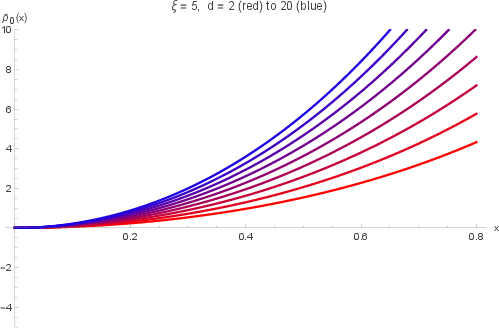
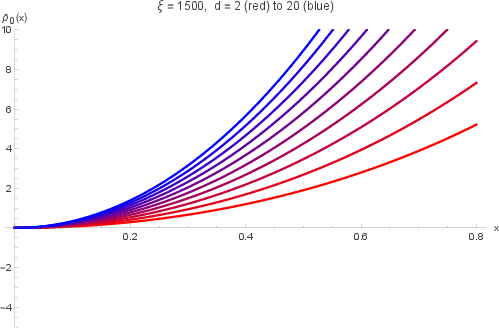
Figure 1: The total scalar density 2tρ0total after including sub-extremal spinning states shows that negativity is lifted for all allowed degeneracies and central charges.
These negative densities violate modular invariance and unitarity and imply that naive pure gravity does not correspond to a consistent CFT2. Existing resolutions—such as adding compact bosons or conical defect states—have only addressed specific portions of the spectrum and typically require additional matter degrees of freedom in the dual.
Prescription: Spinning and Overspinning States
The paper studies the efficacy of including spinning states in three classes:
- Sub-extremal spinning defects: states with ∣M∣>∣J∣, lying below the BTZ bound.
- Extremal spinning defects: states at ∣M∣=∣J∣, saturating the BTZ bound.
- Overspinning states: states with ∣M∣<∣J∣, i.e., above threshold but not black holes.
Sub-extremal and extremal spinning states can be interpreted as conical, or more generally as spinning, defects in the bulk. The overspinning sector is newly interpreted here not as matter-induced strings, but as bulk BTZ geometries with overspinning parameters, which are nonsingular quotients of AdS30 (though with causal pathologies in the Lorentzian section).
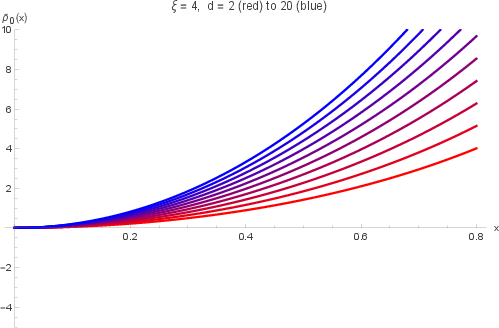
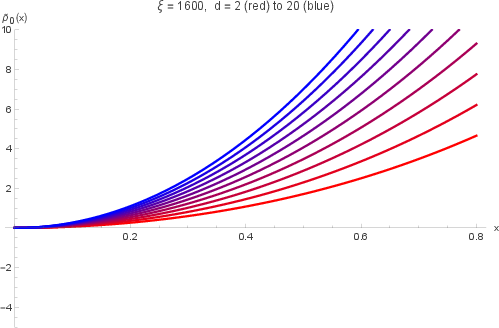
Figure 2: The total scalar density after adding extremal spinning states; positivity is ensured for all displayed central charges and degeneracies.
Positivity, Quantization, and Spectral Impact
When spinning states with carefully chosen quantum numbers and degeneracies are included, the following notable outcomes are established:
- For both the threshold and large-spin negativities, positivity can be restored by adding pairs of spin-parity seeds with conformal weights and spins scaling linearly with the central charge.
- There is an explicit quantization on the central charge AdS31 determined by integer-valued spin constraints: AdS32, AdS33, or AdS34, depending on the sector.
- For sub-extremal and extremal spinning states, there is no upper bound on the additional degeneracy AdS35; the overspinning regime, however, acquires a maximal permitted AdS36 for which positivity is preserved, dependent on AdS37.
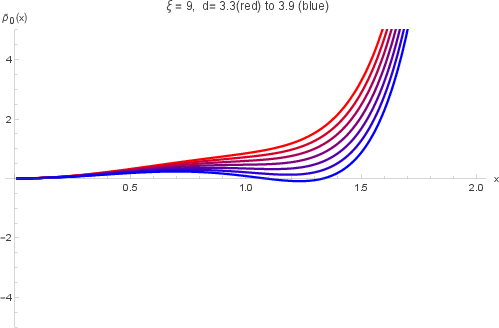
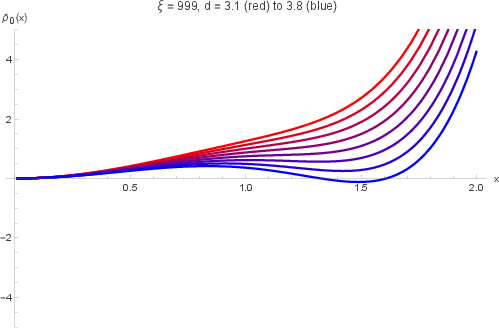
Figure 3: The total scalar density after adding overspinning states. Positivity is lost for AdS38, imposing a bound on maximal allowed degeneracy for the overspinning sector.
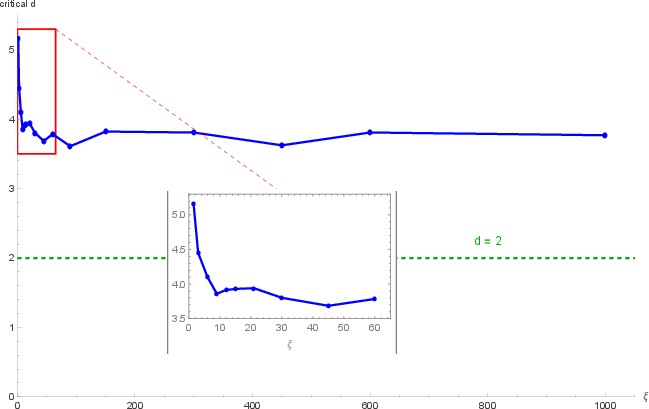
Figure 4: Dependence of the maximum allowed degeneracy AdS39 for positivity of the scalar density as a function of the central charge PSL(2,Z)0. The bound stabilizes at large PSL(2,Z)1.
The additional states lie at specific loci in the PSL(2,Z)2 phase diagram (see discussion and Figure \ref{fig:phase-diagram} in the original paper), and in the overspinning case, they reside precisely above the black hole threshold, preserving the spectral gap.
Bulk Interpretation and Causal Structure
Sub-extremal and extremal spinning states are interpreted as spinning defects—these are quotient geometries of AdSPSL(2,Z)3 with conical singularities (for sub-extremal) or parabolic generator identifications (for extremal), invariably with regions containing closed timelike curves (CTCs). The overspinning states are interpreted as smooth BTZ quotients lacking curvature singularities and supported purely by metric (i.e., no explicit matter), albeit with causal pathologies in Lorentzian signature. The paper adopts the viewpoint (cf. [Witten, (Witten, 2021)]) that such causal violations are admissible in the Euclidean gravitational path integral.
The approach avoids introducing additional non-metric degrees of freedom and keeps the bulk geometries purely gravitational, albeit at the expense of including backgrounds with pathological Lorentzian continuations.
Scalar Correlators and CFT Interpretation
The computation of scalar two-point functions on these backgrounds is addressed in detail. In all cases, the propagators are constructed via appropriate mode sums and method-of-images, and can be matched to sums over Virasoro vacuum blocks in all OPE channels in the dual CFT. This robustly connects the inclusion of spinning states in the spectrum with the universal structure of heavy-light correlators in the holomorphic bootstrap.
In the overspinning sector, the construction proceeds via analytic continuation in the metric's parameters, and despite the presence of complex conjugate horizons, the correlators remain manifestly real due to the structure of the method-of-images sum.
Implications and Further Developments
The results have several notable implications:
- Restoration of Unitarity in the Path Integral: The addition of spinning/overspinning states restores unitarity nonperturbatively in the MWK prescription without introducing unphysical continuous spectra or negative densities.
- Quantization of Gravity's Central Charge: The necessity of certain central charge quantization conditions emerges from the requirement of integer spin and spectral positivity.
- Euclidean Dominance Over Lorentzian Pathologies: Pathological causal structures in Lorentzian signature are unavoidable in these bulk geometries but are relegated to non-physical status in the Euclidean path integral.
- Universality of Vacuum Block Dominance: The resulting two-point correlators on these quotient spacetimes provide universal CFT data, reinforcing the correspondence between gravitational and CFT modular structures even in the presence of defects or nonstandard saddles.
The paper outlines potential future directions, including computations of one-loop determinants on these backgrounds, possible connections with Euclidean JT gravity and matrix integrals, and further clarity on the role of spinning/overspinning geometries in the semiclassical sum over topologies.
Conclusion
This work provides a comprehensive analytic framework for curing known pathologies in the PSL(2,Z)4 gravity partition function by including spinning and overspinning geometries. The resulting spectrum is fully unitary, and the construction naturally respects modular invariance and spectral gap requirements. The analysis sharpens the geometric and CFT understanding of these states, clarifies their role in the quantum gravitational path integral, and highlights compelling directions for the study of three-dimensional quantum gravity and holography.

