- The paper demonstrates that filament linear densities across seven molecular clouds follow a Salpeter-like power-law, confirming a robust statistical link with the stellar IMF.
- The study employs advanced SED fitting and multiscale filament extraction with getsf to quantify median linear densities scaling nearly linearly with spatial resolution.
- The findings imply that hierarchical filament fragmentation underpins the universality of the IMF and informs predictive models of star formation efficiency.
Filament Linear Density Functions and the Salpeter IMF in Nearby Molecular Clouds
Context and Motivation
The stellar initial mass function (IMF), especially its Salpeter power-law slope (ψ=1.35 for dN/dlogM∝M−ψ), represents a fundamental observational constraint in star formation theory. Recent Herschel observations uncovered the dominance of filamentary structures in the mass budget and star-forming activity within molecular clouds, motivating the filament fragmentation paradigm for the origin of dense cores and stellar mass distributions. A direct, robust statistical connection between filamentary linear densities and the IMF slope has remained elusive due to limited multiscale and multi-cloud analyses.
Data, Methods, and Filament Extraction
The study presents a rigorous statistical analysis of the filament linear density function (FLDF) across seven molecular clouds (Taurus, Ophiuchus, Perseus, Orion~A, California, IC~5146, Vela~C), spanning ∼140–920 pc distances and encompassing both quiescent and massive star-formation regimes.
Surface density maps were constructed from Herschel PACS and SPIRE data using spectral energy distribution (SED) fitting (hires algorithm) with corrections for zero-level offsets via Planck data. Filamentary skeletons were extracted with getsf—an advanced multiscale decomposition technique guaranteeing unbiased detection at scales from 14′′ to 216′′, with robust segment-by-segment surface density profile fitting incorporating finite boundary effects.
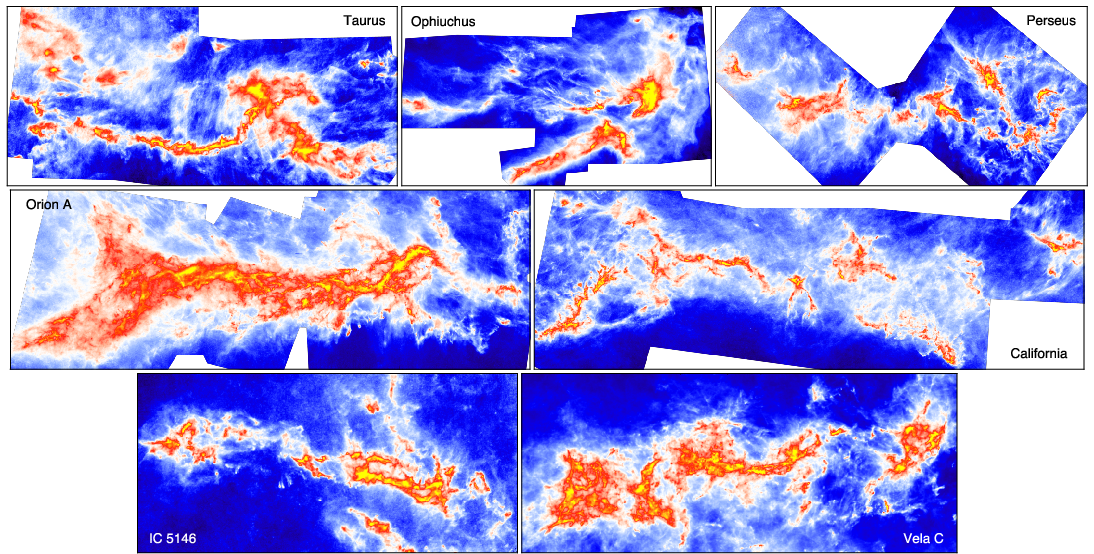
Figure 1: Overview of the seven studied molecular clouds, showing 13.5′′ resolution surface density maps with prominent filamentary networks.
Filament skeletons at multiple scales reveal a hierarchically nested structure, with individual segments providing statistically significant distributions of mass per unit length.
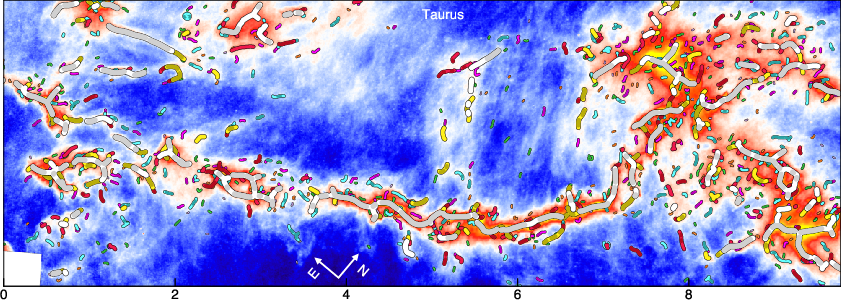
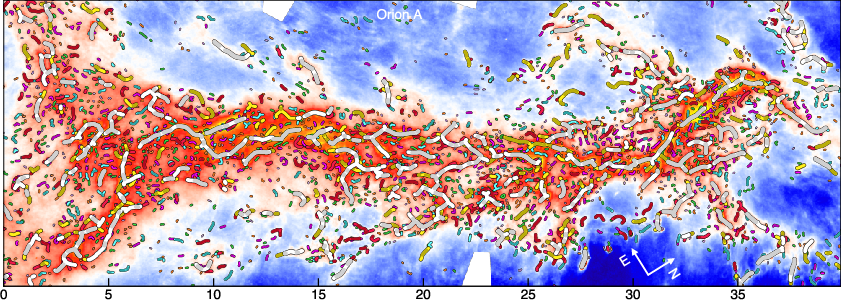
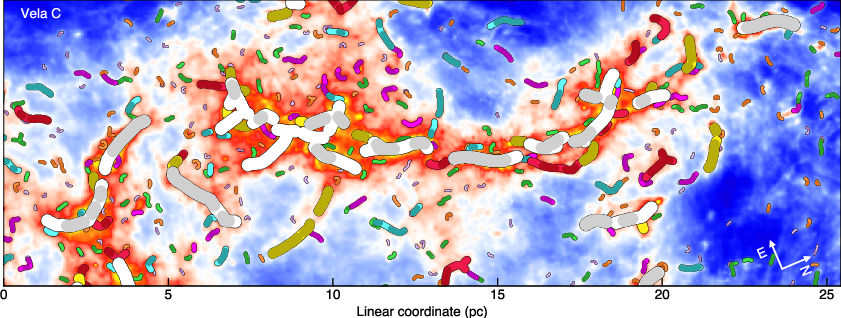

Figure 2: Surface densities in Taurus, Orion~A, and Vela~C, overlaid with multiscale getsf-extracted filament skeletons (14–216′′ scales).
Scale-dependent Linear Density Distributions
A fundamental outcome is the quantification of scale-dependent distributions Λk (mass per unit length) for all segments and filaments:
- Median linear densities (Λ~k) increase nearly linearly with detection scale, Λ~∝Yk1.01±0.18, ranging from dN/dlogM∝M−ψ0\,pcdN/dlogM∝M−ψ1 on dN/dlogM∝M−ψ2 to dN/dlogM∝M−ψ3\,pcdN/dlogM∝M−ψ4 on dN/dlogM∝M−ψ5.
- Composite FLDFs across all scales and clouds follow dN/dlogM∝M−ψ6, with dN/dlogM∝M−ψ7.
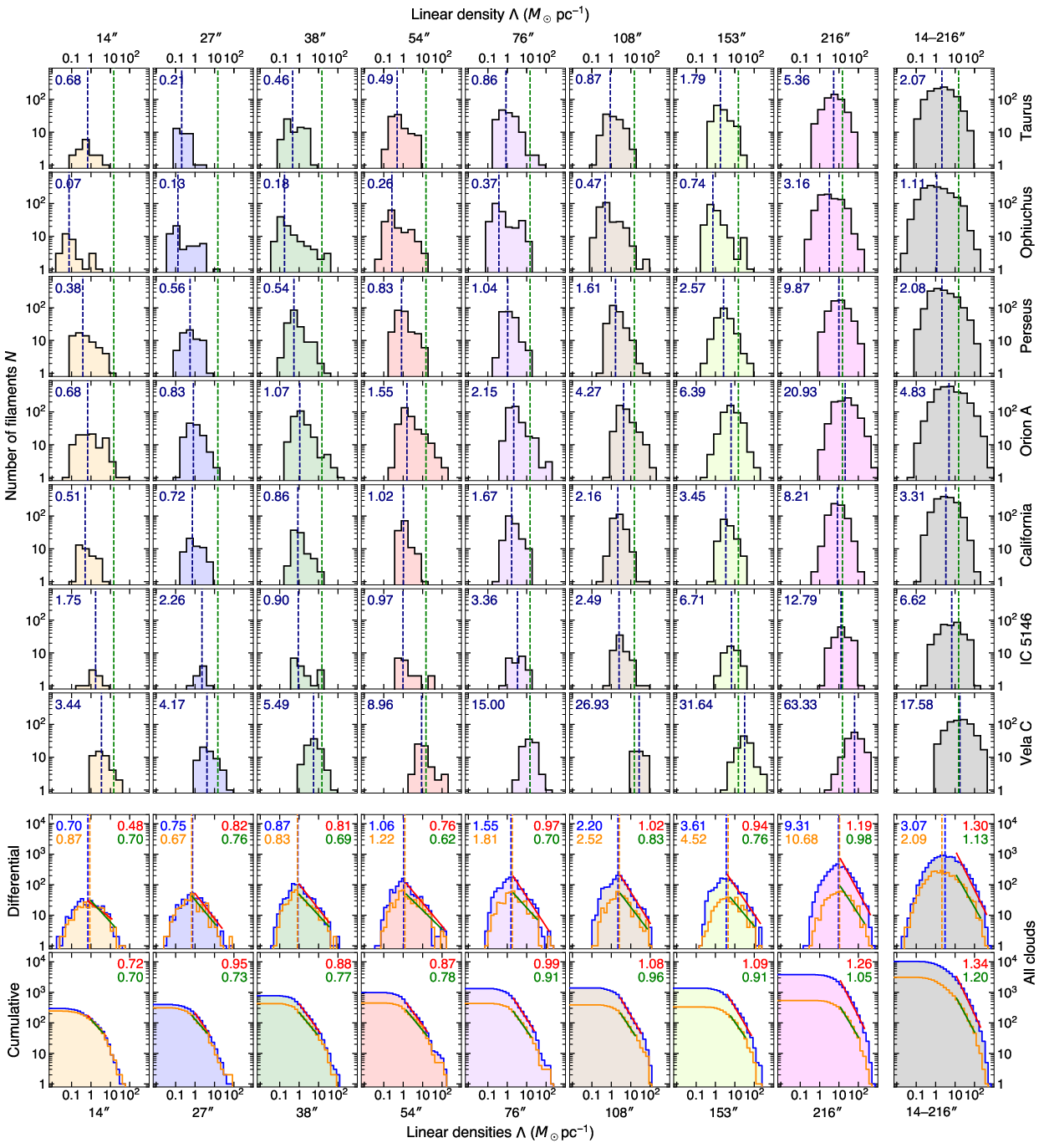
Figure 3: Scale-dependent histogram distributions of dN/dlogM∝M−ψ8 for all filaments and segments, including differential and cumulative forms. Power-law fit slopes are indicated above median thresholds.
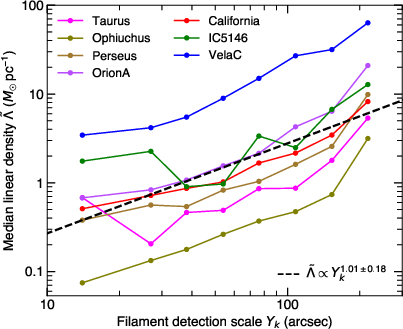
Figure 4: Median linear density dN/dlogM∝M−ψ9 as a function of scale ∼0 for each cloud, highlighting nearly linear scaling.
The cumulative FLDF slope increases with scale, confirming a transition from turbulence-dominated fragmentation (shallower slopes at small scales) to gravity-dominated regimes (steeper, Salpeter-like slopes at large scales).
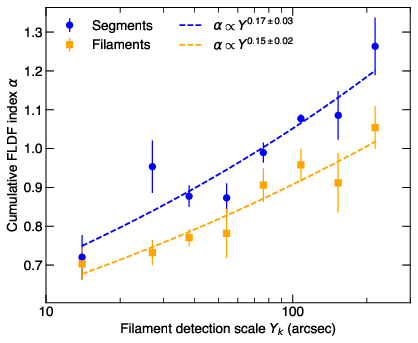
Figure 5: Dependence of the FLDF slope ∼1 on spatial scale ∼2 for both segments and whole filaments; best-fit power-law exponents shown.
Assessment of gravitational stability incorporates the classical criterion, ∼3\,pc∼4 at ∼5 K, with uncertainty margin (∼6 and ∼7) to account for deviations from idealized models.
- The fraction of supercritical filaments (∼8) rises sharply with spatial scale and varies significantly across clouds (e.g., 14\% in Ophiuchus vs. 95\% in Vela~C on ∼9).
- Environmentally, supercritical fractions are directly correlated with indicators of star formation efficiency.
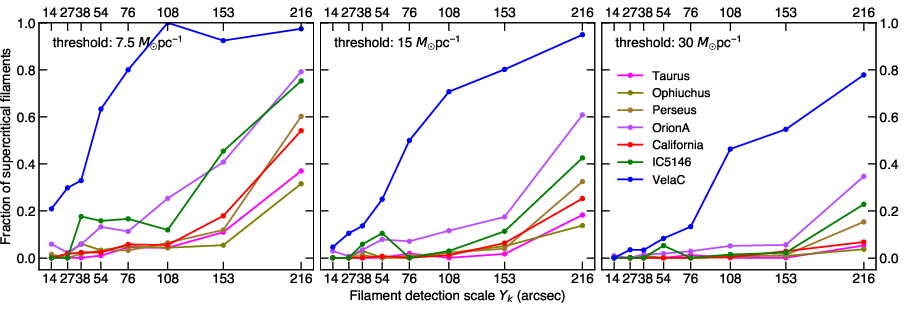
Figure 6: Supercritical fraction of filament segments as a function of scale 14′′0 for different gravitational thresholds, stratified by cloud.
Robustness and Observational Bias Tests
FLDF power-law slopes demonstrate insensitivity to resolution degradation and distance-dependent blending, ensuring observational robustness:
- Across a factor of 14′′1 in cloud distance, measured slopes remain consistent and close to Salpeter.
- Blending only raises measured values of 14′′2, not slope 14′′3.
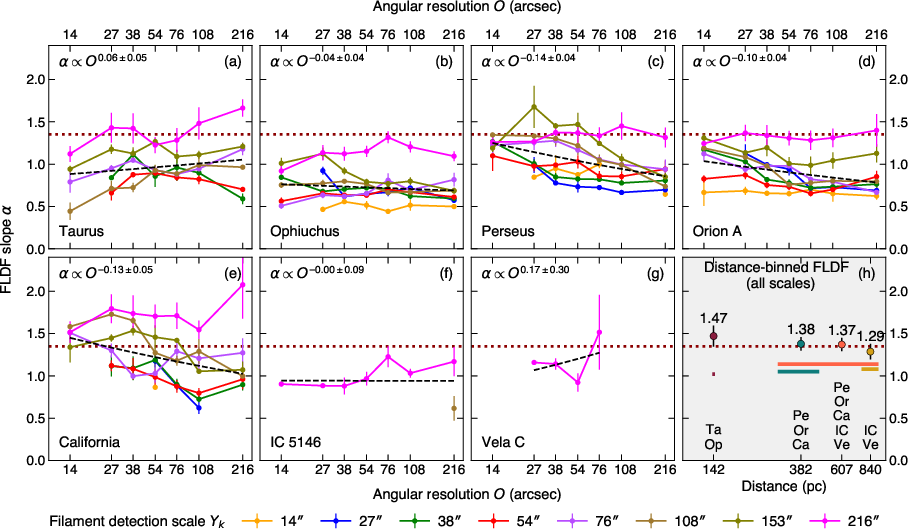
Figure 7: Panels (a–g): FLDF slope 14′′4 as a function of resolution for each cloud; Panel (h): Composite slopes for distance-binned cloud samples, all consistent with Salpeter.
Implications for the Stellar IMF and Core Mass Function
The core mass function (CMF) can be related to the FLDF through fragmentation physics. Under the assumption that fragmentation length 14′′5, the CMF slope is 14′′6.
- Observed scaling of filament width vs. linear density (14′′7) is consistent with 14′′8 in high-mass regions, potentially explaining shallower CMF slopes observed by ALMA-IMF (e.g., 14′′9).
- For 216′′0, fragmentation length is independent of 216′′1, yielding CMF slope matching FLDF, 216′′2.
- Direct simultaneous measurements of FLDF and CMF in the same protoclusters are essential for resolving observed discrepancies at high masses.
The Salpeter-like composite FLDF emerges uniquely from hierarchical filament populations spanning all scales, suggesting universality of the IMF slope is a consequence of integrated, multi-scale gas fragmentation processes rather than from local environmental variations.
Theoretical and Practical Significance
The study provides the first multi-cloud, multiscale measurement confirming a Salpeter-like FLDF, quantitatively validating filament fragmentation paradigms and offering a unified framework linking large-scale filament gas distributions to dense core and stellar mass functions. Observational constraints on the parameter 216′′3 can directly probe fragmentation physics. Practical implications extend to predictive models for star formation rates and efficiencies in galactic environments, as well as refinement of filament detection algorithms.
Future theoretical developments should focus on:
- Joint FLDF–CMF analyses in high-mass star-forming regions.
- Inclusion of magnetic field and turbulence effects in fragmentation physics.
- Integration with simulation-based synthetic observations for calibration.
- Direct investigation of the efficiency variation of fragmentation with linear density.
Conclusion
This work establishes the statistical robustness of a Salpeter-like power-law in filament linear density distributions across diverse molecular clouds. The scaling of median linear density with spatial scale and the emergence of the Salpeter slope only through multi-scale integration provide strong evidence that the IMF's universality is pre-encoded in the filamentary gas structure. These results facilitate the quantitative exploration of fragmentation physics and star formation pathways, bridging large-scale ISM structure and stellar population outcomes (2604.14093).