- The paper presents a novel resonance- and width-aware parton shower evolution scheme that preserves intermediate resonance virtualities during event generation.
- It introduces width-enhanced splitting kernels and dedicated recoil schemes to accurately model finite-width effects near the t-tbar threshold.
- Extensive validation shows improved accuracy in observable predictions and top-quark mass reconstruction, essential for precision studies at future lepton colliders.
Resonance- and Width-aware Parton Shower Evolution and NLO Matching
Introduction and Motivation
This paper presents a novel approach for high-precision Monte Carlo simulation of e+e−→W+W−bbˉ processes, focusing on the region near the top-quark pair production threshold. The core challenge addressed is the accurate modeling of finite-width effects and internal resonance dynamics in parton showers, which are critical for precision top-quark mass measurements anticipated at future electron-positron colliders such as the FCC-ee. Standard parton-shower algorithms inadequately treat resonance dynamics, leading to significant deviations in observable distributions. The authors introduce a resonance- and width-aware evolution scheme within the 0.8 parton shower and event generation framework, enabling next-to-leading order (NLO) matched predictions that properly respect the virtuality of intermediate resonances and account for finite-width effects.
Resonance-aware Parton Shower Evolution
In traditional parton shower algorithms, QCD radiation from decay products can shift the virtuality of intermediate propagators, violating the condition that the resonance’s mass distribution remains unchanged. The resonance-aware approach resolves this by carefully partitioning the radiative phase space and using dedicated recoil schemes so that radiation off decay products of a resonance conserves its virtuality.
The authors exploit the flexibility in the auxiliary recoil vector n used in the scalar emission kernel, enabling preservation of resonance assignments during momentum reshuffling. For emissions originating from top decay products, the recoil is assigned entirely within the identified resonance, avoiding spurious contamination between distinct resonance systems. This scheme extends prior resonance-aware NLO matching techniques by systematically maintaining resonance virtuality during event evolution.
Width-aware Evolution Near Threshold
Near the ttˉ production threshold, finite-width effects manifest as nontrivial modifications to the QCD radiation pattern—especially in the soft and collinear regimes. The authors derive width-enhanced splitting kernels, motivated by analytical studies of threshold behavior and interference effects. These kernels interpolate between standard dipole radiation patterns and those governed by the Breit-Wigner resonance structure, regulated by the kernel χ(z), which encapsulates the impact of finite top width on gluon emission probabilities.
This width-aware extension becomes fundamental in the threshold region: ignoring these effects results in order-one deviations in the modeling of the differential rate for e+e−→W+W−bbˉ, particularly for gluon transverse momenta comparable to Γt. The implementation ensures that radiation from color-connected decay products is suppressed away from their respective hemispheres, in accordance with physical expectations.
NLO Matching and Infrared Subtraction
The resonance- and width-aware kernels are analytically integrated for fixed-order NLO calculations, yielding subtraction terms compatible with Catani-Seymour dipole factorization. The authors provide explicit expressions for these integrated counterterms, including the width-dependent finite remainder. The subtraction scheme achieves sub-permille-level accuracy in inclusive cross sections, demonstrating numerical stability and consistency across all subtraction variants.
Phenomenological Validation
The method is validated through a comprehensive set of parton-level and NLO-matched observables. Cross-section contributions using various subtraction schemes are shown to agree to high precision, establishing the reliability of the modified evolution algorithms.
The rapidity of the first parton-shower emission in the Lund plane, defined by the b and bˉ quarks, illustrates the distinct radiation patterns predicted by the width-aware approach. For all-gluon energies, central enhancements and suppressed emissions in the opposite hemisphere are evident. The energy window around Γt highlights a transition region where the radiation pattern interpolates between dipole and resonance-driven behavior, notably affecting the number and distribution of additional jets.
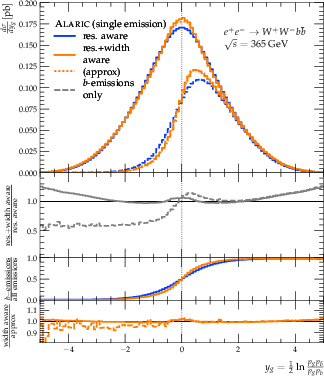
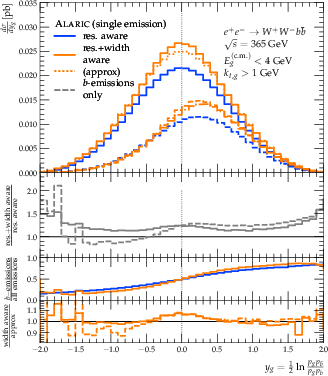
Figure 1: Comparison of Lund-plane rapidity of the first parton-shower emission in standard, resonance-aware, and width-aware evolution algorithms.
A further diagnostic employs NLO-matched distributions, reconstructing the top-quark mass and gluon-jet rapidity in exclusive jet clustering. The resonance- and width-aware matched showers predict enhanced tails in the reconstructed mass distribution and central rapidity enhancements, in contrast with the fixed-order depletion and the default kernel's incoherent radiation pattern. The width-aware scheme uniquely preserves the expected behavior of independent radiation from each b-quark, aligning closely with fixed-order predictions in the relevant phase space.
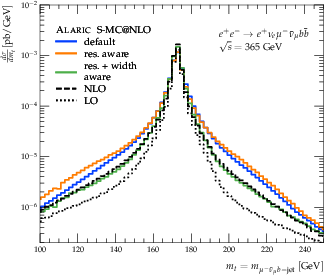
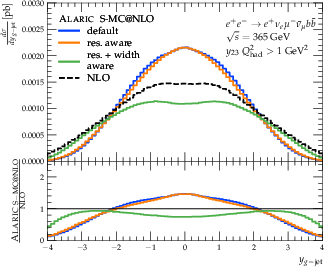
Figure 2: Comparison of NLO-matched predictions for reconstructed top-quark mass and gluon-jet rapidity in standard versus resonance- and width-aware matching schemes.
Additionally, the paper examines leptonic n0 decays, where observable distributions such as visible anti-top mass and angular separation between gluon jet and lepton manifest the distinctive modeling effects. The width-aware kernels reduce the incidence of additional jets and accurately reproduce shape features associated with resonance virtuality dynamics, underscoring the practical necessity of width-aware evolution for future high-precision measurements.
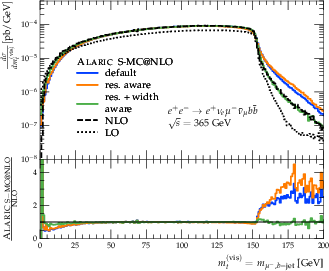
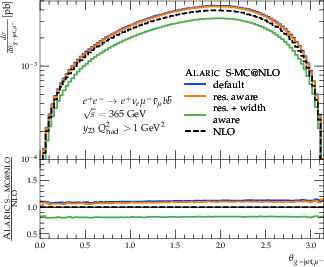
Figure 3: Comparison of NLO-matched predictions with leptonic n1 boson decays, highlighting effects on visible anti-top mass and gluon-lepton angular separation.
Theoretical and Practical Implications
The resonance- and width-aware methodology fundamentally improves the theoretically consistent description of internal resonances in parton shower evolution, critically supporting infrared-safe NLO matching. These advancements are directly aligned with the anticipated requirements for precision top-quark mass determination and related electroweak observables at next-generation lepton colliders.
Practically, the formalism is generalizable to broader categories of processes exhibiting internal resonance structures, such as top quark production and decay at hadron colliders, provided proper resonance identification. Limitations discussed include the requirement of being sufficiently near, but not too close, to the threshold such that Coulomb effects and n2 terms can be neglected. Future theoretical development may incorporate full NLO decay treatments, QED effects, and threshold resummation (cf. Ref. [Bach:2017ggt]).
Conclusion
The paper establishes a rigorous framework for resonance- and width-aware parton shower evolution, coupled with NLO matching, achieving unprecedented accuracy in the modeling of processes with internal resonances. Strong numerical results confirm the precision, and the theoretical construction provides a robust point of departure for future developments in MC event simulation, critical for collider phenomenology and the extraction of fundamental parameters in the Standard Model. The resonance- and width-aware paradigm is pivotal for achieving the level of accuracy demanded by current and upcoming experimental programs, such as the FCC-ee, and sets a practical standard for future parton shower algorithms.