- The paper establishes NP-hardness for pinwheel scheduling using a 3,4-SAT reduction that enforces a density-1 condition.
- It introduces an efficient PTAS that partitions jobs into big, medium, and small using scale separation and periodic partitioning.
- Results extend to related scheduling domains, offering constructive solutions and advancing theory in recurrent resource allocation.
NP-Hardness and PTAS for the Pinwheel Problem
Problem Definition and Historical Context
The pinwheel scheduling problem entails partitioning an m-tuple of positive integers (a1,…,am) into m color classes C1,…,Cm such that every interval of length ai contains at least one element from Ci, for each i in [1,m]. This models a rhythmic scheduling scenario where each task i must be executed at intervals not exceeding ai. The problem encapsulates a broad family of applications, including periodic machine maintenance, packet scheduling in networks, spaced educational repetition, security games, and recurrent resource allocation. Despite decades of study and its centrality to algorithmic scheduling, the computational complexity of the pinwheel problem remained unresolved. Prior to this work, only the exact-period variant and finitely many-scheduling variants had been established as NP-hard. Whether schedulability with general periods admits polynomial-time algorithms was an open question.
Main Results: NP-Hardness and Efficient Approximation
NP-Hardness of Pinwheel Scheduling
The paper establishes, for the first time, that the pinwheel scheduling problem is NP-hard. The proof employs a substantial reduction from the 3,4-SAT problem, a bounded-occurrence version of 3-SAT, exploiting the ability to map variable and clause assignments to job periods and subschedules. Careful "padding" strategies ensure that the constructed instances always have density (a1,…,am)0, i.e., (a1,…,am)1, which is crucial for completeness and for reductions to related scheduling problems.
The reduction necessitates filling variable subschedules with polynomially many jobs, requiring intricate enumeration and combinatoric handling to avoid exponential blowup.
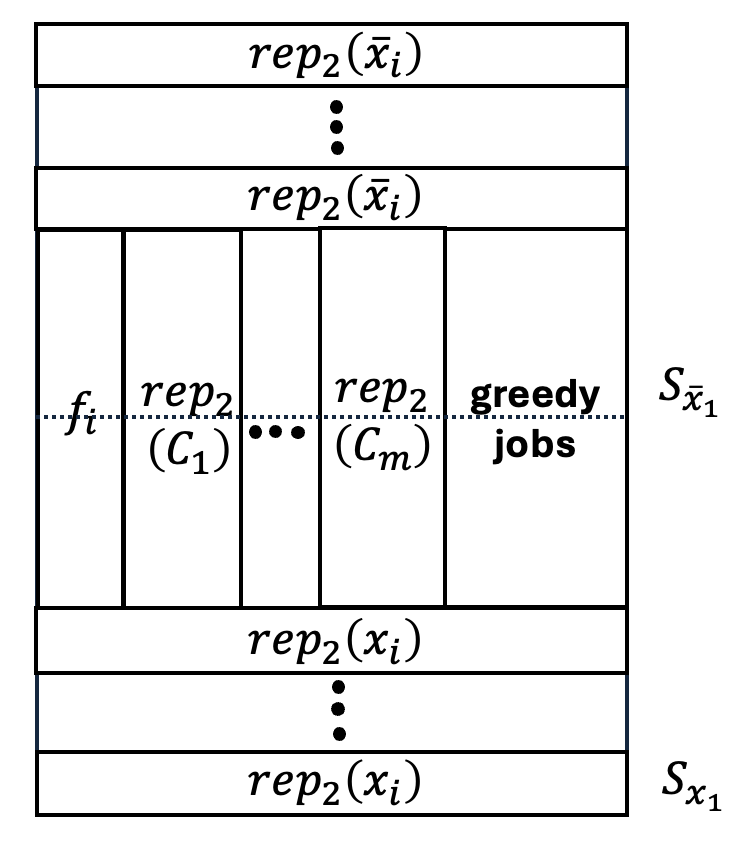
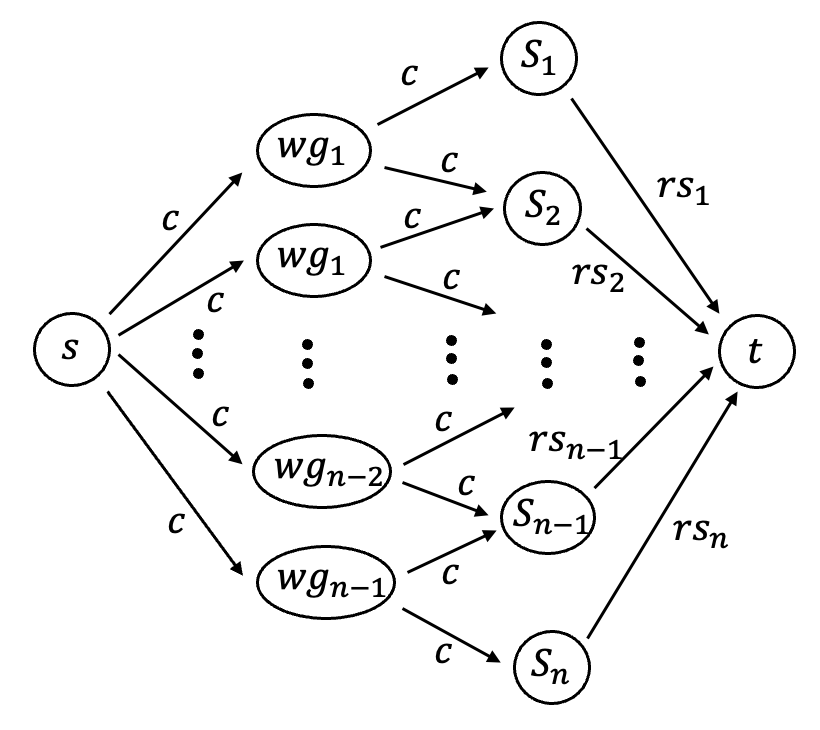
Figure 1: Greedy job additions fill up variable subschedules.
Further, a "warm greedy" addition step facilitates leaving precisely the amount of density needed for clause jobs, ensuring that the completeness and soundness of the reduction hold even under translations of SAT assignments to pinwheel schedules.
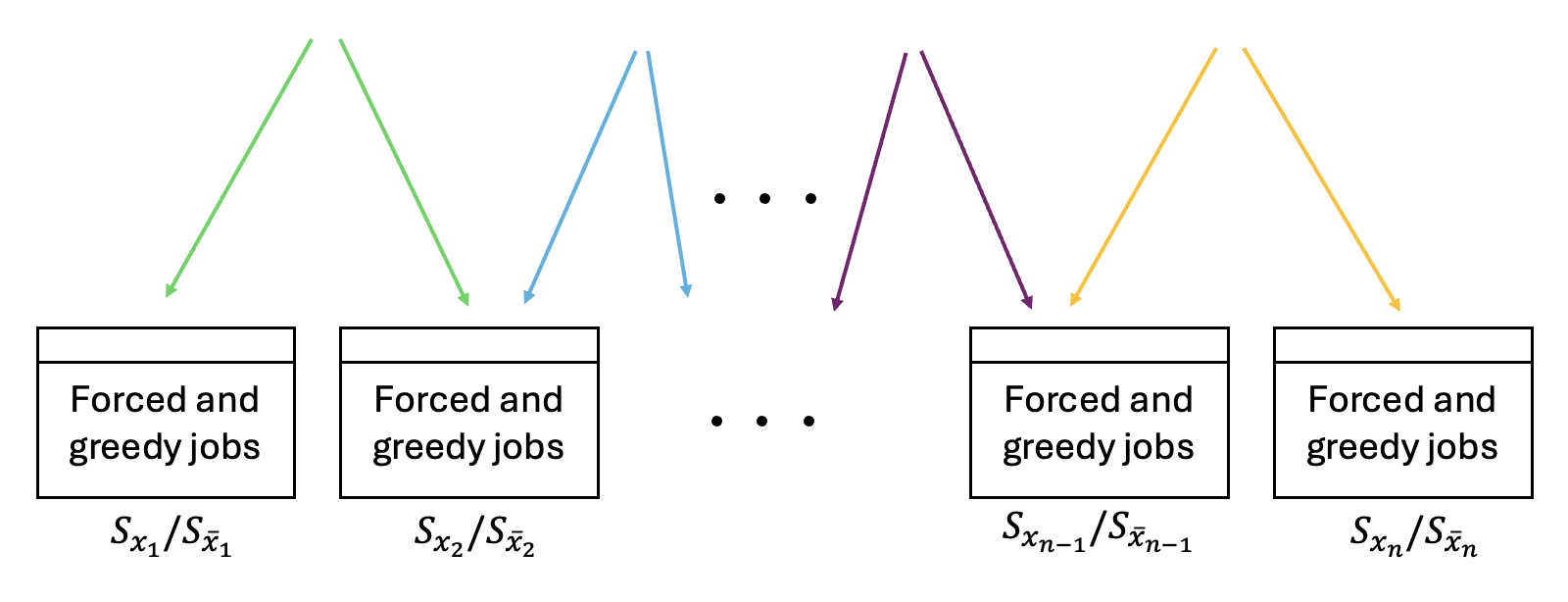
Figure 2: Warm Greedy Job Addition, showing density allocation for clause jobs.
This approach enables NP-hardness proofs for the pinwheel problem, as well as secondary results for related domains including pinwheel covering, bamboo garden trimming (BGT), windows scheduling (including both migration and non-migration variants), recurrent scheduling, and the constant gap problem. Many of these inherit the density-1 property from the reduction, yielding NP-completeness in their respective dense instances.
Polynomial-Time Approximation Scheme (PTAS)
On the algorithmic front, the paper provides, for each (a1,…,am)2, a PTAS (in fact, an Efficient PTAS) for the decision version of the pinwheel problem: given an instance (a1,…,am)3, decide whether it is unschedulable or whether (a1,…,am)4 is schedulable. The PTAS partitions jobs into big, medium, and small, based on period thresholds that depend on (a1,…,am)5. It exhaustively enumerates cyclic schedules for big jobs, leveraging periodicity and density computations to test for existence of sufficiently many "holidays" (idle slots) in the schedule to accommodate medium and small jobs. Medium jobs are placed using the fold operation (from Kawamura), and small jobs' schedulability is certified by density theorems concerning large period instances.
This algorithm is constructive and yields efficient representations of schedules in cases where instances are schedulable. The achieved approximation factor (a1,…,am)6 surpasses previous best results, which were limited to (a1,…,am)7 (2604.13974).
Strong Numerical Guarantees
- PTAS achieves approximation arbitrarily close to 1 for the decision version: for any (a1,…,am)8, either the instance is unschedulable, or a schedule for (a1,…,am)9 can be constructed in m0 time.
- The reduction ensures the NP-hardness of dense instances (m1), hence results extend to constant-gap and optimal-parameter variants of related scheduling problems.
Technical Insights
The hardness reduction introduces several innovations:
- Utilization of 3,4-SAT enables polynomial bound on periods and multiplicities.
- Allowed-periods enumeration, greedy and warm greedy assignment algorithms, and density flow analysis collectively guarantee that the reduction does not require exponentially many jobs; thus, the resulting reduction is polynomial-time.
The PTAS employs scale-separation, periodic partitioning, and density-based feasibility tests, aided by the fold operation to handle jobs of intermediate periods. The efficacy relies on bounding the number of big/medium tasks and exploiting density properties for large period jobs—building on deep structural results for pinwheel scheduling and covering.
Implications for Theory and Practice
The formal NP-hardness proof solidifies the long-suspected computational intractability of pinwheel scheduling. This immediately transfers to a swath of related scheduling and covering problems, closing several outstanding complexity questions in algorithmic scheduling theory. The density-based reduction technique presents a template for further reductions in scheduling domains where density is a central feasibility constraint.
On the positive side, the PTAS opens efficient scheduling for practical, near-optimal settings where precise schedulability is unattainable, but small period inflation is tolerable. The explicit constructive nature of the PTAS schedule makes it suitable not only for theoretical feasibility tests but also for implementations in networked systems, maintenance protocols, and educational review planning.
Future Directions
Anticipated avenues include:
- Tight complexity-theoretic boundaries for variants with real-valued or fractional periods.
- Structure refinement for periodicity and density thresholds, potentially leading to faster fixed-parameter algorithms in special cases, or improved density bounds for related patrolling/covering tasks.
- Application-driven extensions examining robustness to period perturbations and randomization.
- Algorithmic frameworks combining the folding technique and enumeration with online scheduling and learning-theoretic models.
Conclusion
This work resolves the computational status of pinwheel scheduling, affirming its NP-hardness and providing the first PTAS for the approximate decision version. The reduction techniques and algorithmic strategies introduced expand the theoretical landscape of periodic scheduling problems, providing both hardness results and efficient practical scheduling methods for a diverse class of resource allocation and maintenance tasks. The implications touch a broad spectrum of scheduling models, and the techniques are primed for further generalization and practical application.

