Divisible sandpiles via random walks in random scenery
Published 15 Apr 2026 in math.PR | (2604.13968v1)
Abstract: We analyze an optimal stopping problem for random walk in random scenery on general graphs, and determine when it has a finite optimum. We use this to extend a theorem of Levine, Murugan, Peres, and Ugurcan [2016]. They proved that on a vertex-transitive graph, the divisible sandpile with i.i.d. initial masses of mean μ stabilizes almost surely if $μ< 1$, explodes if $μ> 1$, and explodes if μ=1 with positive finite variance. Their proofs rely on conservation of mean mass under toppling. This conservation extends to unimodular random graphs, but fails on general graphs. We prove explosion for all infinite bounded-degree graphs whenever μ≥1, and stabilization for $μ<1$ provided the initial masses have finite p-th moment for some $p>3$. Our conditions are nearly sharp: we exhibit unbounded-degree graphs on which sandpiles with $μ> 1$ stabilize, and for every $p < 3$ we construct bounded-degree graphs on which sandpiles with~$μ< 1$ and finite p-th moment explode.
The paper demonstrates a complete random walk representation of the odometer function, linking mass redistribution in sandpiles to an optimal stopping problem.
It establishes sharp phase transitions, showing explosion when the mean meets or exceeds 1 under variance conditions, and stabilization for mean below 1 with sufficient moment bounds.
The analysis extends previous results from vertex-transitive graphs to general infinite, bounded-degree graphs, incorporating counterexamples that reveal the optimal moment threshold.
Divisible Sandpiles via Random Walks in Random Scenery: An Expert Analysis
This essay provides an in-depth technical summary and analysis of the paper "Divisible sandpiles via random walks in random scenery" (2604.13968), focusing on its primary results, methodologies, sharpness constructions, and implications for the broader study of sandpile models and random processes on graphs.
Background and Model Formulation
The divisible sandpile model on a graph G=(V,E) generalizes the abelian sandpile model by assigning continuous, rather than discrete, masses to vertices. A vertex with mass σ(v)>1 topples by retaining mass $1$ and redistributing the excess equally among its neighbors. The process is iterated in parallel across all unstable vertices. A central question is when a configuration stabilizes (i.e., the process terminates with no further topplings), especially when the masses are infinite in total (e.g., i.i.d.\ assignments with E[σ]=μ). The paper extends the sharp characterization of stabilization and explosion previously known for vertex-transitive graphs to general infinite, connected, locally finite graphs, particularly focusing on bounded-degree cases.
Main Results: Sharp Phase Transitions and Random Walk Representation
General Framework
The central advancement is the complete random walk representation of the odometer function, which tracks the total mass emitted by each vertex up to stabilization (or explosion). The odometer at a vertex can be expressed as an optimal stopping problem for a random walk in the i.i.d.\ random field (the "scenery") given by excess masses ξ(v)=σ(v)−1:
u∞(x)=τ boundedsupEx[k<τ∑deg(Xk)ξ(Xk)ξ].
This refines and generalizes the approach previously limited by reliance on global mass conservation, which fails on non-symmetric graphs.
Phase Transition Theorem
Let G be an infinite, bounded-degree graph. Let (σ(v))v∈V be i.i.d. random variables with mean μ.
Explosion (Non-stabilization):
If μ>1, then stabilization occurs with probability zero.
If σ(v)>10 and either σ(v)>11, or σ(v)>12 is symmetric and σ(v)>13, then stabilization occurs with probability zero.
Stabilization:
If σ(v)>14 and there exists σ(v)>15 with σ(v)>16, then the sandpile stabilizes almost surely; moreover, quantitative control on the odometer's moments is obtained.
If, additionally, σ(v)>17 for all σ(v)>18 and σ(v)>19, then stabilization holds under the optimal corresponding moment condition.
Sharpness is emphasized:
For each $1$0, explicit construction of a bounded-degree graph and i.i.d.\ law (bounded below, mean $1$1, finite $1$2-th moment) results in almost sure explosion (Theorem~\ref{thm:transient-nonstab}, Theorem~\ref{thm:recurrent-nonstab}).
Bounded degree is essential: there exists an unbounded-degree, locally finite tree where any i.i.d. law with finite mean stabilizes, even for $1$3 (Lemma~\ref{ex:counterexample}).
Visual Demonstrations of the Sharpness Phenomena
The interaction between graph geometry and moment conditions for stabilization is visually evident in the provided figures.
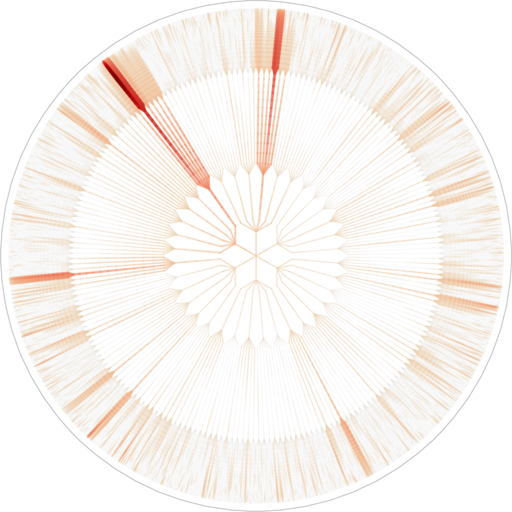
Figure 1: Approximation of the odometer on a tree-of-pipes graph, visualizing the mass cascade effect leading to explosion under a heavy-tail fluctuation even with subcritical mean. The structure is embedded in the Poincaré disk, with deeper pipes indicating vertices of high degree near the boundary.
Here, for mean $1$4, stabilization fails almost surely when only finite $1$5-th moment with $1$6 is assumed. A single large fluctuation near the boundary is sufficient to cause an inward cascade and odometer blowup at the root.
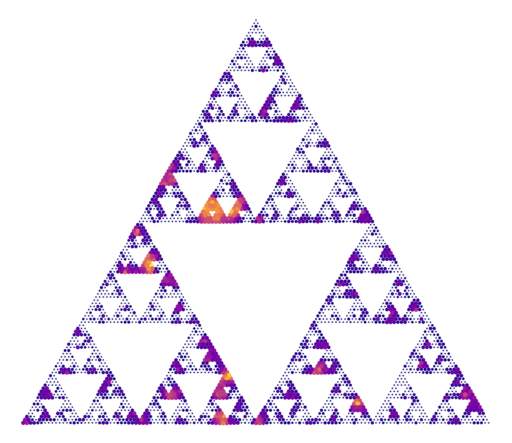
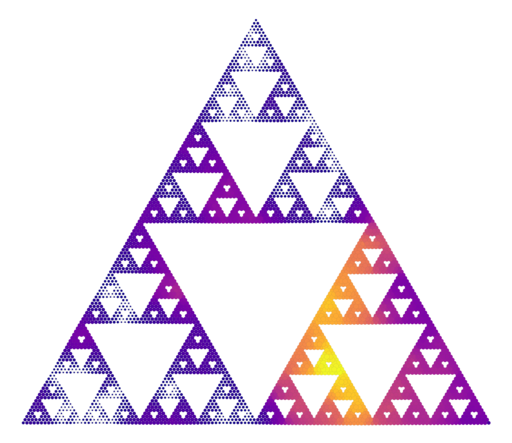
Figure 2: Odometer $1$7 on the Sierpiński gasket (level 6) under i.i.d.\ exponential initial masses, with graphical distinction between subcritical ($1$8) and critical ($1$9) phases. Node color/size is proportional to E[σ]=μ0.
This demonstrates the stationary random rooting property of the fractal, where the critical mean separates almost sure stabilization from explosion, aligning with general phase transition theorems established in the paper.
Methods: Random Walks, Green Functions, and Optimal Stopping
The core machinery is the innovative reduction of stabilization analysis to an optimal stopping problem for random walks in random scenery. The walk payoff decomposes into a deterministic "drift" proportional to E[σ]=μ1, and a fluctuation term based on the local times of the walk and centered excess mass:
E[σ]=μ2
The transition regimes are:
Supercritical (E[σ]=μ3): Positive drift dominates; the walk's reward grows linearly.
Critical (E[σ]=μ4): The drift vanishes; explosion must follow from variance growth in scenery-weighted local times (with two cases: doubly transient – bounded E[σ]=μ5 Green function, and non-doubly transient – unbounded).
Subcritical (E[σ]=μ6): Negative drift; the walk must stop quickly. Concentration inequalities and fine local time control are essential for moment bounds and stabilization.
Notably, the convexity of the value functional facilitates a reduction from the general (possibly infinite variance) symmetric case to the finite-variance case, enabling sharp statements without extra integrability assumptions under symmetry (Proposition~\ref{prop:convexity-reduction}).
An equally critical methodological advance is the characterization of sharpness via counterexamples with precise electrical network analysis (via voltage and Green function estimates) and explicit heavy-tailed constructions embedded in geometric structures tailored to defeat stabilization.
Sharpness and Counterexample Constructions
The authors construct bounded-degree graphs (notably "tree-of-pipes" graphs) where, for any E[σ]=μ7, there exist i.i.d. laws with finite E[σ]=μ8-th moment and mean less than E[σ]=μ9 for which explosion is almost sure—proving the near-optimality of their ξ(v)=σ(v)−10 stabilization threshold. This demonstrates that local geometry and network structure can amplify the effect of a single heavy mass, and that the infinite i.i.d. tail (not the mean alone) drives instability in high-volatility environments even when the drift is negative.
Broader Theoretical and Practical Implications
These results refine the understanding of self-organized criticality and stabilization in sandpile models, particularly beyond highly symmetric (transitive) structures. The random walk representation methodology is robust and immediately suggests further generalizations and applications:
Obstacle problems: The developed framework connects the odometer to discrete nonlinear potential theory and obstacle problems, suggesting analogs in resource allocation and load balancing networks.
Other interacting particle systems: The phase transition nature of the stabilization/explosion dichotomy parallels phenomena in activated random walks and other models with conservative local interactions.
Graph-theoretic thresholds: The precise role of geometric exponents (ξ(v)=σ(v)−11, ξ(v)=σ(v)−12, ξ(v)=σ(v)−13), as well as volume growth and heat kernel bounds, incentivizes further work on universality and the detailed dependence on underlying graph geometry.
Open Problems and Directions
The paper identifies several open problems with potentially far-reaching consequences in discrete probability and interacting particle systems:
Critical regime without finite variance or symmetry: Does explosion always occur at ξ(v)=σ(v)−14 with infinite variance and no symmetry?
Exact endpoint behavior: Is stabilization possible at the boundary exponents (e.g., ξ(v)=σ(v)−15) on all bounded-degree graphs?
Relaxation of the i.i.d.\ condition: What are the minimal regularity constraints necessary for these sharp phase transitions?
Conclusion
This paper resolves the phase diagram for stabilization and explosion in divisible sandpiles with i.i.d. initial mass on broad classes of infinite graphs, using a sophisticated mixture of probabilistic and electrical analytic methods. The identification of nearly sharp moment thresholds, the resolution of the necessity of bounded degree, and the random walk representation constitute significant advances. The introduced techniques are immediately applicable to further study of sandpiles, related aggregation models, and optimal stopping in random media, opening new avenues for exploration in non-equilibrium statistical mechanics and discrete probability.