- The paper establishes a unified minimax lower-bound framework that quantifies the variance dichotomy in continuous simulation optimization.
- It demonstrates that, under low noise and limited budget, simulation optimization mimics deterministic performance, whereas higher noise or larger budgets reveal stochastic scaling.
- The analysis exposes the critical role of function shape parameters and dimensionality in determining convergence rates and guiding algorithm design.
Minimax Lower Bound Analysis of Variance Dichotomy in Continuous Simulation Optimization
Introduction
The paper "Understanding the Variance Dichotomy in Continuous Simulation Optimization: A Minimax Lower Bound Perspective" (2604.13965) elucidates the intricate relationship between noise variance and complexity in Continuous Simulation Optimization (CSO) via a unified minimax lower-bound framework. The authors rigorously investigate the dichotomous convergence regimes arising from deterministic (σ2=0) and stochastic (σ2>0) settings, challenging the conventional wisdom that variance magnitude only affects constant factors in algorithmic rates. By introducing tight lower bounds that capture both variance-dependence and independence, the work provides a comprehensive theoretical lens for algorithm evaluation and practical deployment in finite simulation budget regimes.
CSO considers stochastic optimization problems where the objective function y(x)=E[Y(x,ω)] can only be accessed through noisy simulation. The feasible space X is assumed compact, and noise follows a σ-subgaussian distribution, with both deterministic and stochastic cases considered (σ2≥0).
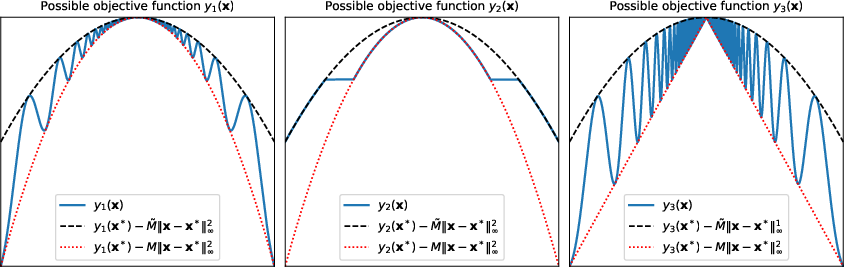
Function shape is characterized via two parameters: α (local smoothness) and β (flatness around the optimum), yielding the envelope:
M~∥x∗−x∥∞β≤∣y(x∗)−y(x)∣≤M∥x∗−x∥∞α.
This abstraction accommodates strongly concave, globally smooth, and irregular objectives, enabling sharp adaptation of bounds to instance difficulty.
Variance Dichotomy: Empirical and Analytical Evidence
The classical analysis posits that stochastic CSO converges at polynomial rates, typically O(n−1/2), insensitive to noise variance, while deterministic CSO achieves exponentially fast convergence, e.g., σ2>00. However, finite-budget empirical studies (see optimization error trajectories) reveal a nuanced regime-switch: at low variance and limited budget, stochastic CSO mimics deterministic performance, but as budget grows, noise dominates and convergence aligns with stochastic lower bounds.
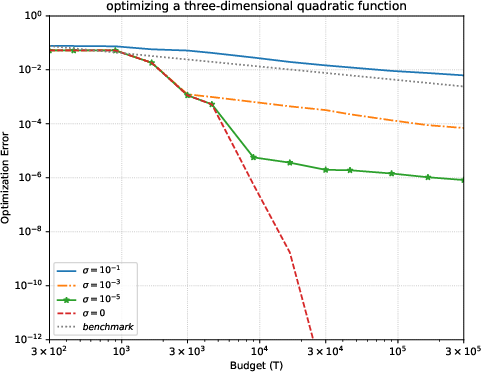
Figure 1: Optimization error as a function of simulation budget under varying noise variance, illustrating the deterministic-to-stochastic regime transition.
Minimax Lower Bounds: Core Results
The analytical centerpiece is the establishment of minimax lower bounds, expressed as:
For σ2>01:
σ2>02
For σ2>03:
σ2>04
Key implications:
Numerical Experiments
Synthetic CSO experiments are performed using both polynomial and oscillatory objectives, across multiple dimensions and noise levels. Algorithms such as StroquOOL, GASSO, Uniform Search, KWSA, and STRONG are benchmarked.
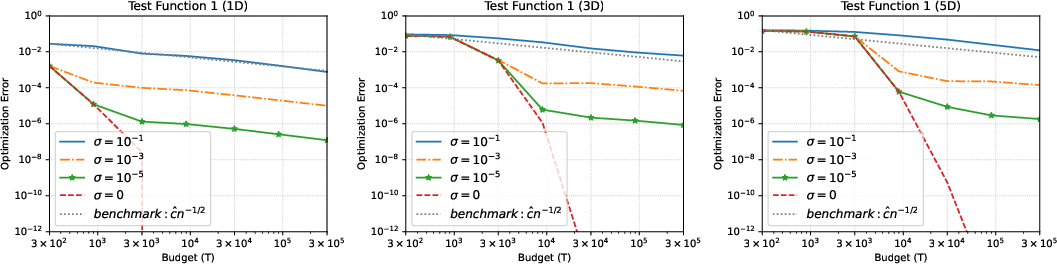
Figure 3: Optimization errors for y(x)=E[Y(x,ω)]0 across multiple algorithms and noise variances, demonstrating empirical regime switching.
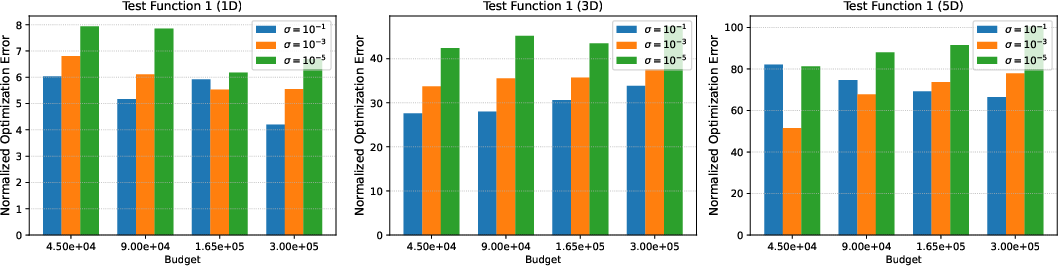
Figure 4: Normalized optimization errors for y(x)=E[Y(x,ω)]1 confirming joint dependence on budget and variance consistent with variance-dependent lower bounds.
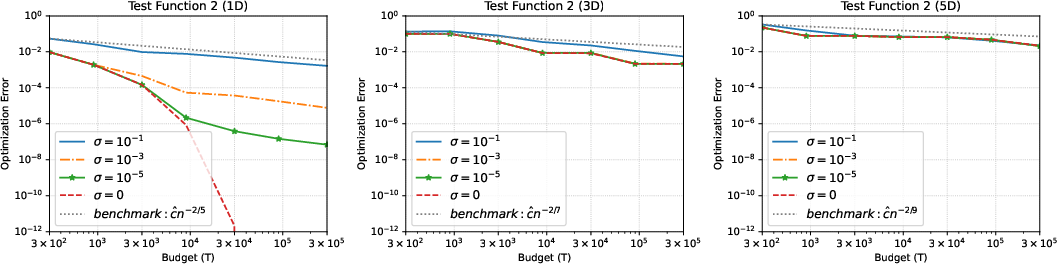
Figure 5: Optimization errors for oscillatory y(x)=E[Y(x,ω)]2 function (y(x)=E[Y(x,ω)]3) illustrating adverse dimensional scaling in stochastic regime.
These results strongly validate the predicted variance dichotomy, with random search methods empirically adapting favorably to variance magnitude. Notably, for low variance and small y(x)=E[Y(x,ω)]4, performance remains close to deterministic, but switches to stochastic scaling for larger y(x)=E[Y(x,ω)]5 or higher y(x)=E[Y(x,ω)]6.
Practical and Theoretical Implications
- Algorithm Design: The minimax bounds suggest algorithms should be adaptive to noise level and budget regime, emphasizing exploration over variance reduction in low-y(x)=E[Y(x,ω)]7, finite-budget CSO.
- Dimensionality: Exponential and polynomial minimax bounds starkly expose the curse of dimensionality (y(x)=E[Y(x,ω)]8), impacting attainable regret rates in stochastic and deterministic cases—high-dimensional CSO remains fundamentally hard.
- Variance estimation: Bounds justify focusing on joint budget-variance allocation, rather than variance reduction alone, particularly for surrogate modeling or tree-based methods.
- Future Directions: Extension to settings with unknown noise levels, refined smoothness (local vs global), and kernel/bandit-based CSO is warranted. Matching exponential convergence constants and optimality proofs under broader conditions are open challenges.
Conclusion
This paper rigorously formalizes the variance dichotomy in CSO, demonstrating that the effective complexity is the maximum of variance-dependent and variance-independent lower bounds. The theoretical insights, validated numerically, have direct implications for adaptive algorithm design and performance benchmarking in practical finite-budget settings. The unified minimax perspective bridges asymptotic and finite-sample behaviors, offering a powerful analytic tool for future advances in simulation optimization.