- The paper demonstrates that independent tuning of band filling and bandwidth significantly affects superconducting onset and density-wave instabilities in bilayer nickelates.
- It employs high-resolution STEM, EELS mapping, and pressure-dependent transport measurements to systematically correlate structural distortions with electronic phase evolution.
- Results show that dopant-induced modulation of lattice distortion optimizes superconductivity, providing new design pathways for correlated oxide superconductors.
Control of Band Filling and Band Width in Nickelate Superconductors
Background and Motivation
The recent surge of interest in bilayer nickelate superconductors, particularly La3Ni2O7 (3), has prompted a thorough investigation of their electronic structure and unusual superconducting properties. These compounds exhibit ambient-pressure antiferromagnetic states and high superconducting onset temperatures under pressure, suggesting unconventional pairing mechanisms possibly distinct from cuprates. The Ruddlesden-Popper (RP) structure enables independent tuning of electronic band width (via isovalent substitution) and band filling (via aliovalent doping), which provides a robust platform for systematic exploration of the interplay between lattice structure, charge carrier concentration, and emergent electronic phases.
Structural and Electronic Configuration
The crystal structure comprises perovskite-like bilayers of tilted NiO6 octahedra separated by rock-salt-like LaO blocks, featuring two crystallographically distinct La positions (R(1), R(2)). This architectural motif is central to the observed electronic phenomena. The electronic structure, delineated via a bilayer model, shows pronounced bonding-antibonding splitting of the 3z2-r2 orbitals and smaller splitting for x2-y2, both with significant dispersion as hybridization increases.
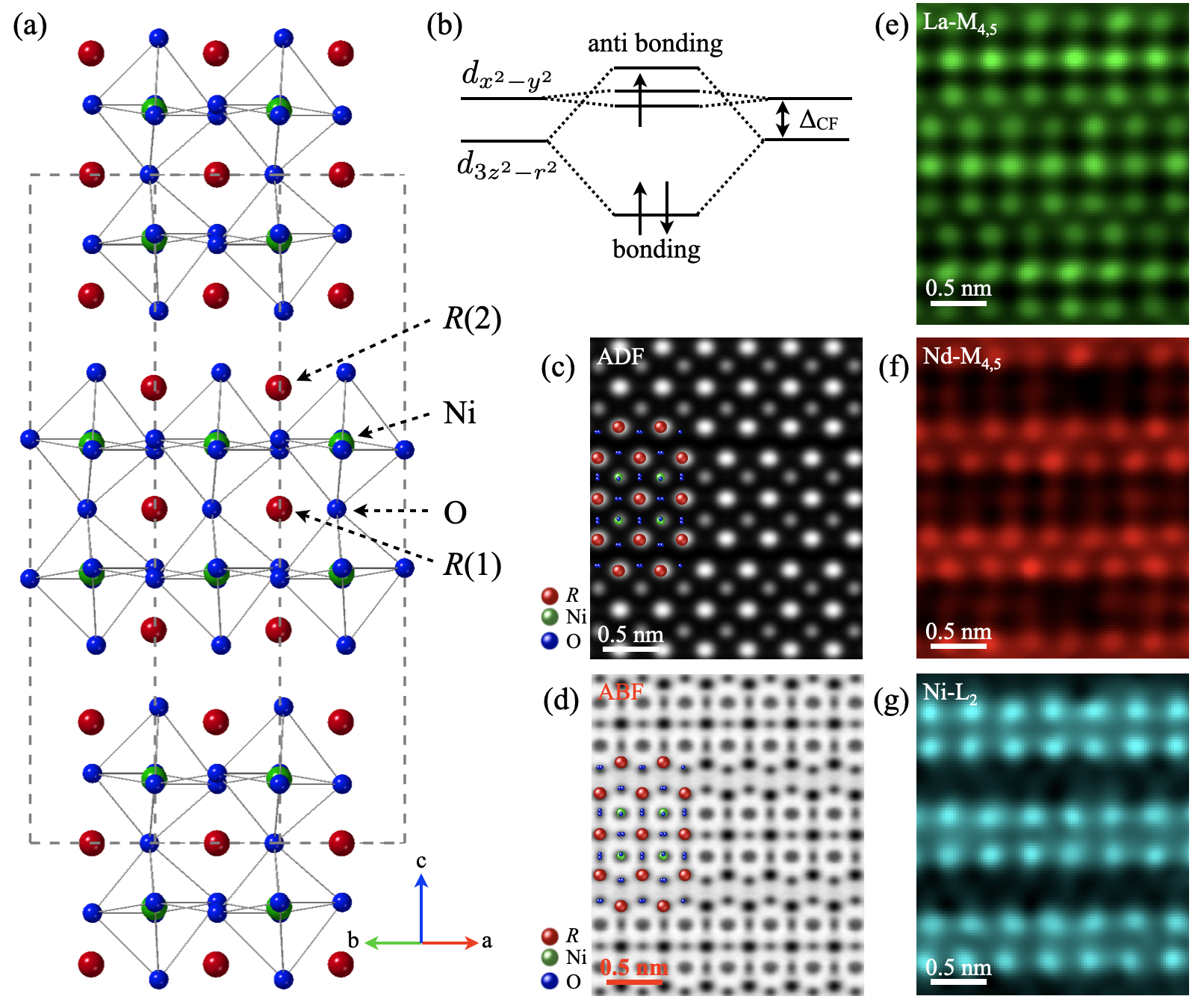
Figure 1: Crystal and electronic structures, showing orthorhombic RP bilayers, La positions, and eg orbital splitting.
Atomic-resolution STEM and EELS mapping confirm phase purity and reveal Nd preferentially substituting at the R(2) site, facilitating systematic modulation of lattice distortion and band parameters. Such structural control is critical, as the alignment and tilting of NiO6 octahedra correlate directly with superconducting phase emergence.
Transport under Pressure and Phase Evolution
Temperature-dependent resistivity measurements across pressures up to 20 GPa for 3, 2, and 1.9 compositions (La20Ni21O22, (La23Nd24)Ni25O26, (La27Nd28)Ni29O70) unveil systematic changes:
- For 3, metallic behavior persists to 10 GPa, beyond which a semiconductor upturn appears at low temperature, transitioning into superconductivity at pressures 7116 GPa with zero resistance at 72 K at 20 GPa.
- 2 exhibits higher resistivity and semiconducting behavior up to 20 GPa where onset of superconductivity is barely reached, indicating band narrowing due to enhanced octahedral tilting.
- 1.9 undergoes a pressure-driven semiconductor-to-metal transition between 12 and 14 GPa, achieving zero resistance at 73 K at 20 GPa.
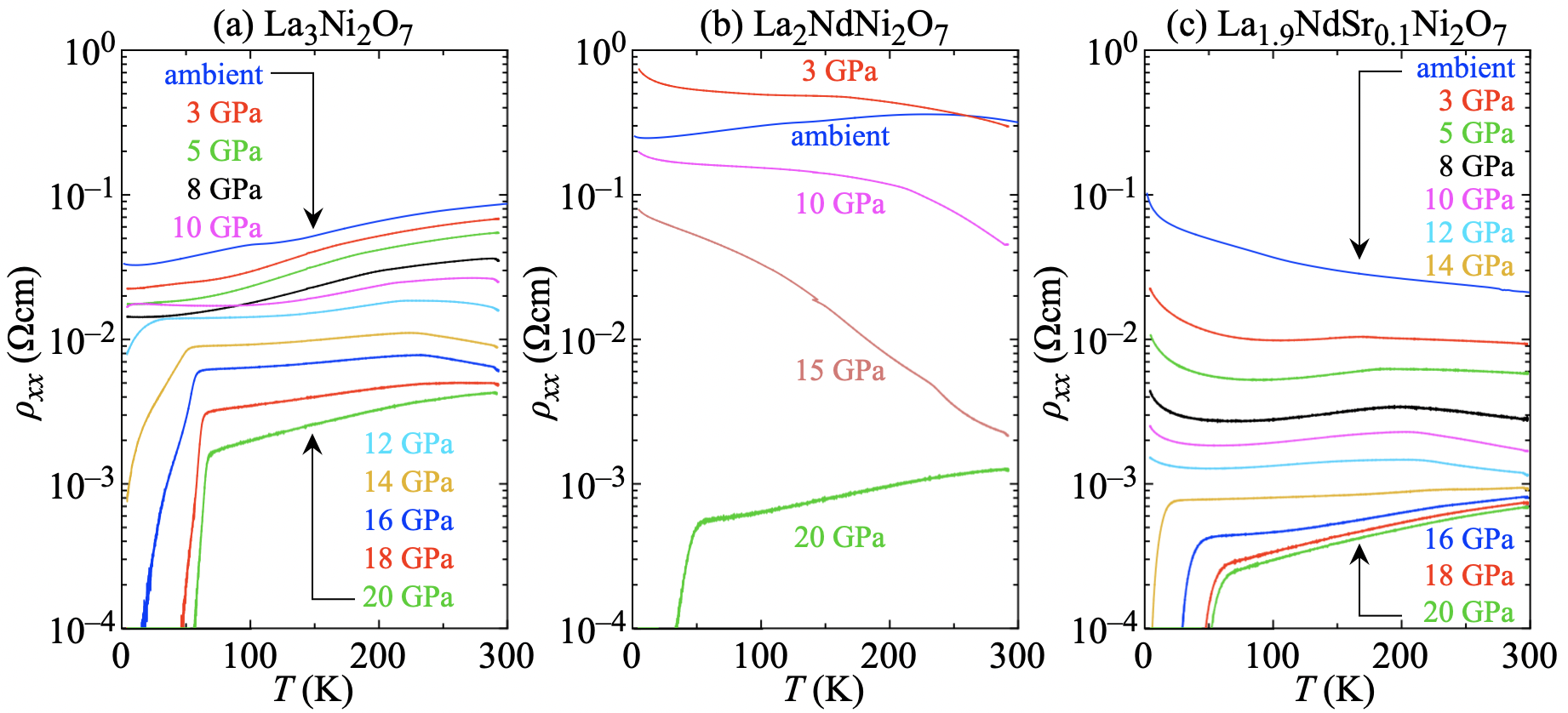
Figure 2: Pressure dependence of temperature-resistivity for La-, Nd-, and Sr-doped nickelates across various GPa regimes.
Distinct anomalies are detected in the nonsuperconducting regime, interpreted as signatures of density-wave instabilities (CDW, SDW). Three characteristic anomalies (74, 75, 76) are quantified: 77 (low-78 anomaly, suppressed with pressure, likely CDW), 79 (high-60 anomaly, enhanced with pressure, candidate SDW), and 61 (resistivity minima, origin unclear).
Pressure-Temperature Phase Diagrams
Comprehensive 62-63 phase diagrams for each composition substantiate the interplay between band filling/band width and electronic phases:
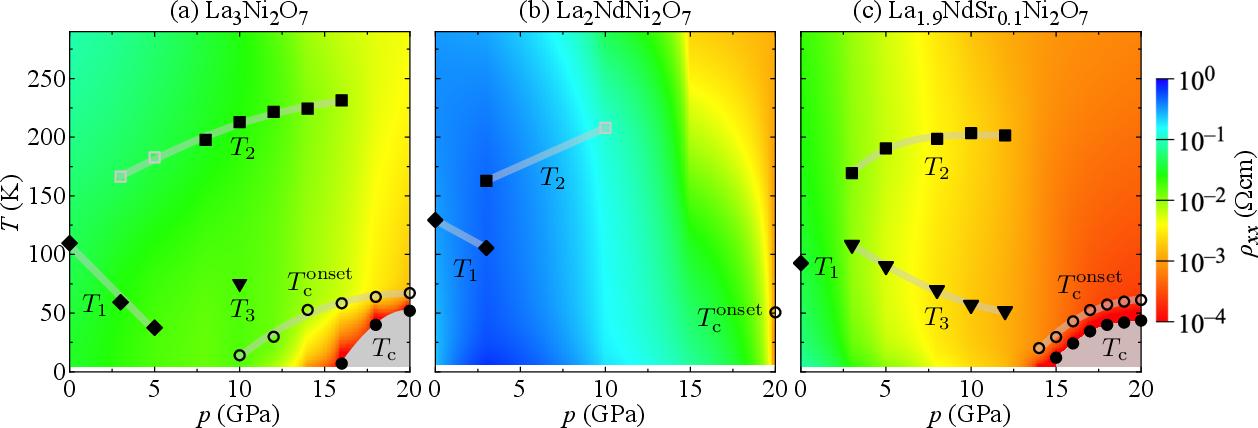
Figure 3: 64-65 phase diagrams outlining superconducting regions, resistivity contour maps, and anomalies in La66Ni67O68, (La69Nd20)Ni21O22, (La23Nd24)Ni25O26.
- In 3, superconductivity emerges promptly after suppression of CDW anomaly (27).
- Nd-substitution (2) increases critical pressure for superconductivity, confirming band narrowing.
- Sr doping in 2-x compositions counteracts band narrowing, lowers critical pressure for superconductivity, and sequentially suppresses 28 anomaly. The superconducting regime is limited to a narrow band-filling range (optimal Sr/La/Nd ratios).
Composition Dependence of Physical Properties
Ambient-pressure resistivity, anomaly temperatures, and critical pressure for zero resistance are mapped against Sr concentration:
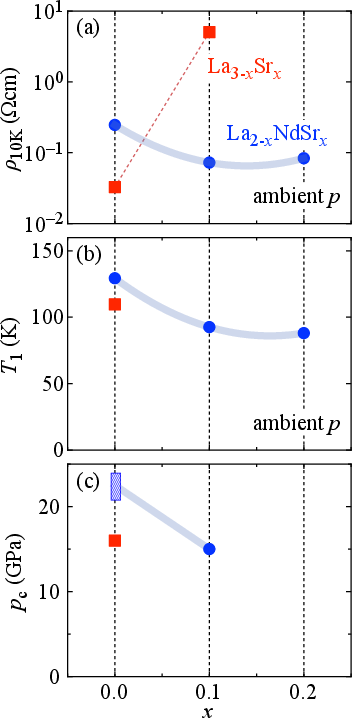
Figure 4: Sr concentration dependence of ambient resistivity, anomaly temperature 29, and critical pressure for superconductivity in 3-x and 2-x nickelates.
- Nd20 substitution enhances 21 anomaly and increases resistivity, attributed to band narrowing via increased octahedral distortion.
- Sr22 doping introduces holes, restores conductivity, reduces critical pressure for superconductivity, and suppresses DW anomalies.
- The solubility limit for Sr is evident at 23, beyond which impurity phases and localization effects manifest.
Implications and Future Directions
These findings provide direct evidence for tunability of electronic phases in bilayer nickelates via independent control of band width and band filling. The phase diagrams reveal decoupling of CDW and SDW features, in contrast to cuprate systems where DW instabilities are typically intertwined, indicating a fundamental difference in ground state competition.
The results underscore the sensitivity of superconductivity to lattice distortion, carrier concentration, and impurity phase control. The high-pressure synthesis protocol significantly mitigates sample-quality-related discrepancies prevalent in prior studies. The observed narrow optimal doping window and bifurcation of DW anomalies may inform future theoretical models and high-T24 design strategies.
Experimental approaches combining high-resolution structural analysis, hydrostatic pressure, and fine compositional tuning establish a framework for dissecting correlated electron systems beyond the nickelate paradigm.
Conclusion
This work demonstrates systematic engineering of superconducting and density-wave phases in RP bilayer nickelates via controlled manipulation of band parameters. The pressure and dopant-dependent phase evolution clarifies the role of structural distortion and hole doping in governing superconducting onset and DW instabilities. The decoupling of DW anomalies, critical pressure trends, and optimized superconducting windows provide a quantitative roadmap for further exploration of correlated oxide superconductors and underscore the distinct electronic physics of the nickelate family relative to cuprates (2604.13875).