- The paper demonstrates that the leading-order negativity is determined solely by a submatrix of the reduced density matrix, which scales linearly with detector count.
- It employs a rigorous perturbative framework to quantify how spatial arrangements and switching functions optimize entanglement extraction between causally disconnected regions.
- Analysis of multipartite configurations and chain protocols reveals that increasing detector numbers enhances both harvested entanglement and the range of viable parameter regimes.
Bipartite Entanglement Harvesting with Multiple Unruh-DeWitt Detectors
Overview
The paper "Bipartite entanglement harvesting with multiple detectors" (2604.13869) provides a rigorous perturbative analysis of entanglement extraction from the quantum vacuum of a massless scalar field using networks of Unruh-DeWitt (UDW) detectors. The study generalizes previous harvesting protocols to multipartite systems, detailing how spatial arrangements and detector parameters influence extractable bipartite entanglement between causally disconnected regions. The key technical result is that the leading-order negativity, as an entanglement monotone, is fully determined by a submatrix of the reduced density matrix whose size grows linearly with the total number of detectors.
Perturbative Framework and Density Matrix Structure
The model considers N stationary UDW detectors interacting locally and weakly with a massless scalar field in Minkowski spacetime. The interaction Hamiltonian is parameterized by coupling strengths, switching functions, and spatial smearings, with detectors initially uncorrelated and in their ground states. The evolution is treated at leading order in λ using a Dyson expansion. The reduced density matrix ρ^AB after tracing out the field is block-diagonal, decomposing into the one-excitation sector and the vacuum/two-excitation sector: ρ^AB=ρ1⊕ρ2+O(λ4)
where ρ1 contains matrix elements relevant to bipartite entanglement and scales as N×N. The full density matrix scales exponentially in detector number, but crucially only the ρ1 block determines the leading-order negativity.
Negativity and Additivity in Large Systems
Negativity N(ρ^) is employed as a diagnostic of NPT entanglement, efficiently computed as the sum of negative eigenvalues of the partial transpose ρ^TB. The analysis shows that, in perturbation theory, negativity is additive across independent bipartitions, even though it is not strictly additive in general. The partial transpose preserves block structure, and only the one-excitation block ρ~1 provides negative eigenvalues at leading order: λ0
where λ1 are eigenvalues of λ2.
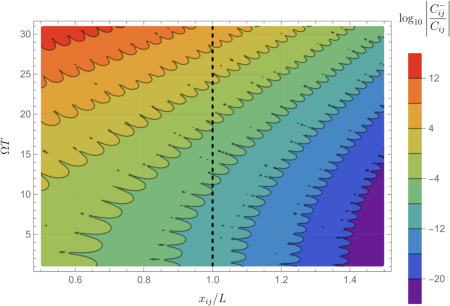
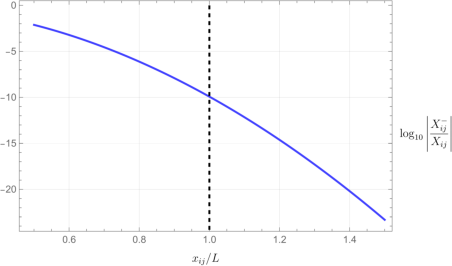
Figure 1: Relative commutator contributions to the reduced density-matrix elements for pointlike detectors with Gaussian switching (λ3), illustrating effective causal disconnection at detector separation λ4.
Spatial Optimization and Causal Structure
The paper systematically quantifies how spatial configurations impact harvested entanglement. The causal disconnection constraint is imposed by requiring that cross-subsystem detector pairs remain spacelike separated. The authors analyze the contributions to density matrix elements arising from the Wightman function, decomposing into symmetric (entanglement harvesting) and antisymmetric (field-mediated communication) parts, showing the regime where genuine harvesting dominates.
Two-Detector Protocol
Revisiting the two-qubit scenario, the harvested negativity is derived analytically with Gaussian switching and pointlike smearing: λ5
where λ6 is the nonlocal excitation amplitude and λ7 is the local term, both closed-form functions of detector separation and energy gap. Optimization yields maximal harvesting at minimal causal separation and a characteristic energy gap.
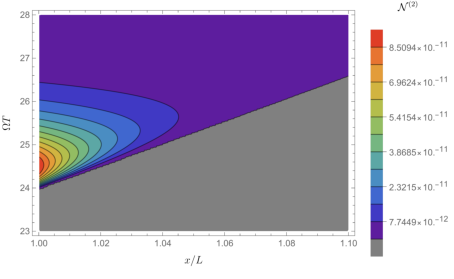
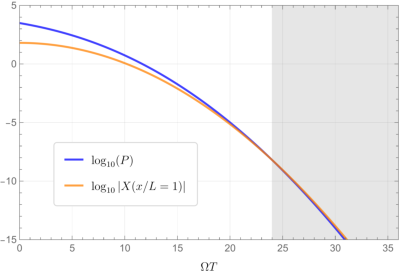
Figure 2: Contour plot of leading-order negativity between two detectors as a function of separation λ8 and energy gap λ9; maximum at ρ^AB0, ρ^AB1.
Multipartite Configurations
Three-Detector Analysis
All spatial geometries for three detectors are systematically explored. The global maximum occurs for the ABA linear arrangement, with alternating subsystem assignment, and a suboptimal arrangement is found when two detectors of the same subsystem are slightly offset. Nonzero harvesting appears over wider parameter regimes than the bipartite case.
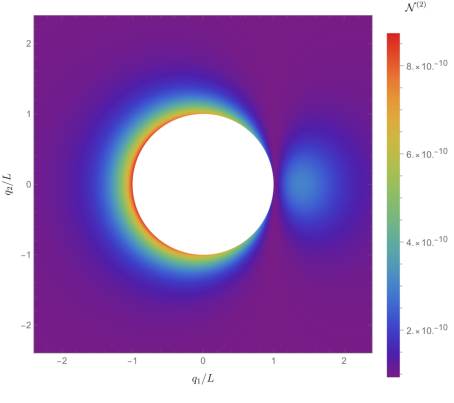
Figure 3: Illustration of general three-detector arrangement; density plot of negativity as a function of the movable detector's position reveals multiple maxima.
Four-Detector Analysis
Six symmetric configurations are investigated:
- AABB, ABBA, ABAB linear arrangements;
- Rectangle, skewed square, and tetrahedral-like geometries.
Analytic expressions for negativity are derived for each. The diagonal-square configuration (detectors at maximal intra-subsystem separation, minimal cross-subsystem separation) yields the strongest bipartite harvested entanglement.
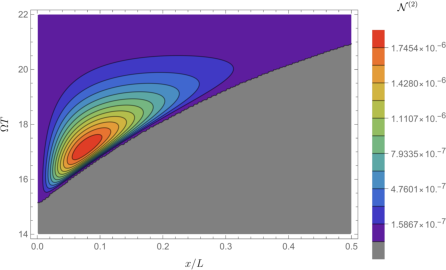
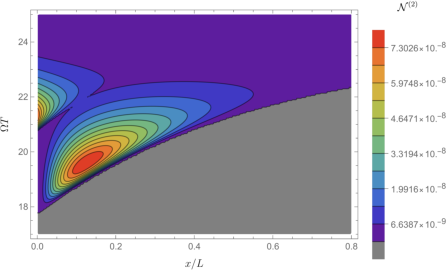
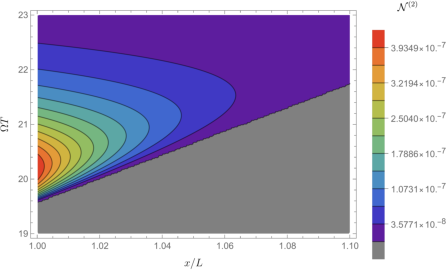
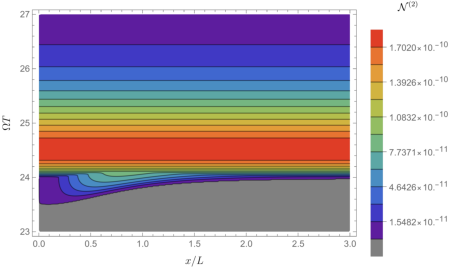
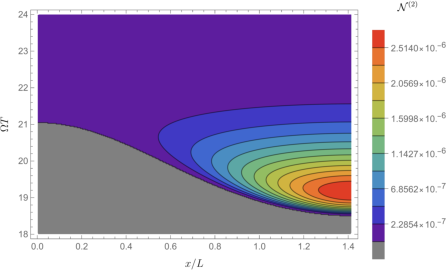
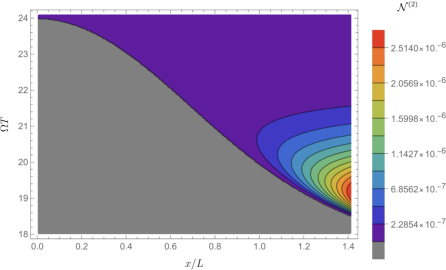
Figure 4: AABB, spatial arrangement showing detectors at tunable distances; contour plot of negativity as a function of spatial and internal parameters highlights local maxima.
Scaling and Chains
A linear chain protocol with alternating subsystems is analyzed. For a chain of ρ^AB2 detectors, the harvested negativity exhibits linear scaling with ρ^AB3, demonstrated numerically for up to 50 detectors. The submatrix structure ensures computational tractability even in large systems, but caution is noted regarding the breakdown of perturbation theory for sufficiently large ρ^AB4 at fixed coupling.
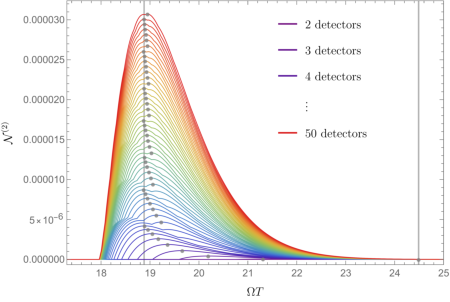
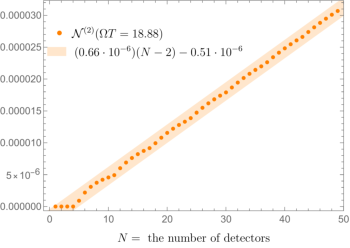
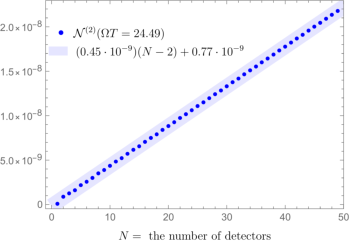
Figure 5: Leading-order negativities for chain setups as a function of energy gap ρ^AB5, showing linear growth with detector number.
Switching Function Dependence
Comparisons are presented between Gaussian, truncated Gaussian, and compactified polynomial (CP) switching functions. For strictly compactly supported switching, periodic regimes of nonzero harvesting appear and additivity persists, but maximum negativity and scaling are modified. Optimal spatial configurations (minimizing cross-system separation, maximizing intra-system separation) are robust to these variations.
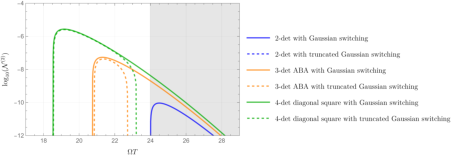
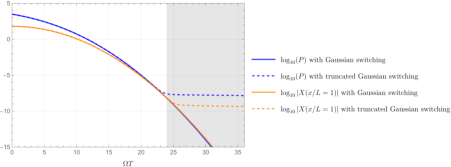
Figure 6: Comparison of harvesting with truncated and standard Gaussian switching; two-detector harvesting regime disappears for truncated switching.
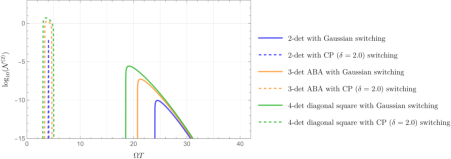
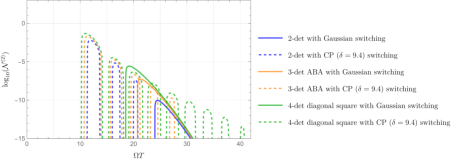
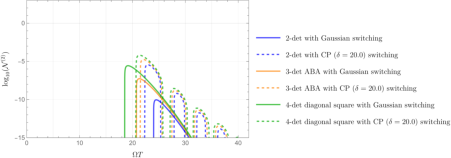
Figure 7: Comparison with CP switching, showing periodic harvesting regimes dependent on differentiability; scaling of entanglement regime width with detector number.
Practical and Theoretical Implications
Strong numerical evidence is provided for the claim that increasing detector number both amplifies harvested entanglement and broadens the parameter regime (energy gaps, separations) for successful extraction. The analytic reduction from exponential to linear scaling in negativity computation is significant for the design and numerical modeling of multipartite quantum field protocols. These insights are directly relevant for the engineering of relativistic quantum information schemes, particularly in scenarios exploring quantum communication and correlations in multimode fields.
From a theoretical standpoint, the results clarify the operational structure of field entanglement, supporting the view that field quantum correlations exhibiting multimode structure can be efficiently extracted by optimal spatial distributions of localized probes. The scaling properties suggest that macroscopic or distributed readout schemes may leverage multipartite correlations for enhanced quantum processing tasks.
Future Directions
Prospective research includes extensions to curved spacetimes, non-perturbative analyses in strongly coupled or large detector regimes, and genuine multipartite entanglement harvesting measures beyond bipartitions. Experimental implementations in quantum field analogues (e.g., trapped ions, quantum circuits) would benefit from the optimal arrangements and switching strategies identified.
Conclusion
This paper establishes a formal basis for efficient bipartite entanglement harvesting in quantum field theory using multiple detectors, demonstrating analytic tractability, scaling properties, and spatial optimization protocols. The results set the stage for further investigations in relativistic quantum information with multipartite detector ensembles, providing concrete guidance for theoretical development and experimental realization.