- The paper demonstrates that torsion-induced one-loop corrections notably suppress the gravitational wave signal from inflaton decay through four-fermion interactions.
- It systematically computes one-loop effects in both two-body and three-body decay channels, establishing perturbativity constraints in the (x, y) parameter space.
- The analysis reveals that loop corrections can reduce the GW spectrum by up to two orders of magnitude, impacting predictions for early universe reheating.
Torsion-Induced One-Loop Corrections to Inflaton Decay and Stochastic Gravitational Waves
Introduction and Theoretical Framework
The paper "Torsion induced one-loop corrections to inflaton decay and the Stochastic gravitational waves" (2604.13844) investigates the quantum field theoretic implications of spacetime torsion, arising in the first-order formalism of gravity coupled to fermions (Einstein–Cartan–Sciama–Kibble theory), on inflaton decay processes and their associated stochastic gravitational wave (GW) signals. The main focus is on the loop-level effects generated by torsion-induced four-fermion interactions, a dimension-six operator suppressed by the Planck scale, and their phenomenological consequences in cosmological settings where the inflaton mass is substantially below—but not negligibly far from—the Planck scale.
The total action comprises kinetic and mass terms for the inflaton (φ) and fermions (ψ), a Yukawa interaction, and the torsion-induced four-fermion sector. The torsion term takes the generic form 643!κ2(ψˉγ5γaψ)(ψˉγ5γaψ), with κ∼MPl−1.
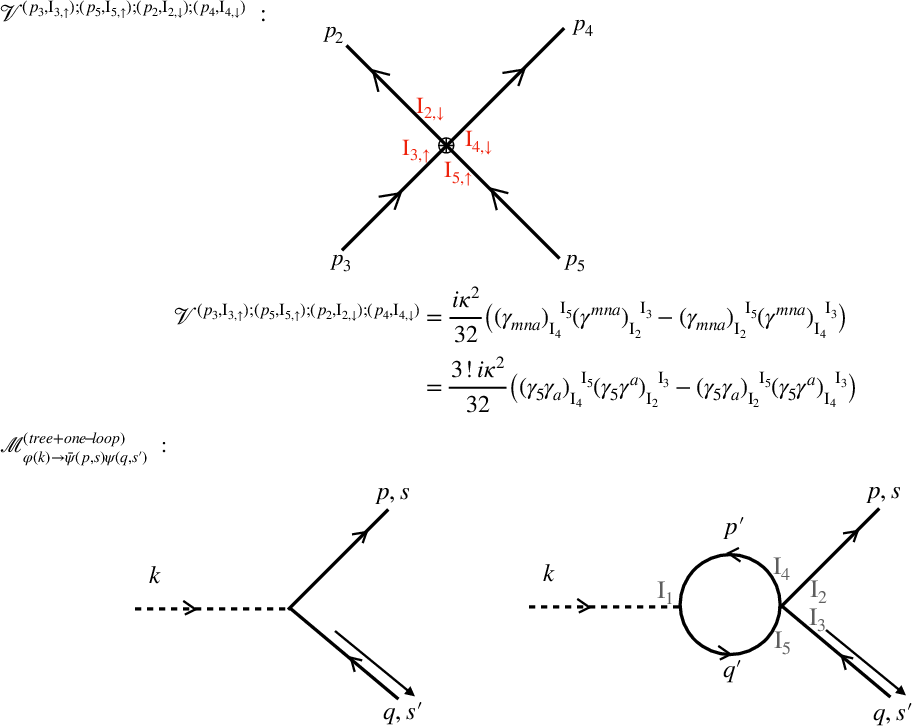
Figure 1: Feynman rule for the torsion-induced four-fermion interaction (upper) and the one-loop diagram for inflaton two-body decay mediated by combined Yukawa and torsion-induced four-fermion terms (lower).
Perturbativity and Parameter Space Constraints
Leading one-loop corrections to the inflaton two-body decay (φ→ψˉψ) and three-body bremsstrahlung decay (φ→ψˉψhab, with hab being the graviton) are systematically computed. These corrections depend critically on the renormalization scale u due to dimensional regularization and the MS scheme, entering as logarithms and arctanh functions in the amplitude expressions.
A central diagnostic is the ratio Rφ→ψˉψ(0) (and analogously ψ0 for the three-body channel), quantifying the fractional modification of decay rates by loop effects. To maintain perturbative reliability, constraints are imposed such that the loop-corrected squared amplitudes remain within ψ1 times their tree-level values, delineating the allowed region in the ψ2 parameter space, with ψ3 and ψ4.
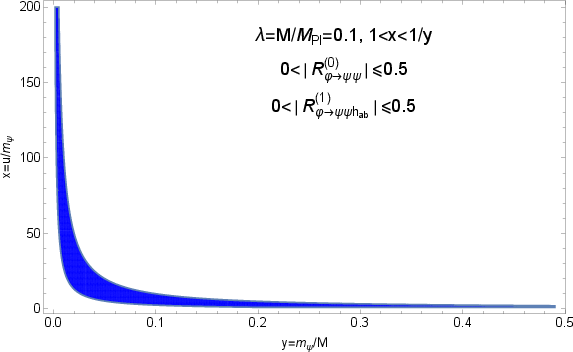
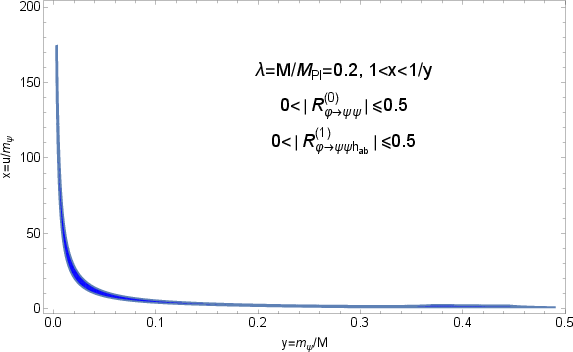
Figure 2: Combined constraints on ψ5 parameter space from two- and three-body decay ratios, ensuring perturbativity for representative inflaton masses.
One-Loop Corrections to Three-Body Decay and Graviton Emission
The analysis of the three-body decay process incorporates both tree-level and one-loop diagrams. The loop effects contribute only via external fermion legs due to the structure of the Feynman rules, with diagrams internal to the bremsstrahlung graviton emission vanishing identically. The resulting differential decay rate ψ6 exhibits an infrared divergence (regulated by a cutoff) and is independent of ψ7 in the loop-induced sector.
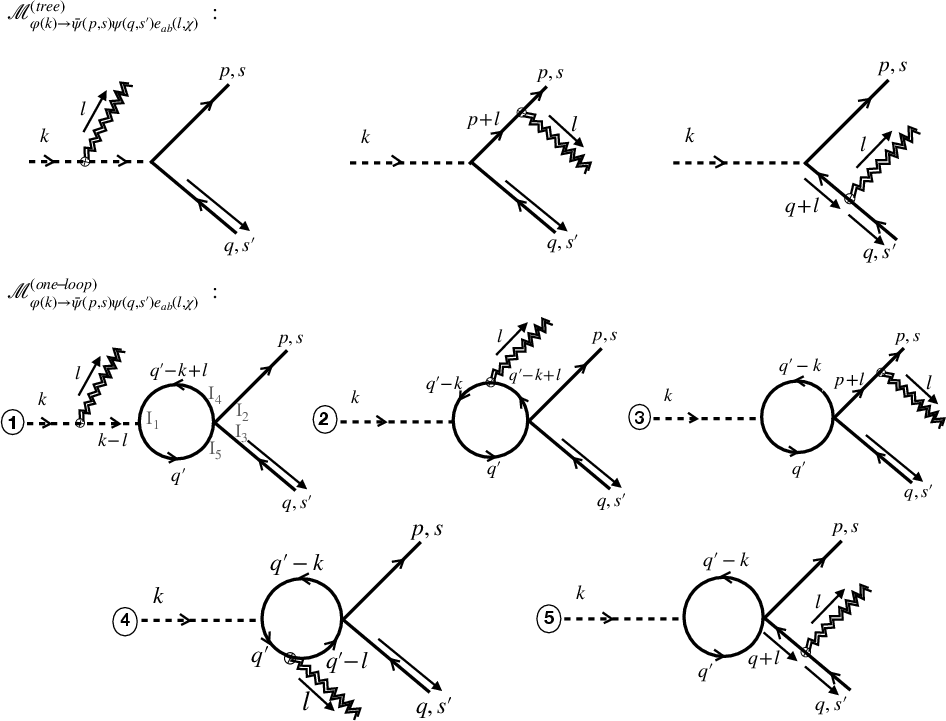
Figure 3: Feynman diagrams for inflaton three-body decay, illustrating the structure and origin of the fermion loop corrections with graviton emission.
The ratio ψ8, defined as ψ9, parametrizes the influence of loop corrections on the GW spectrum. The deviation 643!κ2(ψˉγ5γaψ)(ψˉγ5γaψ)0 is shown to be highly asymmetric: enhancements reach at most 643!κ2(ψˉγ5γaψ)(ψˉγ5γaψ)1, while suppressions can extend to two orders of magnitude under relaxed perturbativity near the Planck mass domain.
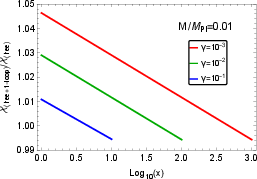
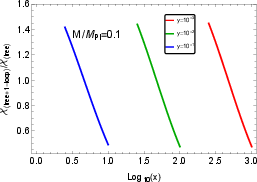
Figure 4: Loop-induced deviations in 643!κ2(ψˉγ5γaψ)(ψˉγ5γaψ)2 as a function of 643!κ2(ψˉγ5γaψ)(ψˉγ5γaψ)3, highlighting the strong asymmetry as parameters approach the edge of perturbative validity.
Magnitude and Regimes of Suppression
The most pronounced reduction in the GW signal arises for inflaton masses 643!κ2(ψˉγ5γaψ)(ψˉγ5γaψ)4. For 643!κ2(ψˉγ5γaψ)(ψˉγ5γaψ)5, loop-induced effects remain negligible, while for 643!κ2(ψˉγ5γaψ)(ψˉγ5γaψ)6, suppressions are both numerically substantial and critically dependent on 643!κ2(ψˉγ5γaψ)(ψˉγ5γaψ)7. This is further corroborated when perturbativity constraints are relaxed.
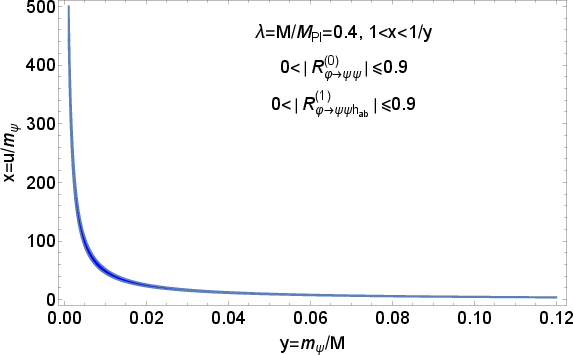
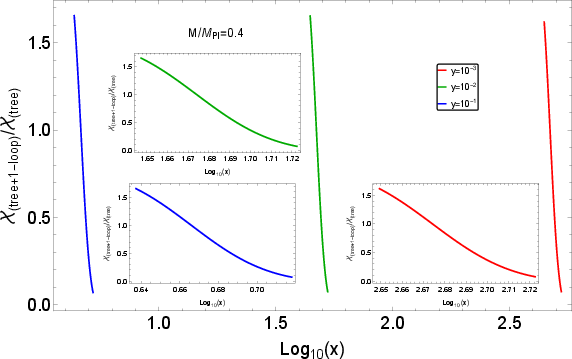
Figure 5: Extreme suppression/enhancement of 643!κ2(ψˉγ5γaψ)(ψˉγ5γaψ)8 with large inflaton mass and relaxed perturbativity, showing the dependence on the renormalization scale.
Impact on the Stochastic Gravitational Wave Spectrum
The GW spectrum 643!κ2(ψˉγ5γaψ)(ψˉγ5γaψ)9 is directly determined by κ∼MPl−10. The Boltzmann equations governing the densities of inflaton, GW, and radiation during reheating are solved, incorporating the loop-corrected decay widths. The frequency range and amplitude of the GW signal depend on κ∼MPl−11, κ∼MPl−12, and the aforementioned dimensionless ratios. Loop corrections can shift the predicted GW signal downward by up to two orders of magnitude, moving it outside the reach of present and future GW detectors.
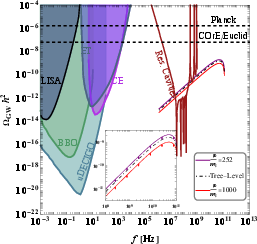
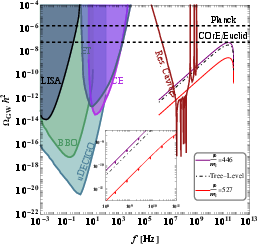
Figure 6: Gravitational wave spectra for different parameter choices, illustrating the maximal enhancement and suppression relative to tree-level results and overlaying observational sensitivity curves.
Physical Implications and Future Directions
The results highlight the significant suppressive power of torsion-induced fermion loop corrections on the stochastic gravitational wave signals from inflaton decay, with modest prospects for enhancements. This has practical implications for realistic model building, specifically in theoretical scenarios involving reheating and inflaton couplings to fermions, where tree-level analyses may overestimate observable GW signals.
Notably, the degeneracy between scalar and fermionic final states in tree-level GW production models may be broken at the loop level, suggesting loop corrections as a possible probe of underlying particle content. In addition, the parameter sensitivity implies that constraints on inflaton and fermion masses and Yukawa couplings from primordial GW measurements could be sharper than previously recognized.
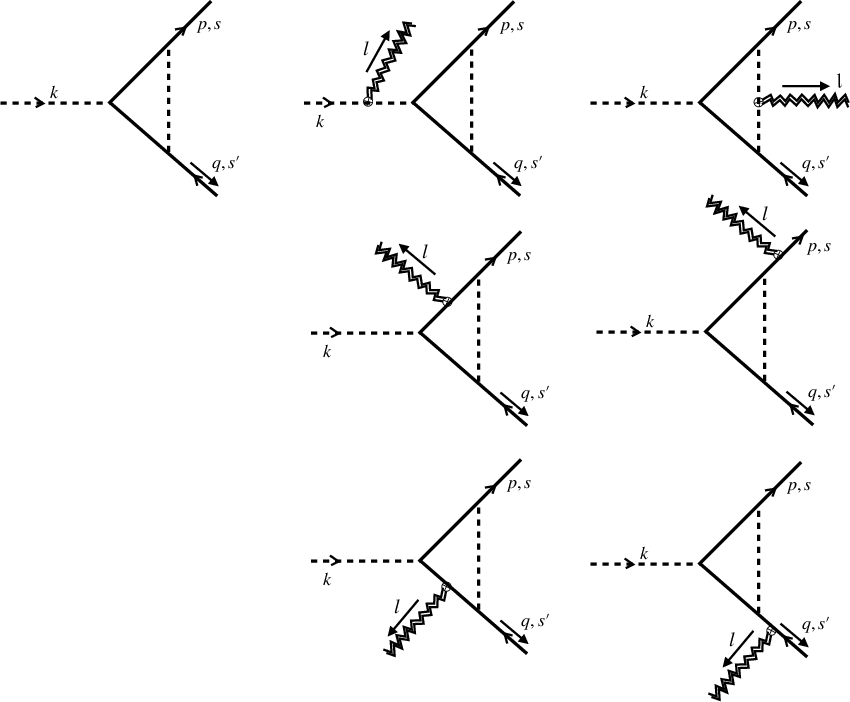
Figure 7: One-loop diagrams in the Yukawa sector neglected in present analysis, which could further modify decay rates and GW spectra if included.
There remain open questions requiring non-perturbative assessment, especially as κ∼MPl−13 approaches κ∼MPl−14, where coupling strengths render perturbative QFT unreliable. Extension to scalar channels, annihilation processes, and inclusion of higher-order Yukawa contributions (κ∼MPl−15) should be considered in future work.
Conclusion
The paper presents a rigorous effective field theory calculation of torsion-induced one-loop corrections to inflaton decay processes and their consequences for stochastic gravitational wave generation. Suppression of the GW signal due to fermionic self-interactions is pronounced and asymmetric, especially as the inflaton mass approaches the threshold where quantum gravity effects become important. Inclusion of such loop-level effects is critical for credible phenomenological predictions in cosmological model building and for extracting constraints from future GW observations. Further theoretical developments, including non-perturbative analyses and application to broader particle content, will refine the understanding of torsion and its observational signatures.