Composite Silhouette: A Subsampling-based Aggregation Strategy
Published 15 Apr 2026 in cs.LG | (2604.13816v1)
Abstract: Determining the number of clusters is a central challenge in unsupervised learning, where ground-truth labels are unavailable. The Silhouette coefficient is a widely used internal validation metric for this task, yet its standard micro-averaged form tends to favor larger clusters under size imbalance. Macro-averaging mitigates this bias by weighting clusters equally, but may overemphasize noise from under-represented groups. We introduce Composite Silhouette, an internal criterion for cluster-count selection that aggregates evidence across repeated subsampled clusterings rather than relying on a single partition. For each subsample, micro- and macro-averaged Silhouette scores are combined through an adaptive convex weight determined by their normalized discrepancy and smoothed by a bounded nonlinearity; the final score is then obtained by averaging these subsample-level composites. We establish key properties of the criterion and derive finite-sample concentration guarantees for its subsampling estimate. Experiments on synthetic and real-world datasets show that Composite Silhouette effectively reconciles the strengths of micro- and macro-averaging, yielding more accurate recovery of the ground-truth number of clusters.
The paper introduces Composite Silhouette, a novel framework for adaptive cluster-count selection using discrepancy-aware subsampling and aggregation.
It leverages weighted micro- and macro-averaged Silhouette scores to mitigate biases from imbalanced and heterogeneous data conditions.
Empirical and theoretical results confirm rapid convergence and reliable recovery of the ground-truth number of clusters across diverse datasets.
Composite Silhouette: Subsampling-Based Adaptive Aggregation for Internal Cluster Validation
Motivation and Problem Statement
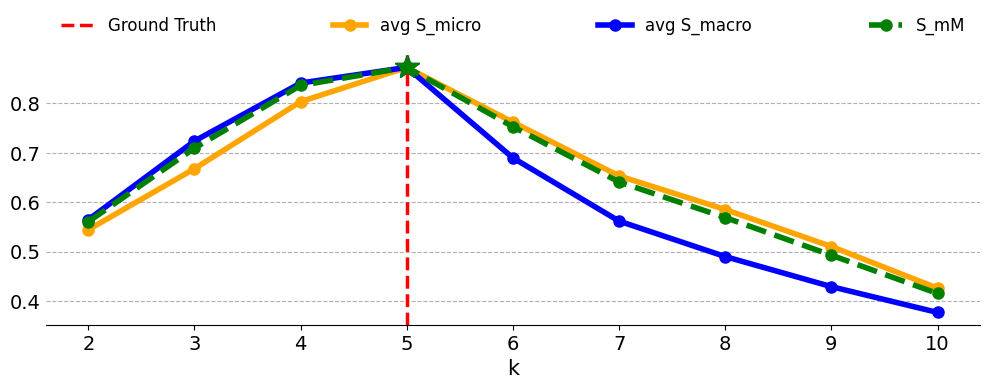
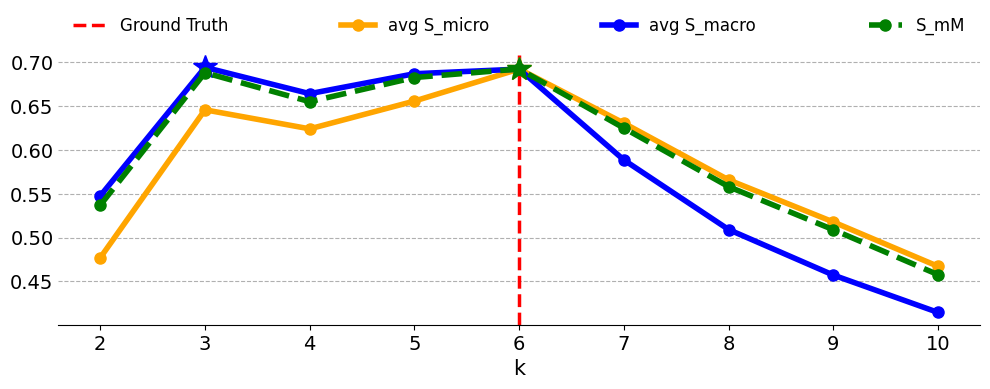
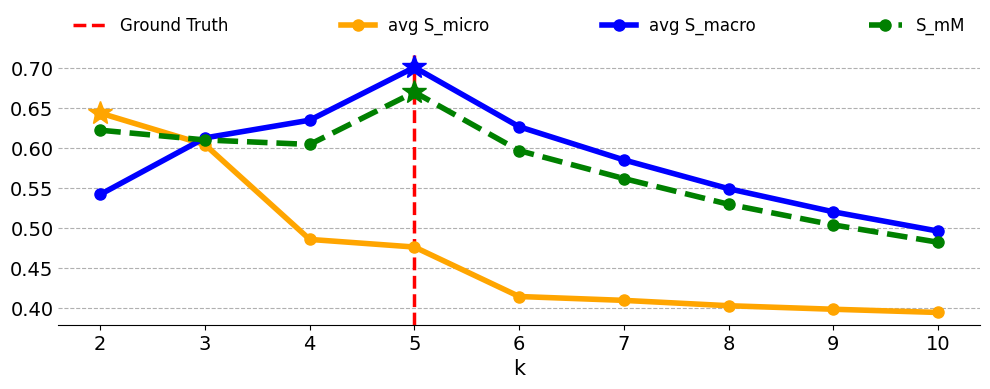
Cluster-count selection remains a prominent challenge in unsupervised learning, particularly in domains with substantial cluster-size imbalance or structural heterogeneity where conventional internal validation indices often yield inconsistent or biased model selection. The Silhouette coefficient, a widely adopted metric, is typically aggregated via micro-averaging—favoring larger clusters—or macro-averaging—emphasizing smaller clusters. Neither approach consistently yields optimal results across diverse data regimes, leading to fundamental inductive bias conflicts Figure 1.
Figure 1: Illustration of the trade-off between global micro-averaging and local macro-averaging for cluster validation, highlighting domain impact and bias conflict.
The key issue stems from the absence of principled strategies for balancing these aggregation perspectives in cluster-count selection tasks where structural conditions vary across datasets and applications. Micro-averaging is susceptible to overweighting major groups, while macro-averaging may amplify noise from minor clusters. This motivates a data-adaptive criterion capable of leveraging both perspectives without global preference.
Methodological Framework
Composite Silhouette (SmM) is formulated as an internal criterion employing repeated subsampling and discrepancy-aware aggregation. For each candidate cluster count k, the method performs B independent subsampled clusterings, computing micro- (Sm(b)) and macro- (SM(b)) averaged Silhouette scores per subsample. The normalized discrepancy Δb between these scores is transformed via a bounded nonlinearity (tanh), yielding a convex weight wb for adaptive combination. The overall composite score for k is then the average over B such weighted subsample-level scores:
k0
where k1.
This convex combination ensures responsiveness to local structural variation: subsamples where micro- and macro-views diverge are adaptively weighted based on their observed discrepancy, and the final composite succinctly encapsulates their aggregate behavior across the data.
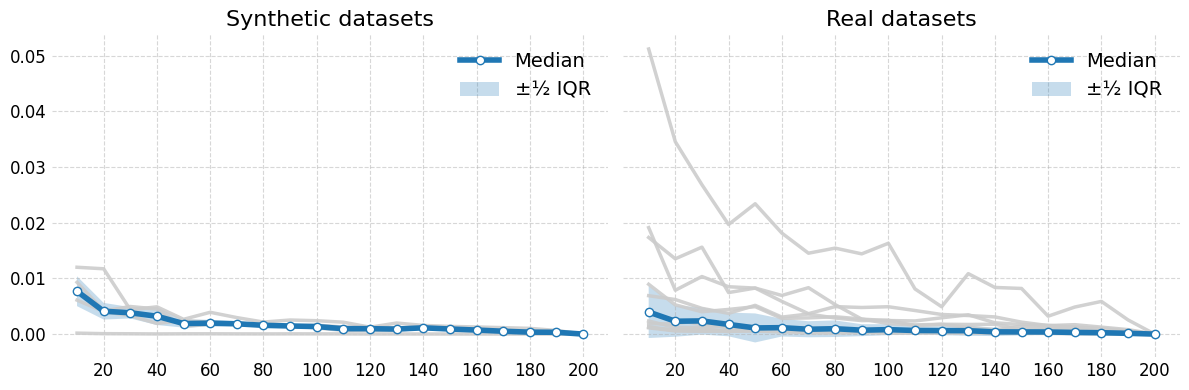
Figure 2: Approximation error of k2 as a function of the number of subsamples k3.
Theoretical Properties and Guarantees
The paper establishes deterministic properties for k4, including that each subsample-level score lies between the corresponding micro- and macro-averaged Silhouette scores, and that the composite differs from globally averaged scores by a discrepancy-dependent correction. Hoeffding-type concentration bounds are derived for the subsampling estimate, showing that k5 converges to its expectation as k6 with k7 rate, both for fixed k8 and uniformly over the candidate set. Under a positive-margin condition on the expected composite scores, the probability of recovering the optimal k9 approaches unity as subsample count increases.
Empirical Evaluation: Synthetic and Real-World Benchmarks
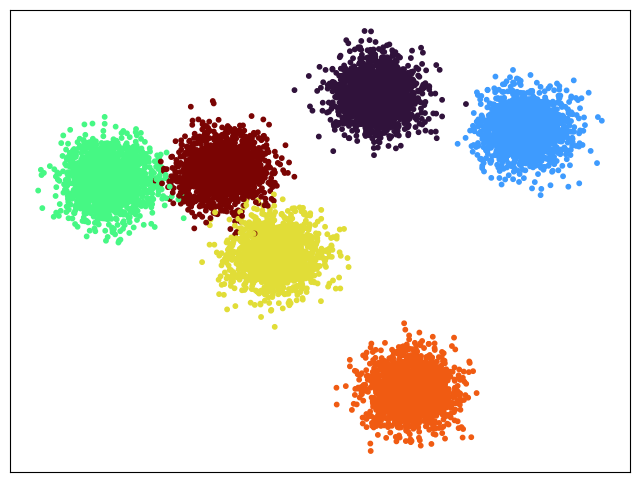
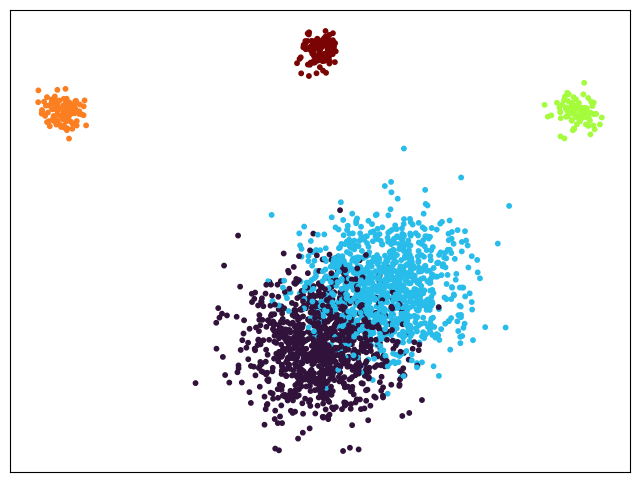
Composite Silhouette's efficacy is validated across four synthetic datasets (S1–S4) representing a progression from balanced, well-separated clusters to complex, heterogeneous, and strongly imbalanced regimes; as well as twelve real-world datasets spanning tabular, image, and text domains, with varied cluster counts and structures.
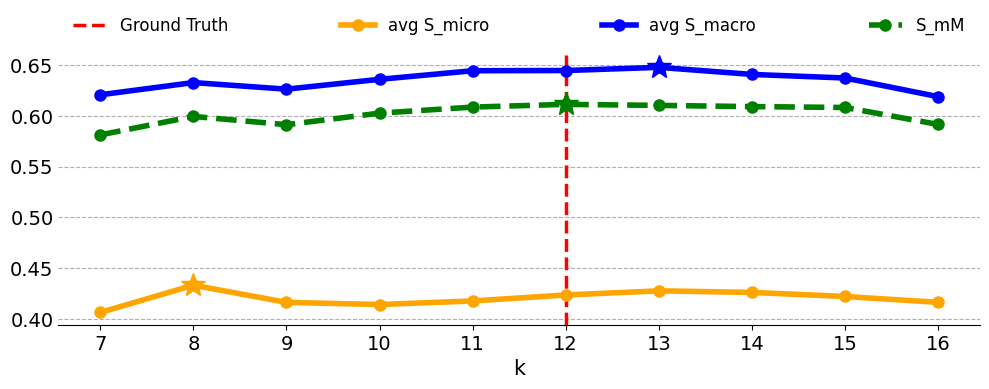
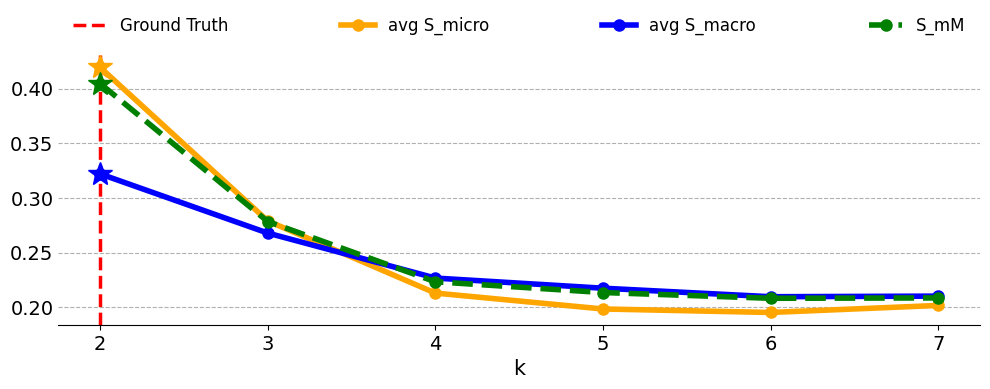
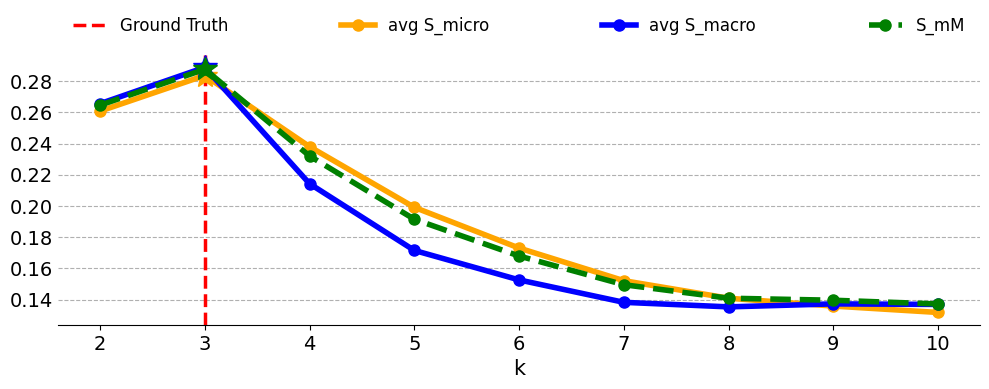
The results demonstrate that B0 consistently recovers the ground-truth number of clusters, outperforming both micro- and macro-averaged baselines, Calinski–Harabasz, Davies–Bouldin, Elbow, and Gap statistics. In strongly imbalanced scenarios (S3, B77), B1 leverages macro-averaging when it aligns with ground truth; in diffuse or ambiguous cases (S4, Nsg, Mds), it adaptively balances both views to achieve robust selection.
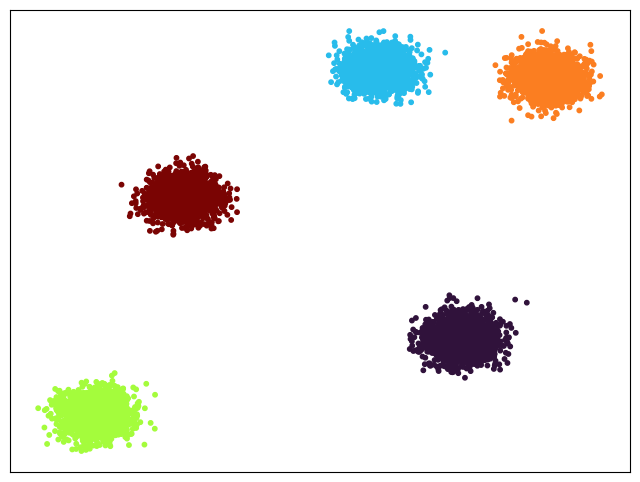
Figure 3: Visualization of S1 synthetic data benchmark, colored by ground-truth clusters.
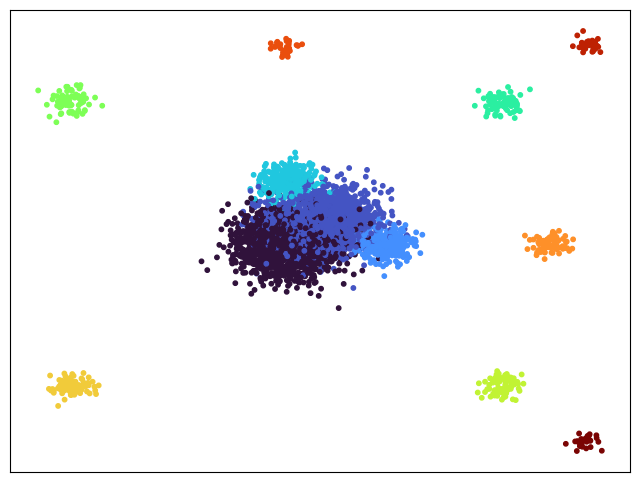
Figure 4: Visualization of S4 synthetic data with structural heterogeneity; cluster size and scale vary dramatically.
Composite Silhouette not only matches or surpasses baseline selection accuracy (Table: paper Table 1), but maintains strong values at ground-truth cluster counts across all dataset types. Its approximation error decays rapidly with modest B2 (10–30 sufficient), and subsample size heuristics allow for scalable application without per-dataset tuning.
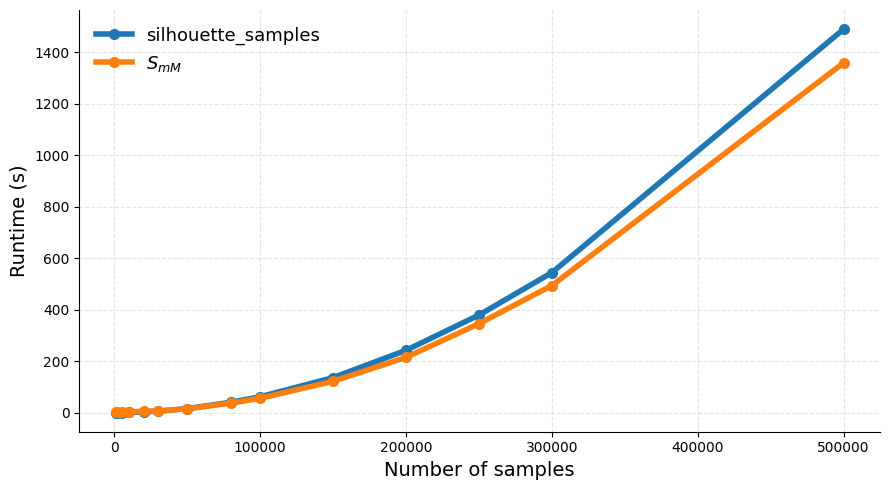
Figure 5: Runtime scaling of B3 versus standard full-data Silhouette score as a function of sample size B4.
Implementation and Practical Considerations
The method’s complexity is dominated by B5 subsampled clusterings and Silhouette computations, with negligible overhead from discrepancy-aware weighting. The proposed automatic subsample-size selection rule ensures robust cluster representation and computational tractability. Composite Silhouette is compatible with parallelization, facilitating efficient operation on large datasets.
The B6 transformation for discrepancy is empirically validated as the most reliable, providing stable cluster-count recovery where linear or step mappings fail. The code is released openly for community adoption.
Implications and Future Directions
Composite Silhouette furnishes a principled, adaptive approach to internal cluster validation, with immediate applicability to model selection in unsupervised learning. Its discrepancy-aware aggregation is robust to structural imbalance and heterogeneity, obviating the need for domain-specific aggregation preference.
Theoretically, this paradigm invites extensions to other validation indices and clustering paradigms, including hierarchical and density-based methods. Potential future directions include systematic characterization of regimes where composite aggregation outperforms both constituent views, investigation into stability for non-Euclidean dissimilarities, and exploration of meta-learning mechanisms for optimizing subsample and aggregation protocols.
Conclusion
Composite Silhouette (B7) represents a significant advance in internal cluster validation, delivering consistent and robust cluster-count selection across diverse real and synthetic domains through subsampling and discrepancy-adaptive aggregation. This framework enables practitioners to reconcile the strengths of micro- and macro-averaging without prior assumptions, offering a practical, scalable, and theoretically grounded strategy for unsupervised model selection (2604.13816).