- The paper presents the emergent topological phase generated through coherent impurity scattering in a one-dimensional metallic system, analogous to the SSH chain.
- It employs a scattering network formalism to model transmission, band gap formation, and robust edge states, linking topological transitions to tunable transport properties.
- Results from a tight-binding lattice model quantitatively map to the network description, guiding experimental realizations using quantum point contact arrays.
Emergent Topological Phase from a One-Dimensional Network of Defects
Introduction and Motivation
The paper presents a rigorous theoretical investigation of emergent topological phases induced by periodic superlattices of defects in one-dimensional (1D) metallic systems. Unlike conventional approaches reliant on band engineering in atomic lattice Hamiltonians, this work demonstrates that coherent impurity scattering can generate symmetry-protected topological phases and robust boundary modes within an otherwise trivial host metal. The emergent phases arise strictly from the spatial modulation and strength of defects, giving rise to a network model analogous to the Su-Schrieffer-Heeger (SSH) chain—thus defining the "SSH network." This approach leverages defect engineering, offering practical and tunable routes to topological physics in metallic platforms.
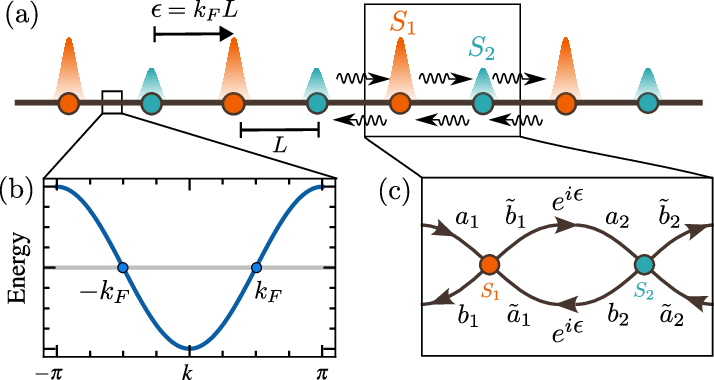
Figure 1: Schematic depiction of a metallic chain doped with spatially modulated defects of alternating strengths, illustrating the physical basis for the emergent network model.
The impurity array is modeled as a periodic sequence of scatterers characterized by two alternating strengths, V1 and V2, separated by distance L. The scattering matrices S1 and S2 encode the transmission and reflection amplitudes and inter-scatterer dynamical phase ϵ=kFL, where kF is the Fermi momentum. Using this formalism, the authors calculate two-terminal transmission T as a function of impurity configuration and dynamical phase, revealing the formation of transmission bands and gaps.
For V1=V2, the transmission spectrum features four finite-gap bands; as impurity strengths approach equality, adjacent bands merge and gaps close. Tuning impurity strengths and dynamical phase allows control of conduction versus insulation—establishing a direct connection between topological phase transitions and transport properties.
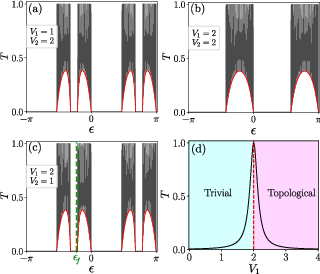
Figure 2: Transmission T versus dynamical phase V20 for various impurity strengths, demonstrating band gap formation and tunable transport.
Topological Characterization: Quasienergy Bands, Edge Modes, and Robustness
The SSH network model is formulated within a generalized scattering-matrix framework, with parameters V21, V22 (scattering strengths) and internal phases. Bloch's theorem yields quasi-energy band structures, featuring gaps at V23 and V24 for inequivalent scatterers. The density of states and transmission calculations confirm bulk-bound correspondence.
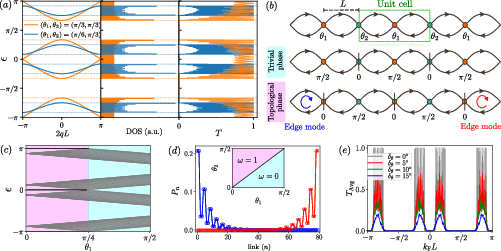
Figure 3: Quasienergy band structure, density of states, transmission, and edge excitations for various scattering strengths, highlighting topological and trivial regimes.
Under open boundary conditions, the network exhibits localized edge states at V25 when V26, analogous to the SSH chain. Winding number computations, discretized over the Brillouin zone, quantitatively distinguish topological (V27) and trivial (V28) phases. Disorder analysis confirms that the system's topological features, including band gaps and edge modes, are stable for moderate disorder in scatterer strengths.
Quantized Thouless Charge Pumping
The authors design a charge-pumping protocol by adiabatically varying scattering matrix parameters along a closed loop in parameter space. This induces a quantized spectral flow of edge modes across the bulk gap and results in integer charge transfer (Q=1 per cycle) when the dynamical phase resides within the bulk gap, manifesting a robust Thouless pump analogous to Hamiltonian models.
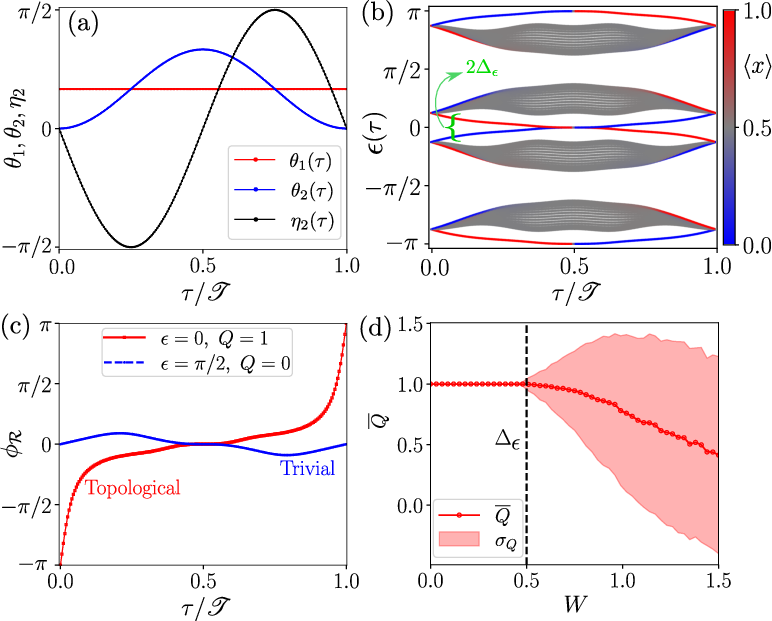
Figure 4: Charge pumping protocol and spectral flow of edge states, confirming quantized topological charge transfer and robust protection against disorder.
Computations of the V29 Chern number in pump cycles corroborate the quantization, and disorder averaging reveals protection up to disorder strengths comparable to the phase gap.
Microscopic Lattice Realization and Exact Mapping
A tight-binding lattice model is constructed with alternating onsite potentials L0 at separation L1, forming a defect superlattice. Bloch miniband calculations demonstrate gapped spectra matching those from the network, and Wannierization of minibands yields an effective SSH-like Hamiltonian with alternate hopping strengths L2, L3. This establishes full quantitative mapping between microscopic impurity parameters and network scattering matrix elements.
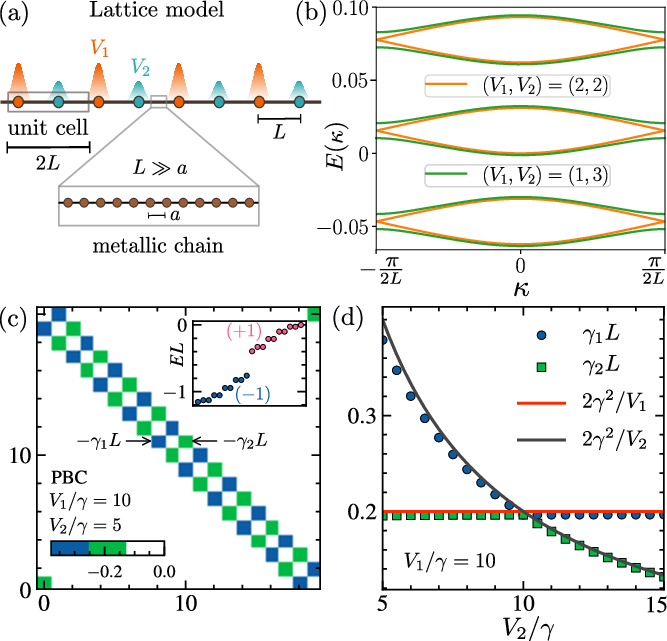
Figure 5: Microscopic tight-binding model, miniband structure, and Wannier Hamiltonian, illustrating quantitative mapping to the SSH network.
The mapping extends to boundary conditions and edge-localized modes, with exact spectral coincidence in both periodic and open systems. The emergent BDI symmetry arises from impurity-induced sublattice symmetry, despite the base model's AI symmetry classification.
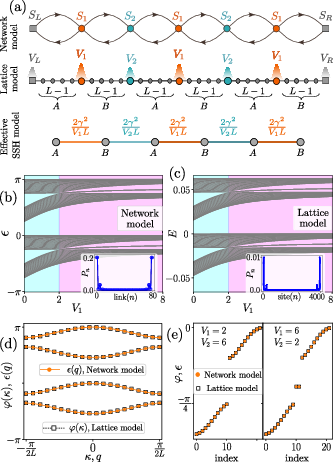
Figure 6: Network representation, mapping, and spectral comparison between network and lattice model, confirming spectral and topological equivalence.
The paper outlines concrete platforms capable of realizing the SSH network model via spatially patterned arrays of quantum point contacts (QPCs) in quantum Hall systems. Each QPC, described by a saddle-point potential with tunable gate voltages L4, maps onto the alternating scatterers of the impurity network. The phase accumulation between QPCs includes Aharonov-Bohm contributions, allowing external tuning by magnetic field.
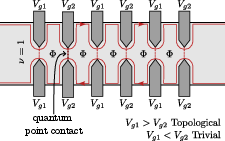
Figure 7: Array of QPCs in a Hall bar geometry with dimerized gate potentials, offering direct realization of the SSH defect network.
The approach is also viable in quantum spin Hall systems with magnetic impurity decoration, Moiré-modulated carbon nanotubes, and other mesoscopic platforms.
Advanced Topological Properties and Interface Modes
The appendices detail derivations of scattering matrix symmetries, transmission calculations, and effective Hamiltonians based on perturbation theory. They further elaborate on topological interface modes arising from mismatched bulk configurations, independent of boundary potentials.
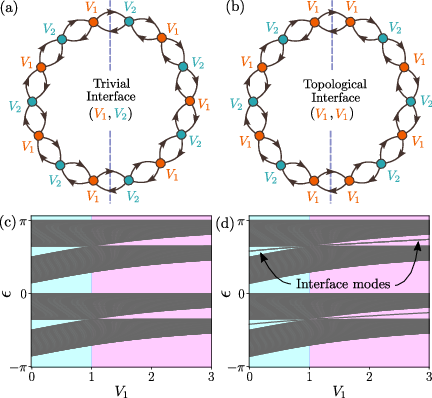
Figure 8: Interface configurations and quasi-energy spectra, demonstrating emergence of localized interface modes strictly due to bulk topology.
Implications and Future Directions
This study provides a rigorous framework for emergent topological phases in low-dimensional metallic systems via defect engineering. On a practical level, it opens new routes for the realization and control of topological edge modes in solid-state devices through impurity patterning. The theoretical implications include the promotion of trivial symmetry classes to higher topological classes, exact mapping between microscopic lattice and network descriptions, and robust quantization in charge transport phenomena.
Potential future developments include: extension to higher dimensions with network models (e.g., Chalker-Coddington-type), systematic inclusion of incoherent scattering or electron-electron interactions, realization of higher-order or fractional topological phases, and exploration of novel transport regimes (Luttinger liquids, interaction-driven topological transitions).
Conclusion
The paper establishes that coherent defect superlattices in one-dimensional metallic systems induce tunable, symmetry-protected topological phases characterized by bulk-boundary correspondence, quantized charge pumping, and spectral robustness. The comprehensive mapping between lattice models, scattering networks, and experimental realizations demonstrates both theoretical depth and practical applicability. This lays the foundation for advanced studies in engineered topological matter and network-based quantum devices.