Stabilization of finite-energy grid states of a quantum harmonic oscillator by reservoir engineering with two dissipation channels
Published 15 Apr 2026 in quant-ph and math.OC | (2604.13529v1)
Abstract: We propose and analyze an experimentally accessible Lindblad master equation for a quantum harmonic oscillator, simplifying a previous proposal to alleviate implementation constraints. It approximately stabilizes periodic grid states introduced in 2001 by Gottesman, Kitaev and Preskill (GKP), with applications for quantum error correction and quantum metrology. We obtain explicit estimates for the energy of the solutions of the Lindblad master equation. We estimate the convergence rate to the codespace when stabilizing a GKP qubit, and numerically study the effect of noise. We then present simulations illustrating how a modification of parameters allows preparing states of metrological interest in steady-state.
The paper introduces a simplified two-dissipator Lindblad framework to stabilize finite-energy grid (GKP) states, reducing experimental overhead compared to four-dissipator schemes.
It provides explicit energy bounds and exponential convergence rates, along with an analysis of logical decoherence under photon loss conditions.
Numerical simulations and analytical methods validate the approach for both GKP qubit and metrological states in platforms like circuit QED and trapped ions.
Stabilization of Finite-Energy Grid States of a Quantum Harmonic Oscillator via Two Dissipator Reservoir Engineering
Overview
This paper investigates a simplified Lindblad master equation for stabilizing finite-energy grid states (GKP states) in a quantum harmonic oscillator through reservoir engineering with only two dissipation channels. The work aims to reduce implementation complexity compared to previous proposals relying on four dissipators, thereby simplifying the experimental requirements for stabilizing GKP codes relevant in quantum error correction (QEC) and quantum metrology. The authors provide explicit energy bounds, analyze convergence rates, and characterize logical decoherence in noisy settings, including photon loss, supported by both analytical results and numerical simulations.
GKP Code Spaces and Finite-Energy States
The GKP protocol encodes logical qubits and qudits into the infinite-dimensional Hilbert space of a quantum oscillator, using grid states that are periodic distributions in position space, stabilized by the action of commuting periodic operators. In practical settings, these ideal states are regularized to finite energy via an exponential operator parameterized by ϵ, resulting in photon number scaling as 1/ϵ.
The authors adopt the standard definition of the GKP subspace based on stabilizers (translations in phase space), and treat both the logical qubit (two-dimensional) and qunaught (single state, metrological applications). The regularization ensures practical realizability in circuit QED and trapped ion platforms.
Simplified Two-Dissipator Lindblad Dynamics
The core contribution is replacing the original four dissipator scheme with a two dissipator Lindblad equation. Specifically, the dissipators are constructed as:
L1=sin(ηq)+iϵcos(ηq),L2=sin(ηq)−iϵcos(ηq)
with η=π for the GKP qubit and η=π/2 for the qunaught, acting as lattice constants.
The resulting equation:
dtdρ=L(ρ)=D[L1]ρ+D[L2]ρ
with D[L]ρ=LρL†−21L†Lρ−21ρL†L.
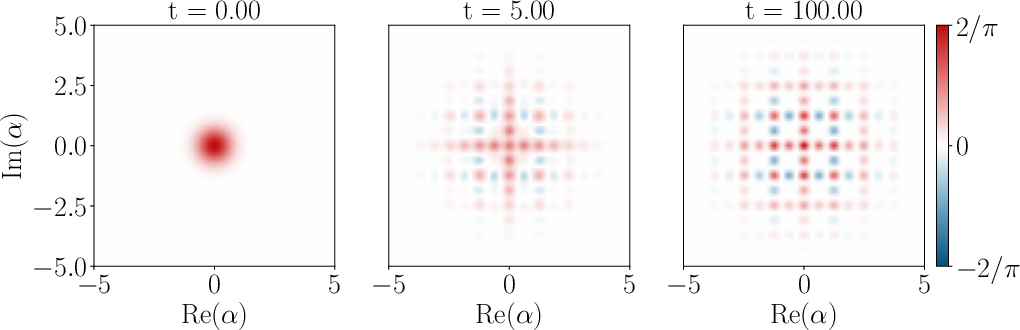
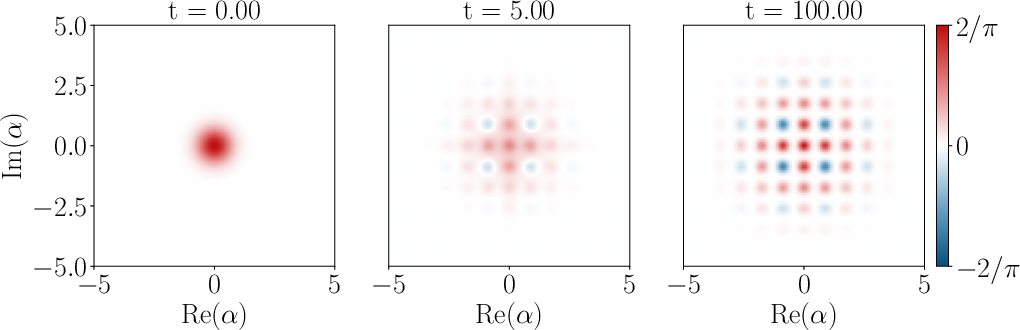
Figure 1: Long-time simulations of the two-dissipator Lindblad dynamics, showing stabilization into a GKP qubit (top) and qunaught (bottom) from vacuum initialization.
Simulations demonstrate convergence to high-fidelity GKP grid states, with the code space determined by the choice of η.
Energy Bounds and Stability Analysis
Explicit estimates are derived for the photon number evolution using duality arguments and operator inequalities. The key result provides an upper bound:
dtdTr(Nρt)≤−λ(ϵ,η)Tr(Nρt)+μ(ϵ,η)
where λ>0, 1/ϵ0 depend on dissipation parameters, ensuring bounded energy throughout trajectory. Notably, 1/ϵ1 is tunable and approaches 1/ϵ2.
Convergence of Logical Observables
Convergence rates for logical observables are analyzed using the adjoint Lindblad evolution (Heisenberg picture), projected onto periodic observables. The reduction leads to a one-dimensional differential operator acting on functions with periodic boundary conditions. Weighted Poincaré and Hardy-type inequalities are established to bound the spectral gap of the operator and, consequently, guarantee exponential convergence to the GKP codespace for relevant observables:
1/ϵ3
with 1/ϵ4 dependent on 1/ϵ5, 1/ϵ6, and the spectral gap constant.
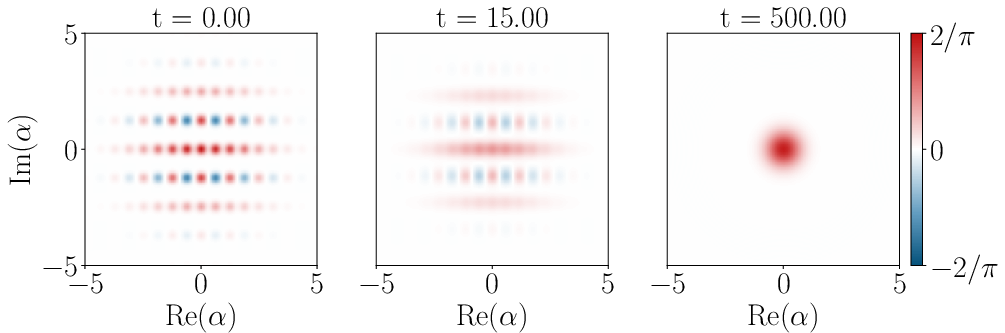
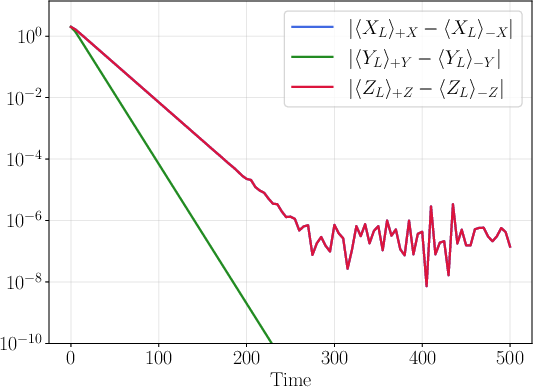
Figure 2: Evolution of an initial logical 1/ϵ7 state under photon loss, comparing unprotected evolution to dynamics with stabilization.
Robustness to Photon Loss
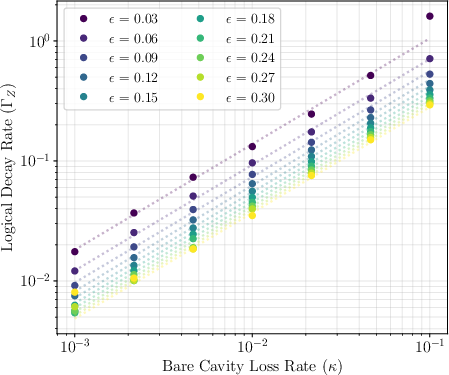
The effect of photon loss is modeled by extending the Lindblad equation with an additional dissipator proportional to the annihilation operator, parameterized by 1/ϵ8. Numerical results reveal that while logical information remains confined to the codespace, coherences within the codespace decay with a rate 1/ϵ9, which scales sub-linearly with photon loss rate and regularization parameter:
L1=sin(ηq)+iϵcos(ηq),L2=sin(ηq)−iϵcos(ηq)0
with fitted parameters L1=sin(ηq)+iϵcos(ηq),L2=sin(ηq)−iϵcos(ηq)1, L1=sin(ηq)+iϵcos(ηq),L2=sin(ηq)−iϵcos(ηq)2, L1=sin(ηq)+iϵcos(ηq),L2=sin(ηq)−iϵcos(ηq)3.
Figure 3: Decay of logical observables (L1=sin(ηq)+iϵcos(ηq),L2=sin(ηq)−iϵcos(ηq)4, L1=sin(ηq)+iϵcos(ηq),L2=sin(ηq)−iϵcos(ηq)5, L1=sin(ηq)+iϵcos(ηq),L2=sin(ηq)−iϵcos(ηq)6) as a function of time under photon loss, exhibiting exponential decay after initial transient.
Figure 4: Decay rate of logical expectation values vs. photon loss rate L1=sin(ηq)+iϵcos(ηq),L2=sin(ηq)−iϵcos(ηq)7 and regularization parameter L1=sin(ηq)+iϵcos(ηq),L2=sin(ηq)−iϵcos(ηq)8, showing power-law scaling.
This scaling is qualitatively worse than the four-dissipator dynamics, which achieves exponential suppression of logical error rates with respect to L1=sin(ηq)+iϵcos(ηq),L2=sin(ηq)−iϵcos(ηq)9 and η=π0.
Steady-State Metrological Grid State Stabilization
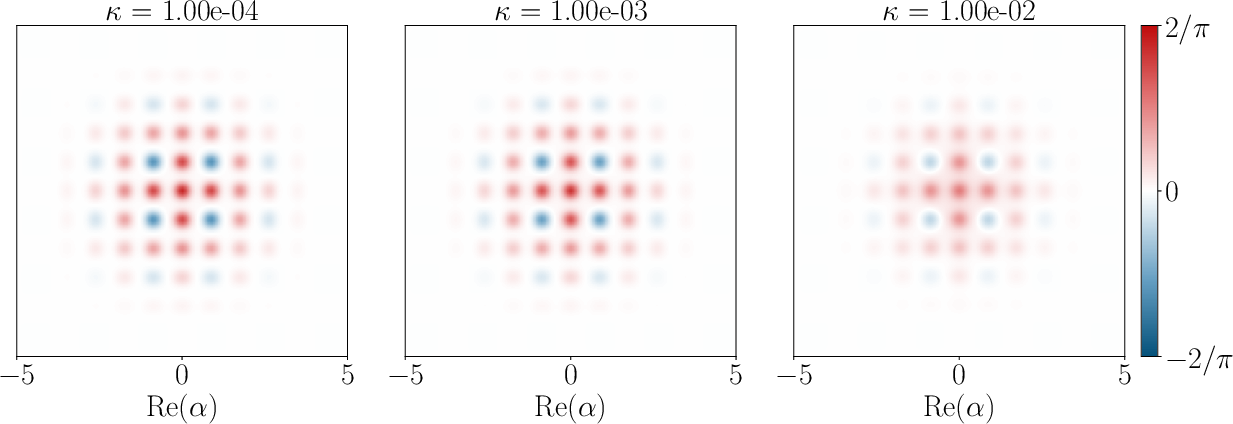
The protocol extends naturally to the stabilization of a GKP qunaught state for metrological applications. The two-dissipator scheme with appropriately chosen η=π1 stabilizes the grid structure, maintaining its modular phase sensitivity even in the presence of photon loss, relevant for multiparameter displacement sensing and quantum metrology.
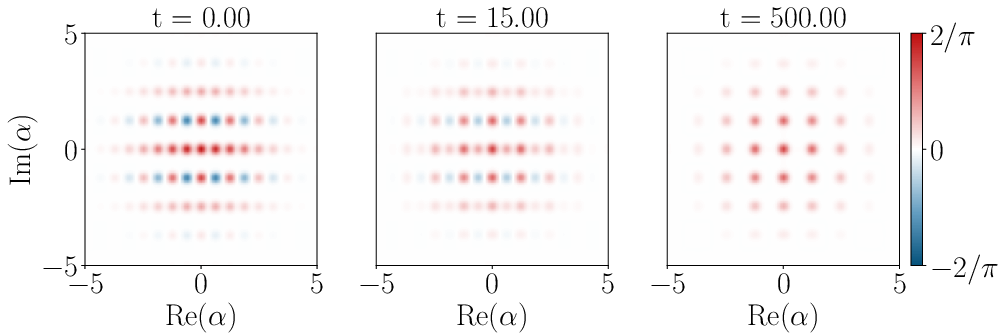
Figure 5: Steady-state of the two-dissipator Lindblad dynamics with photon loss for a GKP qunaught (metrological state), showing periodic structure preservation as η=π2 increases.
Implementation Considerations
The two-dissipator protocol significantly alleviates experimental overhead compared to four-dissipator approaches. In circuit QED, the reduced dissipator count translates to decreased hardware complexity and less stringent requirements for mode impedance, facilitating practical stabilization of GKP codes. In trapped ion systems, the scheme offers flexibility regarding the Lamb-Dicke parameter and could benefit from Quantum Signal Processing methods to compensate for hardware tunability constraints.
Conclusion
This work demonstrates that GKP grid states can be stabilized via a simplified Lindblad master equation with only two dissipation channels, yielding explicit energy bounds and exponential convergence rates. The approach trades robust logical decoherence protection for reduced experimental complexity, making it suitable as an initial validation platform and for metrological state preparation. Theoretical extensions to higher-dimensional grid codes and more general lattice structures are anticipated, with practical implementation closely tied to advances in reservoir engineering and coupling design.
The numerical and analytical evidence establishes the two-dissipator method as a viable compromise, with clear implications for QEC platforms and quantum sensing, and encourages further rigorous analysis and experimental realization of dissipative GKP state stabilization.