- The paper demonstrates coherent control of thermal transport by leveraging hybridization-induced band flattening in pillar-based phononic crystals.
- Finite-element simulations and BLS measurements confirm up to an order of magnitude reduction in thermal conductance for short-period designs.
- The study reveals that fabrication factors like pillar surface roughness induce a transition from coherent to incoherent phonon transport.
Coherent Control of Low-Temperature Thermal Transport in Pillar-Based Phononic Crystals
Introduction
The study explores coherent manipulation of phonon-mediated thermal transport in two-dimensional (2D) phononic crystals (PnCs) formed by periodic arrays of aluminum (Al) pillars on suspended amorphous SiNx membranes. The focus is on establishing robust, controllable reduction in thermal conductance via modifications in phonon dispersion, specifically leveraging both Bragg and hybridization bandgap mechanisms. Unlike traditional holey PnCs, pillar-based designs promise enhanced mechanical robustness, allowing for advanced phonon engineering in low-temperature regimes crucial for quantum technologies and ultrasensitive radiation detectors.
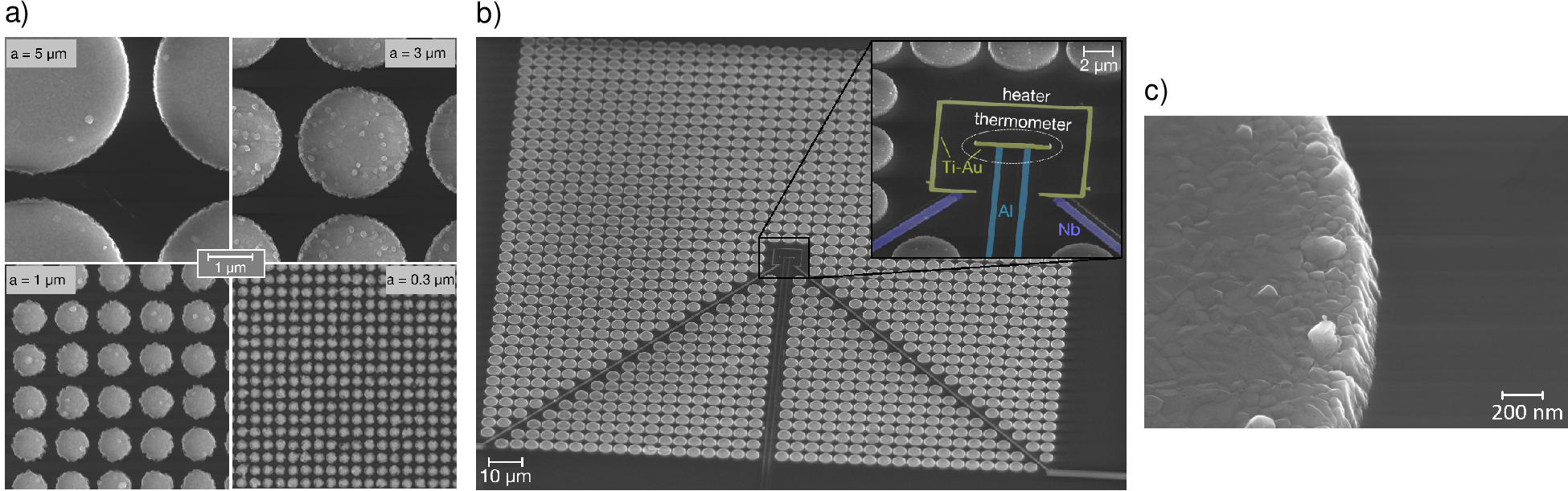
Figure 1: Pillar phononic crystal sample designs, including SEM images of all measured geometries, full sample view, and surface/sidewall roughness.
Device Architecture and Experimental Approach
The samples comprise 300 nm tall, cylindrical polycrystalline Al pillars with varying lattice constants (a=0.3,1,3,5 μm), all with fixed area filling factor (f=0.65), fabricated on 320 nm thick SiNx membranes suspended by etched Si substrates. Each device integrates a superconducting Nb-Au heater and a SINIS tunnel-junction thermometer, centrally located to maximize phonon emission and detection. The heater-thermometer configuration is specifically designed for ballistic transport, enhancing accuracy in radiative emission measurements by nearly eliminating geometrical correction factors. Al pillars act as insulating mechanical resonators in the superconducting regime (T<0.6 K), and electronic diffusive scattering channels are suppressed for thermal phonon energies below 2ΔAl.
Theoretical Band Structure and Spectral Analysis
Finite-element method (FEM) simulations, using experimentally determined material parameters (from Rutherford backscattering and Brillouin light scattering), reveal that periodic pillars induce pronounced flattening of phonon bands, especially via local mechanical resonances hybridizing with membrane modes. Multiple flat bands emerge in the frequency range relevant for sub-Kelvin phononics ($1-10$ GHz), triggering dramatic reductions in phonon group velocity and moderate increases in density of states (DOS).
All pillar PnC designs display increased DOS compared to pristine membranes, but the effective reduction in thermal conductance arises predominantly from suppressed group velocities around resonant frequencies. A narrow Bragg gap appears, but the dominant effect is hybridization-induced band flattening. High-resolution BLS measurements on the smallest-period (a=0.3 μm) PnC confirm simulation predictions, matching the experimentally observed lowest band flatness.
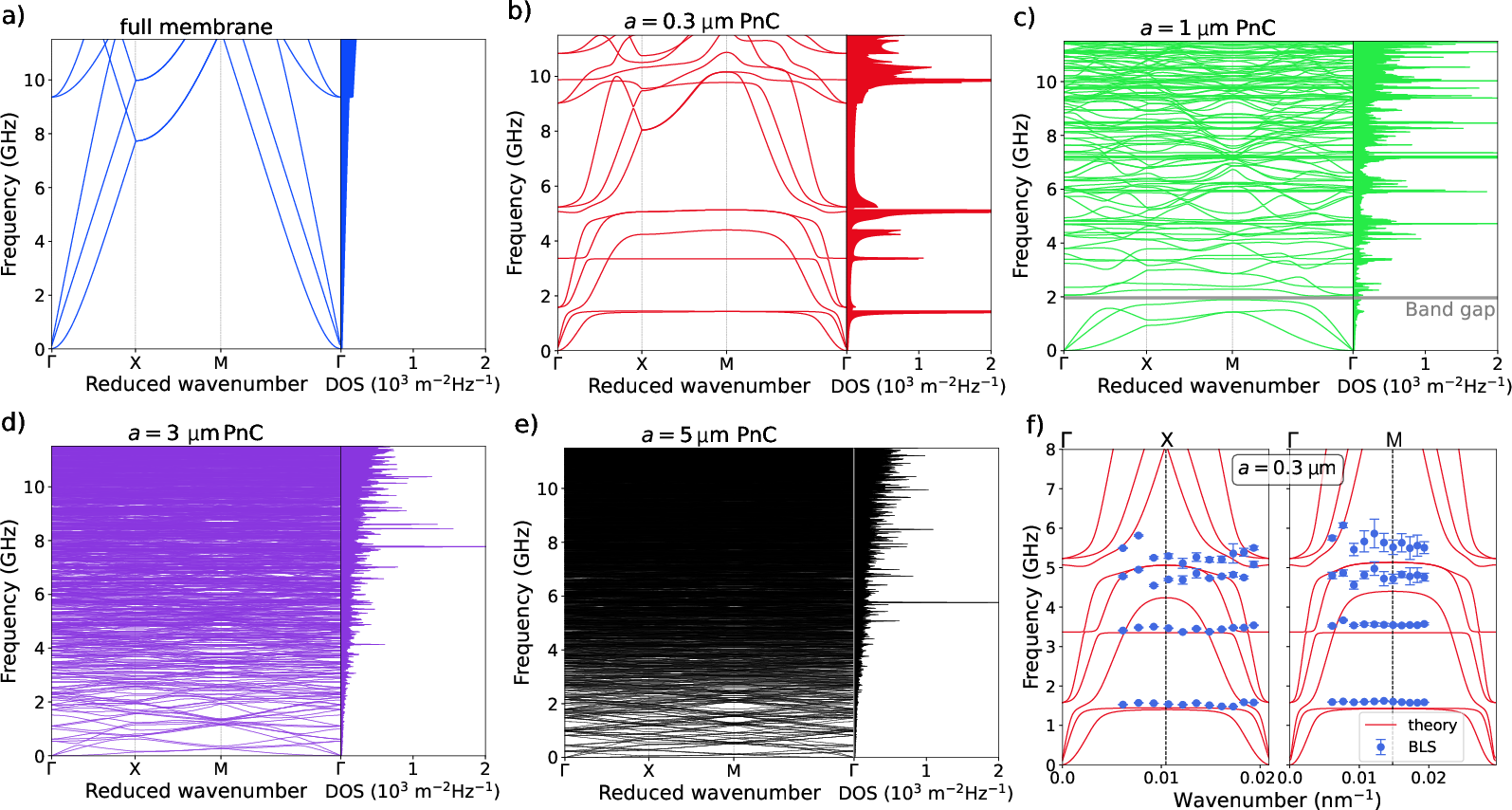
Figure 2: Band structure of the PnCs and comparison to BLS data, showing calculated phonon bands and DOS for all geometries.
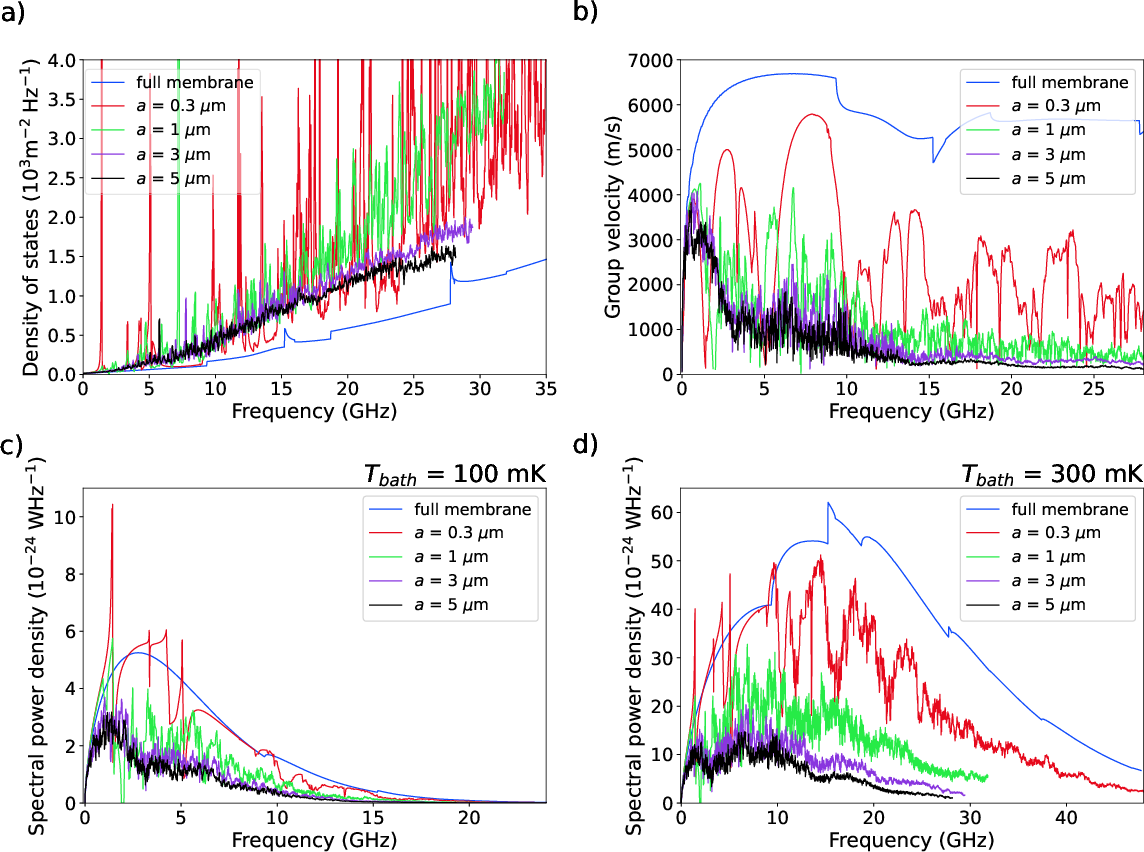
Figure 3: Spectral effects of the PnC band structures, illustrating DOS, average spectral group velocity, and calculated phonon spectral power densities at 0.1 and 0.3 K.
Modeling and Measurement of Thermal Conductance
Radiative phonon emission models integrate heater geometry and full band structure: emitted power P(T) is integrated over populated phonon states according to Bose distribution, and group velocity suppression dominates over DOS enhancement. For smaller periods (a≤1 μm), coherent simulations and experimental results align closely, verifying substantial reductions (up to an order of magnitude) in thermal conductance via coherent mechanisms. The measured temperature dependence agrees with simulations: a=0.3,1,3,50 for a=0.3,1,3,51 μm, with absolute conductance values only a factor a=0.3,1,3,52 lower than theory, and a=0.3,1,3,53 for a=0.3,1,3,54 μm, reaching specific conductance a=0.3,1,3,55 pW/(K·μm).
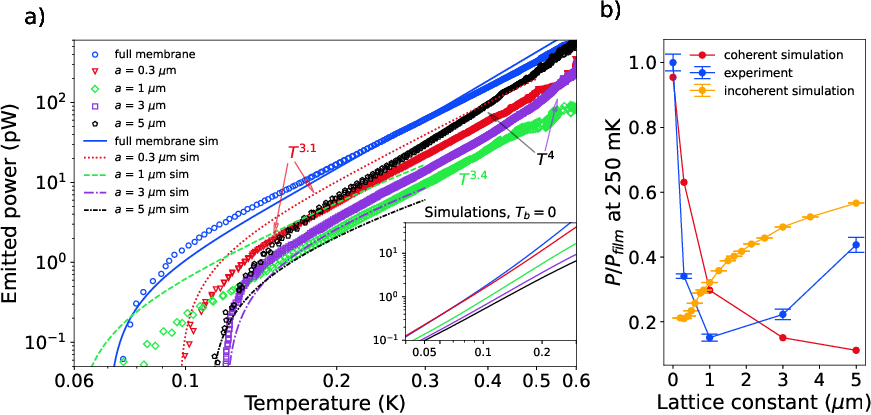
Figure 4: Experimental emitted phonon power and comparison to theory for membrane and pillar PnCs with various lattice constants.
For larger periods (a=0.3,1,3,56 μm), deviation from coherent theory is evident; conductance increases and power law exponent approaches a=0.3,1,3,57, indicative of incoherent, bulk-like or Casimir-limit phonon transport. Monte Carlo ray tracing simulations integrating mode conversions and roughness specularities further support this: conductance rises monotonically with increasing period, consistent with incoherent scattering predictions.
Robustness, Limitations, and Role of Surface Roughness
Fabrication and metrology indicate consistently rough pillar surfaces (rms roughness: 8 nm top, 70 nm sidewalls). For long wavelength phonons, roughness is less impactful in point-scattering regimes (short-period PnCs). However, for larger pillars, increased surface area and sidewall roughness promote diffusive, incoherent phonon scattering, rapidly degrading coherence and reverting transport to diffusion-dominated regimes. Monte Carlo simulations demonstrate minor sidewall roughness effects for conductance, but marker pillar height as a major factor in incoherent regime reduction.
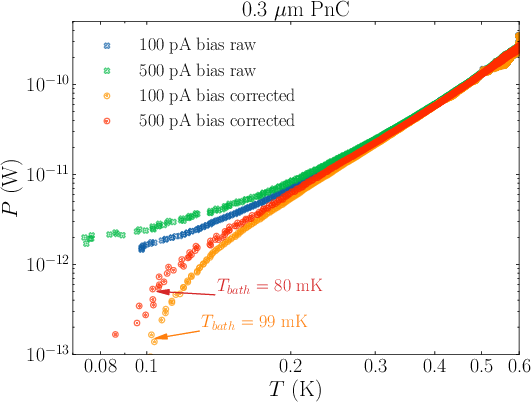
Figure 5: The effect of self-cooling on the thermometry, showing SINIS-junction cooling artifacts for low tunneling resistance.
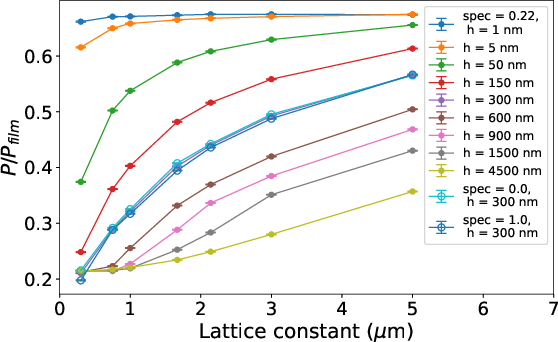
Figure 6: The effect of changing pillar height and sidewall roughness on Monte Carlo simulated conductance.
Implications and Prospects
The work robustly establishes pillar-based PnCs as a potent modality for coherent control of thermal transport at cryogenic temperatures, rivaling holey PnCs in effectiveness while providing greater mechanical robustness. The coherent reduction in conductance is predominantly governed by band flattening via hybridization resonances, as verified by both simulation and BLS. The crossover from coherent to incoherent transport with increasing period and pillar roughness reveals practical fabrication limitations.
Pillar-based PnCs are poised to facilitate advanced phonon engineering for quantum device platforms and low-noise detectors, with mechanical stability enhancing scalability and integration. Theoretical prospects include further reduction of conductance by decreasing membrane thickness or employing smoother pillar fabrication. Precision phonon transport manipulation via local resonances offers pathways toward phononic metamaterials, quantum phonon devices, and thermoelectric optimization.
Conclusion
Coherent modification of phonon dispersions in pillar-based 2D phononic crystals enables strong suppression of thermal conductance at cryogenic temperatures, up to an order of magnitude reduction. Experimental and theoretical analyses show agreement for short-period PnCs, while incoherent transport emerges for larger periods due to surface-induced diffusive scattering. This delineates clear routes for optimizing PnC designs and fabrication to maximize coherent effects, with broad applicability in quantum technology and ultrasensitive thermal management (2604.13527).