- The paper introduces an uncertainty framework that replaces the exact Gibbs state with a set of candidate equilibrium states, fundamentally altering resource purification.
- It presents no-go theorems demonstrating that nontrivial purification is only possible when target states are nearly equilibrium, which directly impacts work extraction and formation.
- The study contrasts clean and dirty battery models, revealing that equilibrium uncertainty leads to operational irreversibility and breaks the standard symmetry of thermodynamic resource theory.
Resource Theory of Quantum Thermodynamics with Uncertain Equilibrium
Motivation and Framework
The paper "Quantum thermodynamics with uncertain equilibrium" (2604.13524) challenges a foundational assumption of quantum thermodynamics: precise knowledge of the equilibrium Gibbs state. Experimental realities—uncertainty in system Hamiltonians and bath temperatures—necessitate a revised framework in which equilibrium is represented by a set of candidate states, not a single exact reference. The proposed framework models athermality as $(\sP, \sE)$, with $\sP$ the set of nonequilibrium states and $\sE$ the set of candidate equilibrium states. This approach generalizes prior black-box formulations and directly reflects experimental limitations.
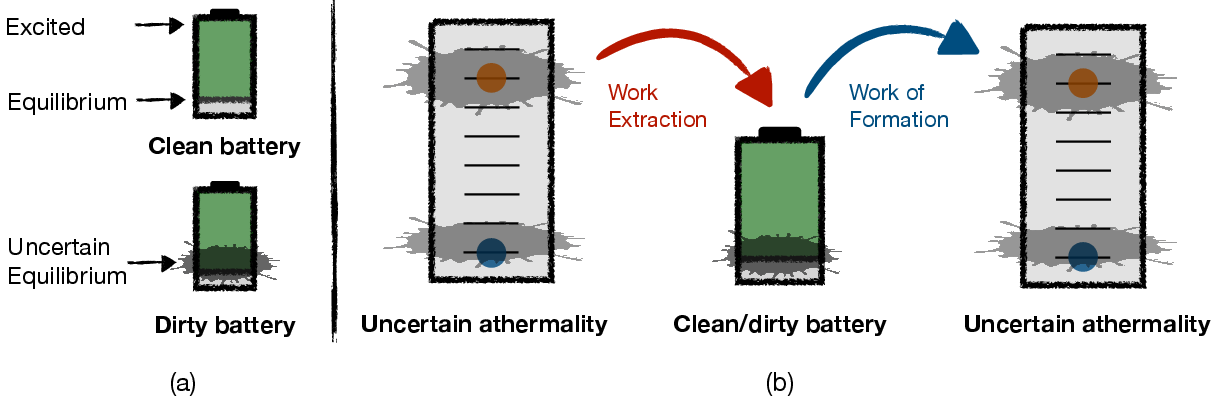
Figure 1: A schematic distinction between clean and dirty batteries, illustrating work extraction and formation under precise and uncertain equilibrium references.
No-Go Theorems and Fundamental Limitations
A central contribution is a sequence of no-go theorems that characterize the consequences of equilibrium uncertainty. The paper proves that, under generic conditions ($\conv(\sP)\cap\aff(\sE)\neq\emptyset$), purification of an uncertain athermality resource—conversion to a definite target, (ρ′,τ′)—is either trivial or impossible. Specifically, conversion is possible if and only if the target is ϵ-close to an equilibrium state, ruling out any nontrivial purification. This result is independent of positivity or complete positivity, relying only on linearity and Gibbs preservation. When applied to work extraction, the theorem precludes any conversion to a fully charged clean battery unless the maximal trace-distance error exceeds $1-1/M$.
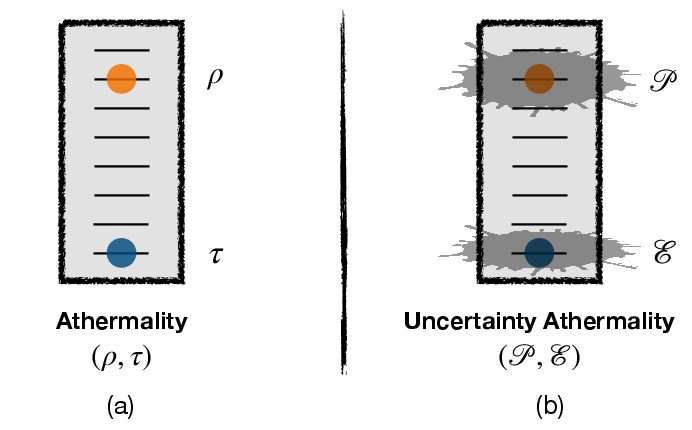
Figure 2: Comparison of athermality descriptions in standard and uncertainty frameworks; the uncertain setting uses sets $\sP$ and $\sE$, reflecting partial knowledge.
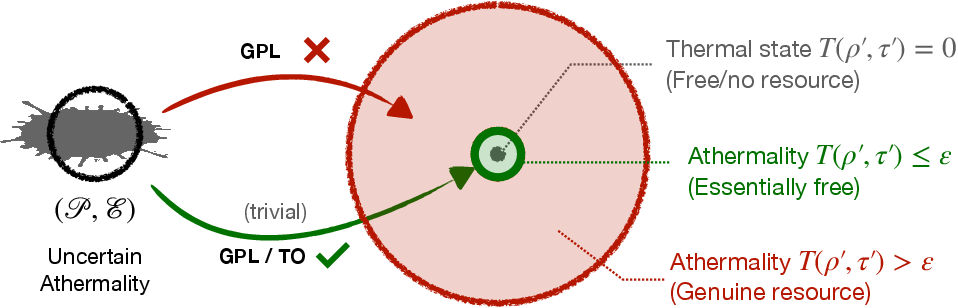
Figure 3: Geometric illustration that purification is only possible if the target state is ϵ-close to equilibrium; otherwise, conversion is forbidden.
The geometric condition is practically generic, arising from arbitrarily small perturbations in system parameters. Even minuscule uncertainty destroys the possibility of nontrivial resource purification, an outcome distinct from no-go theorems in other resource theories such as entanglement.

Figure 4: Uncertainty in external field directions translates to affine span of equilibrium states in the Bloch sphere, satisfying conditions for the no-go theorem.
Battery Models: Clean vs Dirty
To interrogate operational consequences, the authors introduce two battery models:
- Clean Battery: equilibrium state precisely specified.
- Dirty Battery: equilibrium state uncertain within some prescribed set.
Under equilibrium uncertainty:
- For a clean battery, extractable work is characterized by a subspace-constrained min-relative entropy, while formation cost is given by the usual max-relative entropy.
- For a dirty battery, extraction is governed by standard min-relative entropy, while formation is constrained (subspace-constrained max-relative entropy).
Notably, the standard operational symmetry (second-law reversibility) between extraction and formation breaks down: the entropic quantities governing these tasks are not dual within a fixed battery model.
Operational and Geometric Characterizations
The extractable work and work of formation are precisely characterized in one-shot settings, using smoothed min- and max-relative entropies with geometric constraints:
- Subspace-constrained min-relative entropy captures the penalty imposed by equilibrium uncertainty in clean batteries, forcing hypothesis tests to be calibration-free.
- Subspace-constrained max-relative entropy encodes the geometry of the equilibrium uncertainty set in dirty batteries, reflecting the operational challenge in formation tasks.
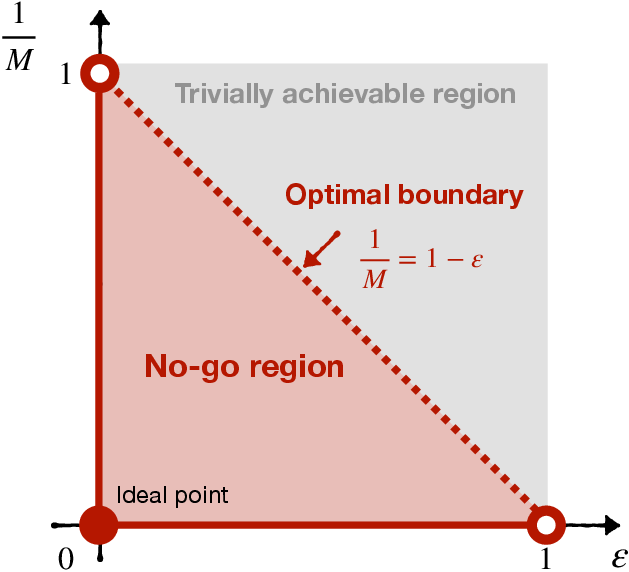
Figure 5: Under uncertainty, the region $\sP$0 is strictly forbidden for work extraction; only trivial transformations are possible beyond this boundary.
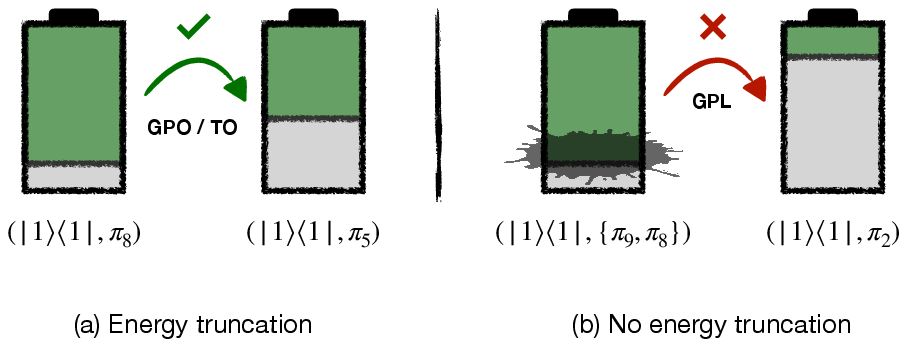
Figure 6: In the standard theory, battery capacity can be freely truncated; equilibrium uncertainty eliminates this monotonicity, forbidding truncation for nontrivial target capacity.
Irreversibility and Asymptotic Regime
In the asymptotic regime (i.i.d. resources), equilibrium uncertainty induces a strong form of thermodynamic irreversibility, even for vanishingly small uncertainty:
- In the clean battery model, extractable work per copy vanishes, while formation cost per copy remains finite—a thermodynamic analogue of bound entanglement.
- In the dirty battery model, extraction remains finite but formation cost diverges.
This strict separation of asymptotic rates violates reversibility and second-law symmetry of standard resource theory, fundamentally reshaping core operational limits.
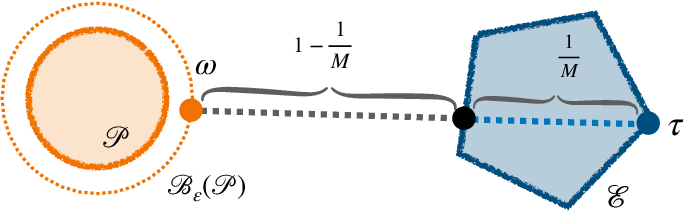
Figure 7: Work cost from a dirty battery is determined by the line segment geometry; the entire segment must remain within the equilibrium uncertainty set for achievability.
Implications and Outlook
The findings have substantial theoretical and practical implications:
- Resource Theory Structure: Equilibrium uncertainty produces qualitative shifts—standard monotonicity and reversibility disappear, and operational distinctions between classes of free operations (TO, GPC, GPO, GPL) collapse.
- Experimental Relevance: Even minute imperfections suffice to destroy familiar thermodynamic regimes, requiring models that account for calibration, drift, and noise.
- Resource Theory Generalization: Extending to other unspeakable resources (coherence, reference frames, asymmetry) may recapitulate analogous no-go phenomena.
- Foundational Perspective: The results indicate that strongly operational thermodynamic limitations arise from quantum structure (linearity, Gibbs preservation) and are not artifacts of classical or idealized protocols.
Speculatively, future work may focus on designing resource frameworks robust to uncertainty, quantifying minimal additional resources required to restore reversibility, or identifying operational regimes where uncertainty can be mitigated or compensated.
Conclusion
This paper establishes that equilibrium uncertainty is not a minor perturbation but a qualitative ingredient reshaping quantum thermodynamics. The resource-theoretic approach with uncertain equilibrium models delivers new structural and operational insights, including no-go theorems, geometric constraints on work extraction and formation, and intrinsic irreversibility in both one-shot and asymptotic regimes. The analysis is rigorous, technically comprehensive, and opens multiple future research directions in the theory and practice of quantum resource manipulation under realistic conditions.