- The paper demonstrates that injection locking enables phase-coherent, distributed optical computing for real-time dot-products and matrix operations.
- It quantifies trade-offs between injection ratio, detuning, and nonlinear effects, with lower ratios yielding improved modulation suppression and stability.
- The findings provide practical guidelines for designing photonic accelerators that bypass conversion penalties, enhancing energy efficiency in AI and simulation tasks.
Distributed Coherent Optical Computing via Injection-Locked Photonic Networks
Motivation and Conceptual Framework
The escalation of computational demand, particularly for neural networks and linear algebra primitives, has exposed the throughput and energy efficiency limitations of conventional electronic computing hardware. Photonic computing has been explored as an alternative, offering inherent parallelism and high bandwidth, but current distributed optical strategies typically rely on amplitude-only encoding, with substantial penalties due to optical-to-electrical (O-E) and analog-to-digital (A-D) domain conversions at interconnect boundaries. These limitations hinder real-time, in-network computations and bottleneck scaling in distributed data-centric workloads.
This paper introduces optical injection locking (OIL) as a fundamental mechanism for distributed, coherent optical computing, enabling remote phase locking and mutual coherence between nodes. OIL facilitates networked, phase-stable processing directly in the optical domain, eliminating unnecessary conversions and buffering. The proposed architecture leverages semiconductor laser injection locking to create a coherent, phase-matched copy of a remote optical source at each node, with scalable fanout and parallel computation on unmodulated carrier signals. This approach supports complex-valued encoding with carrier phase information retained, and enables scalable, real-time linear operations such as dot products and matrix multiplications across distributed photonic chips.
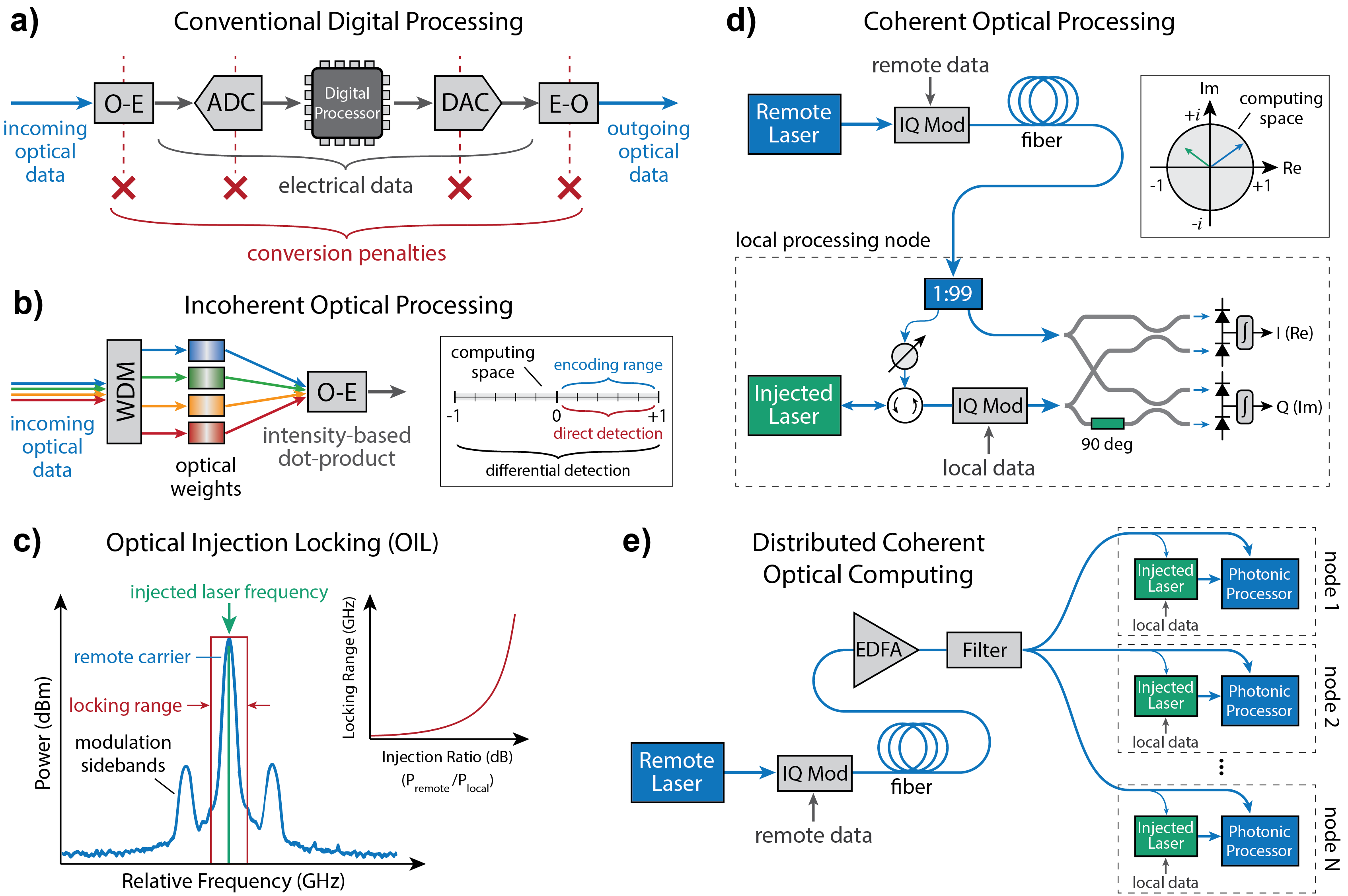
Figure 1: Schematic comparison of conventional digital, incoherent optical, and distributed coherent architectures, highlighting OIL’s coherence-maintaining, scalable photonic network capabilities.
Injection Locking Dynamics: Locking Range and Trade-Offs
The paper quantitatively models injection locking in semiconductor lasers using rate equations, focusing on carrier-level phase and amplitude stability. The classical Adler locking condition is extended to include amplitude-phase coupling via the linewidth enhancement factor α, introducing asymmetry and nonlinear dynamical features in the locking range. The locking window is mapped as a function of power injection ratio and frequency detuning between the remote and injected lasers.
Broad injection ratios are simulated, revealing that higher injection powers expand the locking margin but introduce greater sensitivity to amplitude-phase mixing and nonlinear instabilities, particularly for α=0. Conversely, lower injection ratios yield narrower, more predictable and stable operating windows, mitigating residual oscillation and drift. Stability metrics are empirically defined by thresholding the normalized intensity and phase excursion.
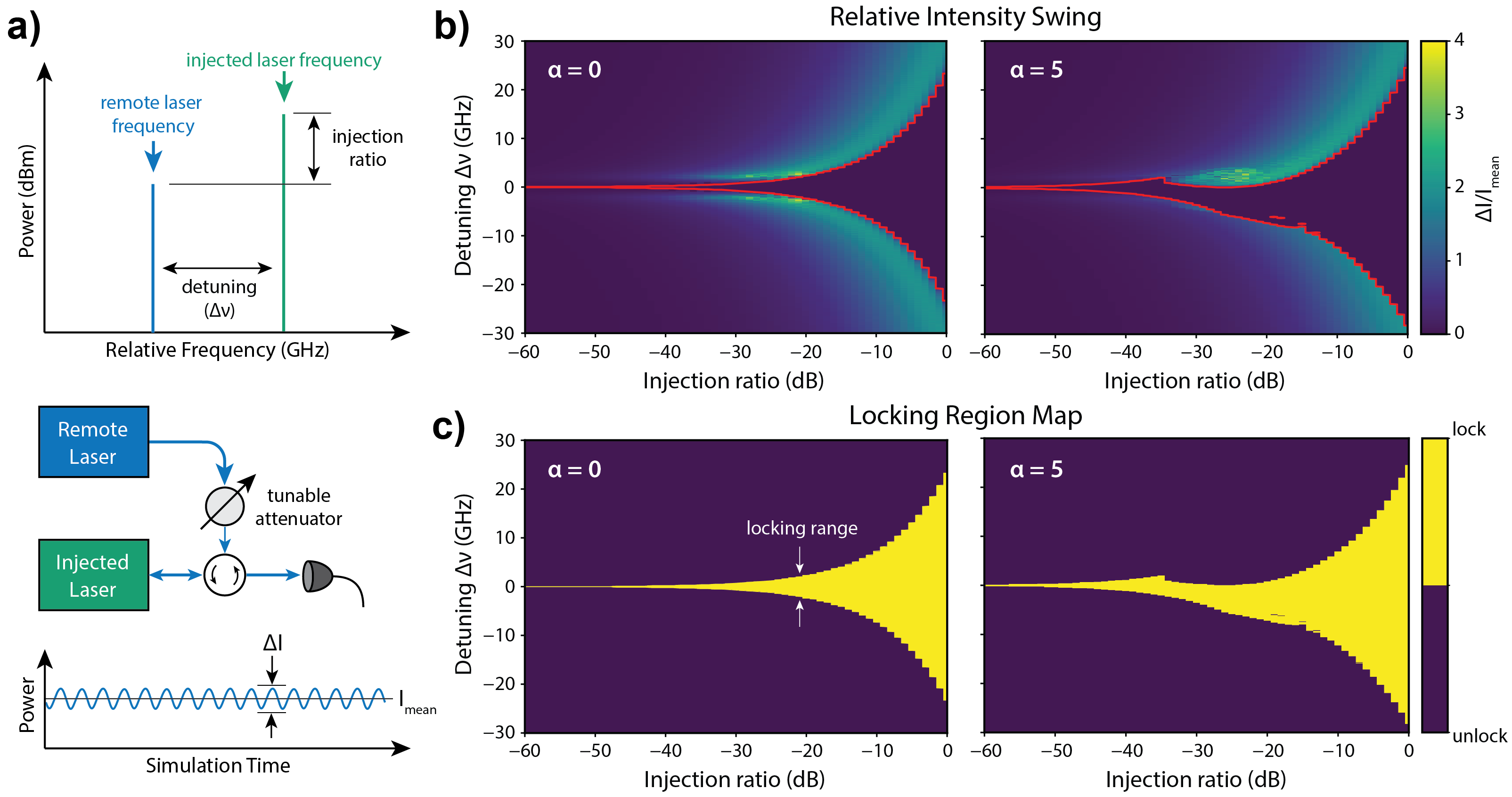
Figure 2: Simulated 2D locking-region maps showing injection ratio and detuning dependence, with clear threshold-based amplitude/phase stability delineations and α-induced asymmetry.
Modulation Transfer and Nonlinear Effects
The frequency-dependent transfer functions between remote modulation and injected laser output are assessed for both amplitude (AM) and phase (PM) modulation using small-signal and large-depth scenarios. The transfer-function analysis shows that stronger injection enhances the coupling of source modulation into the injected laser, especially near the relaxation-oscillation (RO) frequency, where resonance leads to signal amplification and dynamical distortion.
Notably, the RO peak frequency shifts as a function of injection ratio and α, with higher ratios producing sharper peaks and stronger nonlinear features. Amplitude-phase crosstalk channels (AM→PM and PM→AM) become significant for α=0, introducing interchannel distortion. These effects are especially pronounced with increasing modulation depth, making the low-injection regime preferable for operational stability and reduction of residual modulation artifacts.
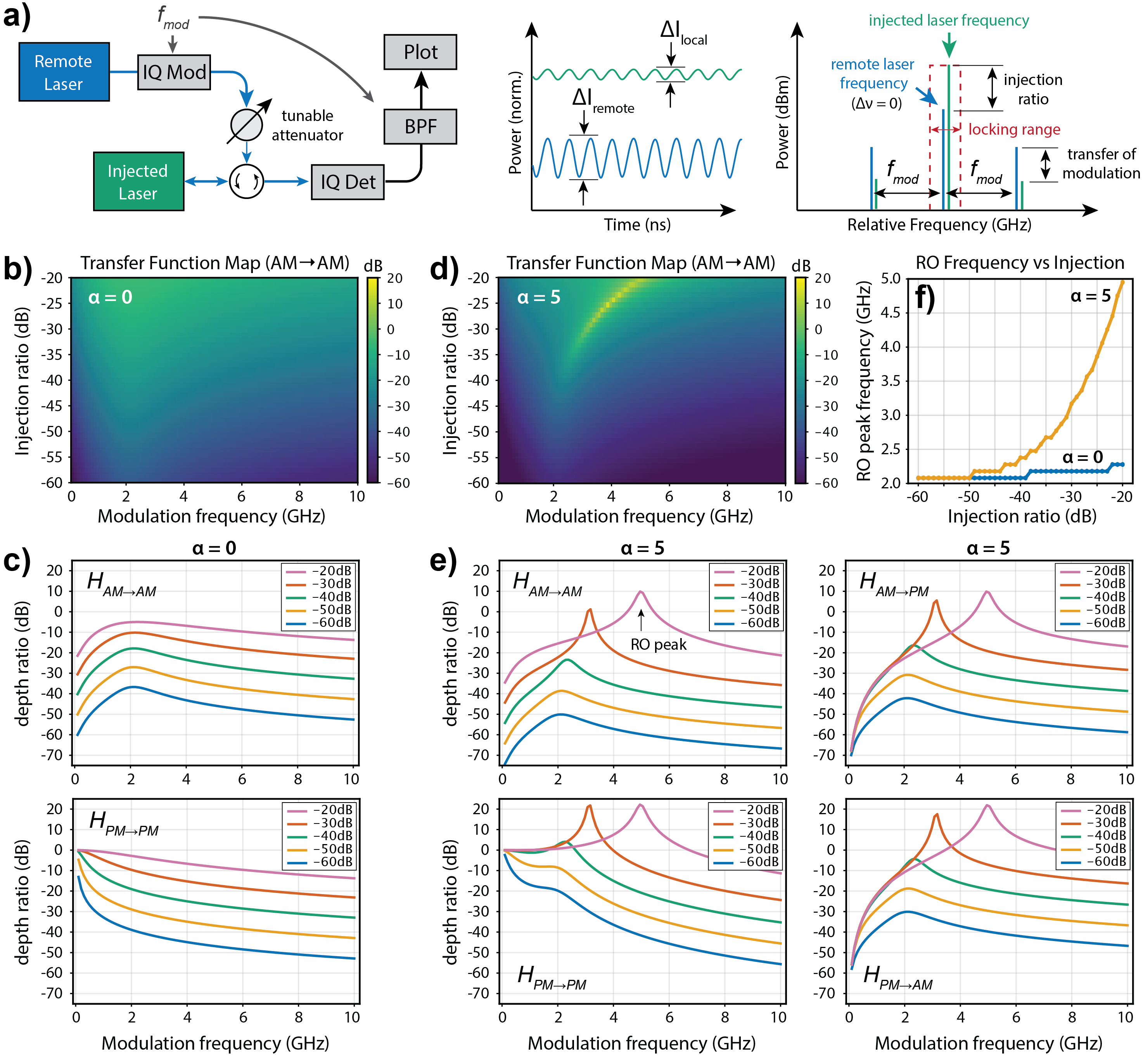
Figure 3: Injection-ratio dependency of AM→AM transfer-function heatmaps and RO frequency shifts, visualizing the nonlinear spectral structure and amplitude-phase crosstalk.
The detuning-resolved transfer maps further elucidate the trade-off: higher injection ratios tolerate broader detuning but manifest pronounced nonlinear instability, while lower ratios enforce stricter detuning requirement yet provide steadier transfer suppression of modulation sidebands, minimizing unwanted cross-modulation.
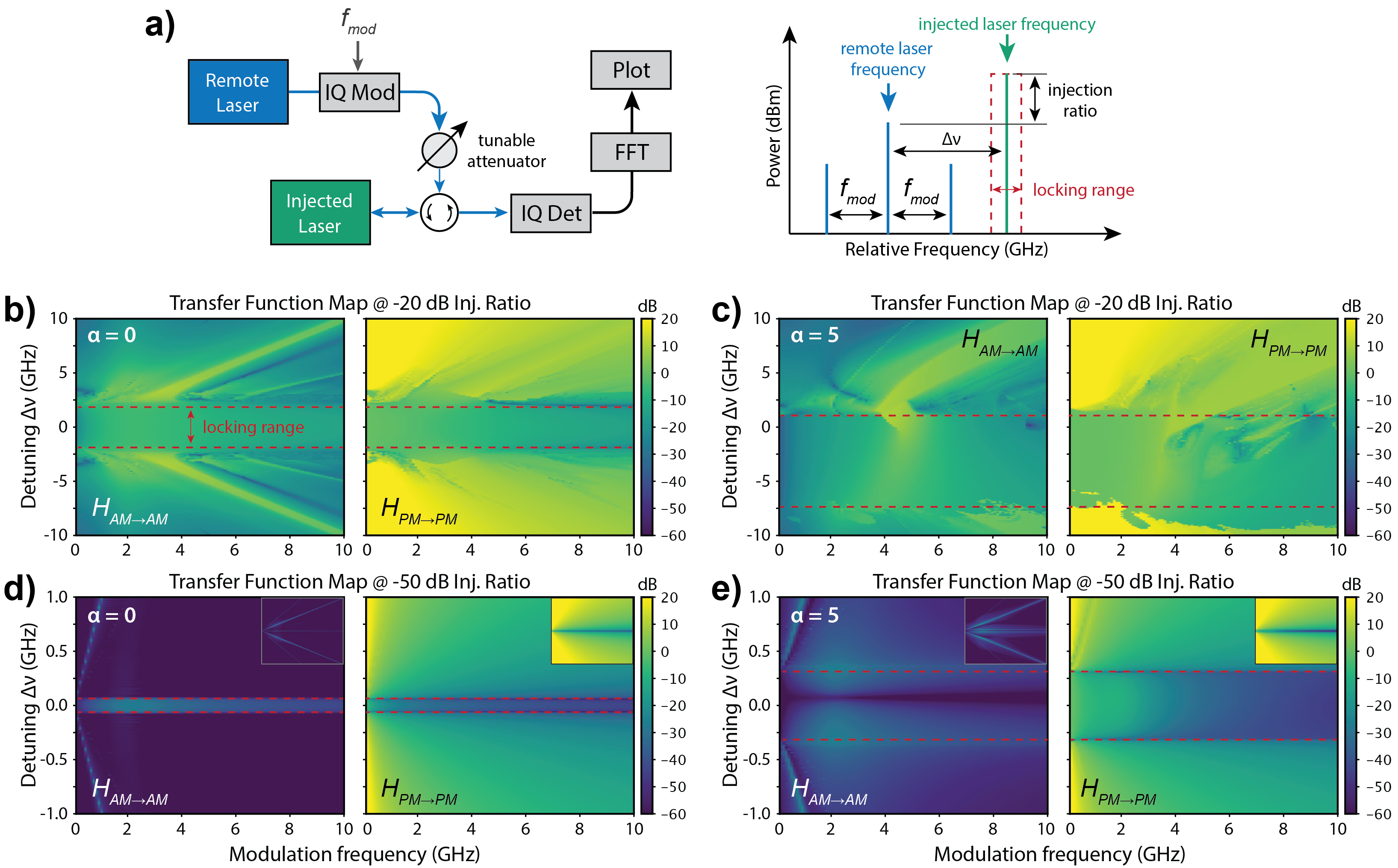
Figure 4: Detuning-resolved transfer-function heatmaps highlighting injection ratio and α's impact on width, symmetry, and dynamical stability of the locking window.
Modulation depth sweeps at low injection reveal that, aside from the RO neighborhood for α=5, the AM response is robust and suppression is nearly invariant across depth. PM-driven responses display systematic roll-off and localized distortion only at high depth and near the RO peak, indicating clearly controllable nonlinearity boundaries for practical system design.
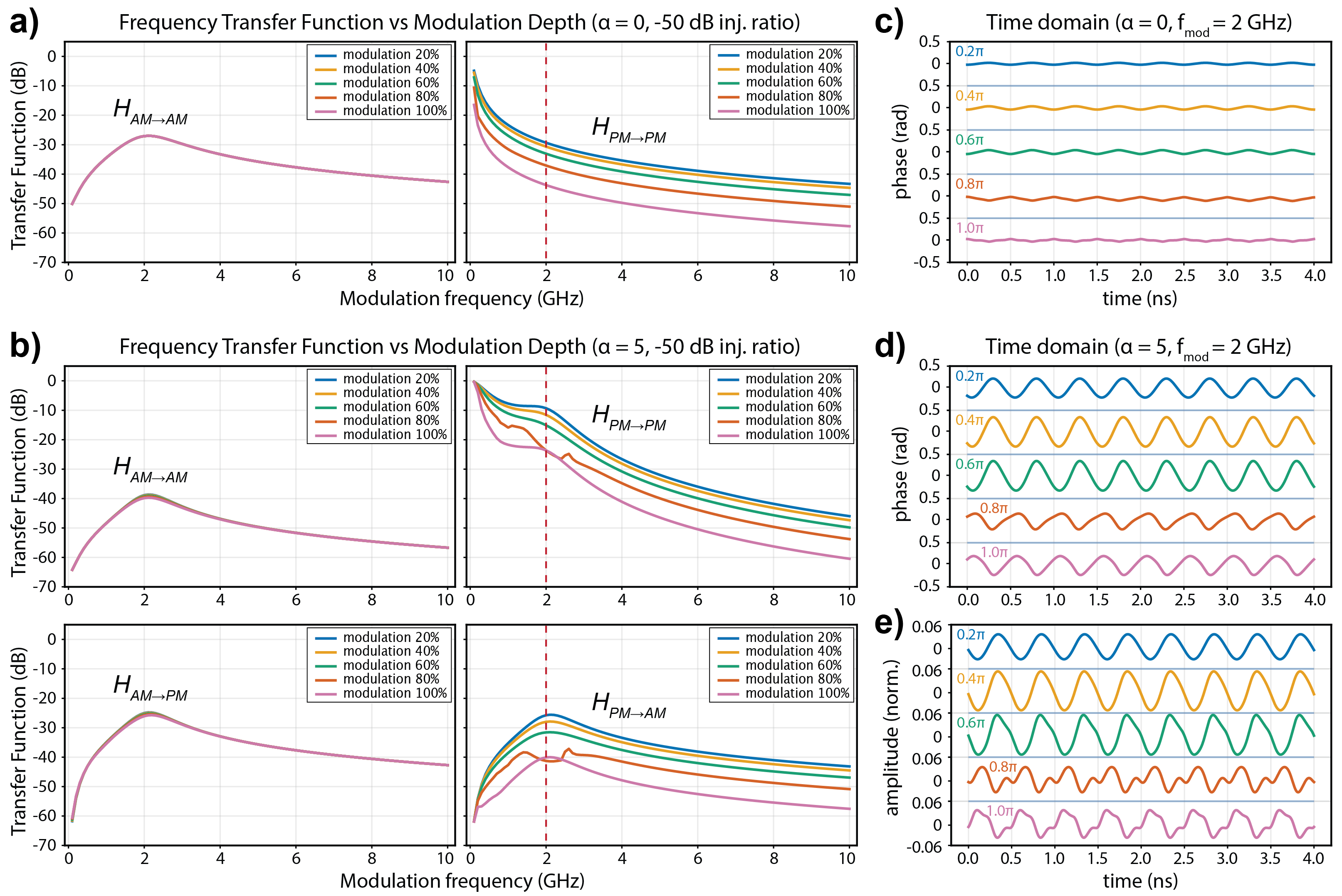
Figure 5: Modulation-depth sweeps at low injection, demonstrating transfer function robustness, time-domain waveform distortion, and frequency-doubling signatures for high-depth PM near RO.
Practical System-Level Evaluation: Symbol Sequence Operations
End-to-end symbol sequence simulations are performed, modeling distributed multiply-accumulate (MAC) operations using balanced photodetection. Realistic real-valued symbol streams, encoded with DC-balanced antipodal pairs, are transmitted and processed, with the injected laser serving as a carrier-locked oscillator isolated from residual remote modulation.
Temporal and spectral analyses confirm that lowering the injection ratio reduces residual modulation artifacts, improves waveform fidelity, and minimizes coupling of remote modulation into the injected laser. The FFT ratio spectra and dot-product integrals demonstrate closer convergence toward ideal no-injection benchmarks for lower injection ratios, validating the expected computational accuracy improvements.
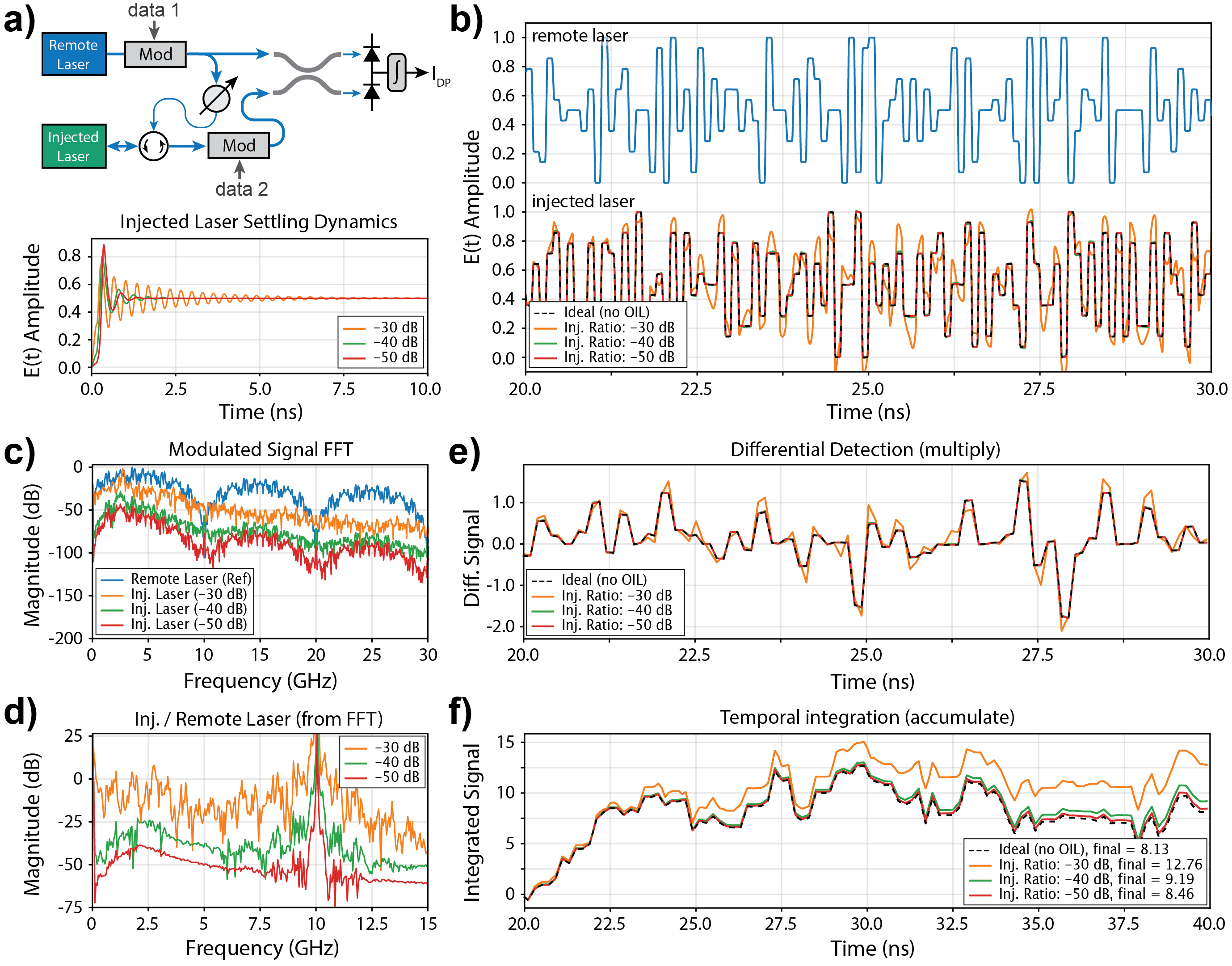
Figure 6: Symbol-level simulation of distributed MAC operations, with spectrally resolved suppression of remote modulation and improved fidelity/integrated accuracy at lower injection ratios.
Theoretical and Practical Implications
The findings underscore the central trade-off between injection ratio (locking margin and detuning tolerance) and modulation suppression (computational fidelity) in distributed coherent optical networks. Theoretical modeling confirms that optimal operation resides at the lowest injection ratio compatible with environmental phase drift and network detuning. Placement of processing bandwidth relative to the RO frequency is essential, particularly for semiconductor lasers with nonzero α=00, to avoid nonlinear amplification and mixing.
Practically, OIL enables scalable, real-time dot-product and matrix-vector operations with phase-coherent networking, eliminating O-E/A-D conversion penalties. This is critical for future photonic accelerators and in-network processing platforms for AI workloads and scientific simulation. Future research directions include inclusion of spontaneous emission noise, channel impairments, polarization drift, WDM compatibility, and experimental validation, together with advances toward full matrix-multiply architectures and throughput scaling.
Conclusion
This work provides an authoritative simulation-based assessment of OIL-enabled distributed coherent photonic computing. Quantitative trade-offs are established for carrier-level locking, modulation suppression, and nonlinear response, setting principled guidelines for architecture and system design. The injection locking approach is validated as a viable foundation for scalable, high-fidelity optical dot-product computation across remote nodes, offering pathways to photonic accelerators with unmatched energy efficiency and throughput.