- The paper introduces a framework using active pumping to bypass Manley-Rowe constraints, enabling infinite momentum bandgaps with minimal modulation.
- It employs plasma frequency modulation in Lorentz-dispersive materials along with spatial nonlocality to uniformly split polaritonic bands.
- Proof-of-concept experiments validate ultra-broadband parametric amplification across resonator modes, opening new avenues for photonic device applications.
Infinite Momentum Bandgaps in Nonlocal Photonic Time Crystals: Theory, Realization, and Implications
Introduction
The manuscript "Nonlocal photonic time crystals: Infinite momentum bandgaps with minimal modulation speed and strength" (2604.13444) systematically reexamines the physical limitations of photonic time crystals (PTCs) and develops a rigorous framework enabling the realization of infinite momentum bandgaps through minimal temporal modulation. Traditional approaches to PTCs are constrained by the Manley-Rowe relations, requiring ultra-fast and strong modulation of material parameters—conditions unattainable at optical frequencies given realistic technological constraints. The authors introduce a conceptually distinct regime: active pumping, achieved by modulating the plasma frequency in Lorentz-dispersive materials and incorporating spatial dispersion (nonlocality). The resulting synthesis provides a path to arbitrarily wide momentum bandgaps, both theoretically and experimentally, with orders-of-magnitude relaxation of required modulation speed and strength.
Physical Foundations and Parametric Resonance in PTCs
Momentum bandgaps, the temporal analog of frequency bandgaps in spatial photonic crystals, arise via parametric resonance when a material property (e.g., permittivity ε(t)) is modulated in time. Standard implementations, modulating reactive elements, encounter stringent coupled conditions: observable momentum bandgaps require both unity-order modulation strength and modulation rates at least twice the signal frequency. These conditions stem from the Manley-Rowe relations and restrict practical implementations at optical frequencies.
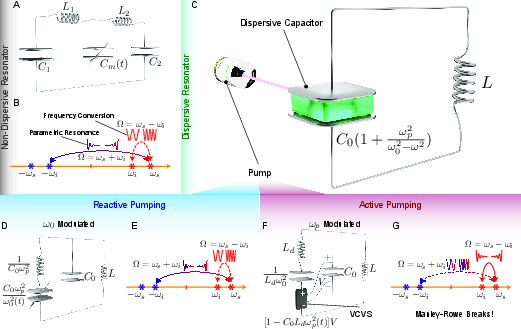
Figure 1: Parametric interactions in non-dispersive and dispersive multi-resonant circuits highlighting the distinction between reactive and active pumping regimes for time modulation.
A crucial theoretical advance in the manuscript is the distinction between reactive and active pumping. Reactive pumping involves modulating elements such as capacitors, leading exclusively to counter-oscillating parametric resonance (e.g., Ω=2ωs) and enforcing strict Manley-Rowe constraints. Active pumping, in contrast, is realized by modulating dependent sources (e.g., voltage-controlled voltage/current sources) and can break these constraints, allowing co-oscillating parametric resonance (Ω=ωs−ωi) with arbitrarily small Ω. By establishing the equivalence between plasma frequency modulation in Lorentz-dispersive materials and active circuit elements, the authors extend these circuit concepts to the optical domain, circumventing traditional speed limitations.
Dispersion Engineering and Spatial Nonlocality
The theory is generalized to propagating waves in dispersive media where the plasma frequency ωp is time-modulated. In standard Drude-Lorentz media, co-propagating momentum bandgaps are achievable, but their width is limited due to non-uniform separation between hybridized polaritonic bands. The authors propose and rigorously analyze a nonlocal, spatially dispersive medium described by a permittivity ε(ω,kz)=1+ωp2/(kz2c02−ω2). This nonlocality uniformly splits dispersion branches, and by modulating ωp at a frequency equal to the average band separation, an infinite momentum bandgap is realized.
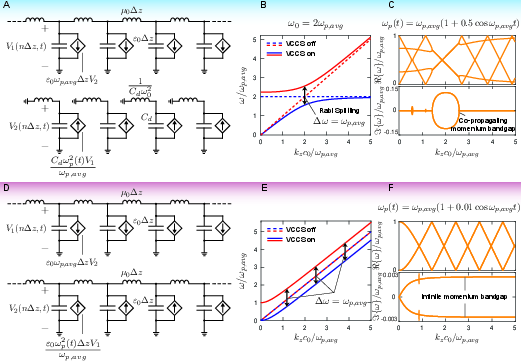
Figure 2: Co-propagating momentum bandgaps in dispersive and nonlocal systems, illustrating circuit analogs and band diagrams for distinct parametric coupling regimes.
The exact transmission-line model elaborates the structure, validating that purely local dispersive coupling results in limited bandgap width, whereas nonlocal coupling via two identical transmission lines leads to parallel dispersion branches and infinite bandgaps under time modulation. The theoretical architecture is further mapped to a material system via spatio-temporal constitutive relations, demonstrating spatial and temporal nonlocality in the medium's response.
The authors implement a proof-of-concept low-frequency experimental setup using commercial voltage-controlled current sources (VCCSs) in a dual-line Fabry-Pérot resonator. The experiment confirms that once the modulation strength surpasses a threshold accounting for intrinsic component losses, all Fabry-Pérot modes undergo exponential amplification independent of mode frequency, a direct signature of the infinite momentum bandgap predicted by theory.
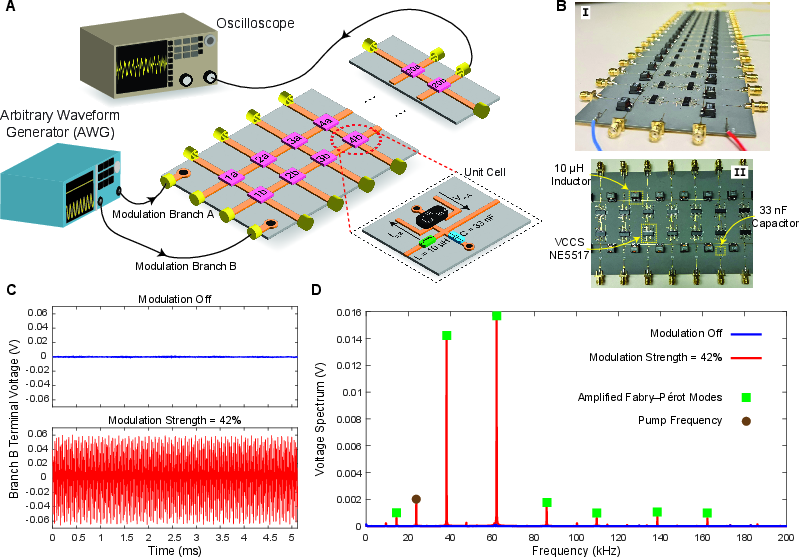
Figure 3: Experimental demonstration of an infinite momentum bandgap in a dual-line Fabry-Pérot resonator, with broadband amplification across all resonator modes.
For practical realization at optical frequencies, the authors propose a wire medium metamaterial whose effective permittivity tensor exhibits the required spatial and frequency dispersion. The analysis demonstrates that while band separation in such metamaterials is not perfectly uniform, it asymptotically approaches a constant, yielding a semi-infinite momentum bandgap under slow modulation.
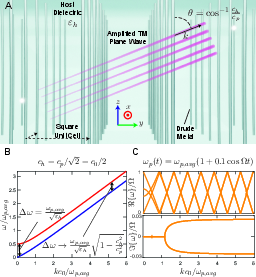
Figure 4: Infinite momentum bandgap in a nonlocal PTC metamaterial modeled by an array of metallic wires in a dielectric host, showing parallelization of dispersion branches.
Implications, Contradictory Claims, and Outlook
The work makes several strong claims:
- Infinite momentum bandgaps, with exponential amplification across arbitrary frequencies and momenta, are achievable in physically realizable metamaterials with arbitrarily low modulation speed and strength.
- The Manley-Rowe limitation on modulation frequency is strictly circumvented only via active pumping achieved through plasma frequency modulation in dispersive media and spatial nonlocality, in contradiction to the widely held assumption that ultra-fast modulation is an unavoidable requirement.
- Experimental results confirm ultra-broadband parametric amplification with modulation frequencies orders-of-magnitude below the resonator frequencies, directly validating the theoretical predictions.
These claims challenge prior studies [Ref29], which achieved wide bandgaps only at fixed frequencies with modulation rates at least twice the wave frequency, fundamentally limited by dispersion characteristics. The authors supply a theoretical framework and practical recipe to bypass these constraints entirely.
The theoretical implications are profound. Infinite momentum bandgaps facilitate universal exponential amplification and control over light-matter interactions, laying the foundation for new parametric circuit amplifiers, optoelectronic devices, spectral engineering, and quantum photonic platforms. Practically, the relaxation of modulation requirements enables implementation at RF, microwave, and optical frequencies using mature technologies such as RFIC/MMIC [Ref28], integrated waveguides, and metamaterials.
Anticipated future directions include experimental realization of nonlocal PTCs at higher frequencies, fine-tuning of nonlocality in wire media for complete bandgap parallelization, and exploration of advanced quantum light-matter interaction regimes enabled by infinite momentum bandgaps.
Conclusion
This manuscript rigorously establishes a theoretical and experimental pathway for realizing infinite momentum bandgaps in photonic time crystals via minimal modulation speed and strength, achieved through active pumping in spatially and temporally nonlocal dispersive media. The explicit violation of canonical Manley-Rowe constraints enables unprecedented optical phenomena and amplification regimes, backed by both analytical modeling and proof-of-concept experiments. The approach unlocks new opportunities for ultrafast, broadband photonic devices, advanced quantum optical systems, and next-generation wave engineering platforms.

