- The paper introduces a narrow-band CaHK photometry method to efficiently select low-metallicity stars in the Jet stellar stream.
- It applies rigorous proper motion, CMD, and metallicity cuts to achieve an 82% purity and 88% recovery of spectroscopically confirmed members.
- The analysis reveals a narrow stream core with significant trailing broadening, suggesting dynamic fanning influenced by Galactic interactions.
Scientific Motivation and Context
The ΛCDM cosmological framework predicts a galaxy formation history dominated by hierarchical mergers and pervasive dark matter substructure, with tidal streams serving as key probes of the accretion history and gravitational potential of the Milky Way. The Jet stream, a ∼30∘ retrograde stellar stream at 30.4 kpc, is an archetype for such studies, with a disrupted globular cluster progenitor, high sensitivity to gravitational perturbations, and low metallicity ([Fe/H] =−2.38). Its position and orbital properties minimize baryonic interference, maximizing susceptibility to dynamical interactions with putative starless dark matter subhalos.
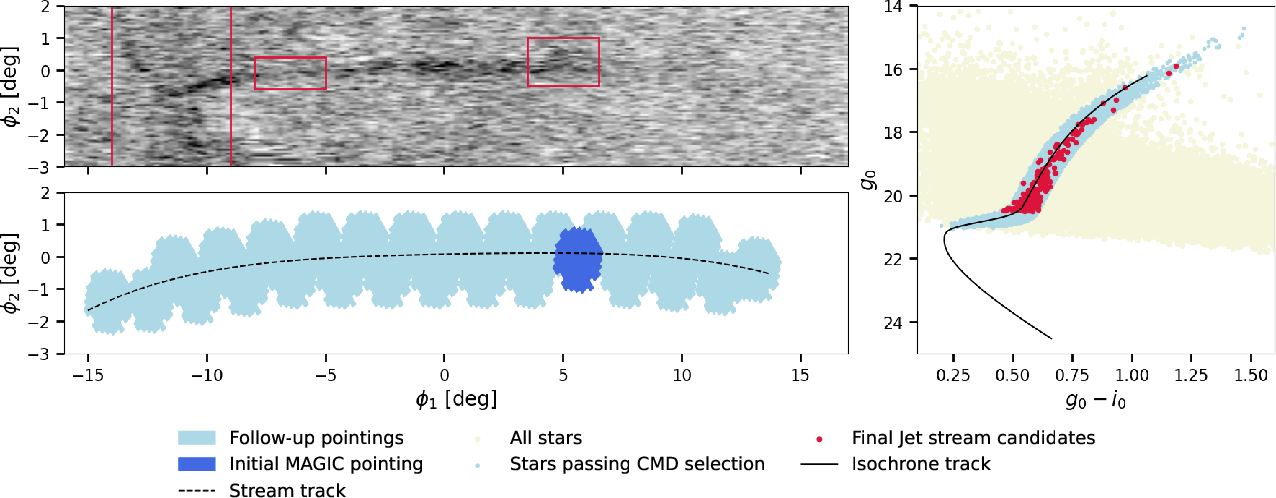
Figure 1: Density map and isochrone-based selection footprints for the Jet stream, illustrating the spatial and CMD morphology relevant for candidate identification.
Spectroscopic membership confirmation is resource-limited; thus, high-throughput photometric metallicity estimation using a narrow-band filter centered on Ca II H&K (∼3950 Å) with DECam enables efficient discrimination of metal-poor stream stars. The MAGIC survey capitalizes on combined deep CaHK, Gaia DR3 proper motions, and DELVE g, i imaging to attain a median metallicity error of 0.23 dex for [Fe/H]CaHK=−2.0, enabling rigorous probabilistic membership selection.
Color–color space modeling, anchored on synthetic spectra spanning a grid of log g and [Fe/H], follows a forward interpolation framework, producing a robust mapping from photometry to metallicity, facilitating separation of stream and foreground bands.
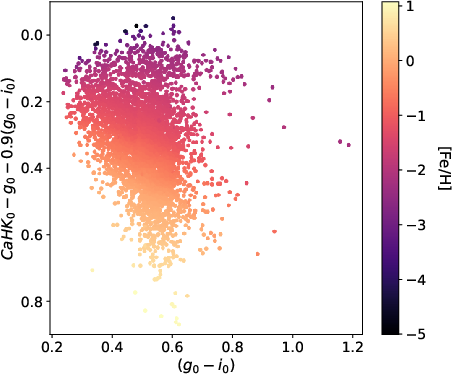
Figure 2: Stars within the color–color diagram are colored by inferred photometric metallicity; distinct bands manifest high discriminatory power for candidate selection.
Candidate Selection Pipeline
A sequence of quality, CMD, kinematic, and metallicity-based cuts is employed:
- Astrometric reliability is enforced via parallax S/N and locus consistency.
- Candidate selection utilizes empirical RGB isochrone from NGC 5053 ([Fe/H]=−2.27, Age=12.7 Gyr), with CMD tolerance ±0.05 mag and spatially variable distance modulus modeled along the stream.
- Gaia DR3 proper motions are rotated into stream-aligned coordinates (∼30∘0, ∼30∘1), matched with spatially-dependent model and propagated uncertainties via Mahalanobis distance, adopting ∼30∘2 for ∼30∘3 confidence.
- Photometric metallicity cuts are centered on [Fe/H]∼30∘4 (a 0.2 dex offset relative to prior spectroscopy), within 2∼30∘5 per-star uncertainty, and additional ∼30∘6 cut for precision.
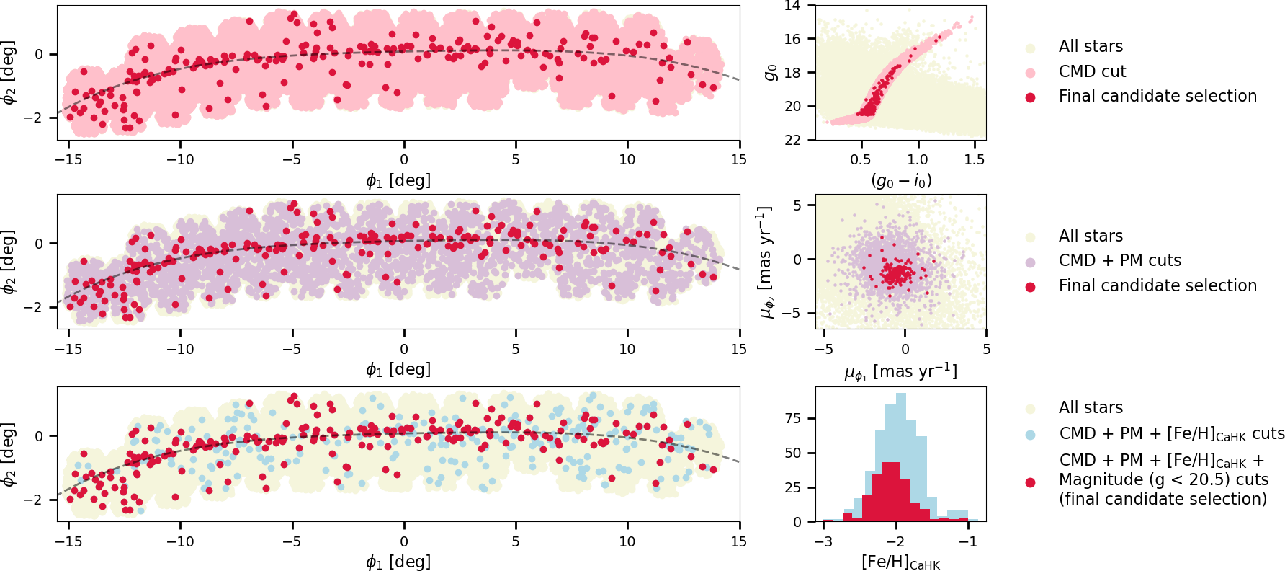
Figure 3: Sequential candidate selection visualized; only stars passing CMD, proper motion, metallicity, and magnitude cuts are retained as robust candidate Jet stream members.
Validation: Purity and Completeness
Comparison to ∼30∘7 spectroscopy establishes sample purity at ∼30∘8: contamination drops from 92.6% (CMD only) to 18.3% with proper motion and metallicity constraints. Completeness against spectroscopically confirmed RGB members, post-selection, remains high, with 88% recovery. This precision enhances efficiency of spectroscopic follow-up and improves statistical reliability of subsequent morphological analyses.
Stream Morphology and Dynamical Structure
Spatial and kinematic distributions confirm a narrow stream core (∼30∘9) consistent with previous estimates, but exhibit significant broadening (=−2.380 up to =−2.381) at larger =−2.382 and trailing ends, with fanning exceeding 88 pc width. Morphological substructures reported by prior broadband studies (e.g., spur, gap at =−2.383) are not prominently recovered, suggesting either selection incompleteness or spurious detections in previous work.
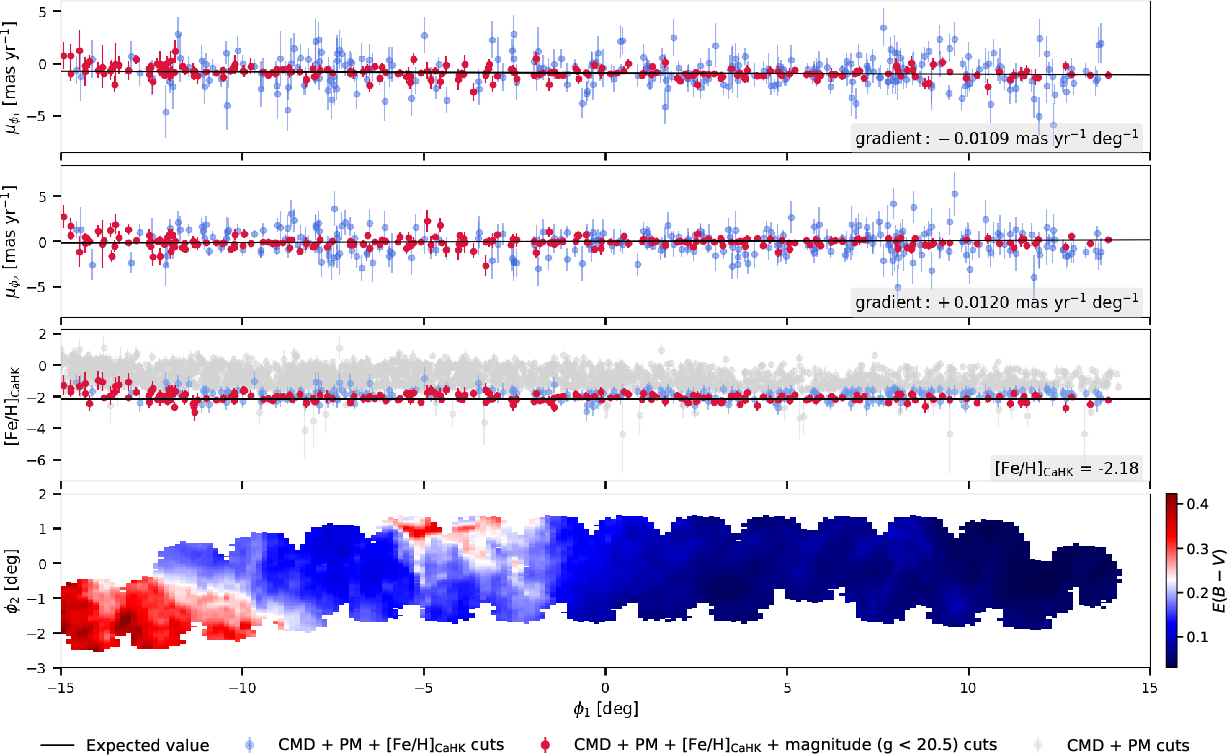
Figure 4: Proper motion along =−2.384, =−2.385, and [Fe/H]=−2.386 as a function of stream length, showing kinematic and chemical uniformity along the core, with increased contamination at large =−2.387.
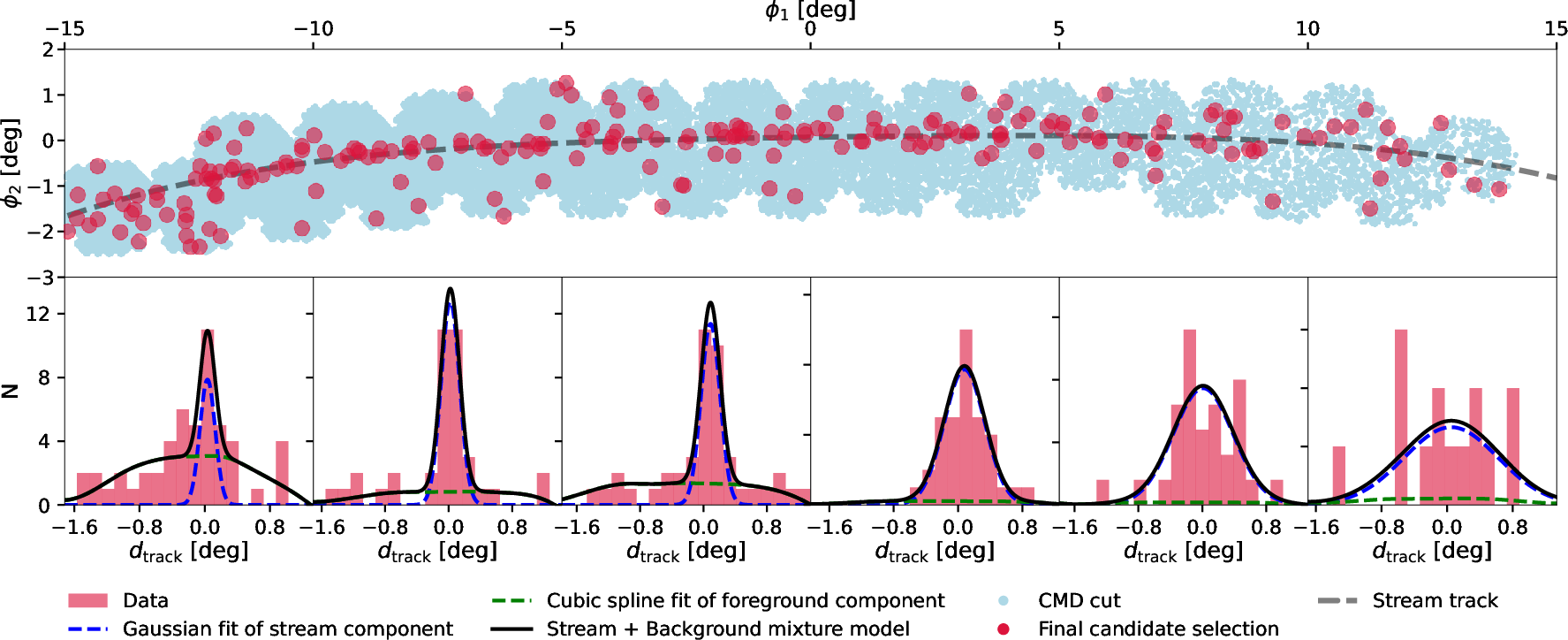
Figure 5: Stream-aligned spatial distribution, highlighting the concentration and broadening of candidate members relative to the best-fit track.
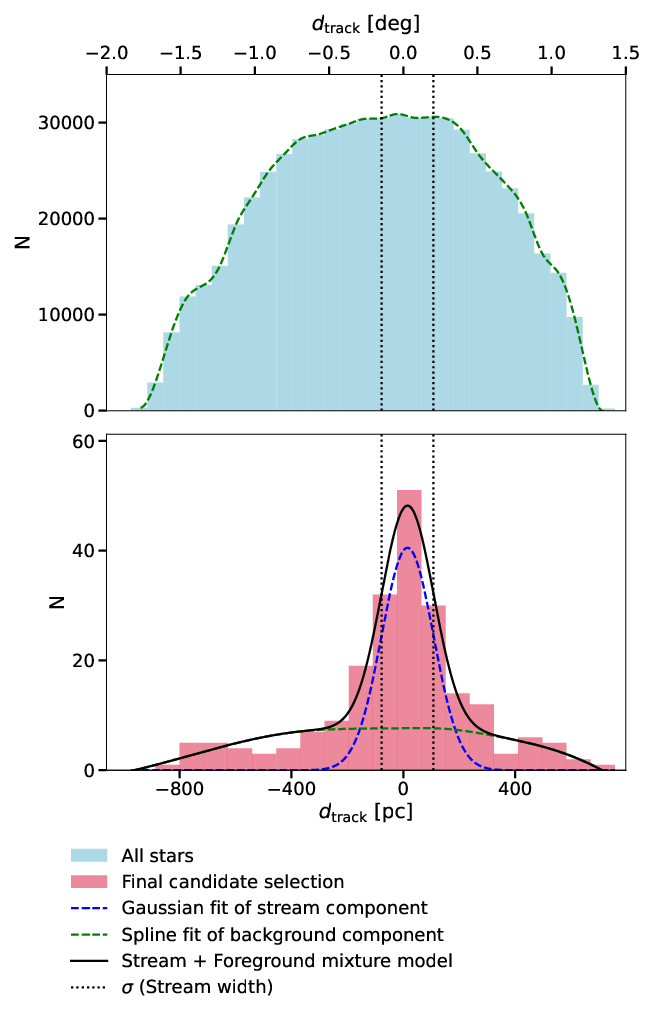
Figure 6: Histogram of perpendicular distances (=−2.388), fit with two-component (Gaussian for stream, spline for foreground) model, providing quantitative measures of stream width and contamination.
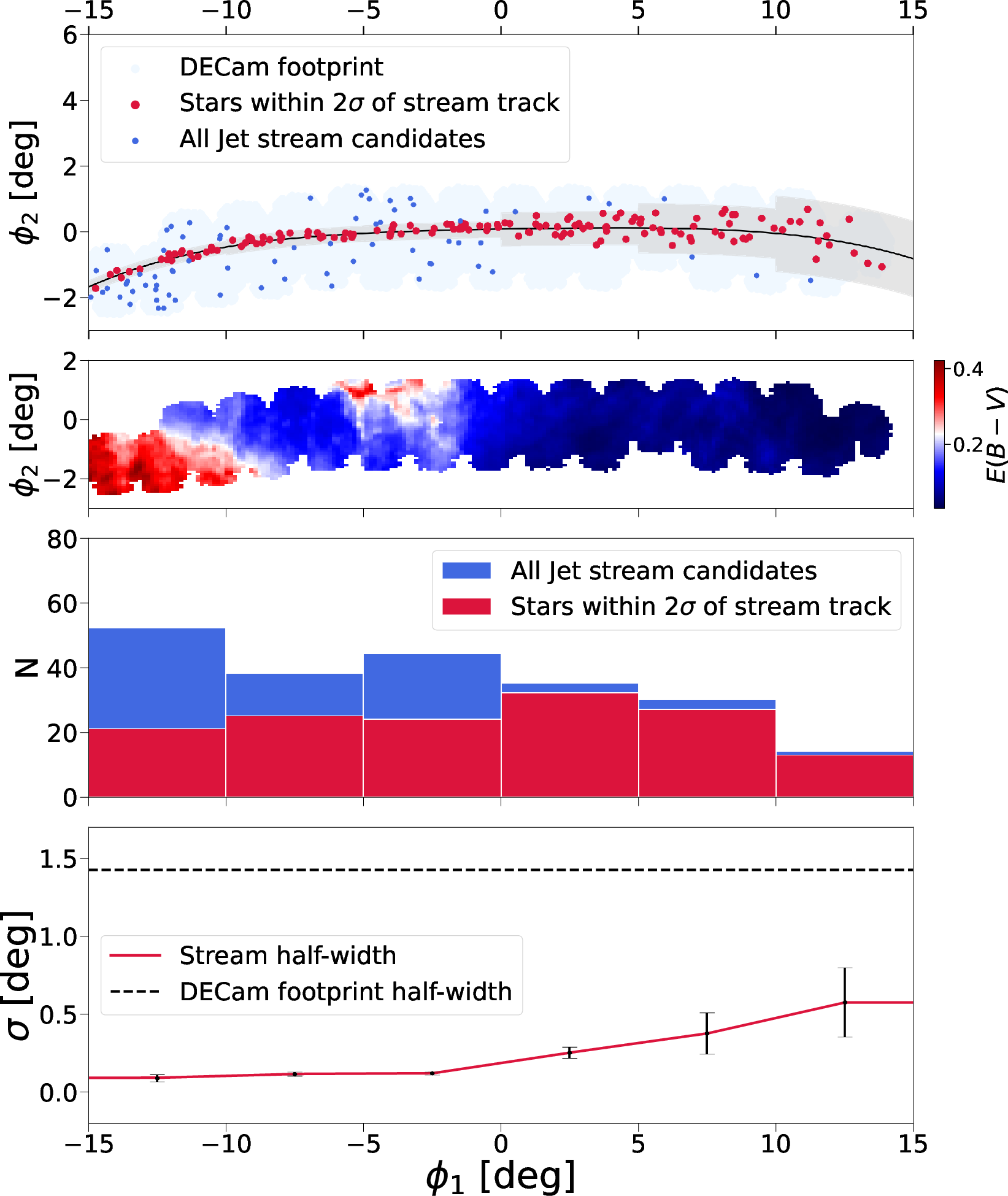
Figure 7: Positions compared to the best-fit stream track with 2=−2.389 envelope, emphasizing empirical stream morphology and envelope-based purity assessment.
The broadening and diffused regions, particularly for ∼0, may reflect chaotic dynamical evolution from Galactic bar interactions or ancient tidal fanning, similar to theoretical predictions for Ophiuchus stream dynamics. However, the much larger galactocentric radius of Jet stream necessitates detailed modeling to ascertain whether bar-induced mechanisms are dominant.
Implications and Prospective Developments
The demonstrated efficacy of narrow-band photometric metallicity estimation for stream membership selection underscores its scalability to other faint substructures, especially with forthcoming surveys such as LSST. LSST's ∼1-band sensitivity, combined with deeper photometry and improved proper motion accuracy, is forecast to increase candidate detections by an order of magnitude, amplifying the capability to resolve substructure and density variations. Further, comprehensive spectroscopic confirmation via coordinated follow-up is essential for robust dynamical and chemical characterization.
The methodology and catalog yielded by the MAGIC survey will be instrumental for next-generation studies into cold stream morphologies, Milky Way halo accretion, and the nature of subhalo-induced perturbations. Photometric metallicities will become a standard for efficient pre-selection, enabling allocation of spectroscopic resources to high-priority candidates.
Conclusion
The paper presents a rigorously validated pipeline for the identification of Jet stream members using DECam CaHK narrow-band photometry, Gaia DR3 proper motions, and DELVE broadband imaging, achieving a candidate purity of ∼2. Stream morphology analyses reveal a core width ∼3 with significant broadening towards the stream's trailing end, supporting interpretations of dynamic fanning but not recovering previously suggested substructures. Photometric metallicity selection substantially reduces contamination compared to traditional CMD-plus-kinematics approaches; the catalog provided will facilitate future spectroscopic follow-up and detailed dynamical investigations. The approach is poised for extension with deeper and higher-precision photometric and astrometric datasets, laying the groundwork for comprehensive studies of stellar streams as probes of Galactic structure and dark matter substructure (2604.13374).