- The paper introduces a geometric framework that explains how vanishing net magnetization enforces spin-degenerate nodes in compensated magnets.
- It employs an effective Zeeman field approach to link local moment arrangements and Bloch state sublattice weights, resulting in momentum-dependent zero crossings.
- First-principles DFT calculations on Mn₃Ga confirm the theoretical predictions, highlighting potential applications in spintronic material design.
Geometric Spin Degeneracy in Spin-Orbit-Free Compensated Magnets
Introduction and Theoretical Framework
This paper establishes a geometric framework for spin degeneracy in spin-orbit-free compensated magnets with vanishing net magnetization, focusing on the unification of spin-degenerate states in antiferromagnets (AFMs), altermagnets (AMs), and compensated ferrimagnets (cFiMs). The central result is the identification of a geometric mechanism, independent of explicit spin-symmetry, that enforces node formation between formally spin-degenerate bands when the net magnetization is zero. This conditions the existence of band degeneracies not just by group-theoretical symmetry but rather by the interplay between local moment arrangements and the structure of the electronic wavefunctions in the nonmagnetic parent phase.
The effective Zeeman field (EZF) approach is central to the formalism. Projecting the exchange field onto the band basis via the eigenstates of the nonmagnetic tight-binding Hamiltonian yields momentum-dependent Zeeman splittings, fi(k), for each band i, determined by both local magnetic moments and the sublattice weights of the Bloch states. Spin degeneracy is enforced at momenta where fi(k)=0—the zero-EZF (ZEZF) condition—a constraint that can be visualized geometrically as the intersection of hyperplanes (ZEZF planes) with the normalization polytope (Hilbert polygon) in the probability space of the wavefunction amplitudes.
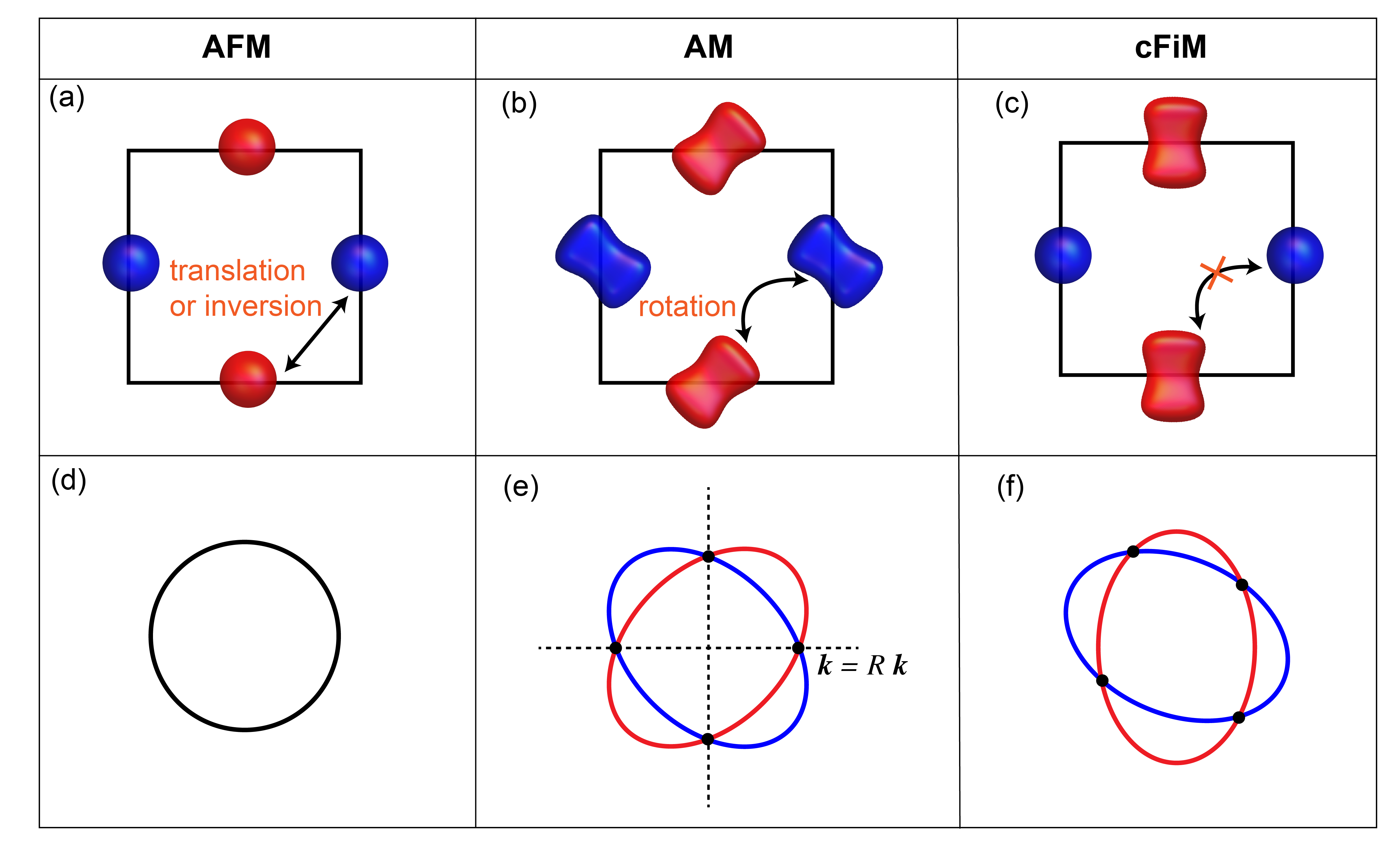
Figure 1: Nodal structure and sublattice relations in AFM, AM, and cFiM; red/blue surfaces denote oppositely aligned magnetic atoms, with corresponding Fermi surfaces and degeneracy structure.
Geometric Analysis and Kagome Lattice Models
Explicit analysis within the kagome lattice paradigm shows that the geometric interpretation is robust across a range of magnetic orders and lattice symmetries. The authors systematically demonstrate that, in ferromagnets, the ZEZF planes are parallel to but do not intersect the Hilbert polygon, hence disallowing spin degeneracies. For compensated configurations (∑nanα=0 for each component α), the ZEZF planes are guaranteed to intersect the normalization polygon, ensuring the presence of spin-degenerate nodes between the formal Kramers pairs.
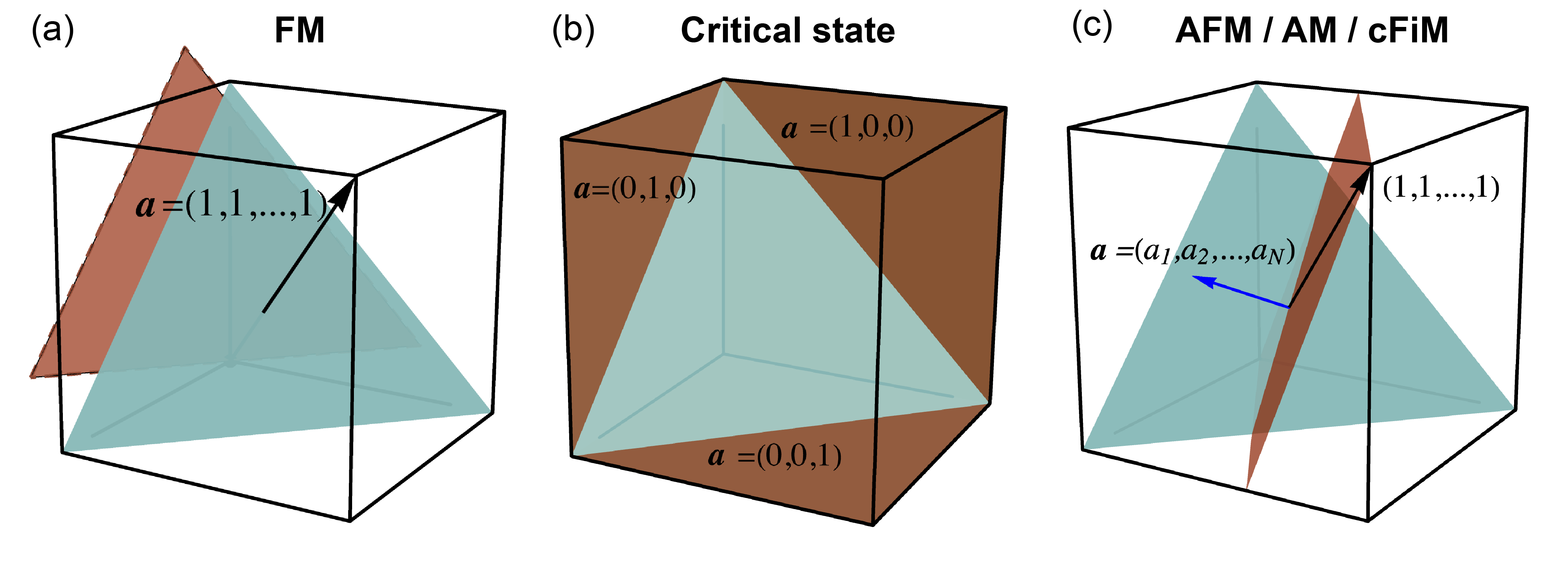
Figure 2: Geometric schematic of ZEZF hyperplanes and the Hilbert polygon for FM, intermediate, and zero net magnetization states.
The analysis is extended to specific lattice realizations:
- In cFiMs, where sublattices are not related by symmetry, the geometric mechanism alone guarantees nodal degeneracies.
- In AMs, the relevant crystalline symmetry imposes constraints that manifest as additional intersections along symmetry-invariant lines in momentum space.
The structure and connectivity of ZEZF solutions—lines or points in k space—are modulated by symmetry, magnetization configuration, and the parent band degeneracies.
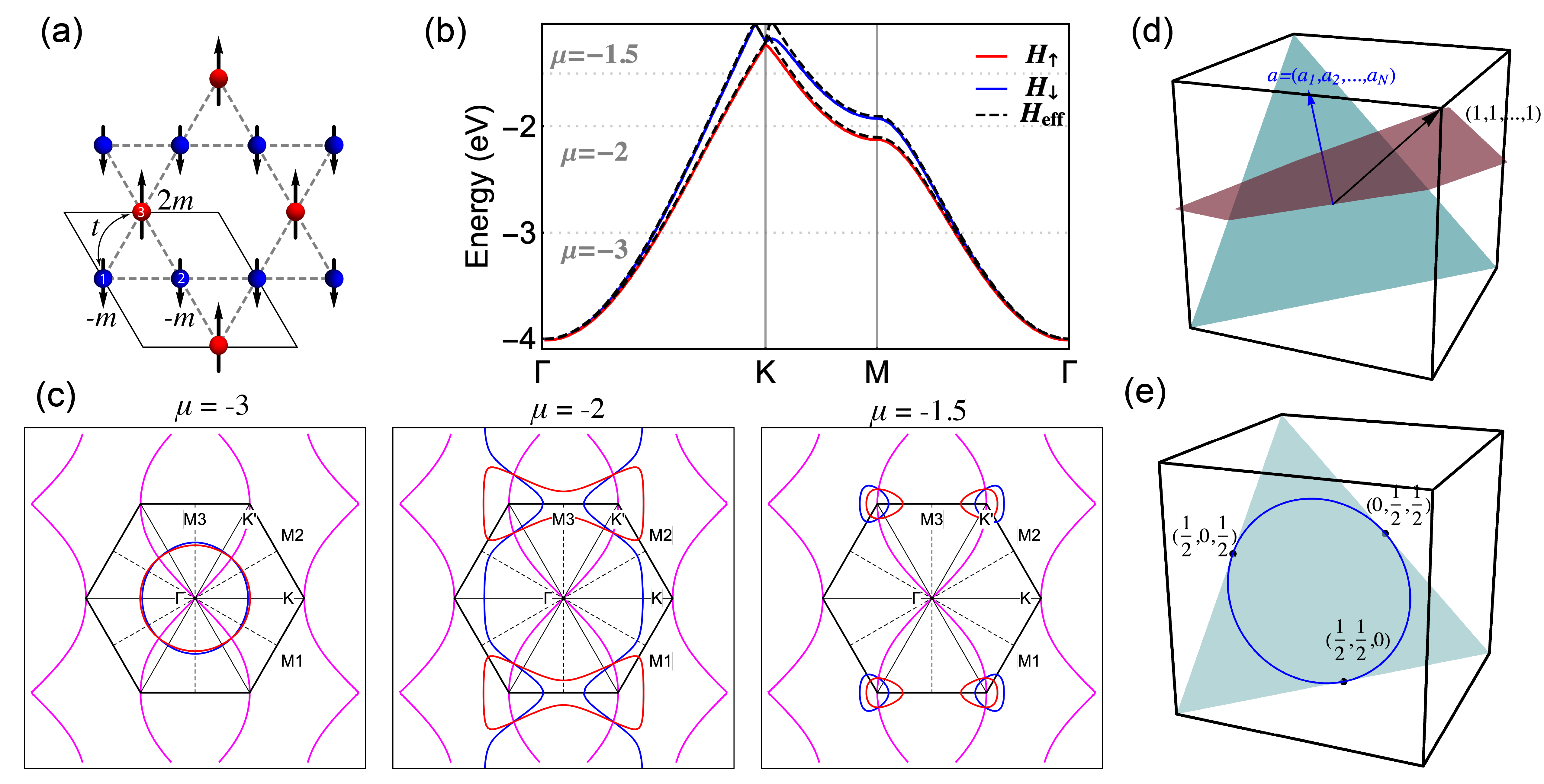
Figure 3: Realization of a cFiM on kagome, band structure, Fermi surface, and illustration of ZEZF-plane/Hilbert polygon intersections.
Numerical and First-Principles Demonstration
First-principles calculations for Mn3Ga, a cubic Heusler cFiM, provide direct verification of the geometric theory. DFT computed band structures and spin-resolved density of states (DOS) exhibit clear spin-degenerate features along specific directions, precisely matching the momenta predicted by the intersection of ZEZF planes with the Hilbert polytope. The total magnetization, validated via site-resolved DFT, is nearly vanishing, and the effective Hamiltonian constructed from the Wannierized nonmagnetic bands plus effective Zeeman term quantitatively reproduces the spin-degeneracy pattern observed in the ab initio data.
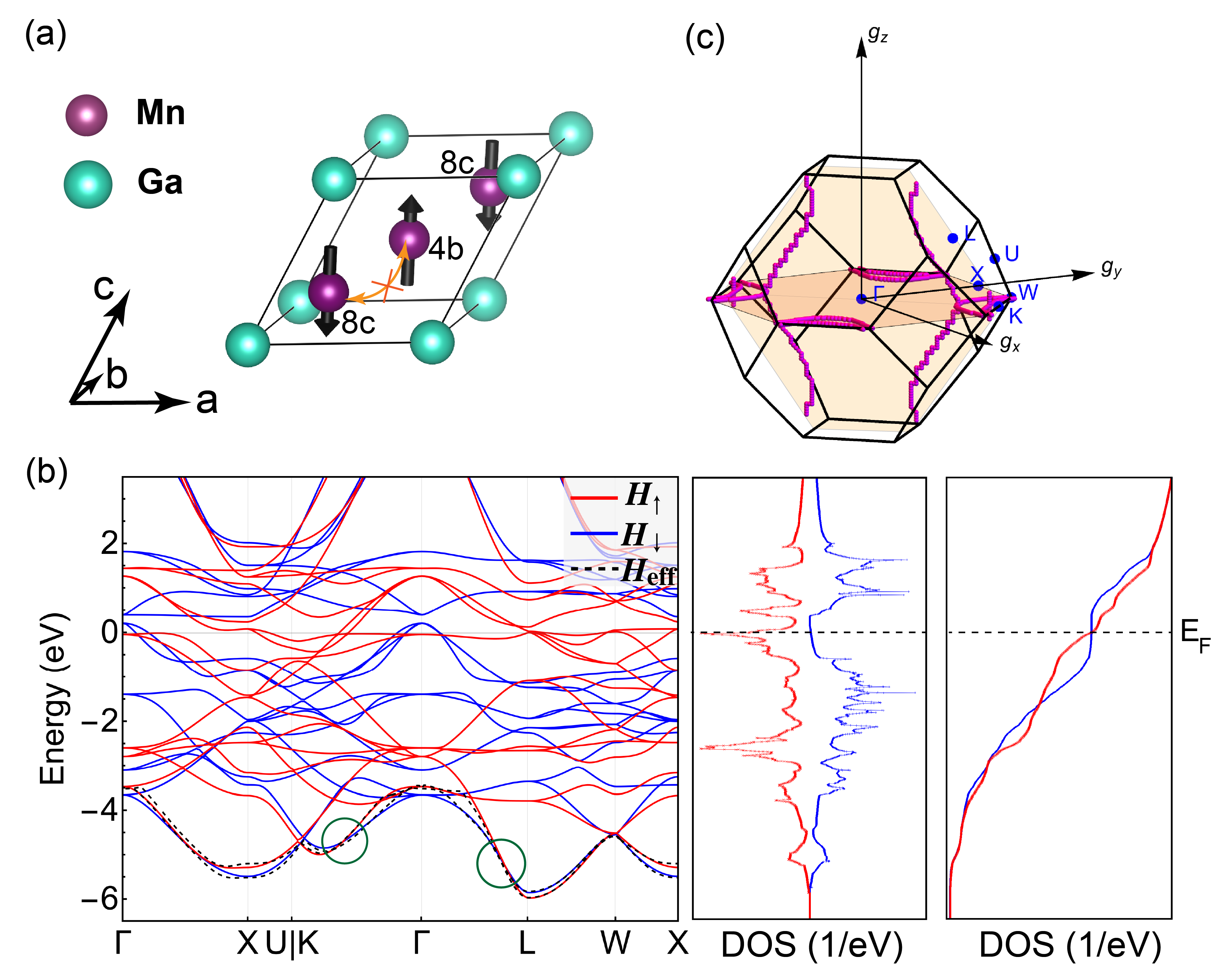
Figure 4: Crystal structure, spin-resolved DFT bands, DOS, and calculated ZEZF-momenta for Mn3Ga, highlighting correspondence with geometric predictions.
Follow-up comparisons of band dispersions from the full and effective models confirm that the departure from exact degeneracy predominantly arises near parent-band crossings (e.g., at high-symmetry points with additional degeneracies), but the approach reliably captures the structure and presence of spin zeros essential for interpreting transport and spectroscopic probes.
Extension to Other Magnetic Classes and Generalizations
The geometric criteria are extended beyond cFiMs to AMs and near-AFM phases. In the latter, small deviations from perfect compensation affect the connectivity of the ZEZF solutions in momentum space, potentially disconnecting nodal lines and altering the global topology of spin degeneracies—a feature of practical importance for tuning electronic properties via small perturbations. Noncollinear and coplanar magnetization patterns are also discussed via multi-plane intersections, showing that for N=3 sublattices with zero net moment, only two ZEZF conditions suffice and the solutions reduce to finite sets of degeneracy points in the Brillouin zone.
The procedure is further illustrated for 2D altermagnet RuF4, where degeneracies protected by crystalline symmetry are successfully reproduced within the effective Zeeman framework, verifying the generality of the approach.
Implications and Future Outlook
The paper provides a unified theoretical framework capturing non-symmetry-protected spin degeneracies in compensated magnets with weak spin-orbit coupling, with strong implications for fundamental studies of band topology and for practical spintronics materials engineering. The geometric approach enables the systematic identification and control of spin degeneracy patterns across a wide class of magnetic materials, extending to filling-enforced systems and noncollinear textures relevant for next-generation quantum devices.
Importantly, the results suggest that spintronic functionalities—such as efficient spin-orbit torque, large tunnel magnetoresistance, and unconventional response effects—can be achieved and finely tuned in cFiMs and related systems without reliance on conventional symmetry arguments. The proposed methodology is expected to influence both the computational search for candidate materials and the experimental interpretation of spin-dependent spectroscopies and transport.
Future developments may include:
- Exploration of interaction effects and their deviation from the weakly interacting regime assumed here
- Systematic database-driven screening of compensated magnets using the geometrical approach
- Examination of interplay between geometric spin degeneracy and disorder, temperature, or strong correlations in real materials
- Generalization to systems with substantial spin-orbit coupling where combined symmetry and geometric effects may yield novel degeneracy topologies
Conclusion
This work rigorously demonstrates that geometric constraints set by vanishing net magnetization play a pivotal role in enforcing band degeneracies in spin-orbit-free compensated magnets, independent of explicit spin symmetry. Utilizing the effective Zeeman field as a bridge between local moment structure and band eigenstates, the authors furnish a broadly applicable tool for analyzing and predicting the complex nodal structure in AFMs, AMs, and cFiMs. The implications for understanding spin-dependent phenomena, the design of spintronic materials, and the classification of magnetic phases are significant, providing new directions for both theoretical and computational investigations in quantum materials science.
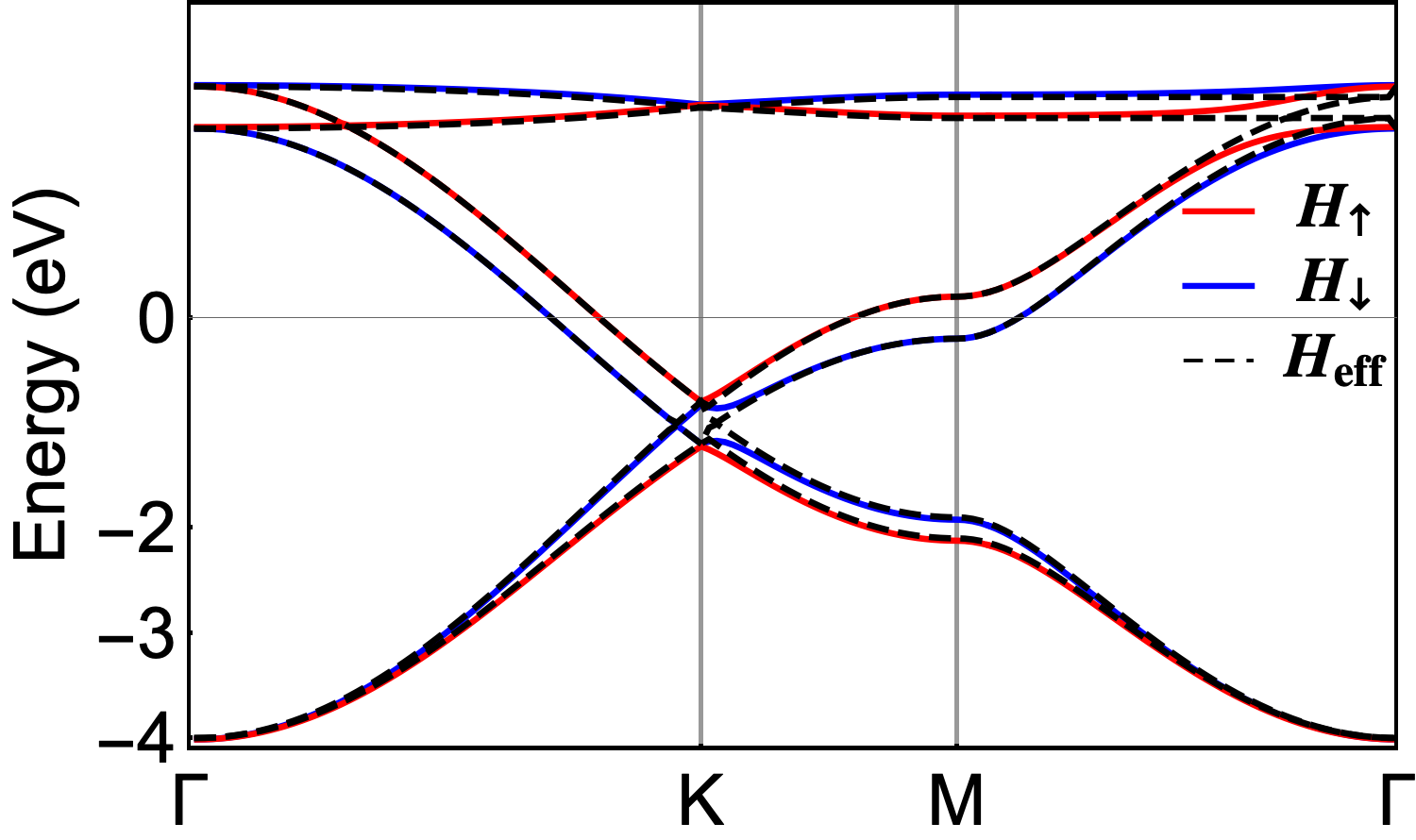
Figure 5: Comparison of tight-binding band structures and corresponding effective Zeeman Hamiltonian predictions, demonstrating the reliability of the geometric approach.