- The paper demonstrates that Gould’s Belt is a transient spatial alignment of cluster complexes, not a physically unified or dynamically expanding ring.
- The paper utilizes high-quality Gaia DR3 astrometric and photometric data alongside rigorous bias corrections to reexamine local Galactic kinematics.
- The paper redefines local Galactic dynamics by linking distinct cluster genealogies and projection effects, challenging classical expansion and rotation assumptions.
Gould’s Belt Reconsidered: Spatial and Kinematical Disentanglement in the Gaia Era
Introduction
This study presents a comprehensive reevaluation of Gould’s Belt—a classical, purportedly ring-like, and kinematically distinctive local Galactic structure—using high-fidelity astrometric and photometric data from Gaia DR3, specifically focusing on young massive stars and nearby clusters. Historically, the Belt has been modeled as an inclined, expanding, and rotating ring of young stars, gas, and dust surrounding the Sun. The paper scrutinizes both spatial and kinematical coherence of this feature, leveraging precision data and modern models of cluster genealogy and Galactic structure, and posits a paradigm shift in the interpretation of the Gould’s Belt phenomenon.
Data, Methods, and Sample Construction
The analysis is rooted in two homogeneous, high-quality Gaia DR3 datasets:
- OB star sample: The ALS III catalog, limited to stars within 0.75 kpc of the plane and (M>8M⊙), provides 338 candidates in proximity (<150 pc) to the Belt’s putative ellipse.
- Cluster sample: The open cluster database from Hunt & Reffert (2023), filtered to clusters younger than 70 Myr, yields 160 clusters assigned to the major families identified by Swiggum et al. (2024): αPer (57 clusters), Cr135 (25), M6 (17), γVel (7), and a residue linked to the Radcliffe Wave.
Astrometric corrections and parallax bias adjustments follow Maíz Apellániz (2022). Cluster distances benefit from weighted parallax means. Kinematic analysis utilizes the galpy MWPotential2014 model for orbit integrations over timescales <45 Myr.
Spatial Configuration: Apparent Ring Versus Physical Structure
Traditionally, the Belt has been visualized as a real 0.7×0.5 kpc elliptical ring, with a 15∘–20∘ inclination relative to the Galactic plane. The analysis reveals that this apparent ring is a transient asterism—a spatial alignment of discrete cluster complexes rather than a single dynamically bound structure.
The visualization from the north Galactic pole (Figure 1) makes clear that the “ring” of OB stars, while formally matching the geometry posited by Perrot & Grenier (2003), coincides spatially with overdensities linked to the Radcliffe Wave and the Split, but the ring is not traced continuously by dust and gas. The anti-central arc is dominated by the vertical undulations of the Radcliffe Wave, not by a physically unified inclined plane.
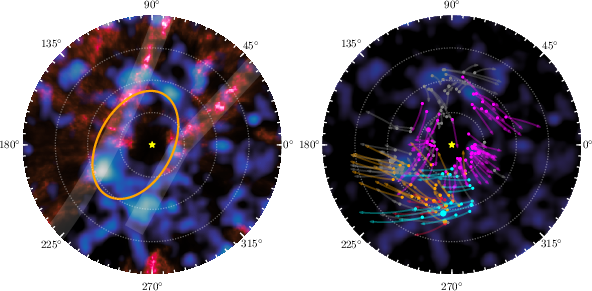
Figure 1: OB star density, dust distribution, Radcliffe Wave, Split, and cluster families overlaid across the $800$ pc solar neighborhood from above the Galactic plane.
Kinematical Analysis: Dispelling Expansion and Rotation
A key result is the absence of a dynamically coherent expansion or rotation associated with the spatially-defined ring. Simulations tracking cluster family orbits from 45 Myr ago to projections 30 Myr hence (Figure 2) show that the current ring-like appearance is highly ephemeral. Member clusters were not co-located or co-moving in the past, and will soon disperse in configuration, contradicting classical expansion and rotation scenarios.
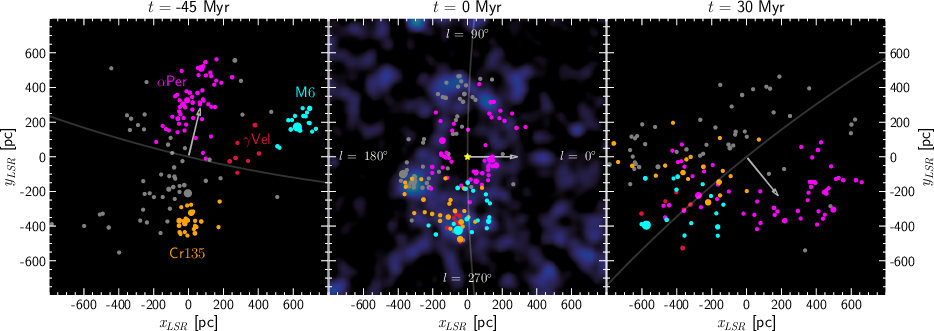
Figure 2: Evolution of young cluster distribution: more heterogeneous and scattered in the past, transiently forming a ring at present, and destined to dissolve.
Bulk kinematics, including previously reported expansion rates (e.g., K=7–$11$ km/s/kpc) and an angular rotation <1500 km/s/kpc<1501, are shown to be artifacts: when the kinematics of the main association centroids alone (e.g., Ori OB1 and Sco-Cen OB2) are input to classic analytical frameworks, the “canonical” kinematic parameters for the supposed Belt are reproduced. In reality, these parameters result from the fortuitous juxtaposition of unrelated dynamical streams.
Moreover, the supposed bulk translation (<1502 km/s relative to the LSR) disappears entirely when appropriate solar motion corrections are applied, and no significant net drift is seen in the cluster sample contemporary with the adopted LSR (Schönrich et al. 2010).
Biases and the Persistence of the Gould’s Belt Construct
The persistence of the Gould’s Belt hypothesis is attributed in the paper to several well-understood but significant observational and data analysis biases:
- Malmquist bias artificially enhances surface number density near the Sun due to survey magnitude limits and extinction, amplifying ring-like features.
- Lutz–Kelker bias and parallax inversion errors, in the absence of Bayesian priors, inject spurious intermediate-distance overdensities, enhancing any apparent rings.
- Prior to Gaia’s precision astrometry, both biases contributed to the impression of a real, observer-centered local ring.
The study demonstrates that with Bayesian distance inference and rigorous sample selection, no spurious ring is produced.
The origin of kinematic patterns also lies in the degeneracy between the solar circular motion relative to the LSR and the average local velocity. When the LSR is anchored to more distant populations or re-evaluated using current OB and cluster samples, the Gould’s Belt appears kinematically indistinguishable from the broader solar environment, and the apparent motions vanish (Figures 3 and 4).
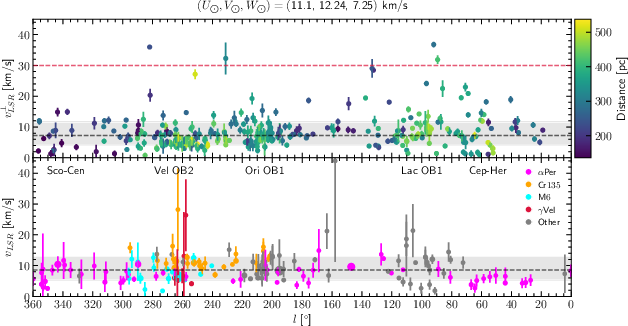
Figure 3: Peculiar velocities of OB stars and clusters: no evidence for coherent expansion or rotation in the Gould’s Belt sample across longitude.
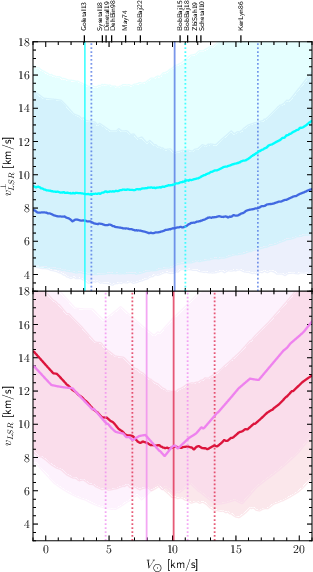
Figure 4: Minimization of median peculiar velocities as a function of assumed <1503 demonstrates that spurious bulk motions result from outdated LSR prescriptions.
Implications and Future Directions
This work decisively weakens the case for any physical or kinematical coherence of Gould’s Belt as a unified structure. The results demand a theoretical shift—toward recognizing complex, transient, and heterogeneous cluster formation histories within the local Milky Way, best interpreted as the result of overlapping star-forming events, the emergence of cluster families, vertical disk oscillations (e.g., the Radcliffe Wave), and dynamical scattering mechanisms. The historical notion of a dynamically meaningful inclined belt must be superseded in all future modeling of local Galactic structure and star formation history.
The paper’s analysis also clarifies the need for rigorous bias mitigation—both observationally and analytically—in mapping Galactic substructure. Ongoing and future Gaia releases, refined cluster catalogues, and kinematical modeling at higher precision will enable increasingly sophisticated disentanglement of the solar neighborhood's complex dynamical evolution.
Conclusion
The apparent spatial and dynamical pattern classically attributed to Gould’s Belt is shown to be a transient, projection-driven asterism arising from a superposition of a few large cluster families and the observer’s location within the Galaxy. No evidence supports a physically coherent, rotating, or expanding ring as previously conceived. The kinematical features historically attributed to the Belt are revealed as consequences of sampling geometry, local star formation history, and adoptive definitions of the solar motion and LSR, rather than manifestations of a true Galactic subsystem. This reinterpretation supplants the traditional belt model, reframing the local disk as an outcome of superposed, independent star-forming complexes and projection effects (2604.13225).

