- The paper introduces the Deferred Cyclotomic Representation (DCR), which decomposes q-hypergeometric series into sparse cyclotomic exponent vectors.
- It reduces intermediate expression swell and catastrophic cancellation, achieving both exact and high-precision numerical evaluations with minimal memory usage.
- The method has significant implications for computing quantum invariants and topological state sums in quantum algebra and mathematical physics.
Deferred Cyclotomic Representation and Stable Evaluation of q-Hypergeometric Series
Introduction
The computation of finite q-hypergeometric series is central in quantum algebra, representation theory, quantum topology, and mathematical physics. Conventional evaluations—both symbolic and numerical—suffer from intermediate expression swell and catastrophic cancellation, especially at roots of unity or in semiclassical regimes. This paper introduces the Deferred Cyclotomic Representation (DCR), a structural reformulation that decomposes q-hypergeometric series into sparse exponent vectors over irreducible cyclotomic polynomials, thus separating multiplicative structure from evaluation and performing cancellations algebraically prior to numerical computation. This yields a canonical combinatorial object whose projection realizes exact or numerical evaluation in any target field.
Quantum integers and quantum factorials are factorized into cyclotomic polynomials, yielding representations of the form
[n]q=q1−n∏d∣n,d>1Φd(q2)
and
[n]q!=qn(1−n)/2d=2∏nΦd(q2)⌊n/d⌋
where each amplitude is encoded not as a polynomial in q, but as a sparse integer exponent vector with respect to the cyclotomic basis {q,Φd(q2)}. Ratios and products among quantum factorials translate to additive updates of these exponents, avoiding dense polynomial arithmetic and enabling cancellations via integer subtraction.
This deferred representation encapsulates the algebraic structure in a field-independent combinatorial object. Evaluation—whether exact or in finite precision—is realized as a projection map, ΠT, applied to these exponent vectors. The DCR mediates between algebraic compilation and field-dependent projection, unifying symbolic, numerical, and classical (limit q→1) regimes as instances of the same structural process.
Complexity and Numerical Stability
The deferred cyclotomic architecture fundamentally alters the complexity profile. Construction of the combinatorial object (DCR) scales nearly linearly in summation length, and its memory footprint remains minimal, with peak allocations orders of magnitude smaller than eager symbolic approaches which suffer from polynomial expression swell. Exact evaluation in cyclotomic fields avoids repeated GCD reductions and intermediate polynomial growth.
Numerical evaluation benefits from algebraic preconditioning: cancellation is performed at the exponent level, compressing dynamic range prior to floating-point subtraction. The amplification factor γDCR governing dynamic range inflation is dramatically reduced relative to eager approaches. As a result, DCR projection systematically delays the onset of catastrophic cancellation and preserves accuracy farther into the semiclassical regime.
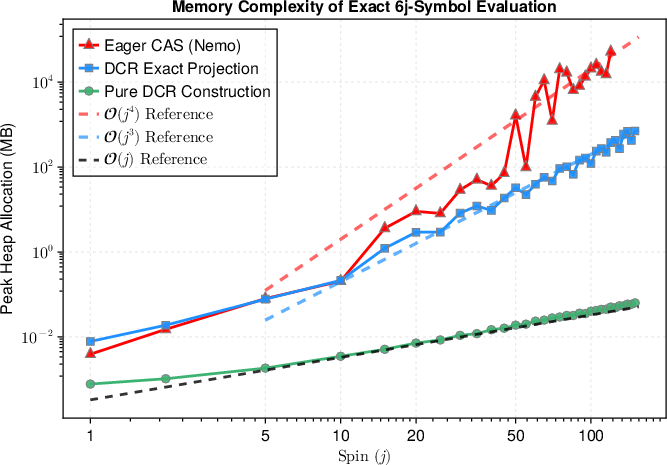
Figure 1: Peak heap memory allocation for exact algebraic evaluation demonstrates DCR construction scales linearly with spin (q0), while eager CAS triggers memory blowup.
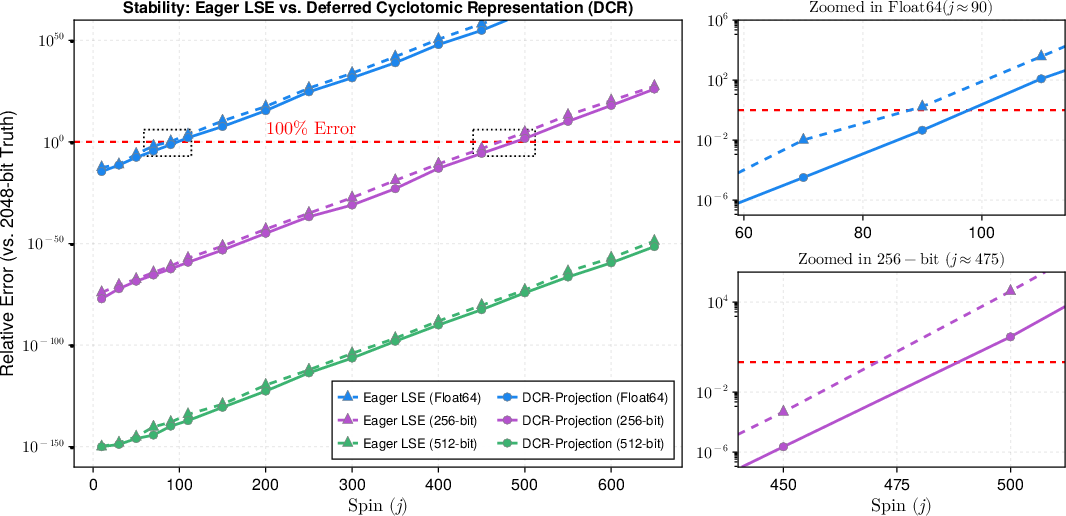
Figure 2: Relative error profiles of symmetric q1-symbol at q2 show DCR projection delays catastrophic cancellation and reduces error magnitude compared to eager LSE baselines.
Structural and Algebraic Implications
The structural separation inherent in the DCR has far-reaching theoretical consequences. The dependence on q3 is entirely mediated by projection: the underlying combinatorial object is parameter-independent. Deformation, admissibility at roots of unity, and classical limits become intrinsic properties of the exponent data. In particular, amplitude vanishing at roots of unity is governed by cyclotomic exponents, and the classical limit reduces the cyclotomic basis to prime factorization of classical factorials.
The DCR establishes a discrete flow in exponent space, providing alternative structural interpretations of q4-hypergeometric summation and recoupling theory. There is strong potential to reformulate coherence identities—including orthogonality and topological invariance—at the exponent level, independent of analytic evaluation. The architecture isolates combinatorial and algebraic aspects of quantum amplitudes, enabling new directions in the analysis of quantum invariants, spin foam amplitudes, and tensor network constructions.
Macroscopic Computation: State-Sum Models and Amortization
In topological quantum field theories and spin foam models, the computational bottleneck arises from repeated evaluation of local recoupling coefficients across large triangulations. The DCR enables a paradigm wherein combinatorial compilation is amortized: only geometrically distinct configurations are represented, and global state-sum observables are computed via projection and aggregation. This decouples local algebraic complexity from global summation, yielding tractable computations for quantities such as the Turaev–Viro partition function.
Strong Numerical Results and Contradictory Claims
The paper demonstrates that:
- DCR construction and projection maintain memory usage in the kilobyte-to-megabyte range even for spin values where eager symbolic CAS evaluation suffers from memory blowup well over 50GB (see Figure 1).
- DCR enables numerical evaluation of the quantum q5-symbol far beyond the breakdown of standard LSE-based methods; sign errors present in eager LSE appear at q6, while DCR maintains phase integrity significantly farther (see Figure 2).
- The dynamic range inflation is reduced by up to q7 orders of magnitude compared to eager polynomial representations.
- The separation of combinatorial compilation from field projection provides microsecond-scale amortized evaluation for repeated parameter sweeps, radically altering the computational profile for high-volume applications.
These results indicate that many limitations previously considered intrinsic to q8-hypergeometric computation—catastrophic cancellation, polynomial expression swell, and inefficiency in symbolic and numerical regimes—are chiefly artifacts of representation choice, not fundamental obstacles.
Practical and Theoretical Implications
Practically, the DCR architecture enables accurate, scalable evaluation of quantum amplitudes, recoupling coefficients, and topological invariants across exact, numerical, and classical regimes. It forms the backbone of efficient state-sum model computation, tensor network evaluation, and manipulations in quantum topology.
Theoretically, the DCR reframes the connection between deformation, admissibility, and quantum-categorical structure. Coherence relations and integrality phenomena in quantum topology may be realized at the exponent level, and Galois symmetries of cyclotomic fields are reflected in transformations of exponent data.
Moving forward, generalization to higher-rank quantum groups, more complex recoupling scenarios, and decorated tensor network contractions will require preserving sparsity and exploiting the combinatorial separation that DCR affords.
Conclusion
The Deferred Cyclotomic Representation provides a structural solution to the stable and exact evaluation of q9-hypergeometric series. By decomposing quantum amplitudes into sparse cyclotomic exponent vectors and separating algebraic structure from field-dependent evaluation, the framework achieves superior numerical stability, exactness, and computational efficiency. It fundamentally alters both practical computation for topological state sums and the theoretical organization of quantum invariants, establishing representation design as a decisive factor in computational mathematics and quantum physics.

