- The paper presents a targeted Bayesian search for continuous gravitational waves from eccentric supermassive binary black holes in OJ 287 and five nearby galaxy clusters using 18-year PPTA DR3 data.
- The paper employs an eccentric waveform model with joint sampling of astrophysical and noise parameters to derive stringent 95% upper limits on strain amplitude, chirp mass, and binary mass ratios.
- The paper’s results exclude equal-mass binaries in key hosts like M87, thereby complementing electromagnetic observations and advancing PTA-based constraints on SMBH demographics.
Targeted Search for Eccentric Supermassive Binary Black Holes in OJ 287 and Nearby Galaxy Clusters with PPTA DR3
Introduction
This paper presents a targeted Bayesian analysis for continuous gravitational waves (CGWs) from eccentric supermassive binary black holes (SMBBHs) utilizing the Parkes Pulsar Timing Array Data Release 3 (PPTA DR3). The search focuses on two astrophysical settings: (1) the blazar OJ 287—a proposed SMBBH system with well-modeled periodic flaring, and (2) the central regions of five nearby, massive galaxy clusters: Virgo, Fornax, Norma (Abell 3627), Hercules, and Coma, which represent high-probability environments for hosting SMBBHs radiating in the PTA band.
A key methodological distinction is the adoption of an eccentric CGW waveform model (GWecc) with fully Bayesian inference, jointly sampling astrophysical and noise parameters, and explicitly modeling both Earth and pulsar terms. This formalism ensures physical self-consistency and mitigates biases arising from model misspecification, particularly relevant due to the non-circularity exhibited by nanohertz SMBBH binaries.
Data, Methodology, and Signal Modeling
The analysis employs the 18-year PPTA DR3 timing dataset, focusing on 30 high-sensitivity millisecond pulsars. Individual source properties—sky location, distance, and, for OJ 287, gravitational wave frequency—are fixed using electromagnetic (EM) constraints. The Bayesian likelihood models both deterministic CGW signals and comprehensive pulsar noise processes, including white noise, spin red noise, dispersion measure (DM) variations, and a common red noise (CRN) component.
Crucially, the CGW search draws from two waveform families: the eccentric GWecc (the search’s primary mode) and a standard quasi-circular model for benchmarking. Priors are restricted for physical validity (e.g., merger timescale exceeding the data span), and the sampling incorporates orbital eccentricity up to e0=0.8.
The statistical significance of a putative CGW is assessed via the Bayes factor B between CRN+CGW (signal) and CRN-only (null) models. In the absence of detection, 95% credibility upper limits are computed for the intrinsic strain amplitude and (for clusters) chirp mass and mass ratio q.
Results: OJ 287
Bayesian Model Comparison and Parameter Inference
Both the eccentric and quasi-circular waveform searches toward OJ 287 are prior-dominated, with Bayes factors B=0.82 (eccentric) and $0.94$ (circular), indicating no evidence for a CGW from OJ 287. Posterior distributions for CGW parameters, including total mass, eccentricity, and symmetric mass ratio, remain consistent with the imposed priors except in the highest-mass, data-excluded region.
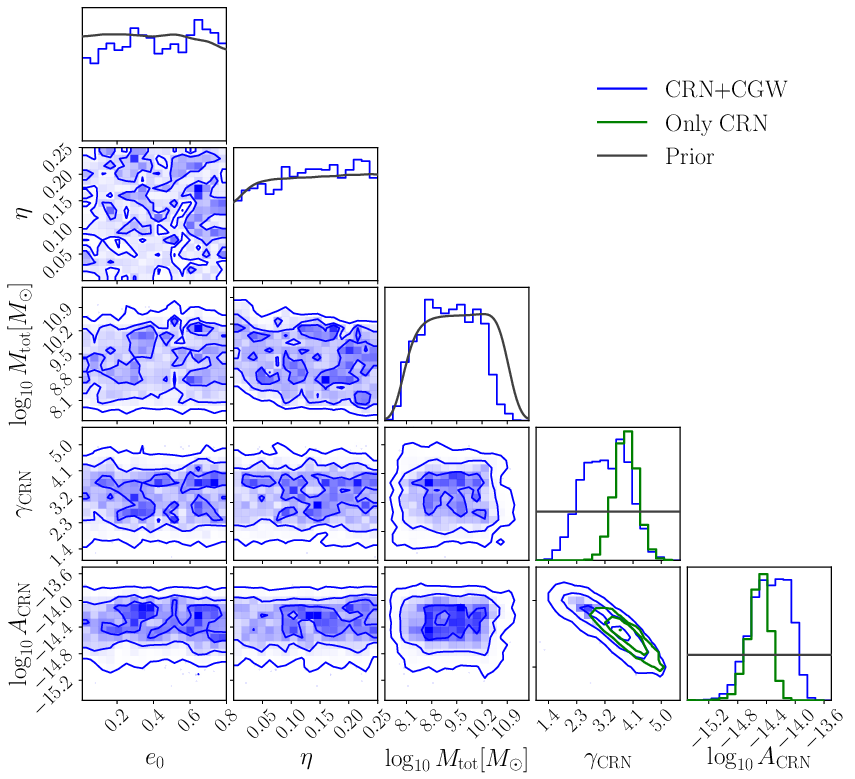
Figure 1: Posterior distributions for CGW and CRN parameters toward OJ 287 under the eccentric (blue) and noise-only (green) models.
The posterior for the GW strain amplitude produces 95% upper limits of log10h0<−14.18 (eccentric) and log10h0<−13.94 (circular), notably above the expectation from electromagnetic binary models, which predict log10h0=−15.93.
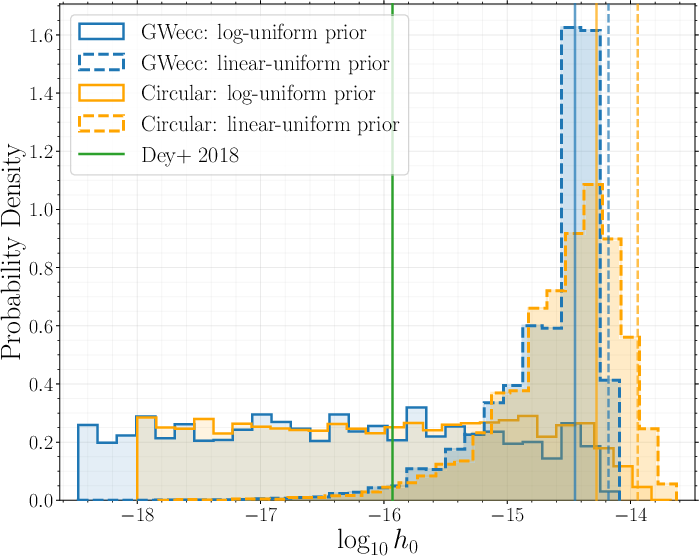
Figure 2: Posterior distributions of GW strain amplitude for OJ 287 under eccentric and circular models; the EM-predicted strain is well below the PTA limit.
A prior-dominance diagnostic shows data-informative constraints on Mtot dominate for low-eccentricity, near-equal-mass configurations, but for e0≳0.6 the validity prior restricts sensitivity due to rapid orbital evolution and breakdown of the waveform model.
The main empirical result is a 95% credibility upper limit for the total mass of B0, direct from PPTA observations. This is above the EM-inferred B1 for the region of high eccentricity and small B2 (B3, B4) preferred by optical flare models, so GW data do not yet constrain or contradict the EM binary hypothesis in this parameter space.
Results: Galaxy Clusters
Detection Statistic and Upper Limits
For all five cluster directions, Bayes factors for CGW models are consistently B5, with no significant evidence for individual SMBBH sources. Thus, stringent upper limits on astrophysical parameters governing SMBBH binaries are derived.
The 95% upper limit on chirp mass B6 as a function of GW frequency is computed for each cluster. The most constraining limits are found for the Virgo cluster (B7 Mpc; B8 excluded at B9 nHz), with progressively weaker (but still significant) limits for more distant clusters. Compared to all-sky, circular-binary searches, the targeted analysis leads to an improvement in sensitivity by a factor q0 in q1.
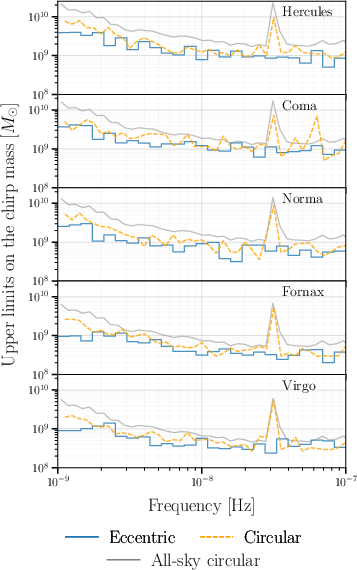
Figure 3: Frequency-dependent 95% upper limits on chirp mass for each cluster (blue: eccentric, orange: circular), with all-sky limits in gray for reference.
Binary Mass Ratio Constraints
By combining these chirp mass limits with dynamical BH mass estimates for specific galaxies (e.g., M87, NGC 4889), frequency-dependent upper limits on binary mass ratios q2 are derived:
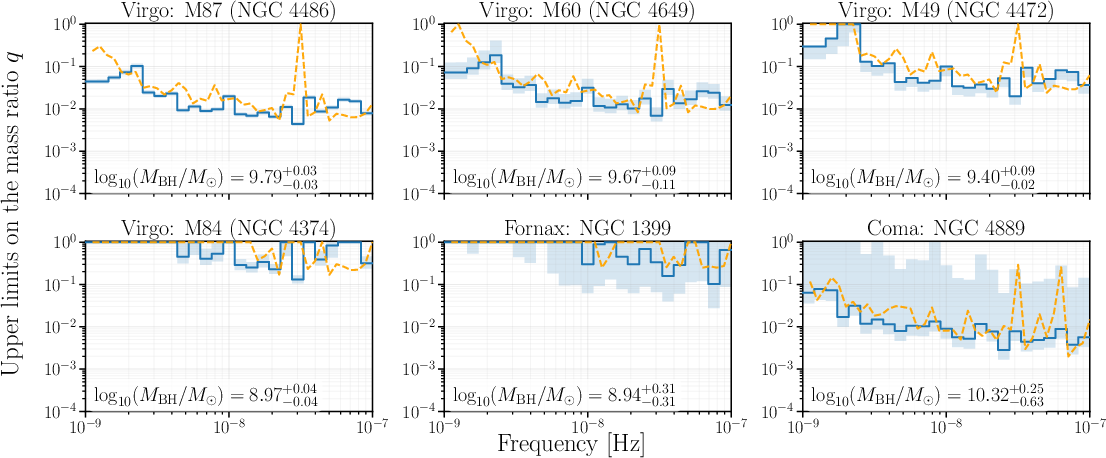
Figure 4: 95% credibility upper limits on binary mass ratio q3 vs GW frequency for representative central galaxies (M87, NGC 1399, NGC 4889).
The most conservative constraints are placed at the peak-sensitivity frequency for each host (usually q410–20 nHz), and yield q5 for M87 and q6 for NGC 4889, effectively ruling out equal-mass binaries in these galaxies within the sampled orbital period window.
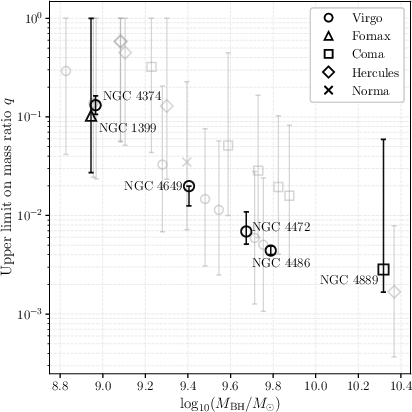
Figure 5: Cluster member galaxy mass ratio upper limits at the most sensitive GW frequency, showing robust exclusion of equal-mass binaries for hosts with direct dynamical q7 estimates (black symbols) and order-of-magnitude constraints for others (gray symbols).
These mass-ratio exclusions are directly interpretable astrophysically: for M87, the current limits on q8 in parsec-scale orbits complement horizon-scale constraints from EHT imaging, providing multi-scale exclusion of major SMBBHs in the nucleus.
Implications and Theoretical Context
From a practical standpoint, the results demonstrate the ability of PTAs to probe the demographics of SMBBH remnants in local galaxy clusters. The constraints on q9 act as direct tests for the presence of major or minor merger remnants, and for prominent candidates (M87, NGC 4889) already rule out equal-mass systems in the B=0.8200.01–0.1 pc regime. This impacts models of galaxy evolution and SMBBH coalescence rates in dense environments.
The adoption of eccentric waveform modeling is methodologically important: by capturing the multi-harmonic structure inherent in eccentric binaries, the analysis is robust against the range of plausible orbital configurations, especially relevant where environmental effects prevent rapid circularization of orbital motion.
Theoretically, these non-detections (and derived upper limits) are advancing toward the ability to challenge, falsify, or confirm detailed electromagnetic models of prominent systems (e.g., OJ 287’s flare timing models) as PTA sensitivities improve further. In tandem with high-resolution imaging constraints (e.g., VLBI and EHT on scales B=0.821 mpc), this provides a unique, panchromatic probe of SMBH binary evolution across the full parameter space from the inspiral to merger and accretion-dominated regimes.
Future Developments
Stronger spectral constraints and longer temporal baselines from ongoing and next-generation PTA datasets (e.g., IPTA) will shrink the parameter space for allowable SMBBH configurations in local clusters and prominent candidates such as OJ 287. Full integration of spatially correlated noise modeling and advanced treatment of multi-messenger priors will further enhance sensitivity and interpretability. The eventual detection—or even tighter non-detection—of CGWs from targeted massive hosts will yield decisive empirical constraints on the occupation fraction and dynamical evolution of SMBBHs in the low-redshift universe.
Conclusion
This work delivers a stringent, physically self-consistent Bayesian analysis of CGWs from eccentric SMBBHs in OJ 287 and massive local clusters using PPTA DR3 data. No statistically significant CGW signal is observed, but upper limits exclude equal-mass SMBBHs (B=0.822) in flagship hosts (M87, NGC 4889) at nHz frequencies. This underscores the emergent capability of PTA-based GW astronomy for direct SMBH binary population studies, with implications for multi-scale constraints on galaxy merger remnants. Continued improvements in PTA sensitivity will allow further narrowing of parameter space, offering prospects for discriminating between EM models and empirically reconstructing the demographics of the most massive binaries in the nearby universe.

