Fast measurement of neutral atoms with a multi-atom gate
Published 14 Apr 2026 in quant-ph | (2604.13158v1)
Abstract: Measurement time represents a critical bottleneck limiting the operational speed of neutral atom quantum computers, as it cannot be accelerated through parallelization like other quantum operations. We present a protocol for fast measurement of neutral atoms based on a new, fast multi-atom Rydberg gate that significantly reduces the measurement integration time and improves the measurement fidelity. Our approach employs a multi-qubit register of $N$ ancilla atoms within a single Rydberg blockade region to measure a single data qubit. This enables an $N$-fold enhancement in photon emission collections, while reducing the measurement's sensitivity to loss. The scheme requires spectral separation between the data qubit and the ancillae, achievable through either a dual-species architecture or a targeted light shift. Beyond this, the scheme is straightforward to implement: it relies only on global pulses, global photon collection, and avoids both atom shuttling and numerically optimized pulses. Simulations of a Cs--Rb platform demonstrate that with only five ancillae ($N=5$), measurement infidelity below $10{-3}$ within $6\ μ\text{s}$ is achievable.
The paper introduces a multi-atom Rydberg gate protocol that maps a data qubit’s state onto multiple ancilla atoms to speed up measurement.
It employs global pulse sequences within a Rydberg blockade to achieve an N-fold enhancement in photon emission rate and robust fidelity against atom loss.
Simulations in Cs–Rb systems show over a 10× speedup in integration time, attaining error rates below 0.1% in 6µs with N=5 ancillae.
Fast Measurement of Neutral Atoms via Multi-Atom Rydberg Gates
Introduction
The measurement time of qubits imposes a fundamental limit on the clock speed of neutral atom quantum computers. Unlike gate operations or qubit initialization, measurement cannot be parallelized to bypass slow photodetection or photon scattering. This work introduces a protocol leveraging a fast, multi-atom Rydberg gate, utilizing a collective ancilla register, to substantially accelerate the measurement of neutral atom qubits while simultaneously reducing infidelity (2604.13158). The scheme employs N ancilla atoms, globally addressed and coupled within a single Rydberg blockade region, to achieve both an N-fold enhancement in photon emission rate and improved robustness to atom loss or technical noise. The authors present a complete analytical protocol, detailed numerical simulations, and concrete metrics on achievable measurement speed and fidelity in Cs--Rb systems, comparing favorably to previous approaches both in performance and implementation complexity.
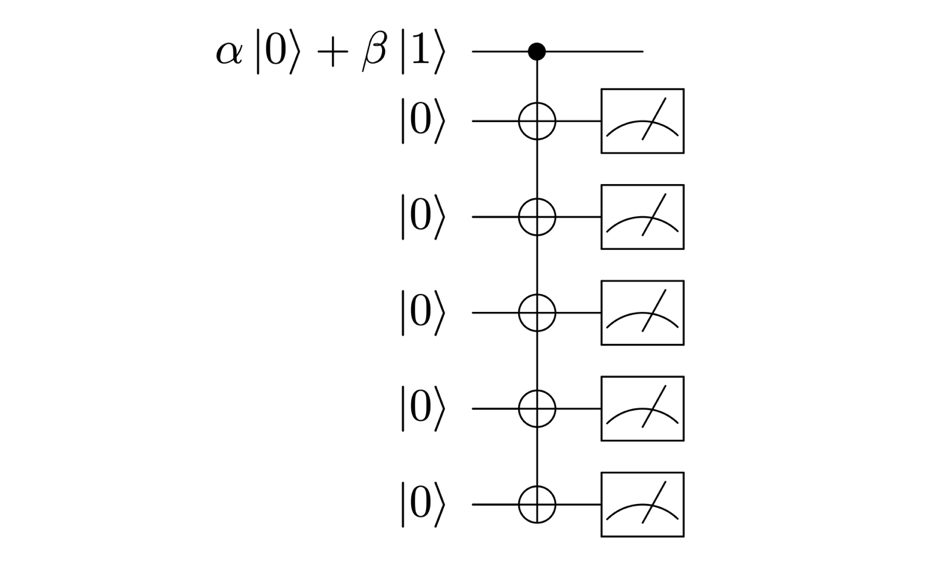
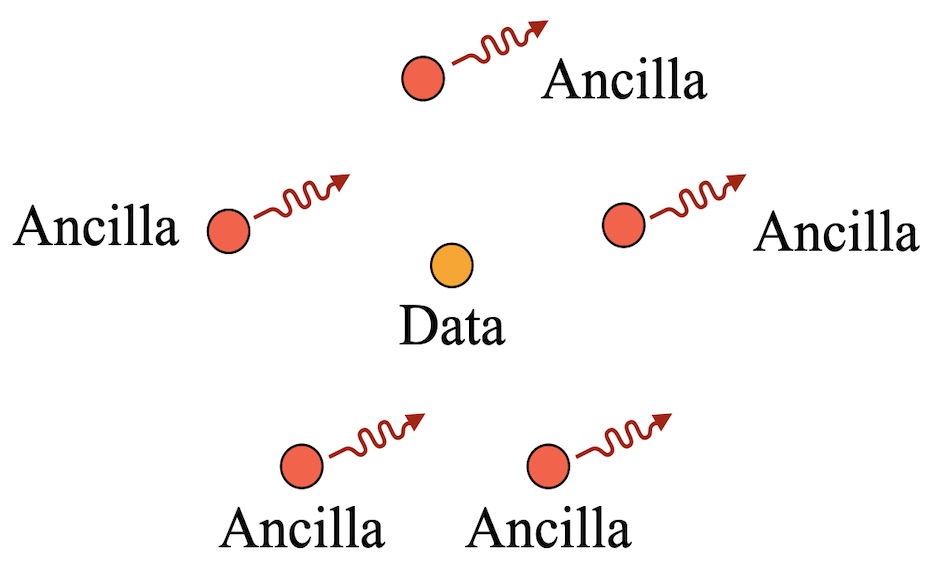
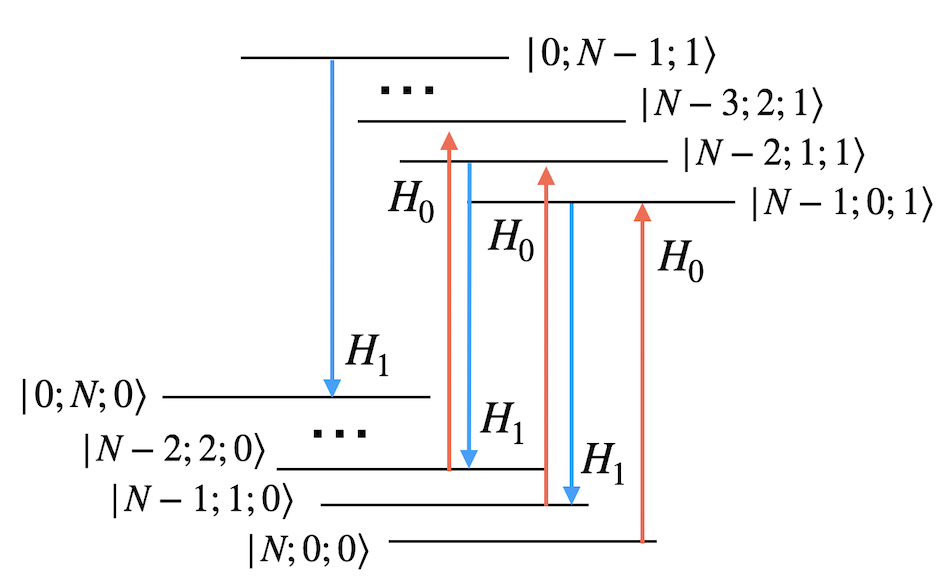
Figure 2: Protocol for multi-atom gate and measurement — (A) gate logic; (B) physical realization with N=5 ancillae within a Rydberg blockade; (C) pulse sequence and symmetric level diagram for data copying.
Protocol for Accelerated Qubit Measurement
The protocol starts with a single data qubit and a register of N ancilla atoms, all confined within the same Rydberg blockade volume. The core innovation is a simultaneous mapping of the data qubit's logical state onto the ancillae via a global Rydberg pulse sequence, as opposed to conventional sequential operations. Either a dual-species approach (distinct atomic species for data and ancilla) or a spectrally selective light shift can be employed for targeted manipulation.
Multi-Ancilla State Mapping
Global pulses H0 and H1 collectively drive ancilla atoms through symmetric Rydberg-excited states, which are protected by blockade, allowing only one Rydberg excitation per system. Population is sequentially transferred from ground states to the logical register, implementing the transformation:
α∣0⟩∣0⟩N+β∣1⟩∣0⟩N⟶α∣0⟩∣0⟩N+β∣1⟩∣1⟩N
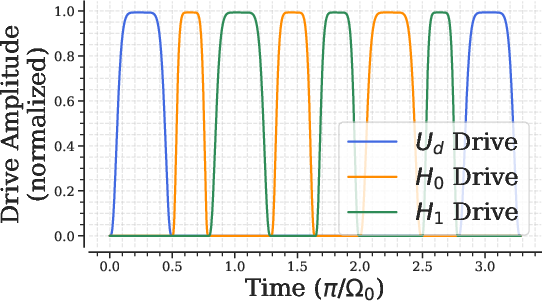
resulting in all ancillae reflecting the data qubit's state. The number of required pulses scales optimally as $2N+2$, and the protocol is analyzed and implemented analytically with exact bosonic mode dynamics.
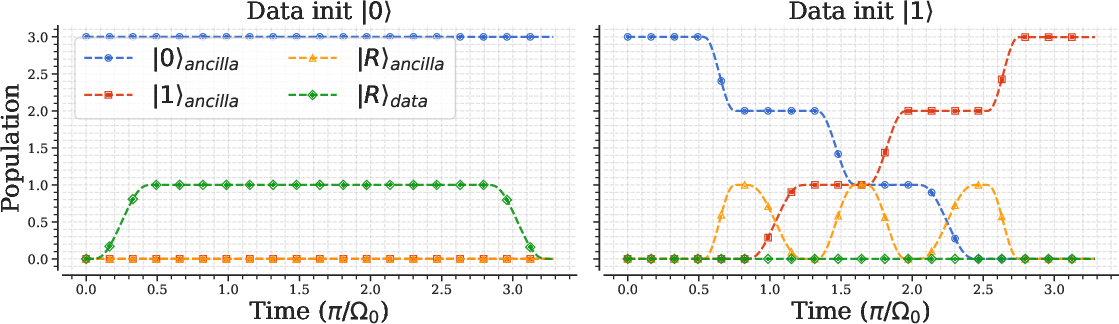
Figure 1: Drive sequence for N=3 ancilla—amplitude profiles and population trajectories for the gate, showing efficient state transfer for both logical data qubit states.
Importantly, no shuttling or complex waveform synthesis is necessary; only global, collectively addressed pulses are used, and the symmetry ensures robustness against disorder and technical imperfections.
Gate Timing and Comparison
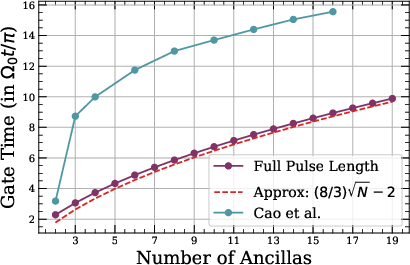
The total gate time for mapping the data qubit is approximated by
T≈2Ωπ(4N−1)
for drive Rabi frequency N0. This scaling is substantially more efficient than previous numerically optimized or sequential gate protocols.
Figure 3: Gate time comparison as a function of N1; the presented protocol achieves consistently faster state mapping versus prior multi-atom constructions.
Measurement Fidelity and Performance Analysis
Precision measurement fidelity depends on both the quantum state transfer fidelity (multi-qubit gate) and the subsequent collective fluorescence readout. The protocol is simulated for a realistic Cs--Rb setup, with full treatment of finite Rydberg lifetimes, blockade energies, atom loss, and photodetection noise.
Gate Infidelity Characterization
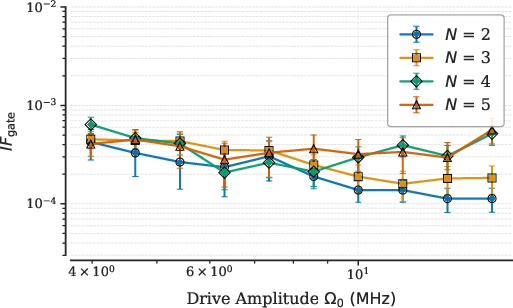
Monte Carlo simulations consider Rabi drive strength, loss, decay, and geometric blockade variation to determine gate-induced infidelity floors. The trade-off between Rydberg decay and blockade-induced leakage is optimized by tuning the global Rabi frequency.
Figure 4: Gate infidelity versus Rabi drive amplitude N2 for various ancilla numbers; N3–N4 geometries modeled with realistic spacing.
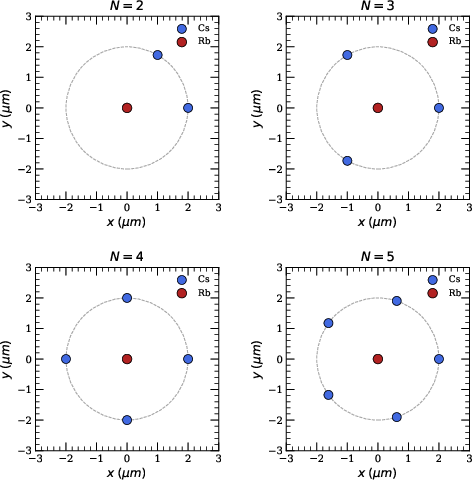
Figure 7: Spatial configurations for ancilla-data qubit systems, N5–N6, all within a Rydberg blockade volume (minimum separation N7m).
Photon Collection and Measurement Simulation
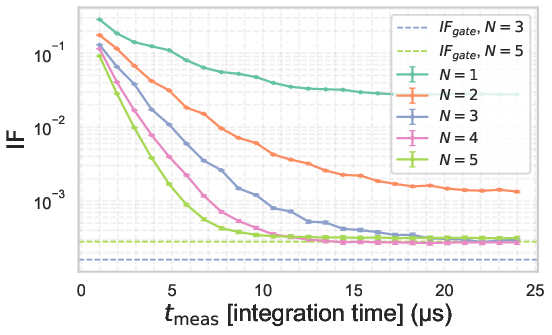
With N8 ancilla atoms, collective photon emission increases the photon collection rate by N9, directly reducing the required integration time. Atom loss and background-dominated noise are explicitly included. The infidelity as a function of measurement duration is shown:
Figure 8: Measurement infidelity (IF) vs. integration time for N=50; infidelity floors imposed by gate errors, showing N=51 reduction in integration time and order-of-magnitude improvement in achievable error rate for N=52.
The protocol achieves N=53 in N=54s for N=55, compared to N=56 infidelity (dominated by loss) even with ideal gate transfer in the N=57 case. Multiple ancillae both increase flux and provide redundancy against atom loss.
Minimal Integration Time for Target Infidelity
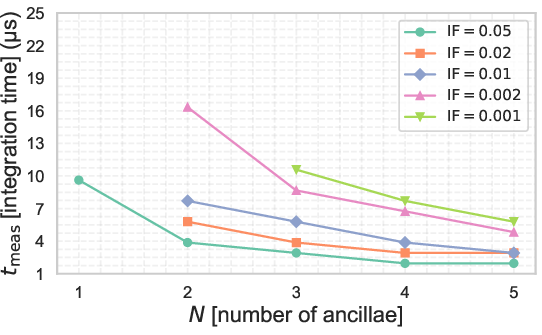
The reduction in integration time scales favorably with N=58, and the achievable speedup for practical infidelity thresholds is quantified:
Figure 5: Minimal integration time required for target infidelity, showing rapid reduction with increasing N=59; for high N0, performance is bottlenecked by gate infidelity.
Spatially Resolved vs Aggregated Detection
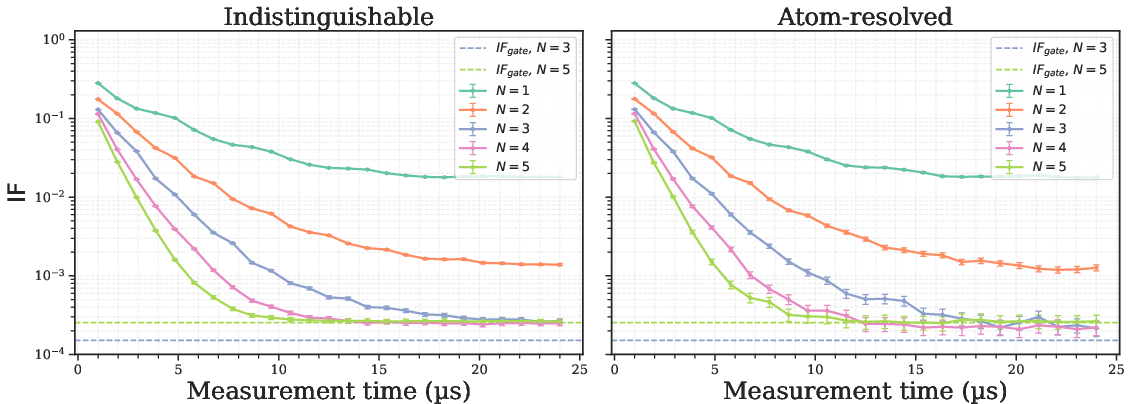
The protocol was benchmarked under both register-aggregated and spatially resolved photon-counting models, with maximum-likelihood discrimination:
Figure 6: Measurement infidelity for aggregated (left) and atom-resolved (right) detection. Both achieve similar fidelity for realistic noise, indicating the simplicity of the aggregated approach is sufficient in practice.
Practical and Theoretical Implications
The reduction of measurement time presented—by over two orders of magnitude for moderate N1—directly addresses a dominant performance bottleneck in neutral atom quantum processors. This advancement pushes atom-based platforms toward competitiveness with superconducting and trapped-ion architectures, particularly for reaction-time-limited algorithms and error-corrected logical computation. In regimes where quantum error correction and decoding require rapid measurement and feedback, the newfound ability to reach N2 measurement windows enables substantial acceleration of logical circuit clock rates.
Figure 9: Schematic of the protocol, highlighting the all-global-pulse, no-shuttling design with scalable ancilla register.
The same protocol constitutes a fast, scalable means for simultaneous multi-target CX operations, which are common in quantum lookup and certain error correction routines. The global addressing and symmetric pulse structure make this method both hardware-efficient and less susceptible to calibration drift compared to individually optimized pulses.
Theoretically, the work demonstrates the utility of symmetry-protected dynamics and collective enhancement for quantum metrology and readout, suggesting broader applications in ensemble-based quantum measurement and other scalable neutral atom algorithms.
Conclusion
This protocol for fast measurement of neutral atoms via a multi-atom Rydberg gate demonstrably reduces both measurement time and infidelity, achieving N3 error rates in N4s using N5 ancillae. The approach bypasses previous bottlenecks associated with slow single-atom readout and complex gate calibration. With only global control and no shuttling or site-specific addressing, the method is immediately amenable to current experimental setups and is extensible to larger-scale processors. Its adoption can reduce the runtime of reaction-time-limited quantum algorithms and facilitate the deployment of advanced fault-tolerant protocols on neutral atom platforms, thus closing a critical gap with fast superconducting hardware while retaining the architectural torque of reconfigurable atom arrays.