Generalization Guarantees on Data-Driven Tuning of Gradient Descent with Langevin Updates
Published 13 Apr 2026 in cs.LG and stat.ML | (2604.13130v1)
Abstract: We study learning to learn for regression problems through the lens of hyperparameter tuning. We propose the Langevin Gradient Descent Algorithm (LGD), which approximates the mean of the posterior distribution defined by the loss function and regularizer of a convex regression task. We prove the existence of an optimal hyperparameter configuration for which the LGD algorithm achieves the Bayes' optimal solution for squared loss. Subsequently, we study generalization guarantees on meta-learning optimal hyperparameters for the LGD algorithm from a given set of tasks in the data-driven setting. For a number of parameters $d$ and hyperparameter dimension $h$, we show a pseudo-dimension bound of $O(dh)$, upto logarithmic terms under mild assumptions on LGD. This matches the dimensional dependence of the bounds obtained in prior work for the elastic net, which only allows for $h=2$ hyperparameters, and extends their bounds to regression on convex loss. Finally, we show empirical evidence of the success of LGD and the meta-learning procedure for few-shot learning on linear regression using a few synthetically created datasets.
The paper presents a framework where Langevin-inspired updates approximate the Bayesian posterior mean through data-driven hyperparameter tuning.
It employs pseudo-dimension theory to derive sample complexity bounds ensuring robust generalization across varied meta-learning tasks.
Empirical results on synthetic regression demonstrate that meta-learned LGD outperforms standard gradient descent, especially in few-shot learning regimes.
Generalization and Meta-Learning Guarantees for Langevin Gradient Descent
Introduction and Motivation
The paper "Generalization Guarantees on Data-Driven Tuning of Gradient Descent with Langevin Updates" (2604.13130) centers on the theoretical and empirical analysis of Langevin-inspired gradient descent methods for regression, particularly in meta-learning settings. The authors address the challenge of data-driven hyperparameter tuning, considering both learning rates and regularizer coefficients, and the broader question of how meta-learned hyperparameters generalize across related tasks.
Core to this work is the Langevin Gradient Descent (LGD) algorithm, which leverages Langevin diffusion concepts—incorporating stochastic noise into parameter updates—to approximate the mean of the Bayesian posterior under a regularized loss. The authors analyze both the Bayes-optimality properties of this procedure for the squared loss and provide rigorous generalization guarantees for hyperparameter meta-learning grounded in pseudo-dimension theory. Experimental results on synthetic regression demonstrate the practical advantages of meta-learned hyperparameters, especially for log-strongly-concave (potentially non-Gaussian) priors.
Langevin Gradient Descent Algorithm: Formulation and Theoretical Guarantees
LGD extends vanilla gradient descent by modifying the parameter update with an additive Gaussian noise term, yielding an update of the form:
wk+1=wk−η(∇l(y,f(X;wk))+r(wk;θ))+2ηξk
where r(w;θ) is a parameterized regularizer and ξk is standard normal noise. For estimation, the algorithm consolidates by averaging predictions from the final steps of the diffusion trajectory—crucially, this mean prediction aligns with the Bayesian posterior mean for appropriate choices of the regularizer and learning rate.
The authors prove (Theorem 4.1) that, for regression with squared loss under a log-strongly-concave prior, there exist hyperparameters η∗,θ∗ such that the LGD estimator (with sufficient averaging and burn-in) achieves expected predictions arbitrarily close to the Bayes-optimal estimator (posterior mean of f(Xv;w∗)). Notably, this property holds even under distribution shift between train and test, and contrasts sharply with vanilla gradient descent, which is mode-seeking and only Bayes-optimal for Gaussian-like posteriors.
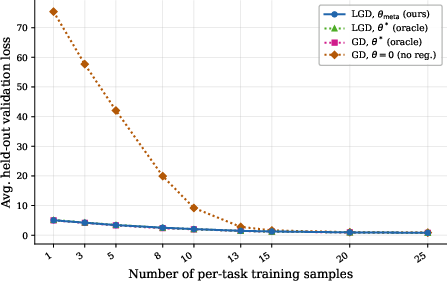
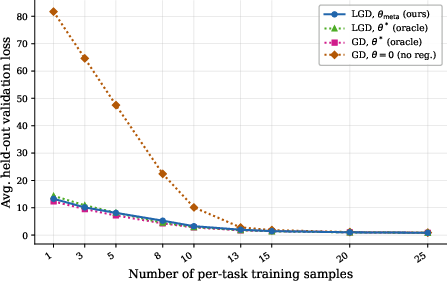
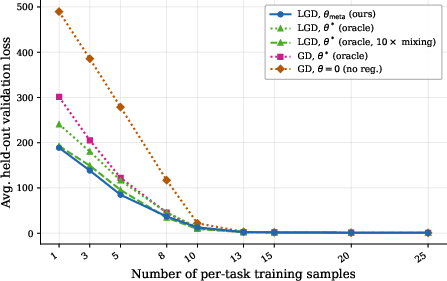
(Figure 1)
Figure 1: Comparison of oracle gradient descent (GD) and Langevin Gradient Descent (LGD) algorithms, and their meta-learned variants, on synthetic regression tasks with various priors.
The generalization performance of meta-learned hyperparameters hinges on how rapidly the empirical meta-objective concentrates to its expectation over tasks. The authors employ the Goldberg-Jerrum framework to upper bound the pseudo-dimension of the function class Lv={lv(θ,η):(data, noise)↦validation loss} corresponding to the validation errors parameterized by the hyperparameters. Under regularity and mild algorithmic complexity assumptions, they establish that this pseudo-dimension grows as O(dh) (ignoring logarithmic factors), where d is the number of model parameters and h is the hyperparameter dimension.
This scaling matches prior work on Elastic Net but, importantly, extends guarantees to general strongly-convex regularized objectives and more expressive regularizer families. Unlike previous works which only justified two-hyperparameter settings and perfect optimization, the analysis here holds for (meta-)learning optimization dynamics with stochasticity and algorithmic bias.
Consequently, they derive that with O(dhpolylog(d)/ϵ2) tasks, minimizing the empirical validation loss over tasks yields hyperparameters whose expected generalization gap to the Bayes' risk is at most r(w;θ)0, with high probability. For well-specified settings and squared loss, they further bound the sample complexity for learning hyperparameters that achieve r(w;θ)1-close Bayes risk as r(w;θ)2, the additional r(w;θ)3-factors arising from accounting for mixing and algorithmic convergence of LGD.
Experimental Assessment
Empirical studies were conducted on synthetic linear regression tasks sampled from various log-strongly-concave priors (isotropic Gaussian, diagonal Gaussian, and strongly-skewed via Softplus modification). For each scenario:
Meta-learned LGD discovers hyperparameters that perform on par with or outperform oracular variants (those with access to true priors), particularly striking under non-Gaussian priors where the posterior mean and mode differ.
LGD significantly outperforms standard GD—both regularized and unregularized—especially in few-shot learning regimes (limited per-task data).
Algorithmic convergence plots demonstrate meta-learned LGD matches or exceeds oracular LGD using an order-of-magnitude fewer sampling steps, highlighting the efficacy of data-driven tuning.
These findings reinforce the theoretical analysis: meta-learned LGD can approach Bayes-optimality efficiently even when standard approaches and naive regularization fail under model mis-specification.
Figure 2: Validation loss comparisons illustrating generalization and adaptation behaviors of meta-learned LGD across different prior families, showing pronounced advantages in highly non-Gaussian and misspecified regimes.
Implications and Future Directions
Practically, this work provides principled justification for meta-learned algorithmic hyperparameters in convex regression, extending the rationale for stochastic gradient-based learning-to-learn paradigms. It demonstrates that:
Meta-learning over LGD-type algorithms generalizes robustly, with explicit, task-complexity dependent sample complexity guarantees.
Theoretical guarantees apply to broader regularizer families and go beyond settings where analytic Bayes-optimality and closed-form posteriors exist.
Data-driven consolidation (mean prediction over Langevin trajectory) is critical for achieving Bayes risk minimization, especially under prior/posterior shift.
Theoretically, this framework offers a foundation for understanding generalization in meta-learning beyond bi-level or point-estimation settings, articulating the key role of algorithmic pseudo-dimension in sample-efficient generalization. The analysis could be extended to:
Model classes with multi-modal or weakly-convex/strongly log-concave priors, relaxing structural assumptions on the objective.
Nonlinear predictors or neural architectures, possibly via functional approximation of regularizers and Bayesian meta-updates.
Robustness to distributional shift across tasks (the analysis already accommodates certain non-i.i.d. conditions).
Conclusion
This paper advances the theoretical and empirical understanding of data-driven hyperparameter tuning—specifically, meta-learning of Langevin-inspired updates for regression. By harnessing algorithmic properties of LGD and rigorously quantifying the generalization capacity via pseudo-dimension bounds, it substantiates the effectiveness of learning-to-learn approaches in provably attaining Bayes-optimality across tasks. The proposed framework bridges meta-learning and empirical Bayes perspectives, and sets a baseline for further work on scalable, theoretically-grounded algorithmic adaptation in modern ML systems.