- The paper introduces a closed-form framework that explicitly computes control switching times in constrained double-integrator systems.
- It derives analytic expressions that simplify calculations by reducing cubic equations to at most quadratic ones for transition points.
- The approach enables low-latency, energy-optimal trajectory planning for applications in autonomous vehicles and robotic systems.
The paper "Closed-Form Characterization of Constrained Double-Integrator Optimal Control" (2604.13007) provides an explicit analytical framework for energy-optimal control of double-integrator systems subject to state and control constraints, with fixed terminal time and free terminal speed. The analysis is fundamentally relevant for dynamic systems—such as Connected and Automated Vehicles (CAVs) and robotic agents—where kinematic and actuation bounds are intrinsic requirements.
The study addresses the canonical double-integrator optimal control problem with quadratic cost—minimizing ∫u(t)2dt—for systems described by position and speed states, and acceleration as the control input. The system is subject to bounds vmin≤v(t)≤vmax and umin≤u(t)≤umax, with prescribed initial position and speed, terminal position, and a fixed maneuver time. In realistic settings, these constraints encode physical limits (e.g., maximum speed, actuation limits) encountered in CAVs and robotic systems. The combination of quadratic cost and box constraints leads to a trajectory structure composed of piecewise arcs—so-called bang (saturated control), unconstrained (affine control), and coast (velocity saturation) phases—where the instants at which transitions (switches) between the phases occur are nontrivial to compute.
Explicit Classification of Control Profiles
Building on prior work [meng2020eco, mahbub2020Automatica-2], the paper demonstrates that, under feasibility (i.e., reachable boundary conditions), all admissible profiles for the free terminal speed case are a concatenation of at most three arcs, drawn from the set:
- Bang: constant input at umax
- Unconstrained (Affine): linearly varying acceleration
- Coast: zero acceleration at maximum speed (v=vmax,u=0)
The admissible control profiles, with their potential transitions and corresponding conditions, include:
- Unconstrained (Affine)
- Bang–Unconstrained
- Unconstrained–Coast
- Bang–Coast
- Bang–Unconstrained–Coast
- Pure Bang (pathological, measure-zero case)
The paper adds rigor by explicitly characterizing all special profiles and the precise conditions for each, surpassing earlier treatments that required sequential feasibility checks and involved intermediate cubic equations. Instead, all switching times are shown to be solutions to at most quadratic equations, directly in terms of the boundary data.
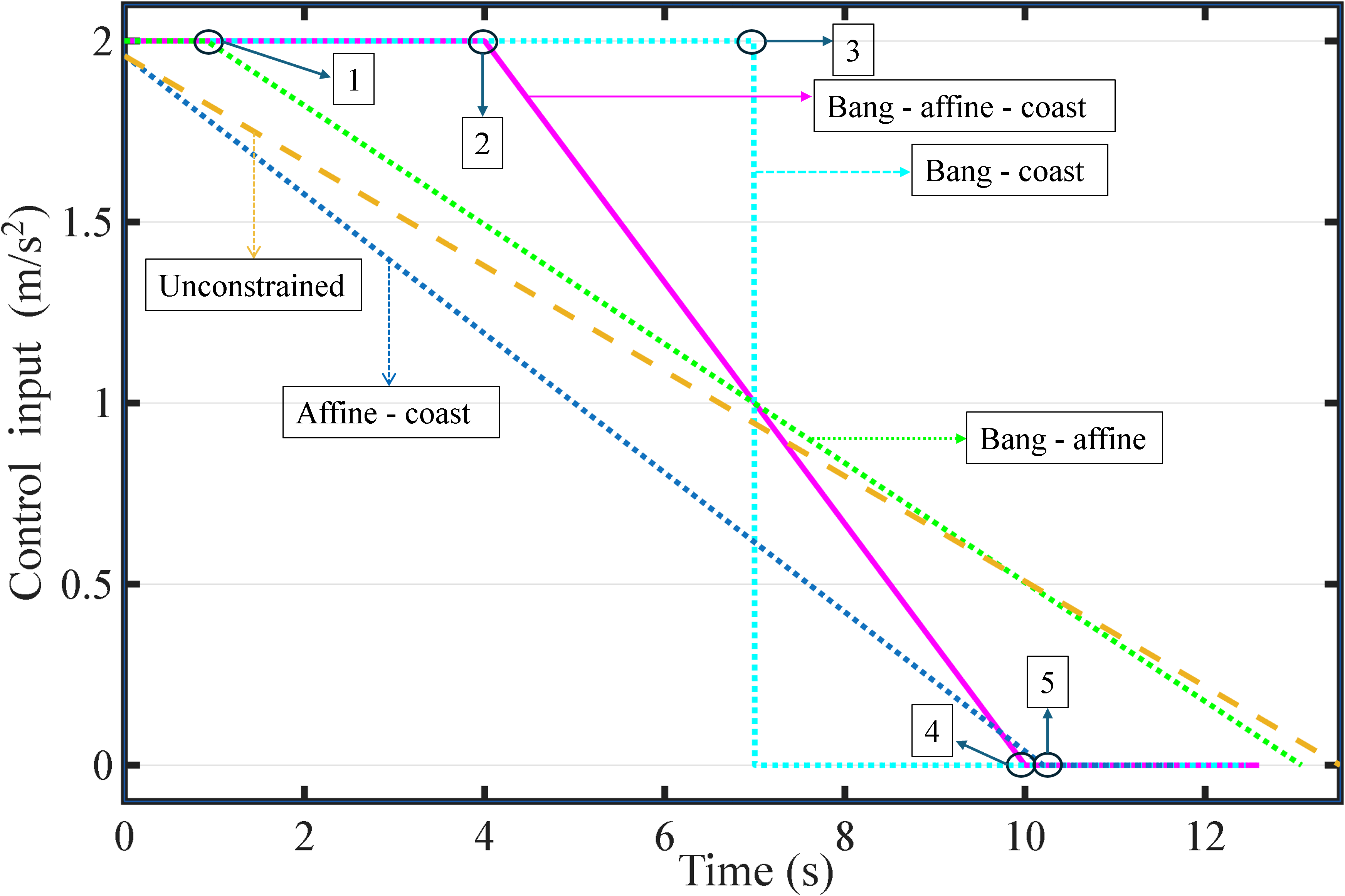
Figure 1: Representative combinations of control profiles, illustrating transitions among bang, affine (unconstrained), and coast arcs for different constraint activation scenarios.
Analytical Derivation of Trajectories and Switching Times
A key advance is the derivation of fully explicit formulas for switching times between arcs for all admissible profiles, without introducing unnecessary auxiliary variables or constants of integration:
- Unconstrained/Affine profile: The optimal control is u∗(t)=α(t−T), where α is determined analytically from boundary conditions. No constraints are active if T is above both the state and control thresholds, ensuring no phase transitions.
- Affine–Coast and Bang–Affine profiles: The switching point to coast or from bang is expressed as a function of (v0,L,T,vmax,umax), requiring solution of a single quadratic equation.
- Bang–Affine–Coast profile: When the unconstrained trajectory simultaneously violates both the state and control constraints, the optimal trajectory is shown to be exactly of bang–affine–coast type—a novel and strong claim that obviates any need for sequential case-checking. Both switching times are direct closed-form expressions in terms of the fundamental parameters.
The pathological pure bang case is treated rigorously and is shown to arise only for measure-zero specific initial conditions, consistent with classical optimal control theory.
Structural and Numerical Implications
The paper claims and proves that when both the unconstrained solution violates both constraints, the solution directly assumes a bang–affine–coast (B–A–C) profile, with no intermediate feasibility/invariance tests needed—a distinct improvement over [mahbub2020Automatica-2]. Moreover, the switching times τc∗,τs∗ between the arcs can be computed explicitly as
vmin≤v(t)≤vmax0
where vmin≤v(t)≤vmax1, and vmin≤v(t)≤vmax2 is an explicit function of vmin≤v(t)≤vmax3 and vmin≤v(t)≤vmax4.
This closed-form characterization greatly enhances the analytical tractability of such constrained control problems and leads to algorithms with bounded computational complexity, making them viable for real-time implementation in embedded systems with limited compute resources. The reduction from solving coupled algebraic (potentially cubic) equations to at most a quadratic equation for each transition is critical for low-latency trajectory generation, such as in CAV platforms.
Practical/Theoretical Implications and Future Directions
The explicit, single-shot classification and trajectory construction enables provably optimal energy-efficient planning for autonomous systems under physical constraints. In addition to direct applications in CAV energy management and safe coordination [Malikopoulos2020, meng2020eco, chalaki2021CSM], the results form a prototype for constrained optimal control in broader contexts where fast, certifiable solutions are essential (robotics, process engineering, aerospace guidance).
Future research will need to:
- Extend the approach to nonlinear (e.g., non-flat) dynamics and multi-agent settings with coupled constraints or interactions.
- Investigate robustness of switching time expressions in the presence of perturbations or modeling uncertainty.
- Incorporate stochasticity or learning-based approaches for scenarios with real-time uncertainty (e.g., traffic networks).
- Analyze the scalability of the closed-form framework for large-scale or networked control problems, including decentralized or distributed implementations.
Conclusion
This work establishes a rigorously grounded, closed-form solution framework for double-integrator optimal control problems with both state and control constraints, offering explicit analytical expressions for all trajectory segments and switching times. The approach enables robust, efficient, and transparent trajectory generation in domains such as CAV coordination and robotics, providing a foundation for future extensions to more complex or higher-order constrained systems.