- The paper introduces LogicEval, a framework that systematically evaluates automated repair techniques for logical vulnerabilities using real-world datasets and fine-grained patch localization.
- It highlights that LLM-based repairs require tailored prompt engineering and auxiliary vulnerability details to produce semantically plausible patches.
- Empirical results reveal that conventional and neural methods poorly generalize to logic bugs, underscoring the need for improved context-aware repair techniques.
LogicEval: Systematic Evaluation of Automated Repair Techniques for Logical Vulnerabilities
Introduction
Logic vulnerabilities—semantic flaws leading to deviations from intended software behavior without triggering classical memory-safety violations—remain a persistent and severe threat to software security. These bugs often enable attacks such as authentication bypass, data leakage, and operational disruption, remaining invisible to tools focused on memory errors. The absence of recurring fix templates, complex context dependencies, and scarcity of high-quality datasets have hindered automation for their detection and remediation.
The paper "LogicEval: A Systematic Framework for Evaluating Automated Repair Techniques for Logical Vulnerabilities in Real-World Software" (2604.12994) addresses critical gaps in the evaluation and benchmarking of Automated Vulnerability Repair (AVR), both for conventional and LLM-based techniques, specifically targeting logical vulnerabilities. The authors introduce LogicEval, an end-to-end, extensible framework coupled with LogicDS, the first curated dataset of real-world logic bugs and their fixes. LogicEval systematically characterizes repair approaches, identifies root causes of failures, and provides empirically grounded recommendations for future research.
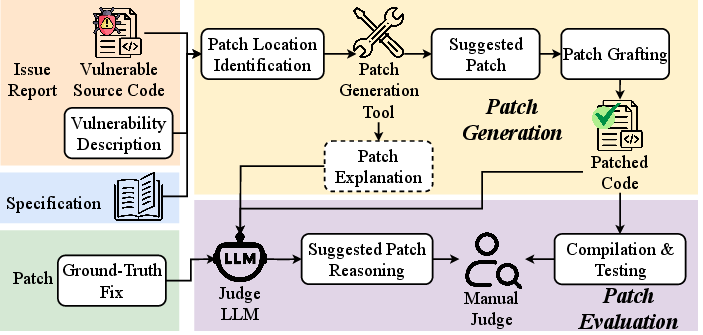
Figure 1: Workflow overview of LogicEval, illustrating input modalities, patch generation and localization, as well as multi-faceted patch evaluation spanning compilation, testing, and LLM-guided reasoning.
Existing Approaches and Limitations
Taxonomy of Automated Repair
Prior work on AVR predominantly addresses memory corruption, leveraging template matching, static or symbolic constraint extraction, and code search paradigms. Template-based methods and constraint-analysis are inapplicable to logic bugs due to the absence of recurring syntactic patterns and the intractability of specifying behavioral invariants in code. Search-based and neural approaches suffer from poor generalization, as logic vulnerabilities are highly context-dependent and underrepresented in existing training sets. Deep learning-based sequence-to-sequence and tree-AST decoders fail to capture the semantics specific to the vulnerable logic, yielding non-plausible patches in most real-world cases.
Recently, LLMs demonstrated significant advances in code understanding and repair for general bugs. Yet, their efficacy for logical vulnerabilities remains unquantified, and their outputs are sensitive to prompt configuration, context, and auxiliary information availability.
Gaps in Evaluation Methodology
Existing evaluation benchmarks like Defects4J and others do not include representative logic vulnerabilities with security impact. Evaluation toolchains rely on address sanitizers or CodeQL for patch validation, which are fundamentally incapable of capturing semantic deviations that underlie logic bugs. Prior frameworks also lack systematic facilities for controlled input variation, localization assessment, and, crucially, reasoning-based validation of patch intent vs. ground truth.
The LogicEval Framework
LogicEval fills these gaps through a holistic design built from first principles to enable rigorous comparison of repair algorithms on logical vulnerabilities. Its key components include:
- LogicDS Dataset: 43 real-world and 43 synthetic Java samples, manually curated from high-impact CVEs, including vulnerable/fixed code pairs, behavioral descriptions, specifications, and context. Dataset curation required roughly 430 person-hours and systematic localization of core fix regions, enabling granular evaluation.
- Input Modality Control: Supports variable configuration of code granularity (block vs. function scope), auxiliary natural language descriptions (vulnerability, specification, repair steps), and explicit context injection.
- Patch Localization: Enforces ground-truth core fix manual localization to factor out the confounding effect of poor automated fault localization on generation accuracy, isolating and benchmarking the true repair capability.
- Patch Generation: Uniform interface to invoke non-learning, deep neural, and LLM-based AVR systems. Supports prompt engineering dimensions (zero-shot, few-shot, chain-of-thought), context rotation, and temperature scaling for LLM evaluation.
- Patch Evaluation: Multi-stage validation via compilation and testing harnesses, coupled with granular manual adjudication for plausible patches. Patch explanations are generated and contrasted against ground-truth rationale using LLM-based reasoning, cosine similarity, and consensus verdicts across multiple LLM judges.
Empirical Results
Non-learning-based (SimFix), and deep learning-based (KNOD) approaches yielded patches for logic bugs that were generally non-compilable or exhibited logic orthogonal to the desired fix. Even with precise localization, these approaches misinterpreted the underlying flaw due to lack of semantic comprehension. LLM-based repair (VRPilot) marginally outperformed others but substantial performance drop persisted in real-world cases.
When evaluating off-the-shelf LLMs (Llama 3.1, Qwen 2.5, OpenAI o3-mini), the following were observed:
- LLMs require auxiliary vulnerability information (descriptions/specifications) to produce semantically plausible patches. The absence of explicit prompts leads them to hallucinate fixes for memory bugs (e.g., inserting NULL checks), underscoring the necessity of descriptive context.
- Prompt sensitivity impacts outcome distribution. Zero-shot prompts achieved higher reasoning and patch quality than CoT or few-shot variants. However, increasing prompt context (moving from block to function) improved compilability at the expense of reasoning fidelity when code size increased.
- Providing repair steps as auxiliary information produces the highest scoring patches, effectively transforming the task into a guided edit.
- Strong numerical results: Out of 43 real-world vulnerabilities, off-the-shelf LLMs generated correct patches for only 5, highlighting the current limitation of pure LLM-based repair for logic bugs, even in the presence of high-quality meta-data.
Evaluation of Reasoning Metrics
A critical innovation is using LLM judges (excluding the generator model to avoid preference bias) to provide binary and graded similarity measures between suggested and ground-truth patches. LLM-guided reasoning verdicts (especially using Qwen) demonstrated high alignment with expert manual curation (accuracy of 0.8), outperforming traditional automated validation metrics (compilation/testing). This establishes the foundation for scalable triage and prioritization of plausible repairs in automated pipelines.
Comparison With Prior Evaluation Work
LogicEval's comparison with prompts and methodology from existing frameworks (e.g., Pearce et al.) demonstrates that omission of vulnerability-specific auxiliary data in prior prompts produces fewer plausible and lower-quality logic repairs, validating the need for auxiliary information provisioning.
Practical and Theoretical Implications
LogicEval dramatically raises the bar for what is required for systematic, actionable benchmarking in logic bug repair:
- The results expose that naive application of LLMs—without tailored prompt engineering and context—will not mitigate real-world logic bugs, as LLMs default to addressing surface-level (often memory) errors.
- The orchestrated pipeline enables fine-grained ablation studies, prompt engineering search, and incremental evaluation of new repair heuristics, separating concerns of localization, generation, and validation.
- The LLM-as-judge paradigm, if used carefully, enables scalable reasoning-centric validation, which is essential given the subjectivity and complexity intrinsic to logical bug repair.
From a research perspective, there is an urgent need for:
- richer program analysis and context inference to bridge the abstraction gap between specifications and fix location;
- integration of reasoning/planning chains that blend symbolic program analysis with LLM generation; and
- larger curated datasets and collaborative frameworks to accelerate research into non-templatic vulnerability classes.
Limitations and Future Directions
Key limitations include the cost and scalability bottleneck of manual logic bug curation, assumption of perfect localization (limiting direct end-to-end adoption in production flows), and potential for LLM judge/generator circularity, which is mitigated by strict generator/judge separation. The present dataset remains relatively small, but captures the diversity and complexity absent from existing corpora.
Looking ahead, LogicEval provides a blueprint for (i) developing advanced localization techniques for logic bugs, (ii) augmenting LLMs with stronger semantic and specification-grounded priors, and (iii) expanding reasoning evaluation into adversarial or multi-agent settings.
Conclusion
LogicEval delivers a systematic, extensible framework and testbed for evaluating and understanding automated program repair for logical vulnerabilities. The findings highlight the inadequacy of existing non-learning and LLM-based solutions in the absence of fine-grained vulnerability context, and establish robust metrics and methodology for future research. Its release is expected to catalyze new advances at the intersection of formal methods, program analysis, and data-driven synthesis for secure software engineering.
Reference: "LogicEval: A Systematic Framework for Evaluating Automated Repair Techniques for Logical Vulnerabilities in Real-World Software" (2604.12994)