- The paper introduces fine projection complexes to overcome classical limitations in the study of homeomorphism groups.
- It establishes coarse Behrstock inequalities and defines velcrot subsurfaces to recover key finiteness properties.
- The constructed complexes support continuous quasi-morphisms that yield elements with positive stable commutator length.
Fine Projection Complexes and Subsurface Homeomorphisms with Positive Stable Commutator Length
Introduction and Motivation
This work advances the study of surface homeomorphism groups, specifically Homeo0(Sg) for closed oriented surfaces of genus g≥2, by constructing new hyperbolic spaces—termed fine projection complexes—on which these groups act coboundedly by isometries. The approach generalizes the projection complex techniques of Bestvina–Bromberg–Fujiwara, crucial for mapping class groups, to the setting of homeomorphism groups. The motivation is twofold: (1) to build new geometric tools which circumvent the breakdown of classical Behrstock-type inequalities and finiteness conditions in this context, and (2) to leverage these complexes to produce nontrivial quasi-morphisms and elements of positive stable commutator length (scl) in Homeo0(Sg), especially for subsurface-supported homeomorphisms.
Background: Curve Graphs, Fine Curve Graphs, and Quasi-morphisms
The curve graph and its relatives provide a central geometric arena for studying mapping class groups and actions of homeomorphism/diffeomorphism groups. For mapping class groups, Bestvina–Fujiwara machinery produces abundant quasi-morphisms and links group-theoretic properties with hyperbolic geometry. However, for Homeo0(Sg), the natural analog is the fine curve graph C†(S), a Gromov hyperbolic graph whose vertices are essential simple closed curves without identification by isotopy, and with edges linking disjoint representatives. Prior constructions falter for Homeo0(Sg): classic WPD/acylindrical hyperbolicity constraints and the Behrstock inequality do not hold in this fine setting, notably due to the uncountable collection of subsurfaces and the lack of finiteness after acting by small homeomorphisms.
Main Constructions
Fine Projection Complexes
A new family of fine projection complexes is constructed, generalizing projection complexes in the non-finite, non-proper, and "fine" (non-isotopy class) setting. The key innovations are:
- Velcrot Subsurfaces: Two essential subsurfaces X,Y are velcrot if C†(X)∩C†(Y) is infinite-diameter in both. This topological/metric relation generalizes the role of isotopy classes and allows a modified finiteness property for organizing the complex.
- Weak Finiteness and Coarse Behrstock Inequality: Using velcrotness, the classical finiteness axiom (P2) is recovered modulo covering by finitely many velcrot classes (see Figure 1 below). The Behrstock inequality (controlling projections between triples of subsurfaces) is established in a coarse form that is robust under small perturbations (see Figure 2).
- Hierarchy and Distance Functions: Projection distances between subsurfaces and collections are meticulously defined to enable a hierarchy machinery for organizing the complex, including a version of the triangle inequality and ordering structure.
The result is that Homeo0(Sg) acts coboundedly by isometries on a family of unbounded quasi-trees constructed using these fine projection complexes.
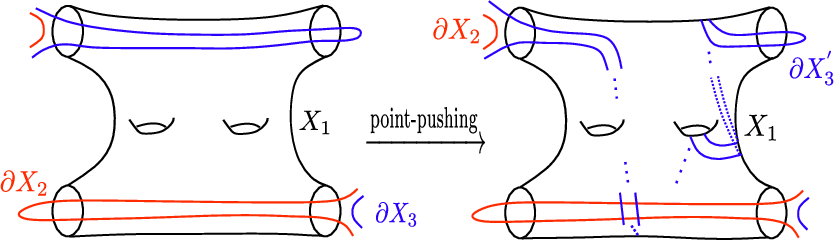
Figure 3: The behaviour of g≥20, the subsurface projection distance, in the fine setting—capturing nontrivial relations among subsurface orbits.
Isotopy and Dual Graph Neighborhoods
The paper addresses the technical complications arising from the absence of isotopy class identification. Subsurface boundaries are isotoped to neighborhoods of the dual graph to g≥21; combinatorial finiteness is then recovered by tracking only a finite set of possible intersection patterns (see Figure 1).
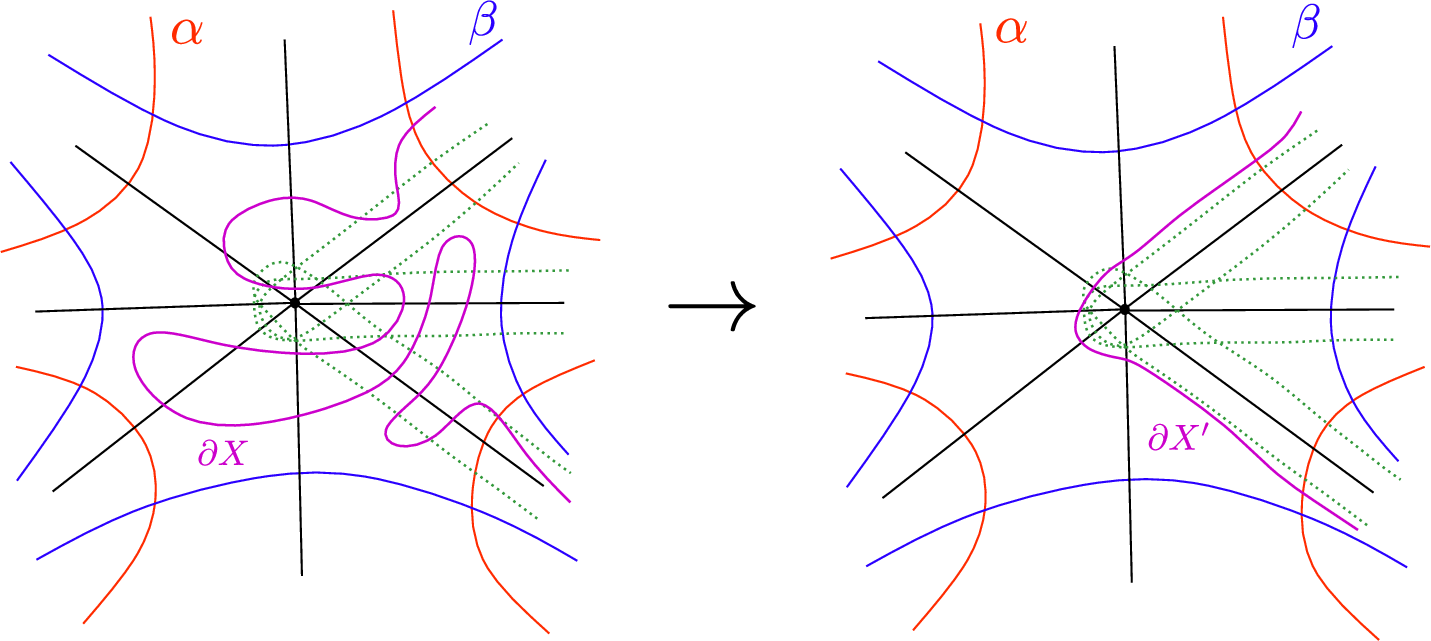
Figure 1: Isotoping subsurface boundaries to neighborhoods of a dual graph, ensuring combinatorial control over the subsurface family.
Fine Behrstock Inequality and Surgery
The fine Behrstock inequality (Theorem~\ref{thm: berhstock} in the paper) is established through a detailed surgery process. Non-essential intersections of subsurface boundaries are removed iteratively by isotopy—ensuring the projection hierarchy required for the complex's hyperbolic structure (see Figure 2).
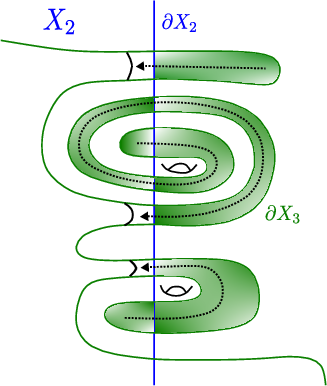
Figure 2: The crucial isotopies that eliminate non-essential intersection points, allowing for a fine version of the Behrstock inequality.
Blown-up Fine Projection Complex and Embedding of Fine Curve Graphs
The construction is further "blown up" to embed fine curve graphs of subsurfaces quasi-isometrically, resulting in a Gromov hyperbolic space on which g≥22 acts by isometries. This complex admits the necessary ingredients for the explicit Brooks/Bestvina–Fujiwara machinery for constructing unbounded quasi-morphisms.
Applications: Quasi-morphisms and Stable Commutator Length
Positive scl on Subsurface Homeomorphisms
A central application is the detection of positive scl elements supported on essential proper subsurfaces, including once-bordered tori. Previous quasi-morphisms (as in Bowden–Hensel–Webb) vanish on homeomorphisms supported away from the entire surface; the current construction yields, for every essential subsurface g≥23, explicit quasi-morphisms unbounded on g≥24 and, by Bavard duality, elements with positive scl.
More precisely, for each such subsurface g≥25, there exist elements g≥26 with g≥27 and g≥28. These include pseudo-Anosov-type homeomorphisms supported on g≥29 as well as elliptic elements for the fine curve graph, filling a significant gap in the understanding of scl for homeomorphism groups.
Continuous Quasi-morphisms and the Fine Setting
The quasi-morphisms constructed are homogeneous and Homeo0(Sg)0-continuous, extending from Homeo0(Sg)1 to Homeo0(Sg)2 using Kotschick's automatic continuity and the density of smooth homeomorphisms. This establishes an infinite family of linearly independent quasi-morphisms on Homeo0(Sg)3, each detecting elements supported in various proper subsurfaces.
Asymptotic Dimension, Large-scale Geometry, and Open Problems
Asymptotic dimension, a central large-scale invariant, is shown to be infinite for Homeo0(Sg)4 (by results of Mann–Rosendal and embeddings of large dimension compacta into the Gromov boundary). The constructed fine blown-up projection complexes, however, do not capture the full large-scale structure of Homeo0(Sg)5. The paper leaves several open questions, notably:
- Is the fine curve graph Homeo0(Sg)6 of infinite asymptotic dimension?
- Is its Gromov boundary an Homeo0(Sg)7-manifold?
Their resolution would further connect the topology of the boundary with large-scale geometric and group-theoretic properties in this infinite-dimensional setting.
Conclusion
The paper establishes a robust framework for extending Bestvina–Fujiwara-type machinery to homeomorphism groups, overcoming the obstacles inherent in the fine (non-isotopy-class) setting. The introduction of the fine projection complex and the notion of velcrot subsurfaces enables cobounded isometric actions, coarse versions of finiteness and Behrstock inequalities, and the construction of continuous homogeneous quasi-morphisms with support on proper subsurfaces. This leads to new classes of elements with positive stable commutator length in Homeo0(Sg)8, even for elliptic elements with support inside essential proper subsurfaces—a situation not detectable by previous methods. The work opens further vistas in the large-scale geometry of homeomorphism groups and the structure of quasi-morphisms in the fine setting.
References
The paper is supported and contextualized by foundational works such as Bestvina–Bromberg–Fujiwara "Constructing group actions on quasi-trees," Bowden–Hensel–Webb "Quasi-morphisms on surface diffeomorphism groups," and recent developments in the geometry of the fine curve graph (2604.12974).