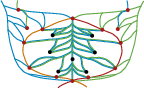
- The paper demonstrates a twentyfold classification of semi-infinite geodesics using Busemann functions to reveal detailed network configurations.
- It shows that shock structures precisely organize the global instability set, with fractal stability islands reconstructing shock interfaces.
- Results highlight the interplay between local non-uniqueness and overall instability in the KPZ universality class, offering key insights for stochastic systems.
Shocks, Instability, and the Twenty Networks of Infinite Geodesics in the Directed Landscape
Introduction and Context
This paper provides a comprehensive geometric and probabilistic analysis of instability and shock structures within the KPZ fixed point and the associated Directed Landscape, the universal scaling limit of last passage percolation models and the central object of the KPZ universality class. The focus is on infinite (semi-infinite) geodesics—maximizers for the Directed Landscape action functional—and their intricate interaction with points of shock and regions of instability in the solutions of inviscid, randomly-forced Hamilton-Jacobi equations.
The main theoretical machinery used includes Busemann function processes (encoding the collection of all infinite-action-invariant characteristics or eternal solutions), shock and instability point analysis, and an exact classification of all possible infinite geodesic configurations emerging from any point. Critical results reveal an intimate interplay: shock structures control the reconstructibility of the instability set, while geodesic networks reflect the underlying random entropy landscapes.
Directed Landscape, KPZ Fixed Point, and Geodesic Structure
The KPZ fixed point arises as a universal attractor for one-dimensional interface growth, modeled by the KPZ equation after suitable scaling. Its probabilistic structure is encoded in the Directed Landscape L, a random continuous field with a variational composition law (akin to the Hopf-Lax formula) and explicit geodesic maximal paths (Figure 1). The paper situates the KPZ fixed point within the context of stochastic Hamilton-Jacobi (SHJ) equations, emphasizing the degenerate, inviscid limit relevant for shock and instability phenomena.
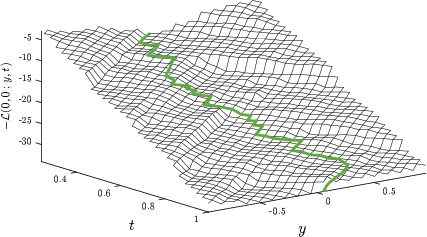
Figure 1: A simulation of the directed landscape (x,s)↦−L(0,0;x,s), with a geodesic path maximizing the LPP functional between fixed endpoints.
For any space-time point, semi-infinite geodesics exhibit three principal types per direction (leftmost, middle, rightmost), with further 20 possible combinatorial configurations once considering both left/right and −/+ families. The central technical object, the Busemann process, enables simultaneous construction and ordering of all such geodesics and their asymptotic velocities, and, crucially, reveals the existence of a countable, dense exceptional set of directions where non-uniqueness—and hence instability—arises.


Figure 2: All 20 possible configurations of θ-directed geodesics from a point p, displaying both stable and unstable types as well as the crucial sign distinction.
Instability Regions: Geometry and Characterization
The instability graph—the set of space-time points where two eternal Busemann solutions differ—is shown to possess highly nontrivial fractal structure: it is closed, nowhere dense, has no isolated points, and forms a complicated, connected graph densely filled with path-connected bi-infinite curves (Theorem 1). A portion of this set can be reconstructed explicitly from the union of boundaries of bounded, open stability islands: these islands are the connected components of the stable region, are all bounded, and have disjoint closures.
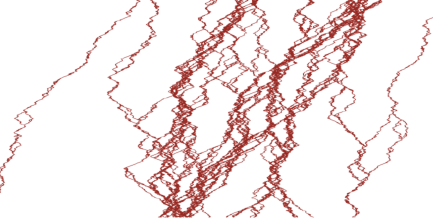
Figure 3: A simulation of a portion of the instability graph—a bi-infinite, closed, nowhere dense fractal with path-connected structure and dense stability islands.
These stability islands are bounded by shock interfaces with misordered −/+ characteristics, and each has a unique tip (highest time) and bottom (lowest time), with the boundaries consisting of continuous, nontrivial shock paths. The union of these boundaries forms a 'skeleton' which is dense in the instability set, confirming the main assertion that shocks completely organize the global instability pattern.
Shocks and Semi-Infinite Geodesics: Classification
Shock points are defined as points of immediate separation between leftmost and rightmost geodesics of given sign. The tree structure of shock interfaces (competition interfaces) and their duality with semi-infinite geodesics is rigorously established, leveraging Busemann process and Directed Landscape properties. Shock types are classified as:
Moreover, for each point, the precise collection and configuration of semi-infinite geodesics is shown to fall into one of twenty exhaustive and mutually exclusive cases (Theorem 2)—a result extending and unifying earlier discrete and continuous models, and achieved via new arguments accommodating the fully continuous-time, continuous-space Directed Landscape.
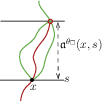
Figure 5: A shock point (x,s)↦−L(0,0;x,s)0 from which left and rightmost geodesics immediately separate—a local source for instability propagation.
Reconstructibility and Implications
A central assertion is that the entire instability structure is recoverable from the union of shock interfaces for the (x,s)↦−L(0,0;x,s)1 and (x,s)↦−L(0,0;x,s)2 Busemann solutions. Boundaries of stability islands provide the 'skeleton'—a countable, but dense, set—whose closure gives the full instability region. This reconstructibility answers a key open question in the stochastic synchronization and uniqueness theory of random Hamilton-Jacobi equations.
Additionally, the results clarify the deep connections between local non-uniqueness (shocks) and global non-uniqueness (instability): although the latter does not correspond directly to the shock set, it is completely determined via their geometric scaffolding.
Technical Results and Key Claims
Prominent technical advances include:
- Explicit instability region geometry: Closedness, path-connectedness, no isolated points, and dense islands ("The set is a closed, nowhere dense, connected graph ... exhibiting a fractal structure: islands occur at all scales and are dense in (x,s)↦−L(0,0;x,s)3" (Figure 3); Theorem 1).
- Semi-infinite geodesic classification: All twenty possible configurations realized densely ("For each (x,s)↦−L(0,0;x,s)4 and (x,s)↦−L(0,0;x,s)5, the (x,s)↦−L(0,0;x,s)6-directed geodesics ... realize exactly one of the twenty configurations in Figure 2"; Theorem 2).
- Skeleton closure equivalence: Closure of island boundaries equals the instability set, despite islands forming only a skeleton.
- Shock-Instability reconstructibility: Shock trees of the two Busemann processes capture the entire instability graph; dust points (non-skeleton) cannot host shock interface intersections.
- Interplay of entropy and geometry: Points of energy/entropy dissipation correspond to island boundaries, suggesting further links to nonequilibrium thermodynamic theory.
Implications and Future Directions
The implications are manifold:
- Rigorous universality: The analysis elucidates phenomena expected to be generic for the full KPZ universality class, informing the behavior of a broad suite of randomly forced systems.
- Quantitative structure of randomness-induced non-uniqueness: The deeply fractal, graph-theoretic view of instability may potentiate new ways to understand random attractor landscapes and their phase transitions.
- Connections to integrable probability and metric geometry: The use of Busemann processes and variational principles bridges combinatorial, PDE, and probabilistic methods.
- Further open questions: On the fine structure of the dust set, universality of Hausdorff dimension, and energy dissipation mechanisms at instability points.
Advances are anticipated in developing further dynamical and statistical characterizations (e.g., energy dissipation, entropy flow) for both shocks and instability regions; understanding how such non-uniqueness propagates and interacts with noise scaling; and applying the present geometric viewpoint to higher-dimensional or more general random Hamilton-Jacobi settings.
Conclusion
This work provides a comprehensive and fine-grained geometric classification of instability and shock sets for the Directed Landscape and KPZ fixed point; unifies and extends previous results by rigorously showing their reconstructibility from shock trees; and delivers a twentyfold exhaustive taxonomy of infinite geodesic networks. The findings have significant consequences for the theory of random Hamilton-Jacobi equations and the probabilistic geometry of universality classes, and pose new questions on the energetic and combinatorial substrate of randomly forced growth.

Figure 6: Stability island construction from a left-isolated point—right and left boundaries are sequences of (x,s)↦−L(0,0;x,s)7 and (x,s)↦−L(0,0;x,s)8 hugging shocks, with interfaces misordered and bounding the island.