- The paper derives analytic expressions for both local and nonlocal couplings in QD–SC–QD systems, revealing atomic-scale oscillations with exponential decay.
- It establishes an exact existence condition for PMMs, showing that small variations in superconductor length can switch the system between 0, 2, and 4 PMMs.
- The study demonstrates that strictly localized Majorana modes cannot form in finite superconductors, guiding the design of nearly localized PMMs in experiments.
Sensitive Dependence of Poor Man's Majorana Modes on the Length of the Superconductor
Introduction and Physical Context
The investigation of Majorana quasiparticles in engineered superconducting heterostructures has been a focal point in condensed matter physics, motivated by both the pursuit of non-Abelian statistics and the prospect of fault-tolerant quantum computation. While various platforms such as proximitized nanowires and topological insulators have been extensively explored, strong practical and theoretical attention has recently shifted toward minimal systems—specifically, quantum dot (QD)–superconductor (SC)–QD hybrids. These systems offer high tunability and reduced disorder. Of particular interest are Poor Man’s Majorana modes (PMMs), emergent zero-energy states in such double-QD–SC hybrids, which, under strong Zeeman polarization, mimic the physics of spatially separated Majorana zero modes.
However, the idealizations common in theoretical modeling—treating the SC as a bulk, infinitely long chain, or as a single proximitized quantum dot—diverge from experimental reality, where the SC is always finite in length. The paper "Sensitive dependence of Poor Man's Majorana modes on the length of superconductor" (2604.12950) rigorously addresses this gap, providing a microscopic treatment of QD–finite-SC–QD systems and a comprehensive analysis of the emergence and properties of PMMs as a function of the SC length.
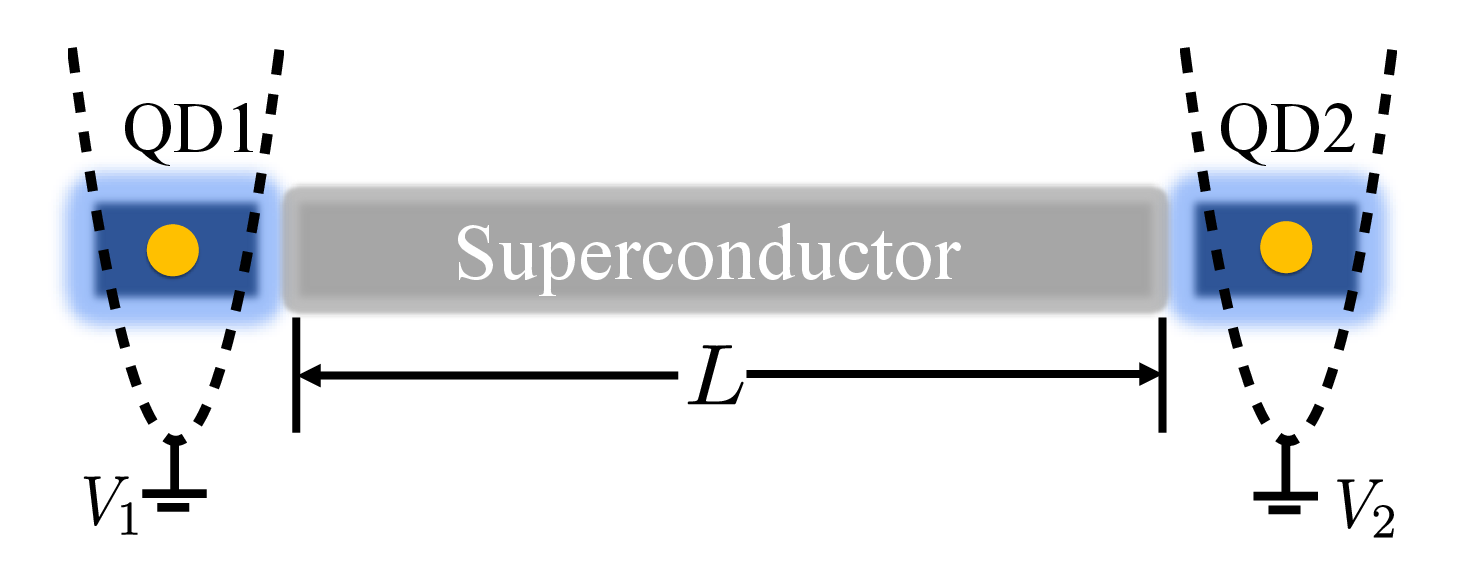
Figure 1: Schematic of the QD–SC–QD system, where the superconductor segment's finite length L and independent gate tunability Vi for each dot are shown.
Microscopic Modeling of QD–Finite-SC–QD Hybrids
The SC is modeled explicitly as a finite-length 1D chain, and the QD–SC–QD system is described by a Hamiltonian including all local and nonlocal couplings, spin-preserving and spin-flip tunneling, and Zeeman effects. Eliminating SC quasi-excitations generates effective couplings in the QD subsystem. In contrast to the weak tunneling regime, the authors obtain analytic expressions for arbitrary tunneling strengths and system parameters:
- Local couplings: Chemical potential shifts and induced pairing gaps.
- Nonlocal couplings: Interdot hopping (elastic cotunneling, ECT), nonlocal pairing (crossed Andreev reflection, CAR), and effective spin-flip terms.
All couplings depend acutely on the length L of the finite SC segment.
The paper demonstrates that all SC-induced couplings (except the local pairing gap in the infinite-L limit) display rapid oscillations as a function of L, with period set by the Fermi wavelength (of order 1A˚), accompanied by exponential decay whose characteristic length is the SC’s coherence length ξ0. This holds for both local and nonlocal couplings and in both spin channels.
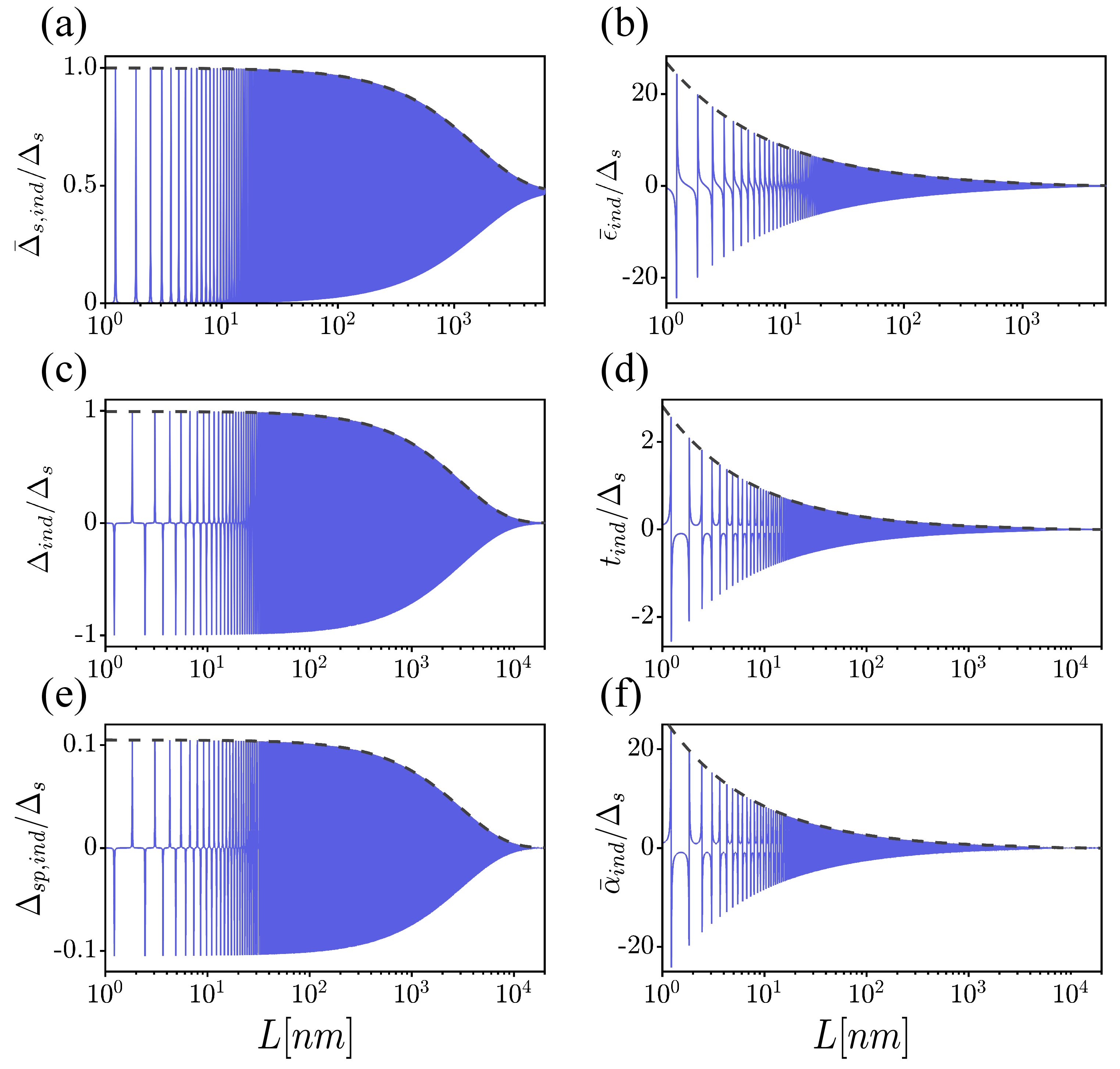
Figure 2: All SC-induced couplings between QDs—pairing, hopping, spin-flip, chemical-potential shift—oscillate with SC length with a period ∼1A˚. All but the local gap decay exponentially with L, vanishing as L→∞.
Thus, the coupling strength between the QDs, and therefore the low-energy spectrum of the hybrid, is highly nontrivial as a function of the geometric length.
PMM Existence Conditions and Strong Dependence on SC Length
An exact existence condition for PMMs is derived, valid for arbitrary SC length, magnetic field, and tunneling. The criterion depends on the explicit SC-induced couplings, and thus shows strong oscillatory sensitivity to Vi0. In detail, the number of PMMs supported by the system alternates between 0 and 2 as Vi1 is varied on atomic scales—i.e., the PMM regime is “fine-tuned” by Vi2. In the limit Vi3, all SC-induced interdot couplings vanish, and the number of PMMs increases to four, contrasting sharply with naive idealized expectations.
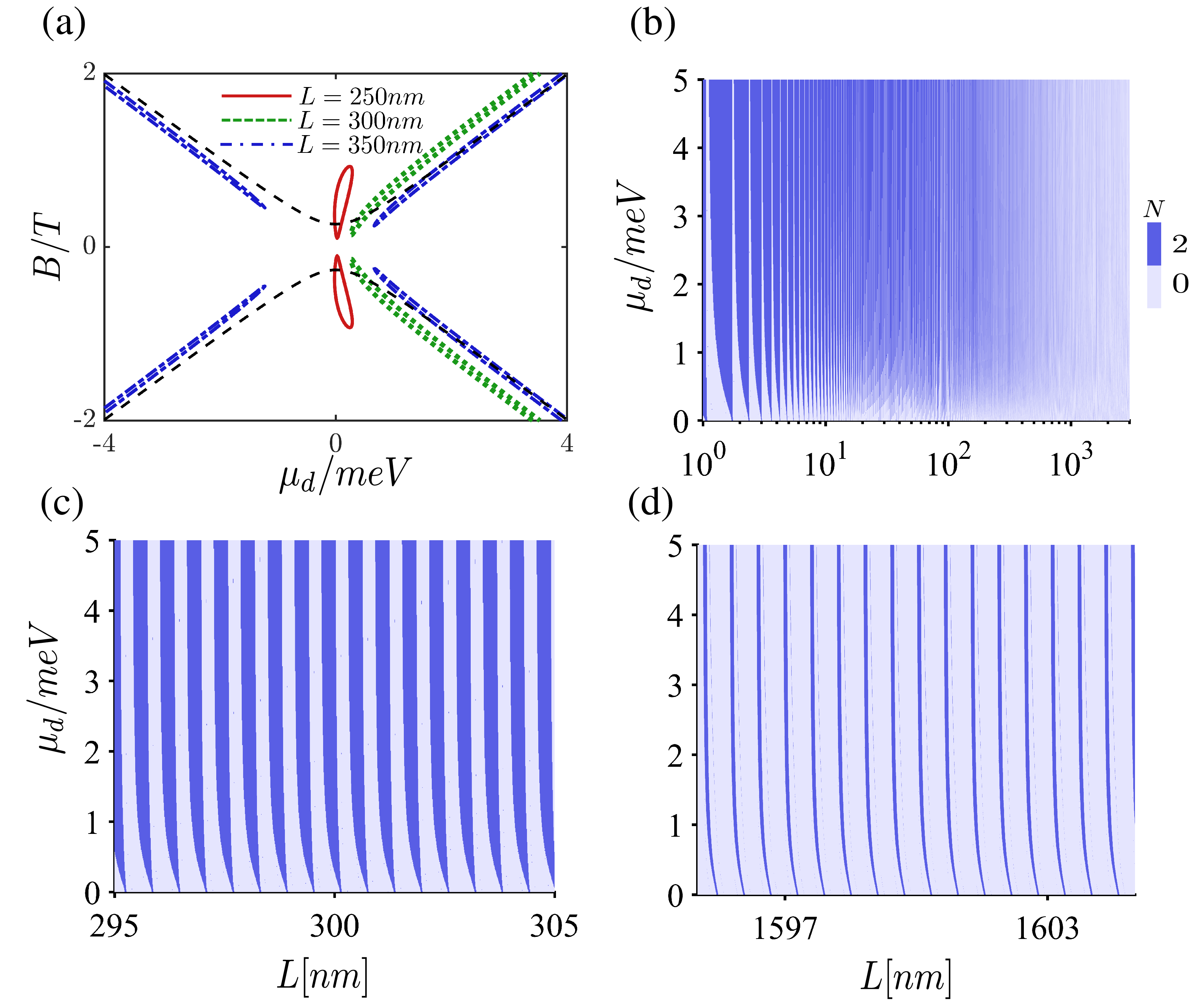
Figure 3: (a) Existence condition for PMMs in realistic device parameter space. (b) Number of PMMs as a function of SC length Vi4; (c,d) reveal rapid oscillations with period Vi5, visible on both sub-micron and coherence length scales.
This atomic-scale periodicity dominates the PMM phase diagram and explains experimental variability in zero-bias signatures. The generalized “sweet spot” for PMM realization can be precisely determined using the derived analytic expressions, guiding empirical design.
Spatial Structure of PMMs and Localization Limitations
Analysis of the full wavefunctions reveals that, for any finite Vi6, it is impossible to obtain exactly localized Majorana-like states on opposite QDs; nonlinear constraints do not admit solutions for strict end-localization. In the strong field/large Vi7 limit, localization is gradually approached, and the system analytically reduces to the idealized “poor man’s Majorana” model. In realistic conditions, only “nearly localized” PMMs can occur, exhibiting significant overlap. The authors’ method rigorously proves the absence of strictly end-localized PMMs for any finite Vi8.
Implications
From a practical perspective, these results provide direct, quantitative criteria for experimental realization of PMMs and the interpretation of low-energy signatures in QD–SC–QD platforms. The analysis explains previous discrepancies between idealized models and observations and situates finite-size effects—oscillatory and decaying SC-induced couplings—as the central mechanism behind the stochastic observation or absence of PMM-related conductance features. Theoretically, the framework is readily extendable to larger QD–SC arrays, as in emerging three-site Kitaev chain devices and synthetic arrays, and offers precise design rules for robust, controllable Majorana physics in engineered mesoscopic systems.
Conclusion
This work provides a technically rigorous, fully microscopic account of PMM formation in QD–finite-SC–QD hybrids. The SC length is shown to critically, sensitively, and non-monotonically determine the existence and number of PMMs, via oscillatory interdot couplings that vanish only asymptotically for infinite Vi9. Strict spatially end-localized PMMs cannot be realized in any physically realizable device with finite SC, though nearly localized modes can occur in appropriate regimes. These insights resolve key theoretical–experimental inconsistencies and define pathways for optimized PMM device engineering and possible scaling to multi-site Majorana networks.

