- The paper establishes a Chebyshev pullback method that replicates limit cycles via separable, monotone polynomial branches.
- It proves sharp degree-amplification inequalities and sets new lower bounds for the Hilbert number H(n) in specific polynomial degrees.
- The study demonstrates that separable replication is limited by a quadratic ceiling, highlighting inherent constraints in the branch-lifting approach.
Limit-Cycle Replication via Chebyshev Pullbacks: Summary and Analysis
Introduction and Problem Setting
The paper "Limit-Cycle Replication via Chebyshev Pullbacks and a Quadratic Ceiling for Separable Schemes" (2604.12883) addresses constructive lower bounds for the Hilbert number H(n), the maximal number of limit cycles of a planar polynomial vector field of degree at most n. This longstanding open problem, the second part of Hilbert’s 16th, lies at the interface of real algebraic geometry, qualitative ODEs, and dynamical systems. The foundational approach for constructing lower bounds for H(n) is via replication: pulling back vector fields through suitable coverings to amplify the count of limit cycles while quantifying the resulting degree expansion.
The paper gives a mathematically explicit, self-contained analytic framework for replication via separable polynomial maps, with a focus on the optimal Chebyshev pullback
Φ(u,v)=(Tm(u),Tm(v))
where Tm is the Chebyshev polynomial of degree m. From the perspective of lower-bound constructions for H(n), the authors clarify the amplification limits of separable replication, prove sharp degree-amplification inequalities, and derive new records for H(n) in several specific degrees.
Chebyshev Polynomials and Branch Geometry
A central technical ingredient is the monotonic branch structure of Chebyshev polynomials. For m≥2, Tm possesses n0 monotone full branches on n1, each diffeomorphic onto n2. The paper formalizes this in Lemma 3.2, partitioning n3 via the sequence n4. On each interval n5, n6 is strictly monotone and surjective onto n7.
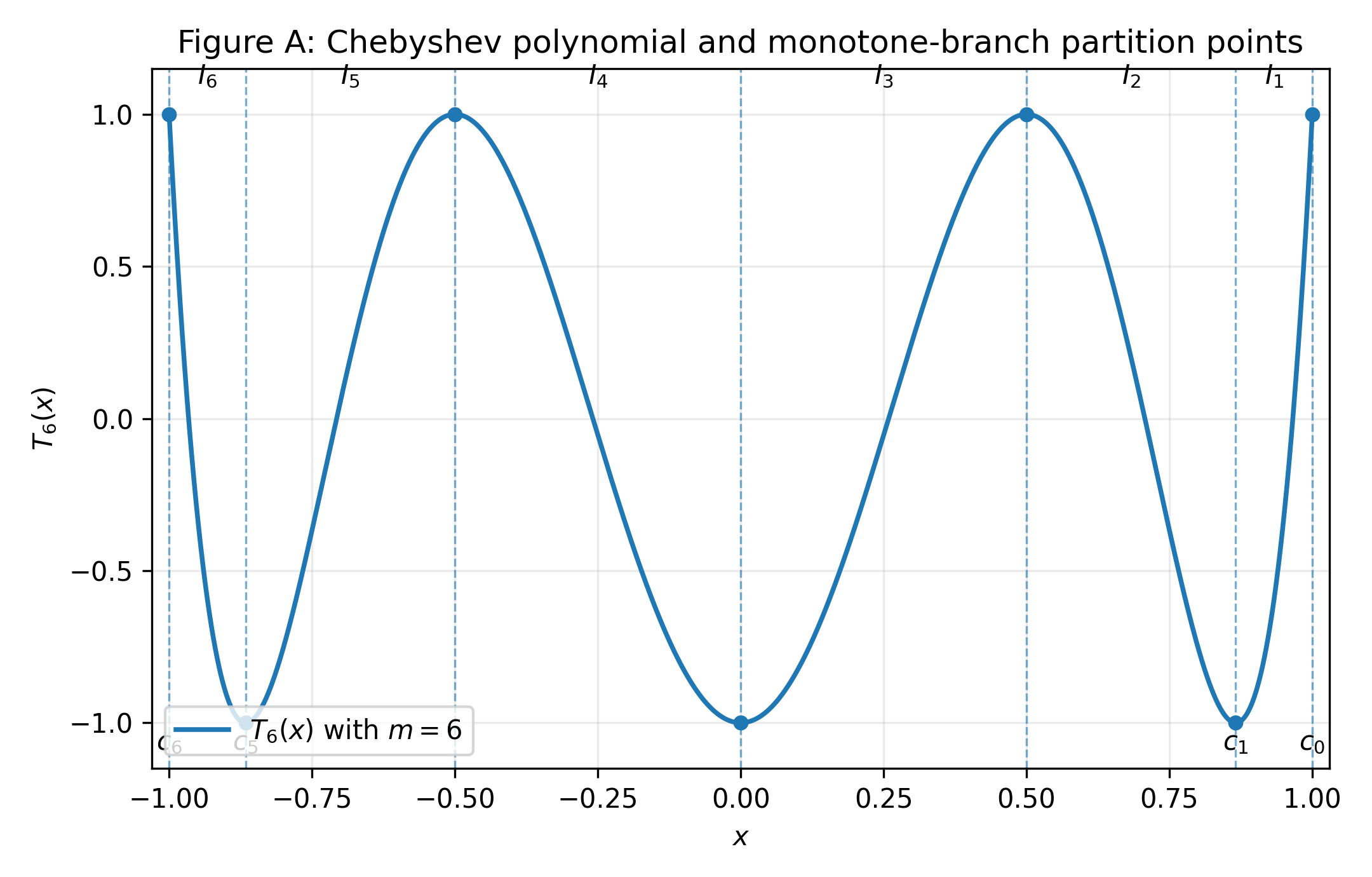
Figure 1: Chebyshev polynomial n8 (n9) and its partition into H(n)0 monotone full-branch intervals.
This structure ensures that H(n)1 partitions the domain into H(n)2 rectangles where H(n)3 is a diffeomorphism, providing a framework for highly structured replication of periodic trajectories.
Chebyshev Replication Theorem
The main replication theorem is as follows:
For any H(n)4 and H(n)5,
H(n)6
That is, every planar polynomial vector field of degree H(n)7 with H(n)8 limit cycles yields, via Chebyshev pullback, a new vector field of degree H(n)9 with at least Φ(u,v)=(Tm(u),Tm(v))0 limit cycles.
The proof utilizes two elementary invariance principles: (1) affine coordinate changes preserve degree and location of limit cycles; (2) multiplying a vector field by a nowhere-vanishing function does not alter the orbit structure or isolation of limit cycles.
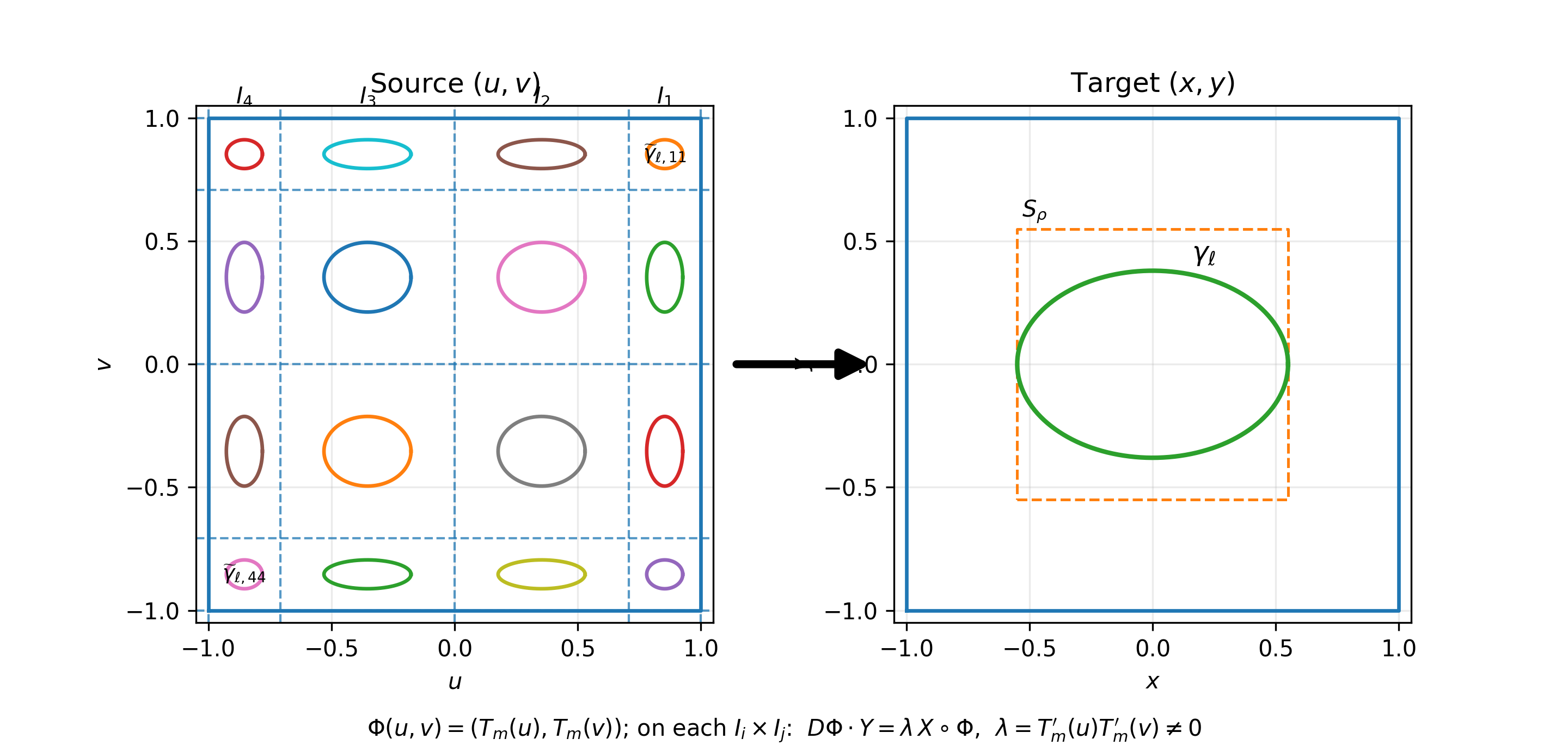
Figure 2: Replication schematic: a cycle Φ(u,v)=(Tm(u),Tm(v))1 lifts under Φ(u,v)=(Tm(u),Tm(v))2 to Φ(u,v)=(Tm(u),Tm(v))3 disjoint cycles in branch rectangles.
On each rectangle Φ(u,v)=(Tm(u),Tm(v))4, the pullback field is explicitly constructed such that its trajectories correspond, up to time reparametrization, to those of the seed field. The commutative diagram formalizes this conjugacy.
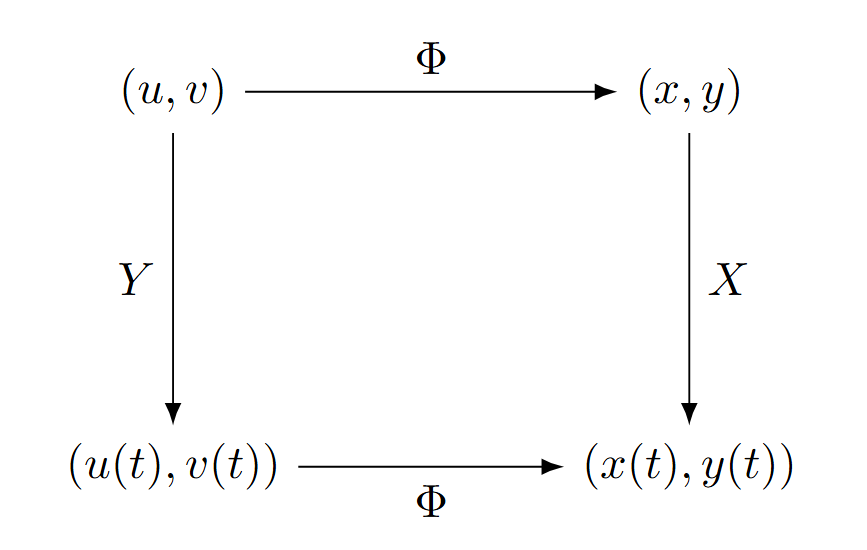
Figure 3: Commutative diagram for orbit and return-map conjugacy under the Chebyshev pullback.
Exact Degree Counts and Quadratic Ceiling
A detailed algebraic analysis shows that the degree of the pullback field Φ(u,v)=(Tm(u),Tm(v))5 satisfies
Φ(u,v)=(Tm(u),Tm(v))6
with equality generically. The Φ(u,v)=(Tm(u),Tm(v))7 factor in the lower-bound is optimal over all separable pullbacks of degree Φ(u,v)=(Tm(u),Tm(v))8, as any real polynomial of degree Φ(u,v)=(Tm(u),Tm(v))9 has at most Tm0 monotone full branches onto Tm1 — equality is achieved by Tm2.
The paper systematically generalizes to arbitrary separable maps Tm3 and proves that replication alone cannot yield more than quadratic growth in the number of limit cycles as the degree increases:
Tm4
where Tm5 is derived from Tm6 by Tm7 iterated separable pullbacks. This quadratic ceiling isolates the structural limitations of purely separable, branch-lifting replication.
Numerical Improvements and Degree-Specific Records
Combining the Chebyshev replication theorem with the best seed bounds in the literature, the authors obtain several new degree-specific lower bounds for Tm8, explicitly outperforming previously published values for Tm9, m0, m1, and m2, among others. For example:
m3
These results leverage the optimality and explicitness of the Chebyshev framework to yield improved lower bounds in concrete instances.
Worked Example: Cubic System and m4 Replication
The paper provides a transparent, visual worked example: starting from a classical cubic vector field possessing a unique hyperbolic limit cycle (the circle m5), the authors apply the Chebyshev pullback with m6.
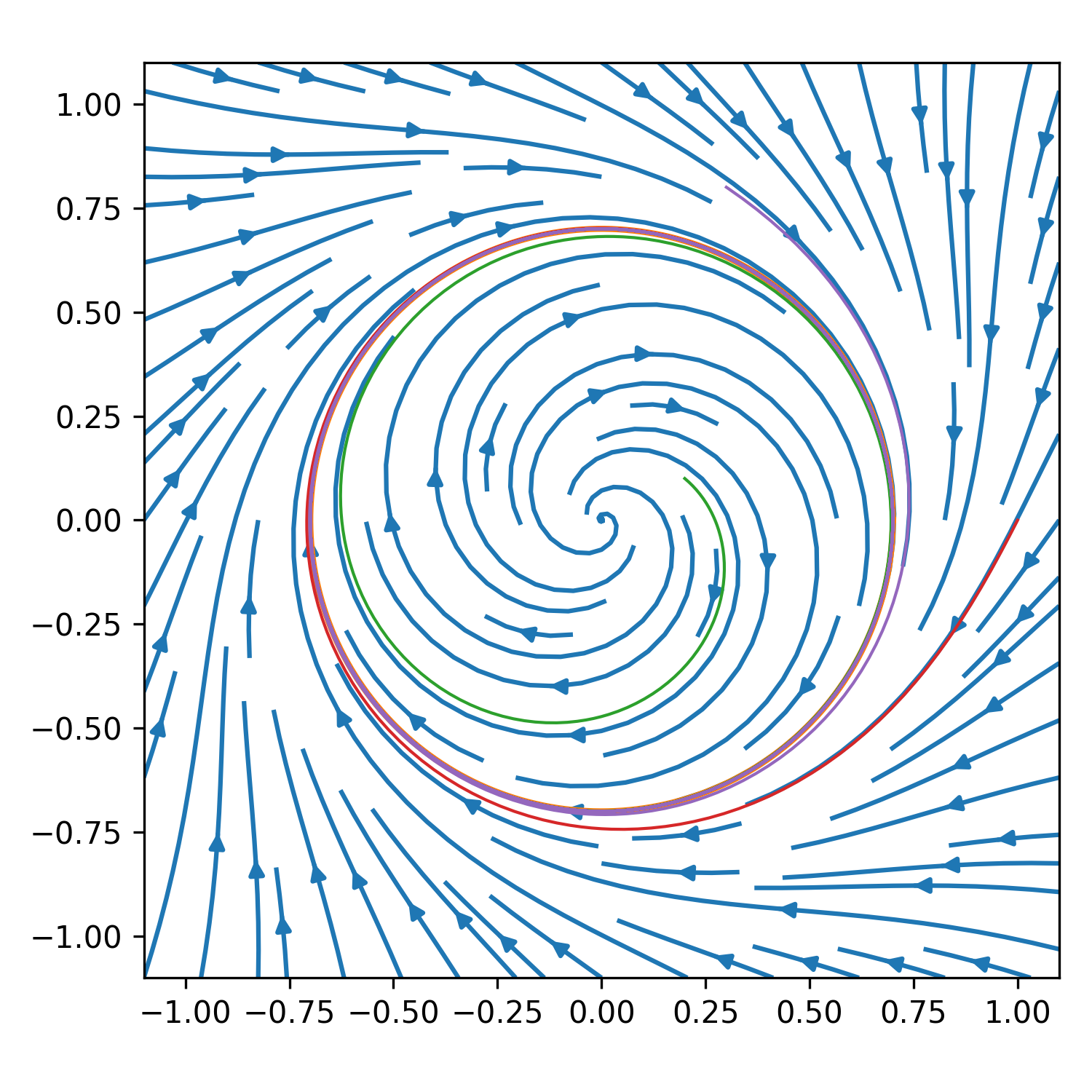
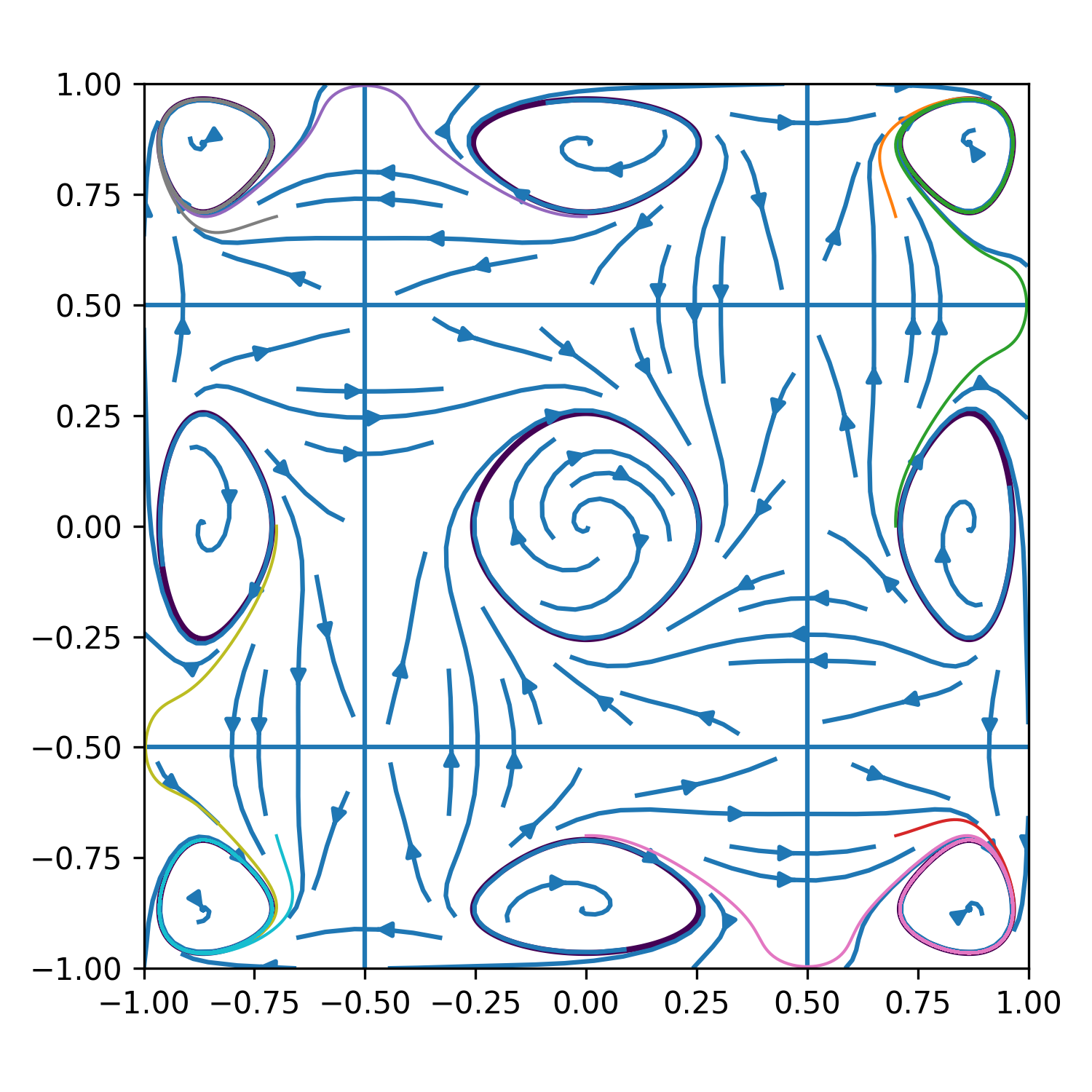
Figure 4: Visual illustration: (left) original cubic limit cycle; (right) m7 disjoint lifts after Chebyshev pullback.
The lift realizes exactly 9 disjoint, isolated limit cycles, one in each branch rectangle, in a degree-11 system, demonstrating the concrete mechanics and count-amplification capacity of the method.
Theoretical Implications
The Chebyshev-based replication theorem sharpens our understanding of the algebraic and combinatorial limitations of cycle-replication via polynomial coverings. The quadratic ceiling result demonstrates that previously published superquadratic (e.g., m8) lower bounds for m9 cannot be explained by replication alone and necessarily require additional non-replication mechanisms, such as local bifurcations and non-separable coverings.
Notably, the paper raises the open problem of extending the analysis to non-separable polynomial coverings H(n)0, where quantifying the 2D branch geometry may permit replication schemes surpassing the quadratic ceiling established for separable maps.
Practical Implications
While the ultimate finiteness and exact asymptotics of H(n)1 remain unknown, the Chebyshev replication framework provides a powerful algebraic tool for constructing explicit families of polynomial vector fields with large numbers of limit cycles at controlled degrees. This is relevant for both theoretical scenarios (e.g., partial answers to Smale’s Problem 6) and for generating test cases in applications of qualitative ODE theory.
Conclusion
This paper establishes a mathematically rigorous, optimal, and explicit methodology for replication-based lower bounds on the Hilbert number via Chebyshev polynomial pullbacks. It provides new degree-specific records, characterizes the structural limitations of pure separable schemes, and motivates further research into non-separable replication mechanisms and hybrid cycle-creation strategies. The work clarifies the algebraic limits of pullback amplification and provides transparent techniques for both numerical and conceptual advances in the theory of planar polynomial vector fields.