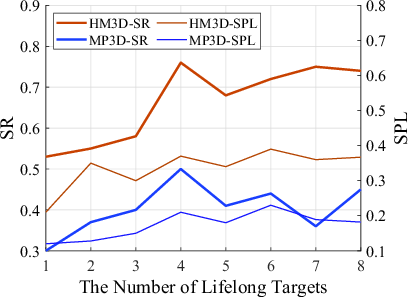
- The paper introduces a modular framework that leverages open-vocabulary memory and probability-based exploration to enable lifelong object goal navigation.
- It employs a rich memory model integrating visual features, spatial descriptors, and synonym-aware querying for efficient instance management.
- Empirical results show significant enhancements in success rate and SPL, validating the approach for continuous and scalable semantic navigation.
OVAL: Open-Vocabulary Augmented Memory Model for Lifelong Object Goal Navigation
Introduction
Object Goal Navigation (ObjectNav) in embodied agents demands semantic understanding and efficient spatial reasoning to locate user-specified objects in unfamiliar environments. Traditional approaches, while effective for isolated single-step tasks, fundamentally lack robust lifelong memory models, rendering them ill-suited for complex, sequential, open-vocabulary scenarios. The paper "OVAL: Open-Vocabulary Augmented Memory Model for Lifelong Object Goal Navigation" (2604.12872) introduces a framework that jointly addresses the requirements of open-vocabulary semantic generalization and persistent, structured memory—enabling robots to perform continual goal-directed navigation in large-scale, dynamically instructed scenarios.
System Architecture
The OVAL system adopts a modular architecture integrating three primary functional components: a probability-driven frontier exploration module, an open-semantic memory model with advanced instance management, and a navigation module employing robust semantic querying and verification strategies.
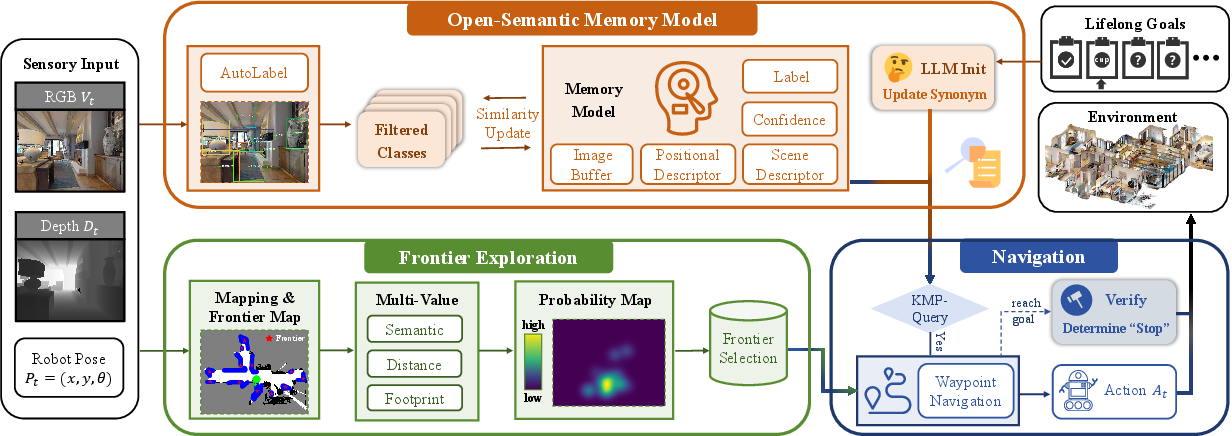
Figure 1: The OVAL pipeline integrates frontier-based exploration, open-semantic memory modeling, and synonym-aware navigation and verification.
The exploration module builds a topological grid with depth and pose, dynamically scores frontiers based on a multi-factor probability map, and guides agents toward regions promising efficient coverage and goal discovery. Simultaneously, the open-semantic memory subsystem abstracts and manages open-vocabulary instance descriptors, supporting robust feature-based object representation and high-fidelity recall. The navigation engine employs substring and synonym expansion (via KMP queries and LLM-generated paraphrase clusters) to bridge lexical granularity mismatches, supports greedy waypoint planning, and verifies success with panoramic imaging and weighted LLM-based semantic validation.
Frontier Exploration with Probability-Based Scoring
Exploration efficiency and coverage are maximized using a probability-based frontier selection strategy constructed from three orthogonal information sources:
- Distance Component (od(F)): Prefers proximal frontiers to minimize trajectory cost and improve SPL.
- Semantic Component (os(F)): Exploits map-level context by leveraging semantic priors (e.g., presence of co-occurring objects) to direct search toward semantically relevant subregions.
- Footprint Component (of(F)): Penalizes frequently revisited locations to enforce coverage and prevent oscillation.
A Gaussian-weighted sum (with adaptive amplitude and spatial decay) aligns these factors, allowing the agent to adaptively balance local efficiency and global exploration requirements.
Open-Semantic Memory Model and Instance Management
Unlike prior systems reliant on raw text labels or rigid category dictionaries, OVAL employs a rich memory representation integrating:
- Object labels Si subject to filtered autolabeling and synonym grouping
- Visual feature buffers (Ii)
- Spatial descriptors (Xi)
- HSV-based scene histograms (Hi)
- Confidence scores (Ci) quantifying observation geometry and detection quality
Memory model management handles instance discrimination via a staged similarity assessment, first comparing scene and positional descriptors and then, in ambiguous cases, invoking local feature correspondence (using SuperGlue) for robust instance clustering.
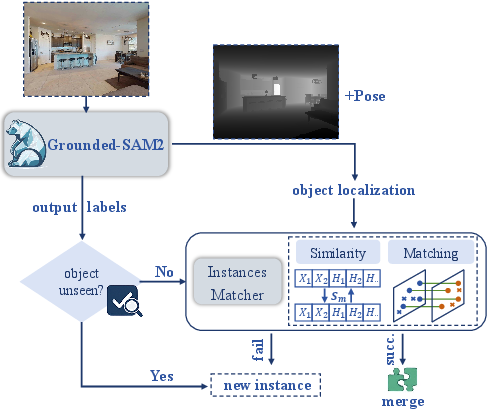
Figure 2: Hierarchical memory model management ensures new instances are accurately merged or instantiated, maintaining retrieval fidelity and manageable storage complexity.
This structured memory, alongside synonym-aware retrieval, allows for efficient and accurate recall—even in highly dynamic, open-vocabulary environments.
Navigation: Goal Query and Stop Verification
To resolve semantic mismatches between user instructions and detected object phrases, OVAL integrates KMP-based substring search and LLM-powered synonym expansion, facilitating robust cross-granularity querying. Upon candidate retrieval, navigation proceeds via waypoint planning, with success verified using a hybrid of panoramic LLM-based presence estimation and the memory model's confidence signal.
Experiments performed in the Habitat simulation suite (covering HM3D and MP3D datasets) evaluate both lifelong ObjectNav and traditional single-episode ObjectNav. OVAL is compared to SOTA training-free, open-vocabulary, and memory-augmented baselines (e.g., VLFM [vlm1], GOAT [goat]). Metrics include SR and SPL.
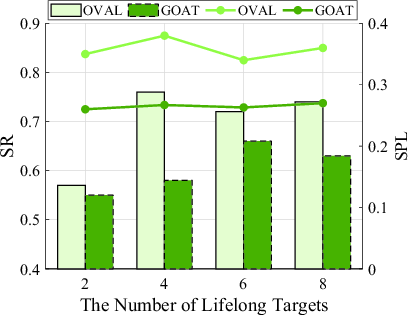
Figure 3: Lifelong ObjectNav SR and SPL benchmarked against GOAT on HM3D, across increasing target list lengths.
Key quantitative findings:
The empirical analysis further highlights that the footprint penalization is most essential for reducing redundant exploration, while semantic cues promote task-specific efficiency.
Practical and Theoretical Implications
OVAL's explicit memory management enables lifelong open-vocabulary navigation by supporting:
- Continuous, non-destructive semantic accumulation across sequential tasks
- Memory-efficient representation and fast query even under high instance multiplicity
- Advanced generalization to unseen labels, reducing reliance on category pre-definition
Practically, this facilitates robust deployment in real-world service robotics (e.g., hotels, homes), where task instructions follow unpredictable, evolving open-vocabulary distributions. Theoretically, the framework demonstrates the importance of modular architecture, explicit memory, and multi-modal semantic reasoning for long-horizon embodied autonomy.
Future Directions
Current limitations include absence of multimodal input fusion and limited robustness to rapid environmental dynamics; integrating audio, textual, or tactile streams, as well as designing temporal abstraction for dynamic memory update, constitute promising directions. Further, improvements in memory compression and error-correction could facilitate even larger-scale lifelong deployments.
Conclusion
OVAL presents a technically rigorous, explicitly managed, open-vocabulary memory and navigation system for lifelong ObjectNav, setting new standards for SR and SPL on challenging benchmarks. The combination of probability-driven exploration, robust multi-descriptor memory modeling, and efficient synonym-aware querying constitutes a significant contribution to the state of persistent embodied navigation, with implications for scalable, adaptive deployment in open-world service scenarios.