- The paper presents a rigorous theory that uses covariant Lyapunov vector (CLV) geometry and spectral properties in fast–slow systems to predict imminent extreme events.
- It introduces quantifiable precursors by monitoring principal angles between fast and slow CLV subspaces and divergence between instantaneous growth rates and Jacobian eigenvalues.
- Numerical validations on systems like the Van der Pol oscillator and Lorenz-96 demonstrate a universal cascade of dynamical regimes with precise forewarning times.
Covariant Lyapunov Vector Theory for Precursors of Extreme Events and Critical Transitions
Theoretical Framework and Geometric Analysis
This work presents a theory for the onset and prediction of extreme events, including critical transitions, in nonlinear fast-slow systems. The approach leverages the geometric and spectral properties of covariant Lyapunov vectors (CLVs). The authors derive a time-evolution equation for CLVs as constrained flows on the unit sphere, enabling the precise characterization of invariant sets such as fixed points and their stability under perturbations of the underlying system's Jacobian.
The theoretical roadmap is detailed, starting from the definition and evolution of Lyapunov exponents and CLVs, moving to the analysis of invariant sets under stationary and non-stationary eigenbases, and culminating with the dynamic splitting of tangent space in fast-slow systems. Central to the framework is the connection between spectral gaps, convergence rates, and the alignment (or tangency) of CLVs with eigendirections of the system Jacobian. The theory formalizes the notion of an "adiabatic condition" for CLV alignment, quantifying the separation of timescales necessary for CLVs to follow the evolving eigendirections adiabatically.
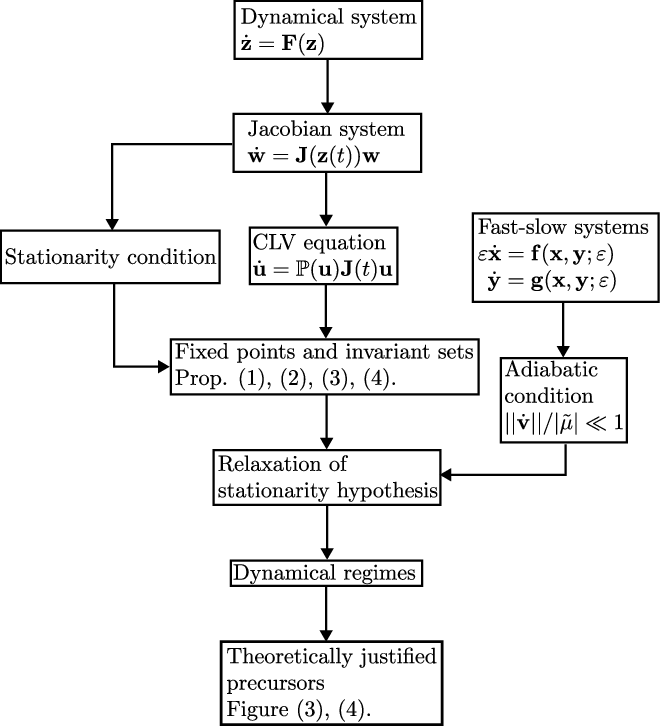
Figure 1: Roadmap summarizing the mathematical and geometric steps used to explain the dynamical regimes and CLV behaviors underlying extreme events and critical transitions.
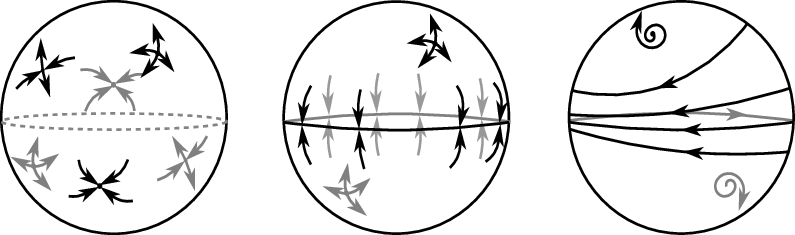
Figure 2: Schematic geometric depiction of CLV dynamics on the unit sphere, corresponding to real, degenerate, and complex conjugate spectra of the Jacobian.
Fast-Slow Decomposition and Tangent Space Dynamics
The theory is built on the fast-slow decomposition of dynamical systems, where distinct subsystems evolve on disparate timescales (fast variables x, slow variables y). The tangent space is correspondingly split into fast and slow eigenspaces, with their mutual transversality providing a structural barrier to CLV tangency under nominal conditions (normal hyperbolicity). The authors formalize how critical transitions correspond to instabilities of the slow manifold, driven by fast eigenvalues crossing stability thresholds.
In this context, CLVs associated with fast time scales align with fast eigendirections except in transition regimes, and slow CLVs are confined to the slow tangent bundle. The spectral structure of the Jacobian governs the rates at which CLVs converge to or detach from these subspaces, directly connecting eigenvalue behavior to precursor signatures.
Universal Cascade to Extreme Events: Cascade Structure and Precursors
The authors propose and mathematically justify a universal sequence of dynamical regimes en route to an extreme event or critical transition:
- Slow Regime: The system state follows the slow manifold, with CLVs tangent to the respective fast or slow eigendirections and strong transversality between fast and slow CLV subspaces.
- Transition Regime: On approach to instability, a fast eigenvalue nears zero, resulting in CLV detachment and, potentially, rotation (complex eigenvalue pairs) or the collapse of CLVs onto the slow tangent subspace. This regime marks the loss of normal hyperbolicity and the failure of adiabatic decoupling.
- Critical Regime: After the instability, dominant positive fast eigenvalues cause multiple CLVs to re-align along the unstable fast direction(s), giving rise to tangency and a breakdown of transversality.
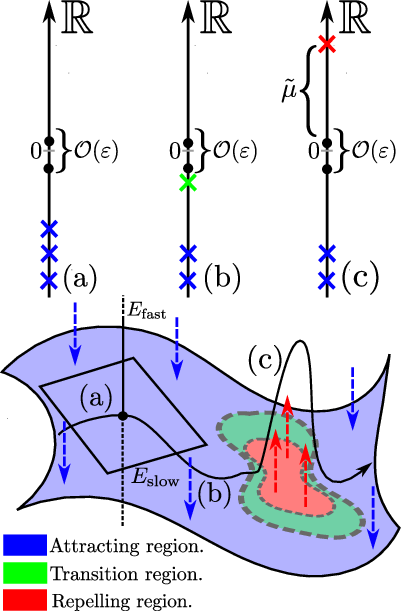
Figure 3: Evolution of the real part of the Jacobian spectrum and schematic depiction of the slow, transition, and critical regimes within the manifold structure of the fast-slow system.
Two algorithmic precursors are constructed from these mechanistic insights: (1) monitoring the principal angle(s) between fast and slow CLV subspaces (vanishing angles signal imminent events), and (2) tracking the divergence between instantaneous CLV-based growth rates (ICLEs) and corresponding Jacobian eigenvalues. Pseudocode for these precursors is schematized.
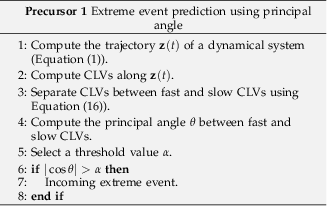
Figure 4: Pseudo-algorithm schematic for precursor based on the collapse of the principal angle between fast and slow CLV subspaces.
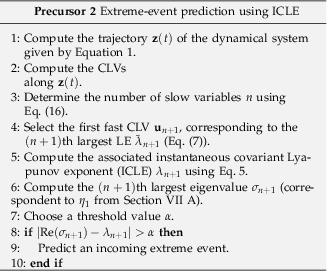
Figure 5: Pseudo-algorithm schematic for precursor based on decoupling of ICLEs and Jacobian eigenvalues.
The theory rigorously demonstrates that these precursors are quantitatively linked to approaching transitions through the geometric and spectral organization of the tangent space.
Analytical and Numerical Demonstration
Van der Pol Oscillator
The canonical fast-slow Van der Pol oscillator is analyzed to explicitly verify the cascade, showing that ICLEs of the stable manifold and its eigenvalues are coincident in the slow regime. In the transition regime, eigenvalues become complex conjugate, CLVs rotate, and the angle between CLVs drops—serving as a precursor signal. The critical regime is marked by the re-alignment of CLVs along the most unstable direction.
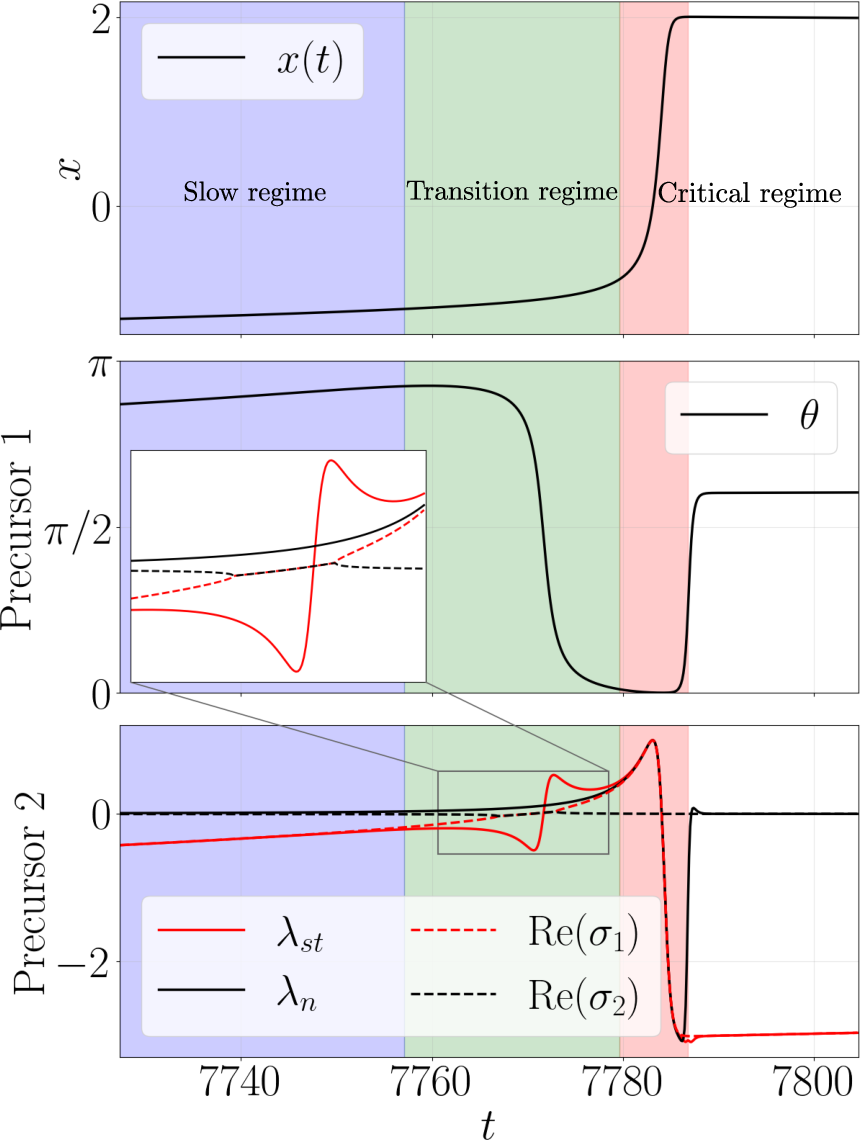
Figure 6: Van der Pol system dynamics showing the evolution of state variable, CLV angle, and ICLEs versus Jacobian eigenvalues; transition and critical regimes are manifest in the alignment behaviors.
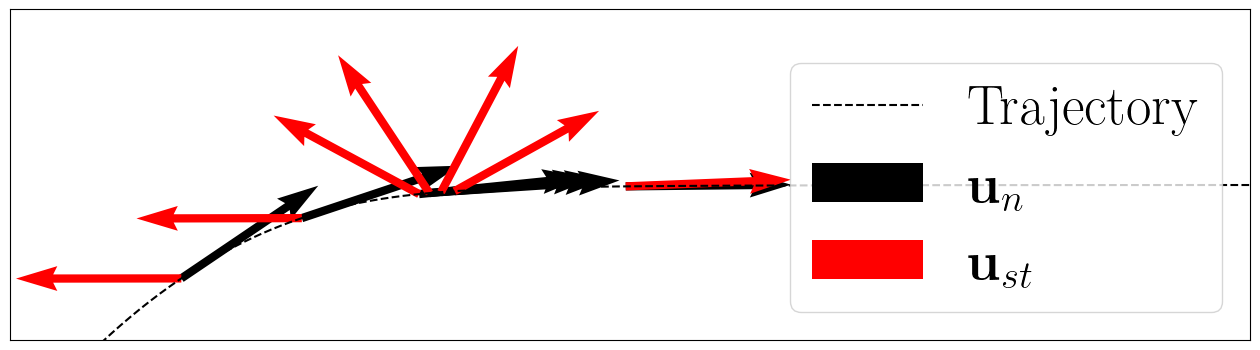
Figure 7: Illustration of the rotation of CLVs during the transition regime, providing a geometric precursor to the critical transition.
Bistable Rössler, FitzHugh-Nagumo, and Multiscale Lorenz-96 Systems
The theory is validated on paradigmatic higher-dimensional systems—chaotic bistable Rössler, coupled FitzHugh-Nagumo units, and a multiscale Lorenz-96 variant. Across all systems, the theoretical signatures for the three regimes and the associated precursors are observed. Notably, the proposed precursors delivered 100% precision and recall for predicting extreme events and critical transitions in extensive simulations.
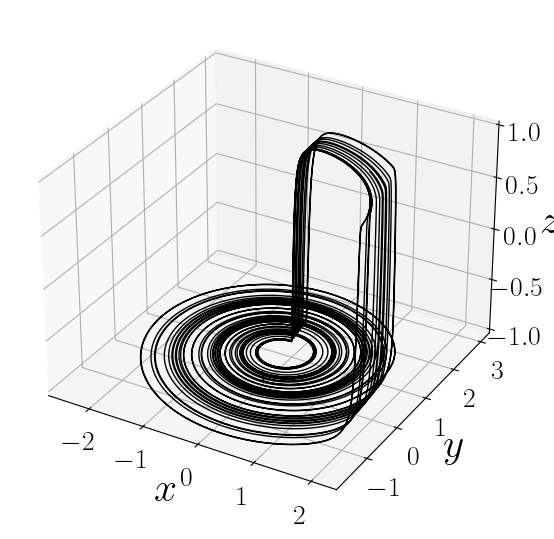
Figure 8: Chaotic attractor of the bistable Rössler system illustrating transitions between attracting manifolds.
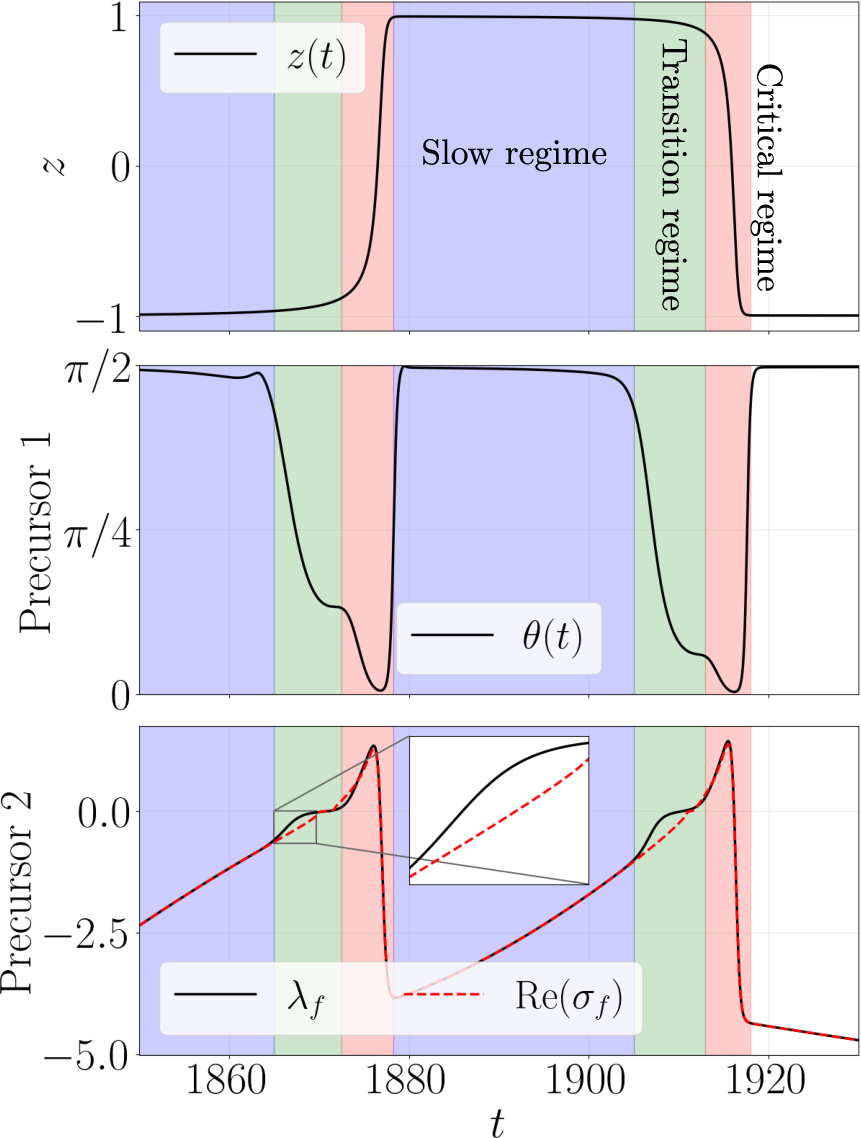
Figure 9: Bistable Rössler—temporal evolution of state, principal angle, and ICLE/eigenvalue, highlighting region of precursor activation.
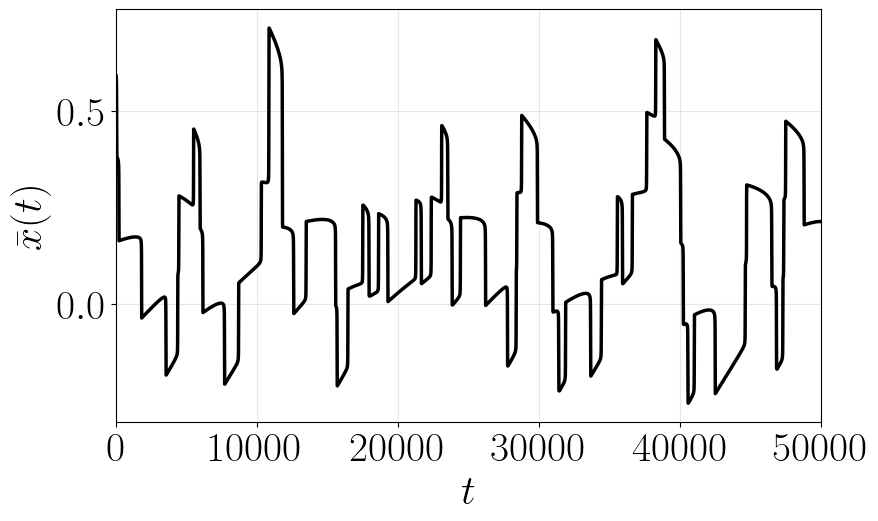
Figure 10: Time series of the mean fast variables in the FitzHugh-Nagumo coupled oscillator system, demonstrating recurring critical transitions.
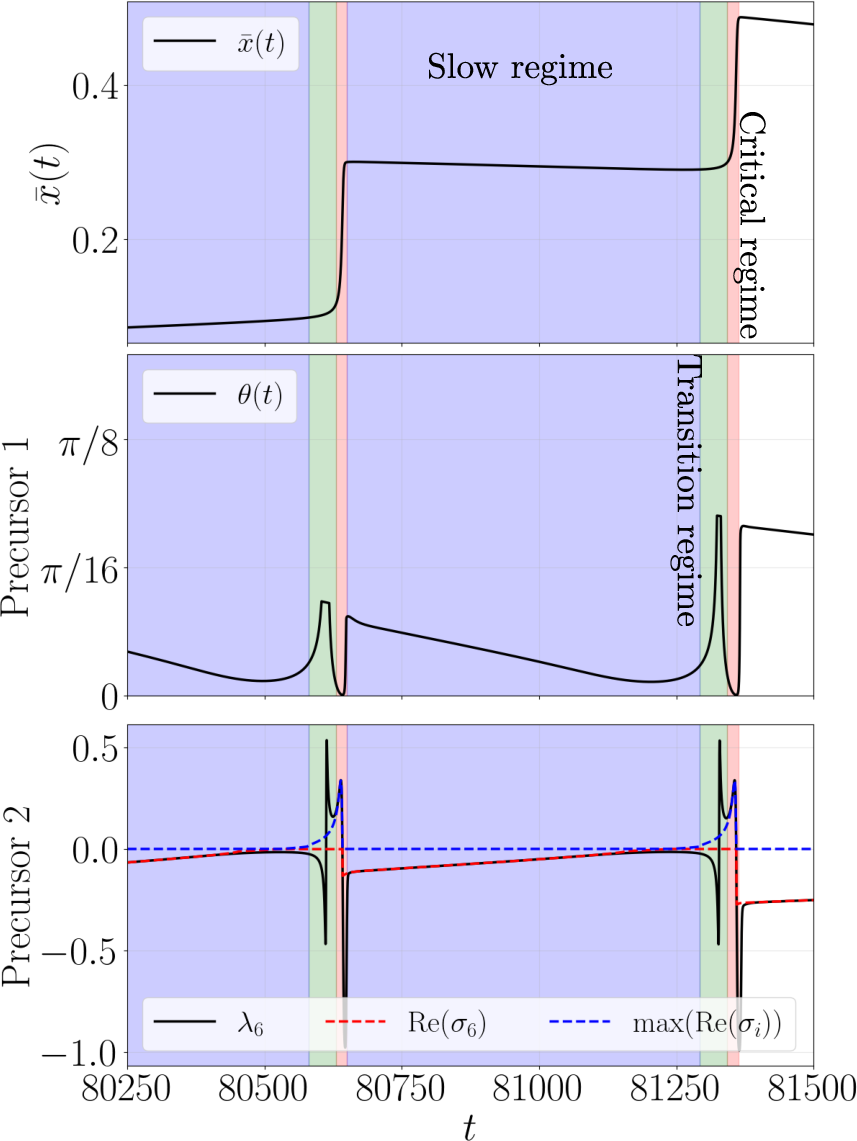
Figure 11: Panelled results for FitzHugh-Nagumo: key dynamical variables, principal angle, and evolution of ICLEs/eigenvalues across events.
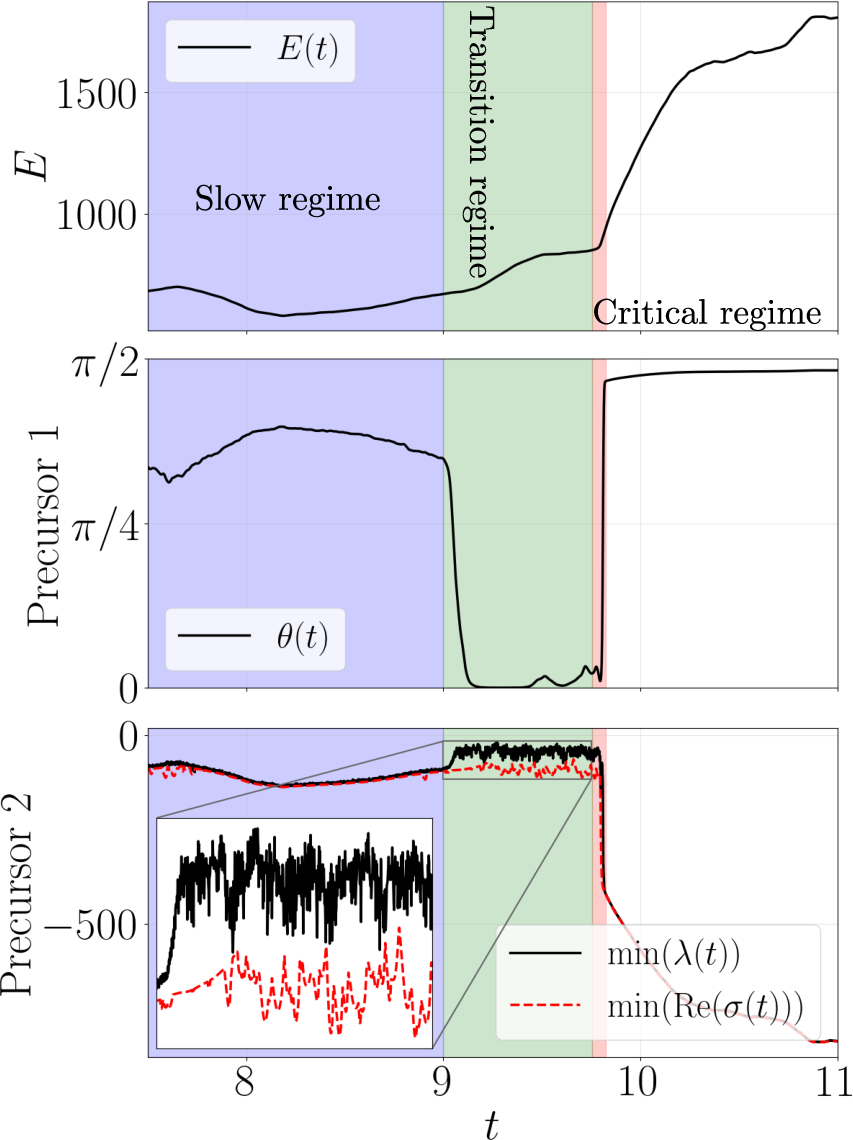
Figure 12: Multiscale Lorenz 96—energy time series (top), angle between fast/slow CLV subspaces (middle), fastest ICLE/minimum eigenvalue (bottom), highlighting the diagnostic signatures of critical transitions.
Prediction performance metrics (F-scores) for all tested systems are uniformly maximal; advance warning times are quantified (see forewarning time distributions).
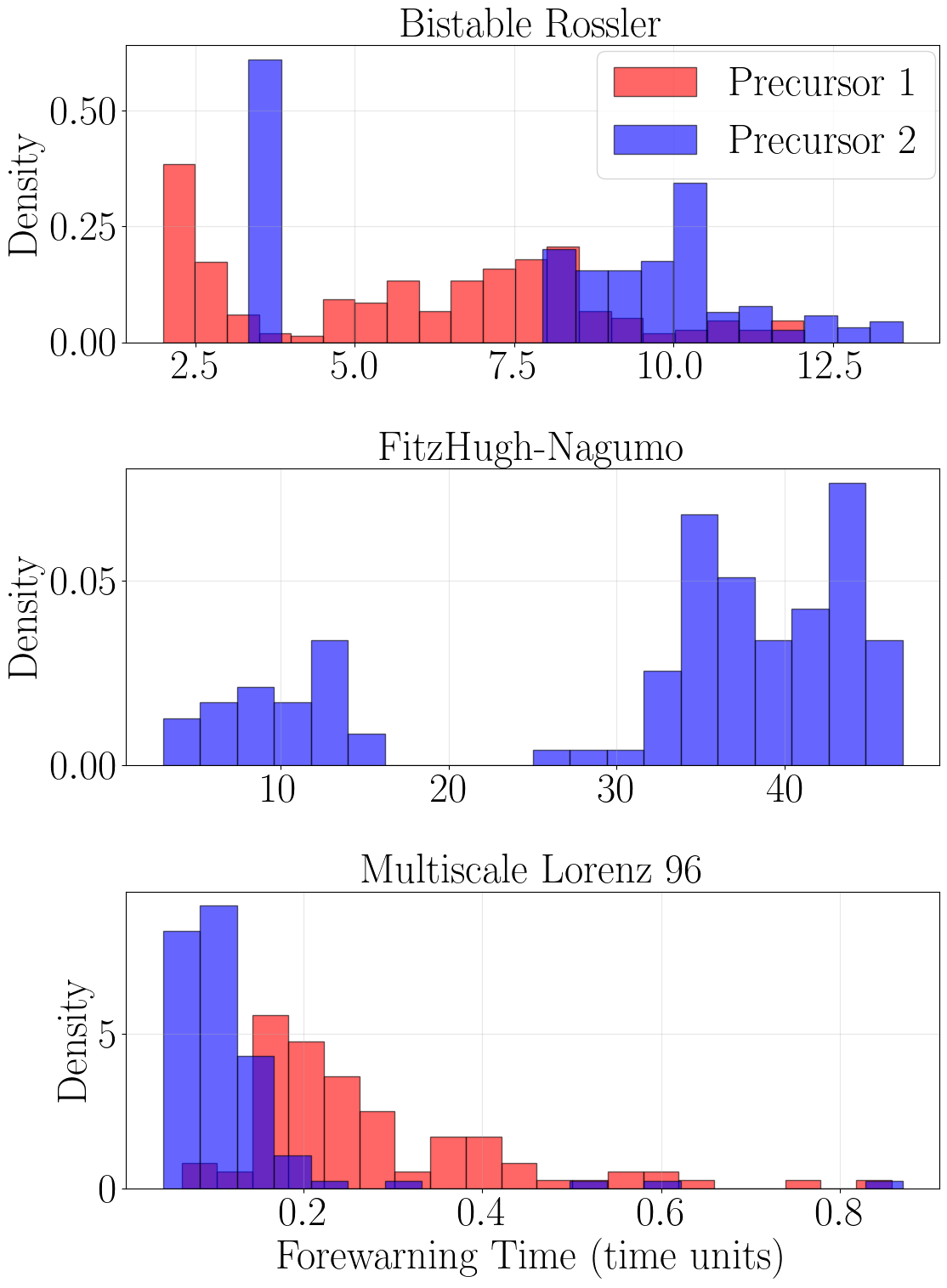
Figure 13: Distribution of forewarning times for the proposed precursors across three classes of systems, demonstrating substantial lead time for intervention.
Implications and Outlook
The theory unifies disparate empirical observations of CLV alignment as warnings for extreme events within a rigorous spectral and geometric framework. The strong claim is that, in fast-slow systems, monitoring geometric and spectral features in tangent space—specifically the alignment of CLVs and their instantaneous growth rates—provides robust, theoretically justified, and highly effective precursors for both critical transitions and more general extreme events.
Practically, this offers a new paradigm for time-forecasting catastrophic events in multiscale systems, potentially transcending the limitations of classical signal-based early warning indicators (e.g., variance, autocorrelation). By grounding the approach in the tangent bundle geometry and leveraging recent advances in CLV computation, the method is directly extensible to high-dimensional, chaotic, and multiscale real-world systems including climate, neuroscience, engineering, and economics.
Theoretically, this work bridges dynamical systems analysis, ergodic theory, and multiscale geometry, providing mechanistic links between phase space geometry (CLV tangency), spectral gap structure, and the emergence of catastrophic instability.
Potential for Integration with AI
Given the increasing efforts in data-driven reduced modeling and AI-based prediction of extreme events ([Qi & Majda 2020], [Bury et al. 2021]), integration of tangent-space diagnostics such as CLV-based precursors into machine learning pipelines could enhance forecasting reliability and interpretability. Embedding CLV-based features as learned or explicit variables within recurrent or reservoir computing architectures may improve the advance warning of regime shifts in systems where approximating the tangent linear dynamics is feasible from data ([Margazoglou & Magri 2023], [Ahmed et al. 2024], [Viennet et al. 2022]).
Further research may address data-driven estimation of CLVs from partial and noisy observations, extension of the adiabatic alignment condition to systems with weak scale separation or stochastic forcing, and application to even higher-dimensional domains.
Conclusion
This paper delivers a mechanistic, quantitatively validated theory that ties the geometry of covariant Lyapunov vectors to forecastable precursor signals for extreme events and critical transitions in fast-slow dynamical systems. Through rigorous derivation, geometric reasoning, and systematic numerical validation, the work demonstrates that real-time monitoring of tangent-space features offers precise and reliable early warnings, with implications for both theoretical understanding and practical prediction strategies in complex multiscale environments. Future developments are likely to focus on further generalization, data-driven estimation methodologies, and incorporation into hybrid dynamical-AI forecasting systems.
(2604.12869)

