- The paper introduces a mechanism linking GW190425 and FRB 20190425A via Gertsenshtein-Zel'dovich conversion in a hierarchical triple system with a magnetar.
- It demonstrates that inverse Compton scattering upconverts low-frequency EM waves to GHz frequencies, matching observed FRB properties with calculated energy fluxes.
- The model overcomes limitations of blitzar scenarios, offering new insights for multi-messenger astrophysics and motivating targeted searches for delayed FRB counterparts to GW events.
Gravitational Gertsenshtein-Zel'dovich Mechanism Linking GW190425 and FRB 20190425A
Introduction and Motivation
The reported temporal and spatial coincidence between the binary neutron star (BNS) merger GW190425 and the fast radio burst FRB 20190425A presents a paradigm-challenging opportunity to probe the physical connection between GW and FRB phenomena. Prior interpretations invoking the blitzar mechanism—where a postmerger hypermassive neutron star collapses to a black hole—have been largely disfavored due to inconsistencies with the event’s inferred inclination angle and stringent kilonova non-detection limits. This paper introduces an alternate framework, positing that the association is mediated by the Gertsenshtein-Zel'dovich (GZ) effect operating in a hierarchical triple system containing a magnetar at an ∼18 AU separation from the BNS. In this model, high-frequency (∼kHz) GWs generated by the merger are converted into EM waves via the GZ effect in the strong magnetospheric field of the magnetar. Inverse Compton scattering (ICS) by relativistic leptons subsequently upconverts the EM radiation to GHz frequencies consistent with the observed FRB.
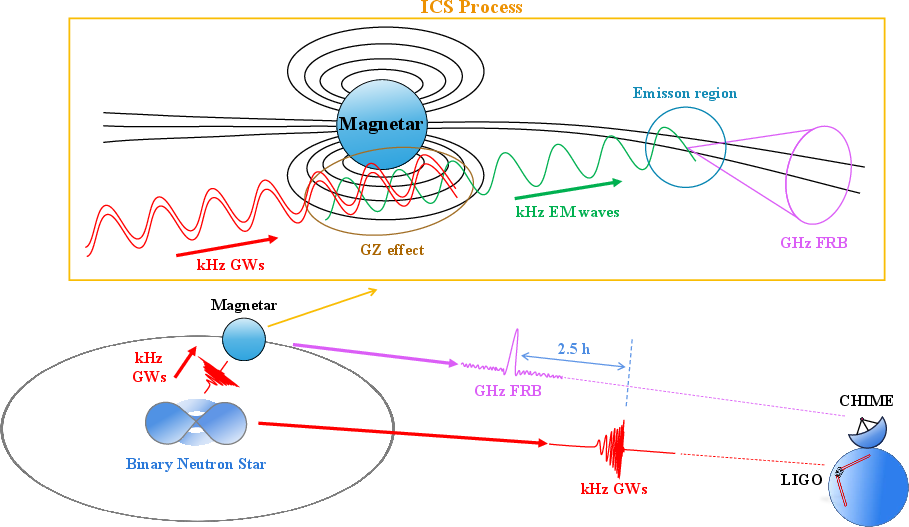
Figure 1: Schematic of the GW-FRB association mediated by magnetospheric GZ conversion and ICS, elucidating the time delay and spatial configuration.
The model aims to quantitatively reproduce the observed properties of FRB 20190425A, thereby providing a physically consistent scenario free from the inclination and ejecta constraints that inhibit previous models.
Theoretical Background: Gertsenshtein-Zel'dovich Conversion
Within the context of a strong external magnetic field, the Gertsenshtein-Zel'dovich effect predicts the partial conversion of propagating GWs into EM waves. For GW190425, the merger generates kHz-frequency GWs, a fraction of which impinge upon a nearby magnetar. The GW strain at the magnetar distance (∼18 AU, matching a ∼2.5 hr propagation lag) is estimated as ∣h0∣∼2.1×10⁻¹⁰, yielding an energy density ρGW∼3.0×10¹⁵ erg/cm³ for f0∼2.5 kHz. EM conversion, dominantly in the X-mode, is characterized by
ρEM≈1.3×10⁸ erg/cm3(6.1×1015 GB0)2(18 AUD)−2
where B0 is the magnetar surface magnetic field.
The typical energy coupled by the GZ effect (Eabs∼1037 erg) is insufficient to power canonical FRBs directly but can trigger significant magnetospheric disturbances, possibly initiating crustal quakes and relativistic outflows conducive to further EM upconversion mechanisms.
Inverse Compton Scattering and GHz Emission Generation
The upconversion to FRB-observable GHz frequencies is ascribed to ICS by relativistic particles energized either by GW-driven starquakes or by dynamical field reconfigurations within the magnetosphere. The observed final frequency is ∼0; for ∼1 and ∼2 kHz, this yields ∼3 MHz, matching observed FRB frequencies.
The ICS process in the strong field limit features an effective cross section scaling steeply with Lorentz factor and field strength: ∼4
The resulting ICS luminosity, incorporating coherent emission scaling, can achieve
∼5
under fiducial parameters, which comfortably matches the observed energetic requirements of gigaparsec-distance FRBs. The calculated flux density is
∼6
for event-consistent parameters, in agreement with FRB 20190425A observations.
Observational Implications and Event Rate Considerations
This framework predicts that FRBs generated via GW-driven GZ and ICS mechanisms will be observationally similar to traditional magnetar-origin FRBs, barring their temporal association with GW events. The expected event rate is low, contingent on the likelihood of magnetar presence within tens of AU of a BNS (or BBH) merger—a rare configuration possibly realized in hierarchical triple systems [Hamers et al. 2019].
Importantly, the temporal offset between GW and FRB is set by the GW propagation delay to the companion magnetar and can span hours. Targeted searches in FRB data for such delayed counterparts to GW events are strongly advocated by this scenario.
Theoretical Implications and Future Directions
The demonstration of a viable GW→EM→FRB channel via GZ and ICS mechanisms significantly broadens the multi-messenger landscape. If confirmed, such associations would provide unique probes of triple system dynamics, GW-EM coupling in ultra-strong fields, and plasma physics in extreme magnetospheric environments. This mechanism is unconstrained by the inclination and ejecta optical depth issues that preclude standard postmerger magnetar-blitzar models.
Future theoretical work should explore the detailed parameter space of magnetospheric configurations, field geometries, and GW excitation channels. Observationally, stacked searches for FRB counterparts with variable delays to GW signals—particularly from BNSs—are motivated. High-cadence, broad-band FRB monitoring near GW event locations may yield decisive evidence.
Conclusion
This work presents a comprehensive, physically motivated mechanism associating GW190425 and FRB 20190425A through Gertsenshtein-Zel'dovich GW-to-EM conversion and subsequent ICS in the magnetosphere of a nearby magnetar. The theoretical model quantitatively accounts for the observed temporal delay, energetics, and spectral properties of FRB 20190425A owing to plausible system parameters. While the event rate for such occurrences is expected to be low, the physical pathway established here opens compelling prospects for multi-messenger astrophysics and warrants further search efforts for delayed FRBs following GW detections (2604.12775).

