Asymptotic Theory for Graphical SLOPE: Precision Estimation and Pattern Convergence
Published 14 Apr 2026 in math.ST, stat.AP, stat.ME, and stat.ML | (2604.12771v1)
Abstract: This paper studies Graphical SLOPE for precision matrix estimation, with emphasis on its ability to recover both sparsity and clusters of edges with equal or similar strength. In a fixed-dimensional regime, we establish that the root-n scaled estimation error converges to the unique minimizer of a strictly convex optimization problem defined through the directional derivative of the SLOPE penalty. We also establish convergence of the induced SLOPE pattern, thereby obtaining an asymptotic characterization of the clustering structure selected by the estimator. A comparison with GLASSO shows that the grouping property of SLOPE can substantially improve estimation accuracy when the precision matrix exhibits structured edge patterns. To assess the effect of departures from Gaussianity, we then analyze Gaussian-loss precision matrix estimation under elliptical distributions. In this setting, we derive the limiting distribution and quantify the inflation in variability induced by heavy tails relative to the Gaussian benchmark. We also study TSLOPE, based on the multivariate t-loss, and derive its limiting distribution. The results show that TSLOPE offers clear advantages over GSLOPE under heavy-tailed data-generating mechanisms. Simulation evidence suggests that these qualitative conclusions persist in high-dimensional settings, and an empirical application shows that SLOPE-based estimators, especially TSLOPE, can uncover economically meaningful clustered dependence structures.
The paper presents a novel asymptotic framework for GSLOPE, showing that scaled estimation errors converge to a unique minimizer that encodes both sparsity and cluster patterns.
It extends analysis to elliptical and heavy-tailed models, deriving explicit variance inflation factors and optimal tuning strategies for robust precision matrix recovery.
Empirical results confirm that TSLOPE outperforms GSLOPE and GLASSO by accurately recovering block structures and reducing RMSE in hidden factor models.
Asymptotic Theory for Graphical SLOPE: Precision Estimation and Pattern Convergence
Introduction and Motivation
The paper "Asymptotic Theory for Graphical SLOPE: Precision Estimation and Pattern Convergence" (2604.12771) develops a detailed asymptotic analysis of Graphical SLOPE (GSLOPE) estimators for precision matrices in multivariate models. The primary motivation is the structured recovery of conditional dependence networks beyond simple sparsity, specifically enabling the identification of edge clusters—groups of precision matrix off-diagonal elements with identical or similar magnitude, as motivated by settings such as latent block models or factor structures in finance.
GSLOPE employs a sorted ℓ1 (SLOPE) penalty that encourages both sparsity and equality among entries, in contrast to the standard entrywise ℓ1 penalty (LASSO-based), such as used in graphical LASSO (GLASSO). This penalty is particularly relevant when the underlying model features homogeneous groups of edge strengths, for which standard sparsity-inducing penalties may yield suboptimal partitions and interpretations. Thus, the analysis aims to separate estimation accuracy from pattern (clustering) recovery and to provide new asymptotic guarantees and tools for both tasks.
Asymptotic Theory for Graphical SLOPE
The main technical contribution is a fixed-dimensional asymptotic framework for convex-penalized M-estimators with polyhedral regularizers. For the GSLOPE setting, the target is precision matrix estimation under both Gaussian and elliptical models, characterizing the error distribution and the limiting recovery of clustering patterns.
Specifically, for n i.i.d. observations from a p-dimensional distribution with covariance Σ, the regularized estimator solves
Θn∈argminΘ⪰0{n1i=1∑nℓ(X(i),Θ)+n−1/2Pen(Θ)}
where ℓ(⋅,⋅) is a chosen loss function (e.g., Gaussian or t-distributed negative log-likelihood), and Pen(Θ) is the SLOPE penalty applied to the off-diagonal entries.
The central result is that, as n→∞ (with ℓ10 fixed), the normalized estimation error ℓ11 converges in distribution to the unique minimizer of a strictly convex function comprising a quadratic form from the population loss, a Gaussian noise term, and the directional derivative of the SLOPE penalty. Importantly, the limiting random variable induces not just sparsity but a specific clustering pattern—a distribution on patterns of tied and zero entries—enabling characterization of both estimation and structural (clustering) risk.
Concretely, the theorem demonstrates weak convergence of the SLOPE-induced "pattern" (an equivalence relation encoding both zeros and equality among nonzero coefficients) conditional on the true underlying pattern structure.
Robustness and Elliptical Models
A significant extension concerns departures from Gaussianity. Many real-world data—particularly in finance and genomics—exhibit heavy tails and other non-Gaussian behavior. The paper addresses this by formally extending the theory to elliptical distributions, quantifying the inflation in the limiting variance due to heavy tails relative to the Gaussian benchmark.
Under elliptical models, precise formulas for both the limiting Hessian and score covariance are derived, making explicit the increased variability:
For GSLOPE under elliptical data, the limiting covariance features a scaling term involving the fourth moment of the distribution's radial component (see Proposition 1).
With a heavy-tailed multivariate ℓ12-distribution (degrees of freedom ℓ13), the inflation becomes especially pronounced for small ℓ14.
The analysis is further extended to a variant called TSLOPE, which utilizes a multivariate ℓ15-loss function. This approach is shown to align more closely with the true precision matrix under heavy-tailed sampling and yields reduced asymptotic variance relative to GSLOPE in such scenarios.
Numerical Results: Estimation and Pattern Recovery
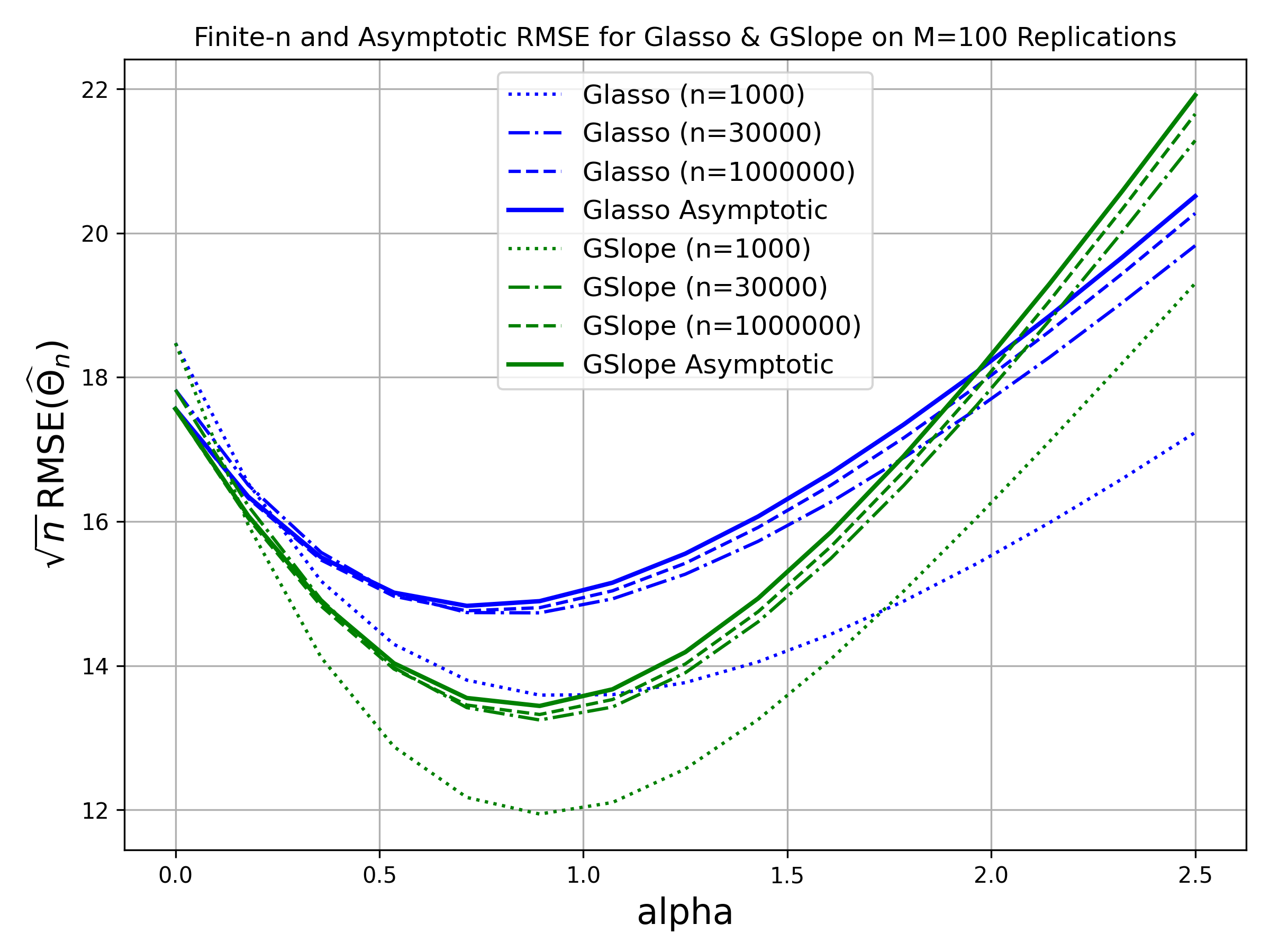
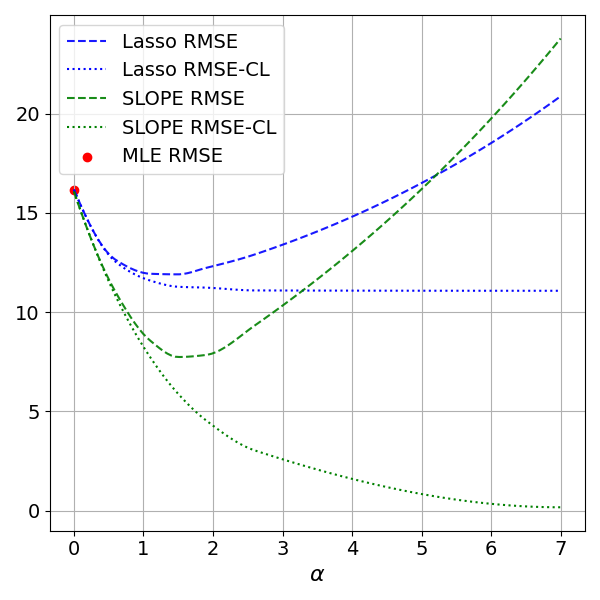
Simulation experiments validate the asymptotic findings, demonstrating convergence of empirical root mean-square error (RMSE) to asymptotic predictions and quantifying decomposition of the error into bias and clustering contributions across a range of regularization strengths.
Figure 1: Convergence of the rescaled empirical ℓ16 to the asymptotic error for Graphical SLOPE and GLASSO as a function of sample size.
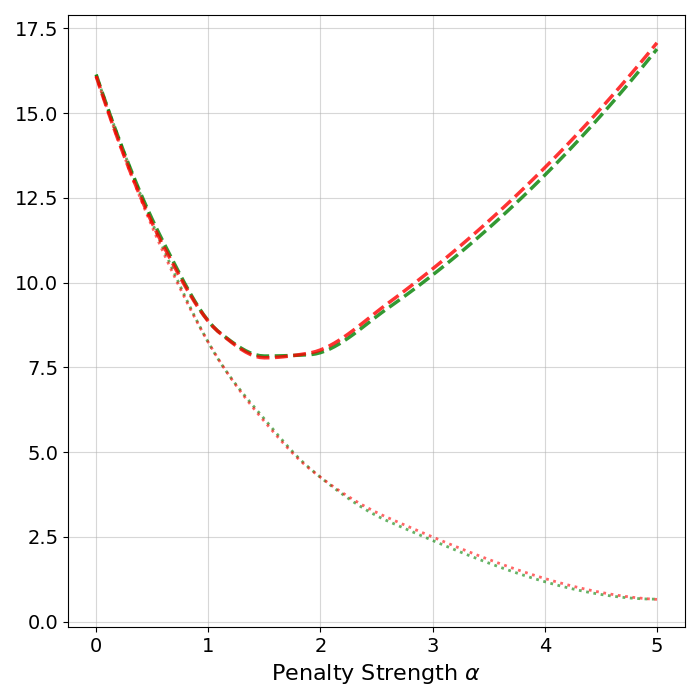
These results empirically confirm that, as ℓ17 increases, the root-ℓ18 scaled RMSE of GSLOPE closely tracks the theoretically derived limiting value, and clustering error (the part of the error due to misidentifying the correct grouping structure) can be decoupled from global estimation error.
Figure 2: Comparison of the asymptotic clustering error ℓ19 versus total n0 for Graphical SLOPE and GLASSO.
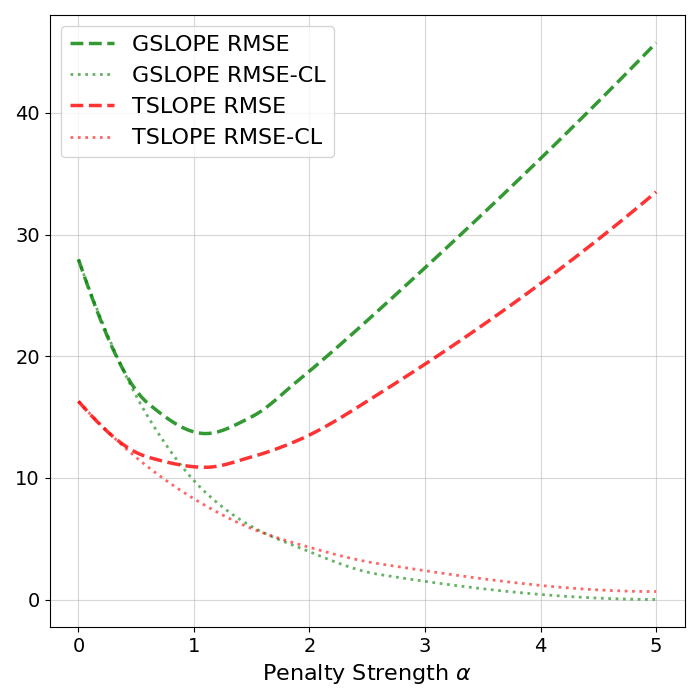
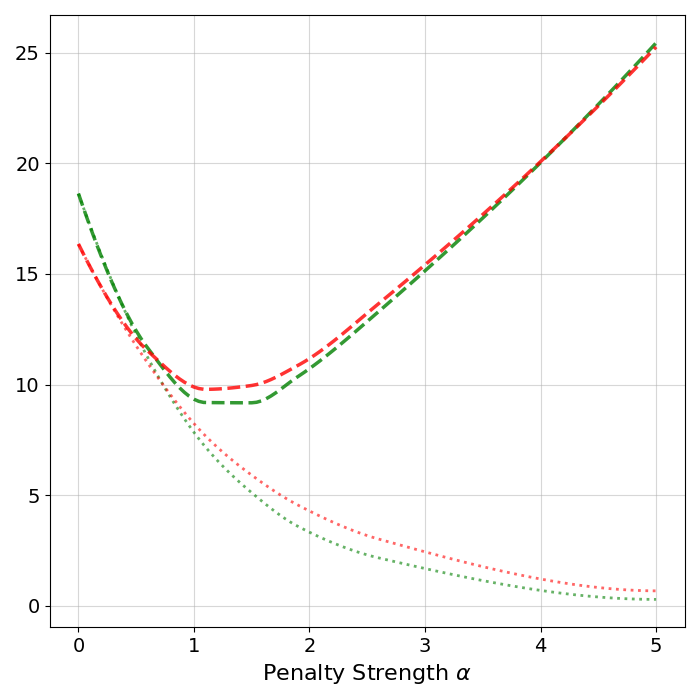
Under heavy-tailed generative models, a direct comparison between GSLOPE and TSLOPE reveals the clear benefit of employing the loss function adapted to tail behavior. For example, with n1-distributed data (small n2), TSLOPE consistently outperforms GSLOPE in terms of both estimation and clustering error; for large n3, the asymptotic errors coincide.
Figure 3: Asymptotic RMSE comparison between GSLOPE and TSLOPE across degrees of freedom n4 for n5-distributed data, illustrating TSLOPE's robustness under stronger tail risk.
Structured Estimation under Hidden Factor Models
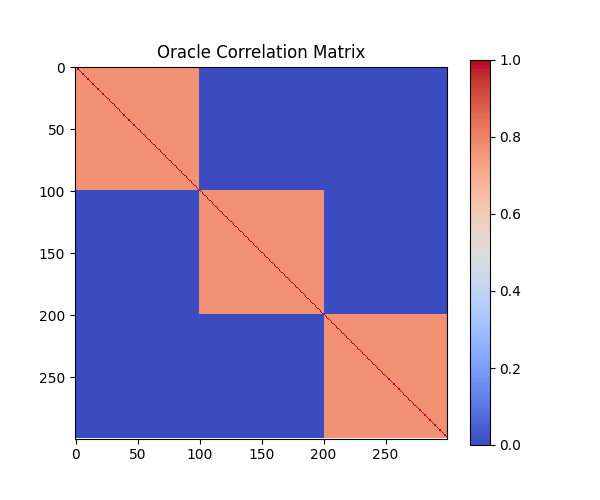
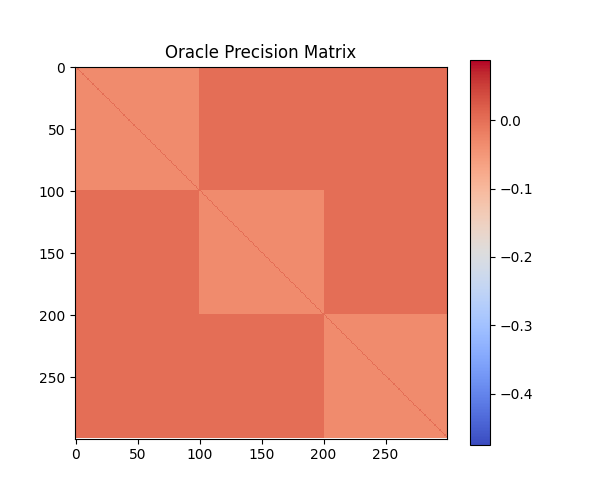
A comprehensive simulation study investigates performance under a hidden factor structure, common in financial econometrics. Here, the true precision matrix exhibits explicit block structure and clusters corresponding to groups of assets sharing exposures to specific latent factors.
Figure 4: Oracle correlation and precision matrices for the hidden factor set-up, visualizing the strong block structure and shared exposures among groups.
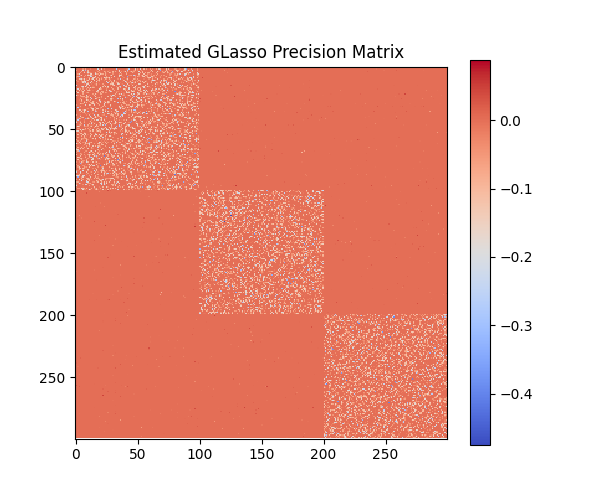
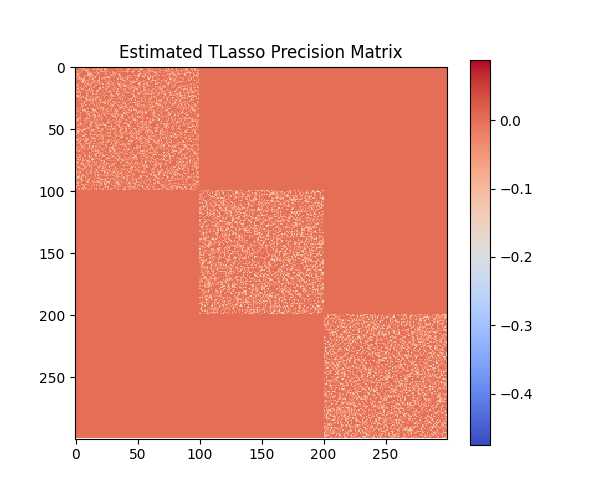
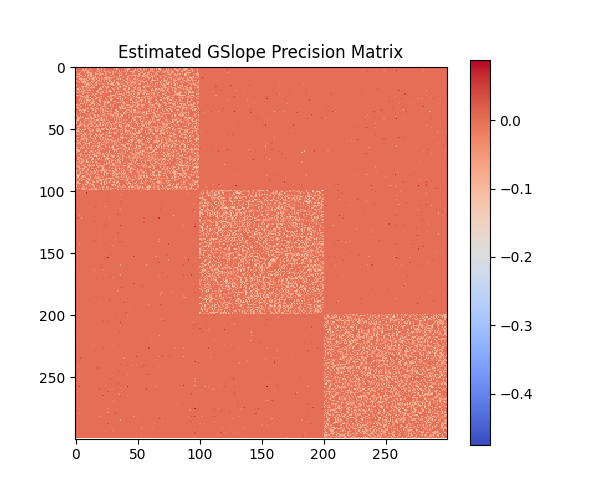
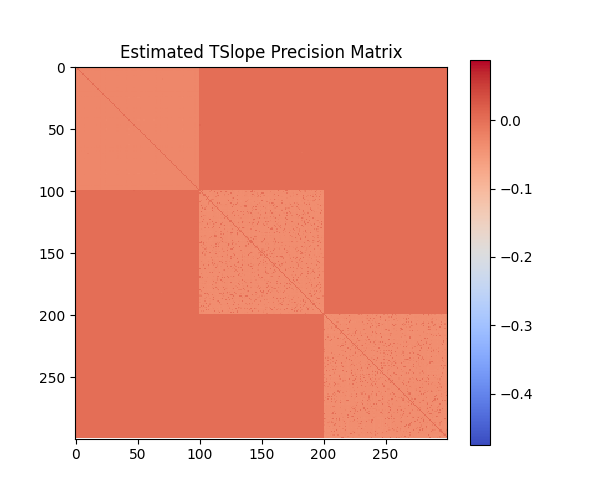
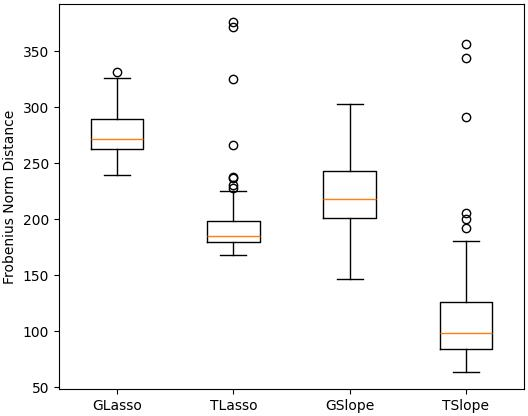
In this high-dimensional setting, both SLOPE-based and standard methods (GLASSO, TLASSO) are compared. For optimal choices of tuning parameters (identified via minimization of Frobenius norm error), TSLOPE demonstrates superior ability to recover not only the sparsity pattern but also the correct edge clusters—closely matching the oracle matrix. Notably, TSLOPE yields the lowest median Frobenius norm distance across repeated samples, while GLASSO reports the largest.
Figure 5: Oracle and estimated precision matrices under the hidden factor model, with method-wise Frobenius norm error boxplots; TSLOPE provides the closest recovery to the true structure.
Empirical Application: Portfolios Sorted by Size and Book-to-Market
The asymptotic and simulation findings are substantiated via application to real-world financial data: daily returns of 25 portfolios sorted by size and book-to-market ratio. Exploiting the economic interpretability of the ordering, the analysis assesses the ability of the estimators to uncover clustered dependence structures.
Clustering of precision matrix entries over rolling windows is evaluated via the Calinski-Harabasz index, providing an objective measure of cluster separability in the estimated conditional dependence graph. TSLOPE consistently achieves the highest values over a grid of regularization strengths, outperforming both GSLOPE and GLASSO.
The clusters identified by TSLOPE not only maximize the internal clustering quality index but also align with economic groupings, as confirmed by visualization of the cluster assignments in the matrix and corresponding network graphs. Strong conditional dependencies cluster among portfolios with similar characteristics, while weaker or absent dependencies prevail across more distant groups.
Implications and Future Directions
The theoretical and empirical analysis demonstrates that SLOPE-based penalties can consistently recover interpretable clustering structures in precision matrix estimation, extending beyond what is achievable with standard sparsity-focused approaches. The results have practical significance for network inference in genomics, neuroscience, and financial econometrics, where both sparsity and grouping correspond to meaningful structural features.
The explicit asymptotic quantification of error and clustering risk enables more principled regularization selection, particularly in the presence of heavy tails or latent block structure. Moreover, the benefits of tailoring the loss function (as in TSLOPE) to the distributional properties of the data are concretely demonstrated.
Potential avenues for further research include generalization to high-dimensional asymptotics (n6), extension to more complex structured penalties (e.g., hierarchical, fused, or atomic norms), and exploration of direct implications for risk estimation, precision matrix-driven prediction, and high-dimensional graphical model selection beyond the precision domain.
Conclusion
The study provides a rigorous asymptotic theory and comprehensive empirical support for GSLOPE and TSLOPE in structured precision matrix estimation. The main findings emphasize the simultaneous estimation of sparse and clustered dependency networks, with TSLOPE offering robustness to heavy tails. The methodological advances establish a foundation for structured regularization in high-dimensional statistical inference and offer direct guidance for applications where both interpretability and statistical accuracy in network estimation are essential.
“Emergent Mind helps me see which AI papers have caught fire online.”
Philip
Creator, AI Explained on YouTube
Sign up for free to explore the frontiers of research
Discover trending papers, chat with arXiv, and track the latest research shaping the future of science and technology.Discover trending papers, chat with arXiv, and more.