- The paper presents a novel finite-temperature framework using the method of random surfaces to compute multi-point correlation functions in the sine–Gordon model.
- It benchmarks two-point functions across weak and quantum coupling regimes while capturing non-Gaussian higher-order correlations with high fidelity.
- Results are validated against conformal and semiclassical limits, establishing a flexible tool for exploring thermal quantum field dynamics.
Finite-Temperature Correlation Functions in the Sine-Gordon Model via the Method of Random Surfaces
Introduction
The sine-Gordon model is a fundamental (1+1)-dimensional integrable quantum field theory with extensive applicability in condensed matter physics, ranging from coupled cold atomic gases to one-dimensional antiferromagnets and quantum circuits. Despite the model’s well-understood integrability and rich exact structure at zero temperature, the finite-temperature regime remains largely intractable by existing analytic or numerical approaches across most parameter regimes. Standard techniques such as form-factor expansions and semiclassical methods are limited to specific weak- or strong-coupling and low-temperature limits; direct numerical treatments face restrictive scaling and convergence issues.
This work introduces a rigorous finite-temperature framework for computing multi-point correlation functions in the sine-Gordon model based on the method of random surfaces (MRS). The approach yields non-perturbative, systematically controlled results where traditional methods break down, most crucially in the intermediate coupling and temperature domains. It provides both high-fidelity two-point and higher-order correlators, exact expressions for N-point functions obeying a neutrality condition, and a robust analysis of the connected multi-point structure revealing the non-Gaussianity of quantum thermal fluctuations. Benchmarking against conformal and semiclassical limits validates the method's precision and scope.
The analysis is performed on the finite-temperature sine-Gordon model defined on a cylinder of length L (space x) and circumference R (Euclidean time τ), realizing thermal equilibrium at T=1/R. Vertex operators V±β quantify the exponential field excitations central to the model’s observable content.
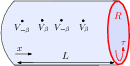
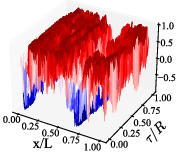
Figure 1: Sine-Gordon system on a cylinder with typical configuration of inserted vertex operators and a sample random surface field mode.
The partition function with exponential perturbation is rewritten as a functional integral over auxiliary Gaussian random variables associated with the Fourier modes of the field. This formulation results in a high-dimensional integral encoding both the free and interacting contributions. Observable correlation functions are then computed as functional derivatives of the partition function with respect to local couplings, realized numerically via Monte Carlo integration of the random surface fields for large mode cutoffs.
This method enables direct numerical construction of real-time and equal-time connected correlators at arbitrary coupling and temperature, limited only by statistical sampling and the mmax Fourier cutoff.
Benchmarking: Two-Point Correlation Functions
The equal-time connected two-point function of vertex operators was systematically computed for various values of the interaction parameter Δ=β2/(4π) and inverse temperature N0:
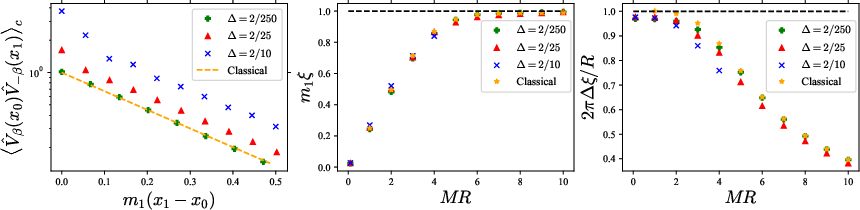
Figure 2: Correlators at MR=1 for various N1 showing quantum deviation from the classical limit. Corresponding correlation length vs dimensionless inverse temperature and normalized scaling to the conformal limit.
At small N2, the MRS results align with the classical sine-Gordon theory, while significant departures emerge in the quantum regime—highlighting the model’s genuine quantum behavior beyond the reach of the classical approximation. The extracted correlation lengths transition smoothly from the low-N3 breather mass gap N4 to the high-N5 conformal prediction N6, with weak dependence on N7 in the quantum regime.
Higher-Order Correlations and Non-Gaussianity
MRS supports exact expressions for general N8-point vertex operator correlators under the selection rule N9, thus covering the experimentally and theoretically relevant neutral and charge-conserving observables. Nontrivial four-point functions were evaluated to interrogate the structure of connected quantum correlations and their deviation from Gaussianity.
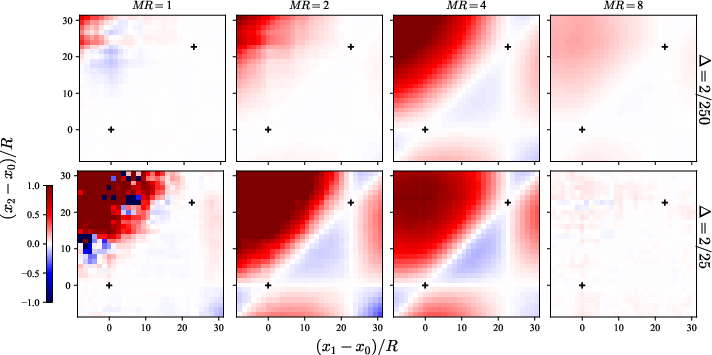
Figure 3: Heatmaps of four-point function L0 deviations from the disconnected (Gaussian) value at varying interactions and temperatures.
The largest connected correlations are found in the intermediate temperature regime (L1–L2), with both strength and regime width increasing with L3. In the high-L4 domain, quantum fluctuations dominate and interactions are suppressed, while at low L5, Gaussianity is restored as the field is confined near the minima of the sine nonlinear potential.
The degree of non-Gaussian correlation is quantified via a kurtosis-like measure L6 integrating the connected four-point deviations:
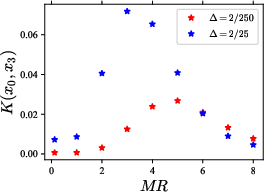
Figure 4: Kurtosis-like measure showing maxima in non-Gaussianity at intermediate temperature, increasing with coupling.
Evaluation of Finite-Size and Numerical Effects
Robustness checks include Monte Carlo sample convergence, analysis of the impact from Fourier mode truncation, and systematic evaluation of finite-size geometrical effects:
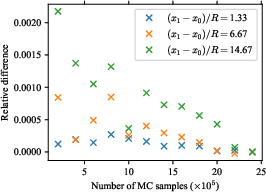
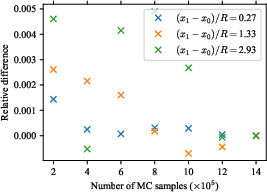
Figure 5: Monte Carlo convergence for both weak and intermediate couplings as a function of sample count.
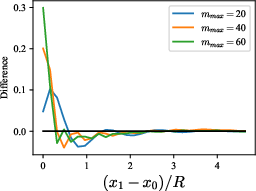
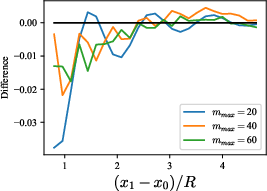
Figure 6: Systematic study of Fourier cutoff artifacts in two-point correlations; finer mode truncation yields smoother exponential decay.
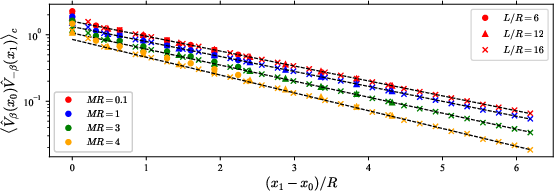
Figure 7: Correlation functions for varying cylinder geometries validate finite-size independence of the extracted correlation length in the universal regime.
Errors increase with both coupling strength and operator separation, but for L7 and L8 samples, results converge and finite-size bias is suppressed in the regime of interest. Remaining numerical uncertainties are localized to very low temperatures.
Implications and Prospects
The MRS method provides controlled, non-perturbative, and flexible access to thermal correlation data for integrable field theories such as the sine-Gordon model out of reach by previous methods. The exact master formula for neutral and charge-conserving multi-point correlators lays a foundation for systematic study of non-Gaussian effects, transport quantities, and comparison with both classical field and lattice Monte Carlo approaches.
Experimentally, the framework offers essential theoretical benchmarks for quantum simulators, e.g., cold atom implementations of sine-Gordon physics. It supports direct calculations of experimental observables (such as higher-order connected correlators) and is inherently extendable to out-of-equilibrium and real-time contexts given the underlying structure of the MRS.
Numerical artifacts are well characterized; with sufficiently large mode cutoffs and system sizes, the method remains robust for the extraction of universal physical quantities in all regimes except at deep infrared scales where statistical noise dominates.
Conclusion
The extension of the method of random surfaces to compute finite-temperature two- and L9-point correlation functions in the sine-Gordon model overcomes the key limitations of traditional approaches, yielding a computationally tractable and exact framework for quantum thermal field theory in one dimension. Strong agreement with known analytical results, precise control over non-Gaussian higher-order correlations, and systematic treatment of numerical uncertainties demonstrate the efficacy and broad applicability of the method. These results establish MRS as a primary computational tool for finite-temperature properties of integrable and near-integrable models, enabling new exploration of thermal quantum field phenomena, benchmarking of quantum simulation platforms, and deeper investigation of fluctuation-dominated quantum many-body systems.

