- The paper demonstrates that integrating recovery loops significantly reduces failure probabilities in safety-critical robotic operations.
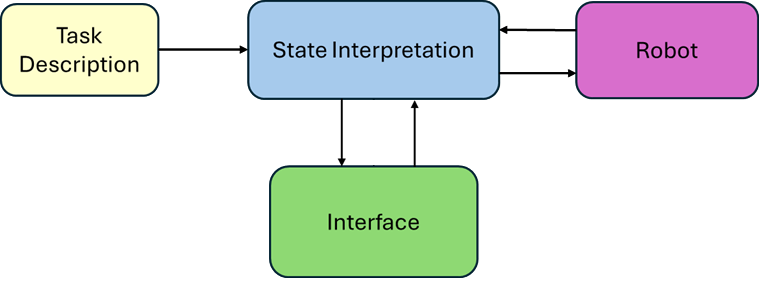
- It introduces a modular system architecture that combines dynamic task descriptions, real-time state interpretation, and effective human-robot communication.
- Empirical insights from nuclear decommissioning use cases underscore the importance of adaptive error recovery in unpredictable operational domains.
Error Recovery in Human-Robot Interaction: Architectural and Practical Considerations
Introduction
The research addresses a fundamental challenge in autonomous and semi-autonomous robotic systems: enabling robust error detection and recovery mechanisms in human-robot interaction (HRI), particularly within safety-critical contexts. Standard approaches to AI evaluation, which emphasize surpassing human-level one-shot task accuracy, often overlook the iterative, adaptive behaviors inherent in real-world problem-solving. Human operators excel not merely through baseline task execution accuracy but through their capacity for error recovery and adaptation during ongoing activities. Integrating such dynamic resilience into robotic systems is essential, especially in unpredictable operational domains.
Nuclear Gloveboxes as a High-Stakes Use Case
Nuclear decommissioning scenarios underscore the necessity for comprehensive error recovery. Gloveboxes are containment systems allowing manipulation of hazardous radioactive materials, historically operated via physical gloves providing both isolation and restricted dexterity. Contemporary robotic deployments in these environments encounter heterogeneous, unstructured, and frequently occluded workspaces. Two predominant robotic integration paradigms exist: retrofitting robots into classic gloveboxes using protective sleeves, and purpose-building gloveboxes with robotic systems embedded from inception.

Figure 1: A robot in a traditional glovebox using a protective sleeve for contamination control.
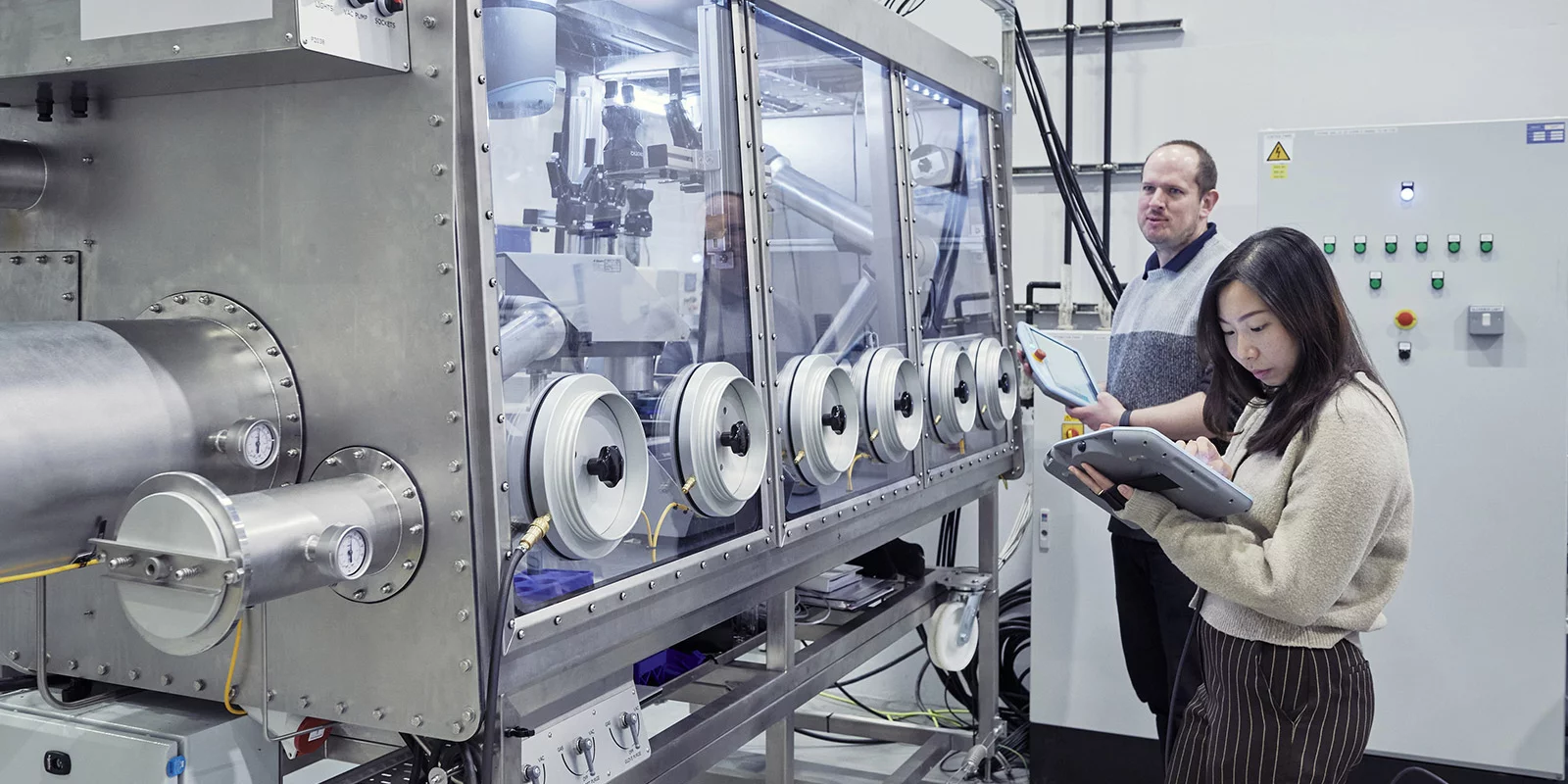
Figure 2: A purpose-built robotic glovebox in the RAICo1 facility, facilitating remote operation via embedded robots.
The unpredictability of these environments emerges from both the material heterogeneity—unknown object types, latent contamination, and difficult-to-assess hazards—and the complicating factor of operational degradation. Radiation and mechanical wear can drive error probabilities higher over time. Errors range from trivial (inefficient task execution) to catastrophic (containment failure), with compounding effects in the absence of rapid detection and recovery.
Core Design and Technical Challenges
Task Definition and Grounding
Systems must accommodate task definitions that are both incomplete and evolving at runtime. Tasks such as waste sorting, repackaging, and containment testing are defined only partially prior to execution; comprehensive knowledge of scene composition is unattainable before intervention. LLM-based workflow agents, e.g., as noted in "Autoflow: Automated workflow generation for LLM agents" (Li et al., 2024), demonstrate promise for dynamic workflow reasoning but remain susceptible to hallucination and brittle task grounding in the absence of robust environmental feedback.
Error Identification and Severity Assessment
Error classes bifurcate into universal (e.g., misgrasp, collision, perceptual misclassification) and domain-specific (e.g., exposure to excessive radiation, compromising containment integrity). The nuclear context amplifies the consequences of nominally "minor" missteps. Importantly, context determines severity and required recovery strategies, necessitating situation-aware detection modules capable of both generic anomaly flagging and task-specific thresholding.
Causal Attribution
Effective recovery is contingent on accurate causal inference. Errors frequently stem from compounded issues—perceptual occlusion, sensing degradation, actuator noise, environmental occlusions, or human operator mistakes in teleoperation regimes. Opaque environments, suboptimal camera placement, and radiation-induced sensor drift require AI systems to utilize redundancy and cross-modal sensing, and where possible, to incorporate human-in-the-loop review for ambiguous cases.
Communication and Human Factors
Timely, effective communication of errors is critical in collaborative HRI settings. Mechanisms span passive logging (enabling systematic diagnosis), active alerts (graphical, auditory, or haptic), and bi-directional interfaces to facilitate human override and feedback. Over-communication risks alert fatigue; under-communication undermines safety and reliability. Techniques developed for rapid dialogue repair in ambiguity resolution [wallbridge2021effectiveness] are directly relevant for minimizing downtime and miscoordination in these systems.
System Architecture for Error Recovery
The paper proposes a modularized system architecture integrating the following functional primitives:
This design emphasizes the necessity of closing the loop not only between robot and environment but among task understanding, perception, control, and collaborative input.
Practical and Theoretical Implications
Reliability Enhancement via Recovery Loops
A critical quantitative argument advanced is that incorporating one or more robust recovery opportunities drastically amplifies effective task completion reliability, with multiplicatively decreasing failure probabilities as recovery attempts compound. For example, two successive recovery opportunities with 5% failure each reduce the aggregate task failure rate to 0.25%, assuming independence.
Future Developments
Imminent research avenues include:
- Development of more sophisticated error taxonomies and severity models tailored to specific HRI contexts and risk profiles.
- Integration of multi-modal, explainable AI subsystems capable of real-time causal hypothesis generation and testing.
- Human-centered interface advances leveraging participatory design and adaptive alerting for reduced cognitive load and accelerated interventions.
- Extension to heterogeneous, ad hoc collaborative robotic teams, where error detection, attribution, and recovery may cross-cut multiple agents and communication pathways.
Conclusion
The work elucidates the inadequacy of one-shot accuracy paradigms in evaluating or engineering AI for complex, safety-critical robotics. Instead, the focus must shift toward explicit consideration of error detection, causal inference, redundant recovery behaviors, and collaborative communication frameworks. This approach aligns AI capabilities more closely with the nuanced adaptivity exhibited by human operators and lays the groundwork for more resilient, trustworthy robotics in dynamic environments.