- The paper introduces a novel HDC framework for adaptive LiDAR segmentation on resource-constrained edge devices.
- It integrates fast high-dimensional encoding with a strategic buffer selection to efficiently combat domain shifts and reduce update costs.
- Empirical results demonstrate significant speedups (up to 13.8×) and competitive mIoU performance on SemanticKITTI and nuScenes benchmarks.
HyperLiDAR: Adaptive Post-Deployment LiDAR Segmentation via Hyperdimensional Computing
Introduction and Motivation
HyperLiDAR presents a novel framework for efficient adaptive LiDAR semantic segmentation, uniquely designed for post-deployment learning on edge devices. The core premise addresses two persistent bottlenecks in real-world LiDAR segmentation: (1) the need for rapid adaptation under domain shift in dynamic environments, and (2) the strict computational, memory, and energy constraints of embedded platforms, which preclude naive retraining of conventional large neural networks. HyperLiDAR leverages the fast learning and computational efficiency of Hyperdimensional Computing (HDC) to enable effective and low-latency post-deployment adaptation, making it a platform-agnostic solution for practical spatial AI systems such as autonomous vehicles.
System Architecture
HyperLiDAR consists of a three-stage processing pipeline:
- Pre-deployment Training: A feature extractor is pretrained offline in the cloud using labeled LiDAR segmentation datasets, and then deployed on the edge device in frozen form.
- Post-deployment Adaptation: Streaming LiDAR scans are processed by the frozen encoder to generate features, which are encoded into high-dimensional hypervectors.
- Inference and Continuous Update: HDC-based class hypervectors are incrementally and efficiently updated using only element-wise (addition, subtraction) operations, bypassing costly backpropagation.
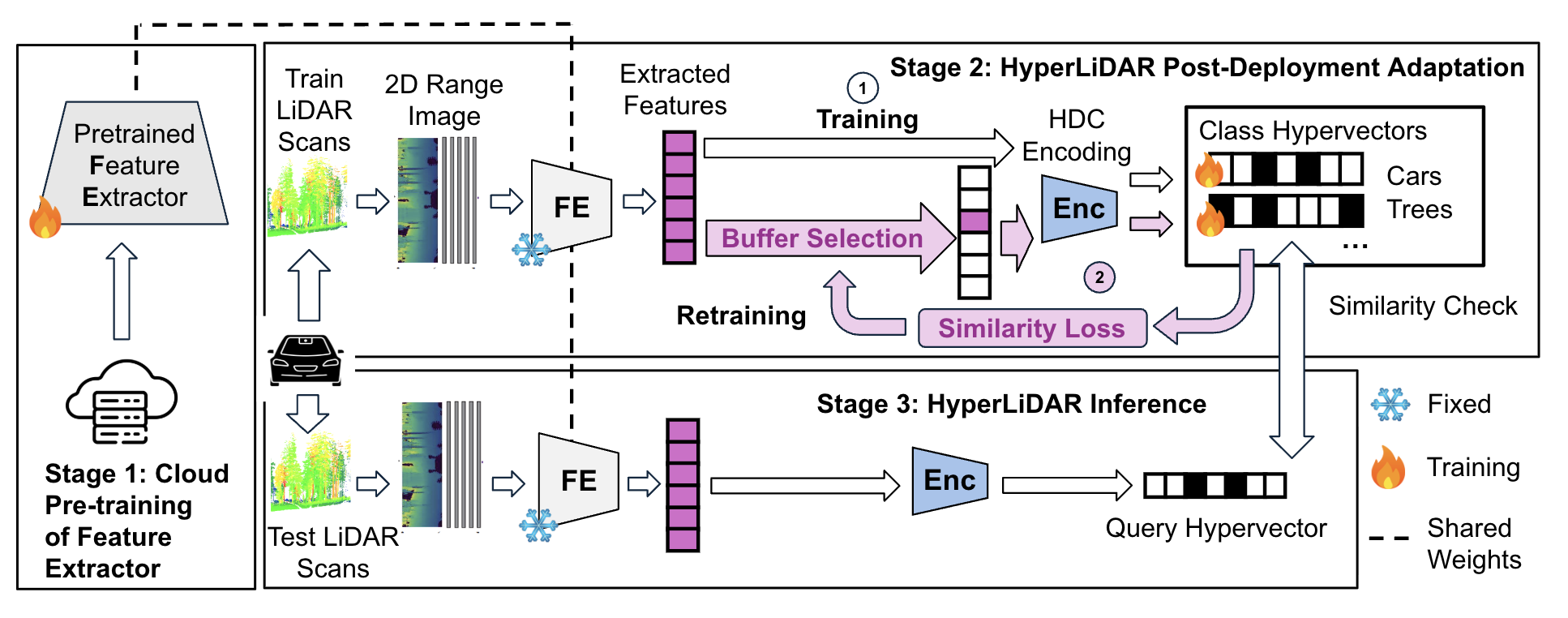
Figure 1: The HyperLiDAR pipeline: cloud-based pre-deployment training, and on-device post-deployment adaptation/inference on live LiDAR streams.
A pivotal technical innovation is the buffer selection strategy for adaptation: after an initial full-data training phase, subsequent updates select only a small core set—specifically, the most misclassified ("hard") samples and a random subset—to minimize encoding and updating cost without sacrificing accuracy. This mechanism is essential for handling dense LiDAR scans (50K-60K points/scan) within the constraints of edge platforms.
Hyperdimensional Computing in LiDAR Segmentation
Hyperdimensional Computing is employed both for its computational parallelism and its robustness against catastrophic forgetting, a major limitation of continual learning with neural networks. In HyperLiDAR, point cloud features are projected into 10,000-dimensional binarized vectors via random projection, forming a discriminative embedding space for fast similarity computation.
The core HDC training and inference mechanism operates as follows:
- Encoding: The feature extractor (based on projection schemes like CENet [cheng2022cenet]) outputs compact descriptors, which are projected into a hypervector space.
- Adaptation: For each misclassified point, the true class vector is incremented and the predicted class vector decremented using the point’s hypervector representation, promoting rapid correction with lightweight operations.
- Inference: For new points, cosine similarity is computed between the point’s encoded hypervector and all class hypervectors, assigning the class with the highest similarity.
This avoids gradient computation and parameter storage typically required by DNNs—a critical efficiency gain for on-device continual learning.
Empirical Results
Comprehensive experiments were conducted on the SemanticKITTI and nuScenes benchmarks. HyperLiDAR was compared to state-of-the-art baselines including CENet and SALUDA, assessing both adaptation accuracy (mean Intersection over Union, mIoU) and on-device retraining speed.
- On SemanticKITTI, HyperLiDAR with buffer selection achieves 54.0% mIoU using only 5% of feature updates—outperforming SALUDA and closely tracking CENet, while using a fraction of the update cost.
- On nuScenes, HyperLiDAR achieves 61.6% mIoU (67.3% in the full-data variant), again updating only 5% of the data.
- Training speed is significantly improved: up to 13.8× faster retraining compared to SALUDA, and 2.25× faster than CENet, on a standard NVIDIA RTX 4090 GPU.
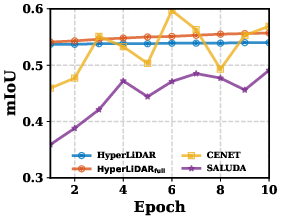
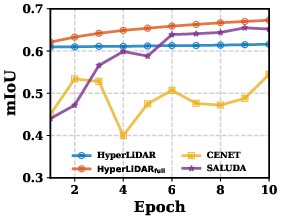
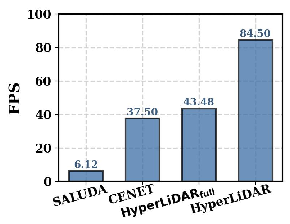
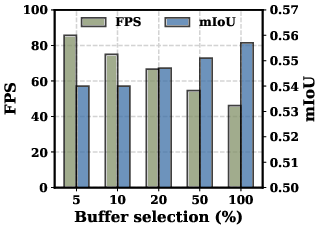
Figure 2: Training convergence (mIoU vs. epoch) for SemanticKITTI and nuScenes shows HyperLiDAR's rapid adaptation and stable learning compared to oscillating neural baselines.
HyperLiDAR also demonstrated robust performance on custom edge ASICs (FSL-HDnn), highlighting low-latency operation in realistic, resource-constrained deployment.
Buffer Selection and Efficiency–Accuracy Tradeoff
HyperLiDAR’s buffer selection mechanism is critical for scalability. Only 5% of points (half hard, half random) are used for adaptation updates after each epoch. Ablating the buffer selection, i.e., updating all points, yields marginal accuracy gains but at much higher runtime cost. Efficiency-accuracy analysis confirms the buffer mechanism allows a near two-fold training speedup (from ~46 FPS to ~86 FPS) with negligible mIoU drop (~0.017).
(Figure 3)
Figure 3: Training speed (FPS) comparison—HyperLiDAR delivers substantial speedups over deep learning baselines.
(Figure 4)
Figure 4: Impact of buffer selection size—smaller buffers drastically increase FPS with minimal sacrifice in mIoU.
Analysis and Theoretical Implications
HyperLiDAR’s approach demonstrates that HDC offers a compelling alternative to gradient-based continual learning, especially for spatial perception tasks inundated with dense, high-dimensional sensory data. The buffer selection strategy further highlights the importance of hard-example mining and data-efficient learning in non-stationary, real-world scenarios. The architecture is agnostic to the feature extractor, paving the way for modular integration with evolving compact point cloud encoders.
Theoretically, leveraging extremely high-dimensional, low-precision representations challenges design defaults centered on neural networks, with implications for the growing field of edge AI—including applications in on-device federated learning, robust adaptation under sensor/environment drift, and even life-long and label-scarce learning (2604.12331).
Future Directions
Building on these results, further extensions of HyperLiDAR may include:
- Lifelong adaptation with dynamic class addition and concept drift detection
- Self-supervised or unsupervised adaptation where labeled updates are sparse or absent
- Extension to other high-throughput 3D data modalities (e.g., radar, multimodal fusion)
- Hardware-specific optimizations leveraging the parallelism of HDC for even lower-latency updates
Conclusion
HyperLiDAR establishes a novel foundation for efficient, adaptive LiDAR segmentation on the edge by synergizing HDC’s lightweight continual learning with targeted buffer selection. Empirical evidence shows that the approach not only rivals deep learning baselines in online adaptation accuracy, but also achieves up to 13.8× training speedup—a crucial property for real-world, real-time deployment. The framework is well-positioned for expansion toward broader edge intelligence and robust AI perception in resource-constrained environments.