- The paper introduces a unified loss function that integrates classification and confidence calibration by leveraging an explicit unknown class.
- It employs focal-weighted log-probabilities, adaptive targets, and a dynamic uncertainty penalty to stabilize training and mitigate overconfidence.
- Empirical results across multiple benchmarks and architectures show stable convergence with superior accuracy-calibration trade-offs, including effective transfer learning.
Socrates Loss: Unifying Confidence Calibration and Classification by Leveraging the Unknown
Deep neural networks (DNNs) commonly suffer from miscalibration, sometimes producing overconfident or underconfident predictions, which undermines their applicability in safety-critical domains including medical imaging, nuclear safety, and robust autonomous perception. Existing approaches to confidence calibration can be classified as post-hoc calibration (e.g., Temperature Scaling) or ad-hoc regularization during training (e.g., Focal Loss, Brier Loss, self-adaptive training-based approaches). Post-hoc methods offer ease of use but are fundamentally incompatible with pre-trained models in knowledge transfer paradigms, and typically require additional labeled data. Most ad-hoc (single-loss or two-phase) calibration techniques either sacrifice classification accuracy for calibration performance or induce training instability due to scheduled/interleaved objectives.
The presented paper addresses this dichotomy by asking whether it is possible to design a single, unified, and stable loss function that enables simultaneous optimization of classification and calibration, achieves architectural and dataset generality, and supports transfer learning.
Socrates Loss: Methodological Framework
Socrates Loss introduces an additional explicit "unknown" (idk) class to the standard c-class softmax output, training over c+1 outputs. This approach is motivated by the connection between selective classification and uncertainty estimation—by learning whenever the model "does not know," the procedure forces explicit treatment of uncertainty within the loss.
Formally, the Socrates Loss for batch instance i at epoch e combines:
- A focal-weighted log-probability on the ground truth class,
- An adaptive target (momentum-smoothed between current and previous predictions),
- A dynamic uncertainty penalty (β)—nonzero whenever any non-ground truth probability exceeds the unknown class’ confidence,
- A focal weighting (γ) for hard instances.
This unified objective regularizes the network such that overconfident predictions either induce an unknown-class penalty (if the "unknown" probability is low), or reduce the loss's gradient, preventing runaway confidence escalation.
The loss’s key components are controlled by two key hyperparameters: the focal modularity factor (γ) and the momentum factor (α), both of which are robust to a range of settings according to the paper’s sensitivity studies.
Theoretical Properties
Socrates Loss is shown to possess important theoretical guarantees:
- Network regularization: The gradient norms arising from the Socrates Loss are strictly smaller than cross-entropy loss gradients once the model attains high confidence, which inherently prevents deleterious overfitting and overconfidence, regularizing the final weight solution and suppressing miscalibration.
- Regularized KL upper bound: The loss forms a regularized upper bound on the Kullback-Leibler divergence between predicted and target distributions, with explicit entropy terms and regularization via the unknown class and focal scaling. This encourages smoother, less overconfident predictions and helps avoid calibration pathologies observed in vanilla cross-entropy and focal losses.
Empirical Results
The evaluation is rigorous and encompasses four standard image classification datasets (SVHN, CIFAR-10/100, Food-101), and multiple architectures (VGG-16, ResNet-34/110, Vision Transformers, ViT with and without transfer learning). Socrates Loss is directly compared to strong ad-hoc (e.g., Focal Loss [lin_focal_2020], Adaptive Sample-Dependent Focal Loss [Ghosh2022], Self-Adaptive Training [huang_self-adaptive_2020], CCL-SC), single-loss, and post-hoc baselines.
Across datasets and architectures, Socrates Loss achieves:
- Stable and monotonic convergence (i.e., avoids loss/ECE oscillations and premature failures of other competing methods);
- Superior or competitive accuracy-calibration trade-offs, as captured in Pareto plots of error rate versus Expected Calibration Error (ECE);
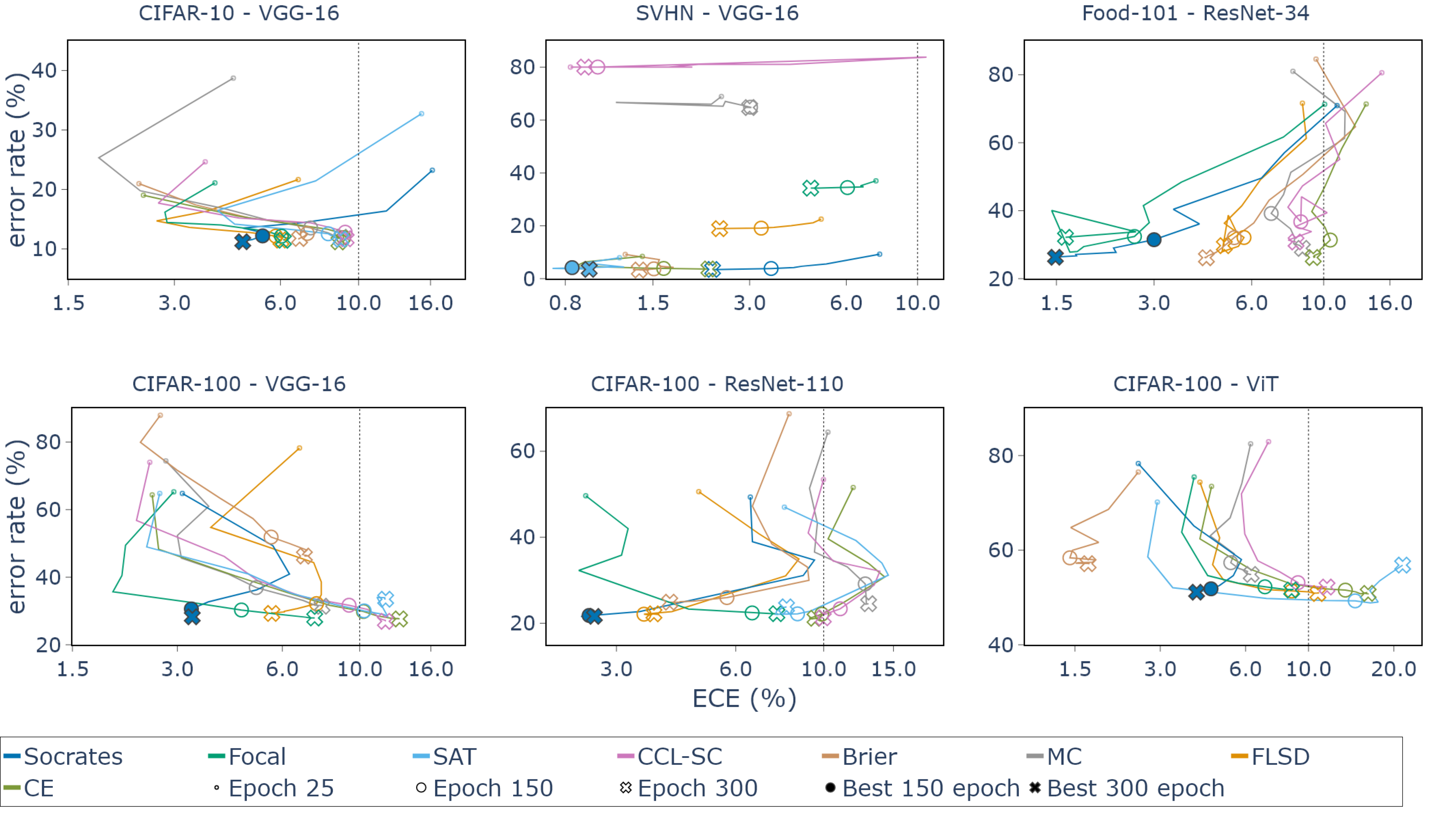
Figure 2: Evolution of error rate vs. ECE for various methods and architectures—Socrates Loss achieves stable and monotonically improving calibration and accuracy.
- Compatibility with transfer learning: In ViT transfer learning scenarios, models trained with Socrates Loss maintain high accuracy and exhibit well-controlled miscalibration even after fine-tuning, unlike most post-hoc and standard loss-based baselines.
- Well-calibrated reliability diagrams: Socrates-trained models achieve calibration curves that most closely follow the ideal (diagonal) target, avoiding systematic overconfidence and underconfidence seen in competing ad-hoc and post-hoc approaches.
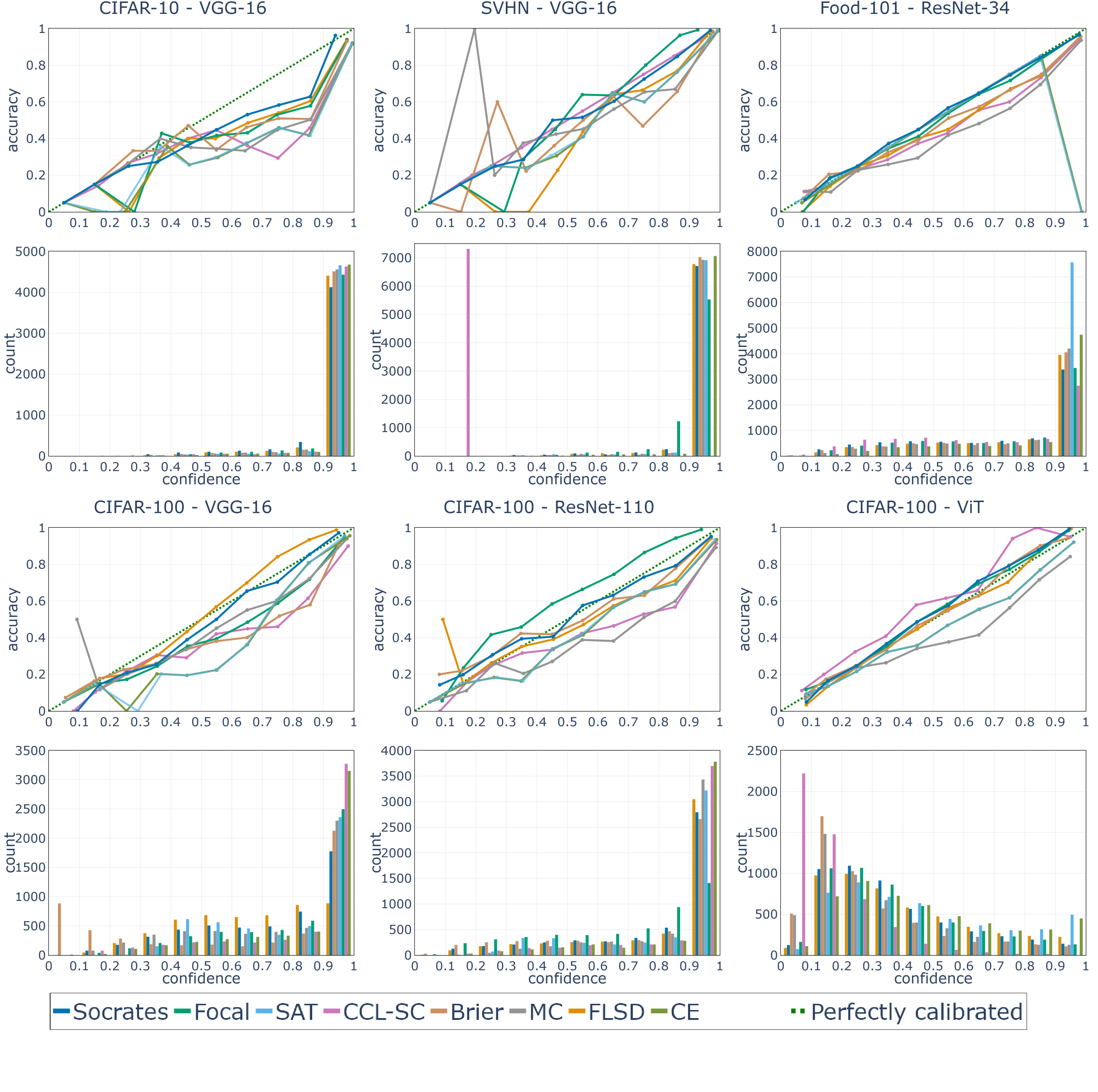
Figure 4: Reliability diagrams on the validation set at epoch 300, showcasing Socrates Loss’ tight adherence to the ideal calibration line across benchmarks.
Table and figure-based ablation studies demonstrate that every major component—dynamic uncertainty penalty, focal weighting, adaptive target—contributes critically to calibration and accuracy. Setting the penalty to zero or removing focal weighting substantially degrades performance.
Analysis of the Unknown Class Behavior
Tracking the evolution of average unknown-class confidence, calibration error, and prediction frequencies reveals that the unknown class is most useful in early and ambiguous predictions, and its presence dynamically adapts the model’s uncertainty responses during training. This mechanism is tied directly to improved calibration dynamics, as shown in the detailed evolution plots.
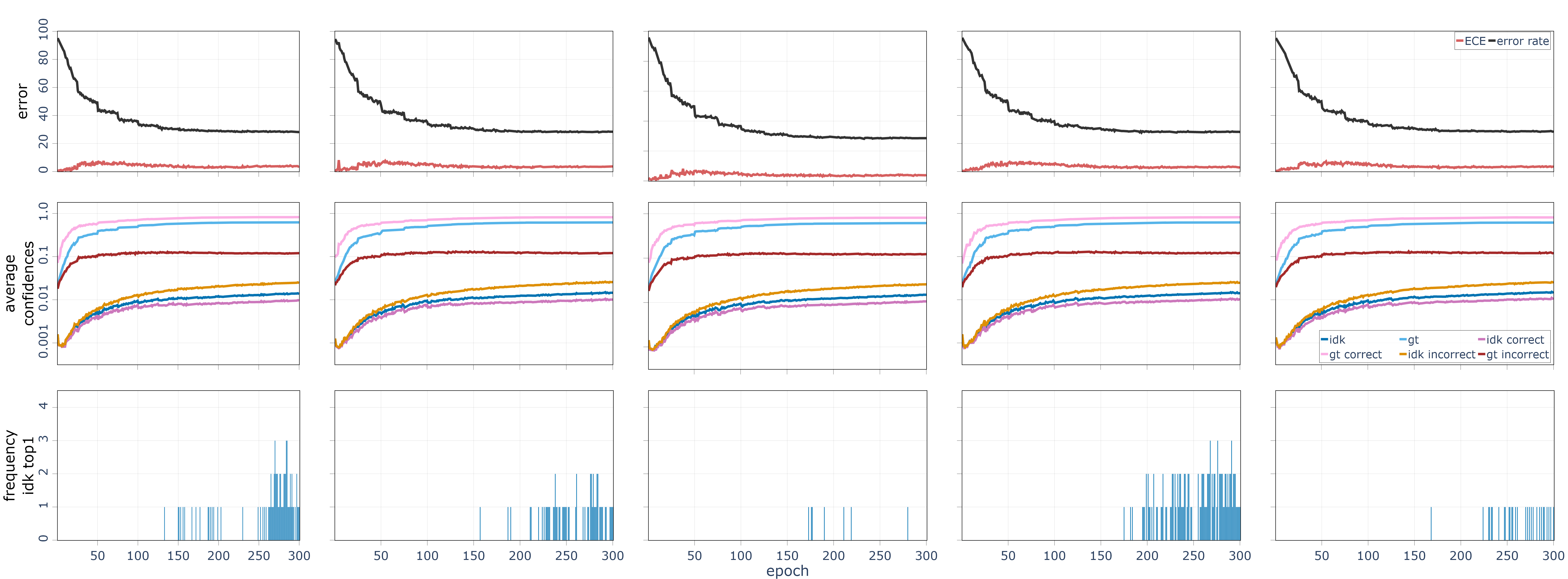
Figure 1: Evolution of calibration error, ground truth and unknown class confidence, and frequency of unknown-class predictions for Socrates Loss on CIFAR-100 (VGG-16).
Sensitivity and Ablation
Hyperparameter studies confirm that Socrates Loss is robust to γ and c0 for commonly encountered settings; small adjustments can further optimize calibration for particular datasets/architectures, but the core stability and calibration improvement remains. Removing any key component yields clear accuracy or calibration degradation, underlining the necessity of each element in the joint objective.
Practical and Theoretical Implications
The findings have several significant implications:
- Socrates Loss constitutes a single unified objective for training confidence-calibrated neural nets with no reliance on two-phase or scheduled loss switching.
- The explicit modeling of the unknown class acts as both a regularizer and an uncertainty quantifier, allowing simultaneous improvements in calibration and accuracy, and supporting transfer learning workflows where representations must be calibrated in weights, not merely at the output.
- The approach is highly robust to architectural choice (convolutional, residual, ViT, etc.) and dataset variability, though attention-based architectures may require further stability tuning.
Strong, nontrivial claims on stability are made: Socrates Loss systematically avoids the instability and non-monotonic ECE fluctuations known to affect regularized or scheduled-loss baselines. Moreover, it is demonstrated that modern neural architectures, when properly regularized via loss, do not necessarily default to overconfidence—a direct contradiction to previously reported trends dependent on vanilla cross-entropy loss [guo_calibration_2017].
Future Directions
Several avenues are highlighted for further work:
- Evaluating Socrates Loss on out-of-distribution (OOD) detection and robust generalization, given its explicit modeling of model ignorance;
- Investigating its applicability and robustness in open-set recognition and selective classification;
- Studying the behavior of the dynamic uncertainty penalty (c1) as a standalone or compositional regularizer;
- Analyzing scalability and sample efficiency in large scale, long-tailed, and few-shot regimes, especially with transformers and in the presence of distribution shift.
Conclusion
Socrates Loss advances the confidence calibration literature by unifying classification and calibration under a single, theoretically grounded, and empirically stable objective. The method leverages an explicit unknown class and a dynamic, adaptive penalty to produce models with improved calibration, regularization, stability across epochs, and compatibility with transfer learning. The approach outperforms and is more robust than both single-loss and scheduled ad-hoc calibration methods, as well as standard post-hoc calibration, on multiple image classification benchmarks and architectures. The explicit modeling of model ignorance within the learned weights positions Socrates Loss as a promising foundation for the next generation of reliable, deployable AI systems and motivates deeper study into uncertainty-centric learning procedures.
Reference: "Socrates Loss: Unifying Confidence Calibration and Classification by Leveraging the Unknown" (2604.12245).

