- The paper presents an EE-CNN-based framework that accurately differentiates original from recaptured images, achieving 98.89% accuracy.
- It integrates on-device enforcement to block forwarding of recaptured images in real-time, ensuring strict privacy control.
- Empirical evaluations with a secure mobile prototype demonstrate robustness under varied conditions with minimal false positives.
On-Device Mitigation of Screen-Recaptured Analog Hole Attacks (S-RAHA)
Introduction and Problem Definition
The paper "Mitigating S-RAHA: An On-device Framework to Prevent Forwarding of Re-Captured Images" (2604.12178) addresses a previously under-recognized attack vector—screen recapture, or Screen-Recaptured Analog Hole Attack (S-RAHA)—against secure mobile communication platforms handling sensitive image content. While mobile operating systems (e.g., Android's FLAG_SECURE) and server-side monitoring can effectively block digital screenshots, these controls are fully circumvented by adversaries who recapture screen content using a secondary camera device. The attack, illustrated in (Figure 1), operates at the physical layer and allows privacy violations and forensic obfuscation that defeat prevailing digital restrictions.
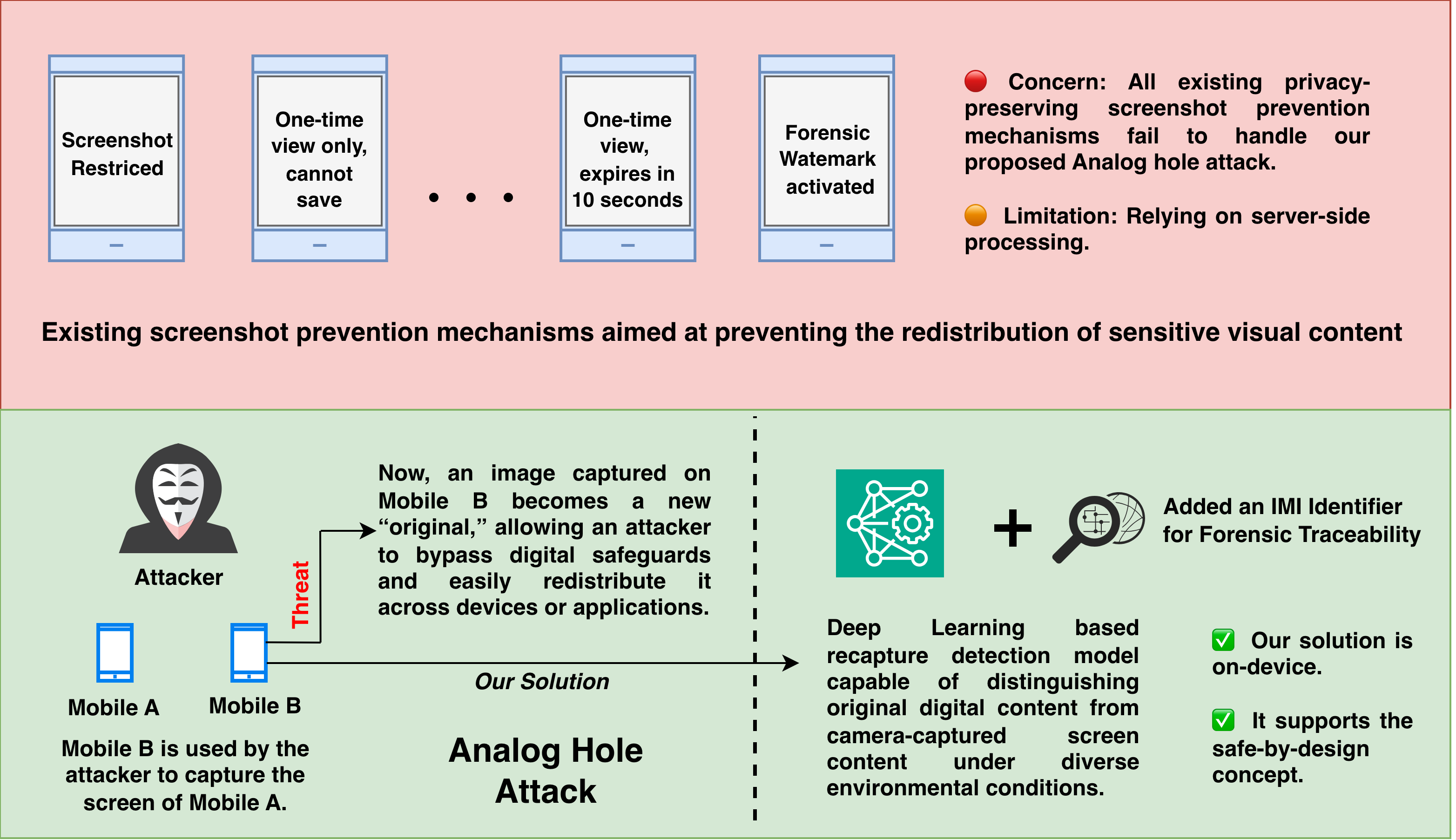
Figure 1: The attack vector: a protected image displayed on a mobile device is photographed by another device, bypassing software-level screenshot prevention.
S-RAHA is fundamentally resistant to application-layer controls and escapes server-side content tracing since the recaptured image is technically an independent photograph with degraded or absent forensic markers. The paper highlights the substantial risks posed to privacy-centric ecosystems (e.g., dating apps, telemedicine, secure communications for law enforcement) and formulates the need for an integrated, on-device, zero-trust architecture that can functionally prevent re-captured image propagation.
Previous IRD (Image Recapture Detection) schemes, including low-level hand-crafted feature engineering [ke2013multiple, thongkamwitoon2015edge] and more recent deep learning or domain-generalized approaches [luo2021scale, hussain2025fewshot, li2023recaptured], have demonstrated efficacy in detecting artifacts from the camera-display pipeline but are fundamentally reactive and lack integration with enforcement architectures. The rise of advanced content generation (cf. recapture-resistant generative tools [park2025chimera]) and high-fidelity displays (OLED, 4K) severely reduce the discriminability of classical forensic markers. In parallel, digital watermarking and robust invisible marker embedding [bai2022ssden, cao2024universal, liu2025screenshooting] have advanced post-incident attribution, but are also bypassed or degraded by physical recapture.
Current market solutions (VeraSnap, Truepic, DeepMedia AI) are primarily focused on authentic capture verification, post-incident forensics, or deepfake detection, with little capability for real-time, on-device proactive enforcement. The paper identifies a critical gap: there are no preventive client-side controls deployed within commercial mobile applications that can both detect recapture-specific artifacts under real-world device diversity and actively block redistribution pre-transmission.
Threat Model and Security Objectives
The threat model assumes an adversary with black-box access to mobile devices, able to recapture any on-screen image using a secondary camera without requiring specialized equipment. Post-processing attacks (e.g., contrast/brightness/rotational manipulations) are admitted. The attack pipeline is highly generic (physical, not digital) and defeats server and client digital controls.
Security objectives for the mitigation framework are:
- Discriminative inference between original and recaptured images across arbitrary device types, lighting, geometric orientation, and display technologies.
- Immediate, autonomous client-side blocking of the forwarding or external sharing of suspected recaptured images.
- Optional, invisible metadata embedding (IMI) to facilitate post-incident leakage tracing.
- High throughput and low inference latency suitable for mobile deployment, with strict control of false positives and negatives.
Architecture of the Proposed Framework
The proposed solution integrates three core components: (i) an Edge-Enhanced Convolutional Neural Network (EE-CNN) for detection, (ii) an on-device enforcement mechanism, and (iii) a conceptual invisible metadata identifier module for forensic traceability.
The main workflow proceeds as follows (see high-level framework diagram, not shown here for figure quota):
- Image Acquisition and Preprocessing: Incoming images are intercepted at the application boundary, normalized, and resized for inference.
- Deep Recapture Detection: The EE-CNN prioritizes spatial edge information via initial convolutional kernels (Sobel-X/Y, Laplacian) and hierarchically extracts discriminative features throughout the network. This is critical for capturing subtle display-camera pipeline artifacts (e.g., moiré, grid interference, degraded sharpness).
- Client-side Enforcement: Images flagged as recaptured are blocked from being transmitted, with user-feedback on decision and confidence score. When no model is available, a fail-closed policy blocks all outbound images.
- Forensic Metadata Embedding: For images passing validation, an invisible metadata identifier (IMI) can be optionally embedded by targeting robust mid-frequency DCT coefficients, allowing traceability even if leakage occurs.
SecureChatDate: Web Prototype and User Interaction
To empirically demonstrate feasibility, the authors deploy a proof-of-concept dating chat application, SecureChatDate, integrating the EE-CNN model for all image transfers. The user workflow and enforcement feedback are shown in (Figure 2) and (Figure 3): images are classified prior to sending, and suspect recaptured images are blocked at the interface, with the UI reflecting validation status in real time.


Figure 2: SecureChatDate interface—active conversation list and upload validation feedback. Image transfer is allowed only after classification.


Figure 3: Enforcement in SecureChatDate: original image (left) passes and enables the send button, while a recaptured image (right) is blocked with a displayed confidence score.
The architecture leverages RESTful APIs and WebSocket protocols and is generalizable to on-device implementations using TensorFlow Lite (Android) or Core ML (iOS), with further optimizations for system-level share-intent interception and background validation.
Model Architecture, Training, and Evaluation
The EE-CNN is deliberately lean (8.7M parameters), with an explicit edge extraction front-end, four hierarchical convolutional blocks, and a two-layer MLP classifier. Training details include a dataset of 1,500 original and 1,500 recaptured images, with substantial device-content diversity and strong data augmentation (geometric transformations, blur, color jitter, JPEG compression). The model is trained using Adam optimizer, L2 weight decay, early stopping, and a 50-epoch schedule.
The network exhibits rapid convergence in 15 epochs, with performance plateauing and no detectable overfitting, as evidenced in (Figure 4).
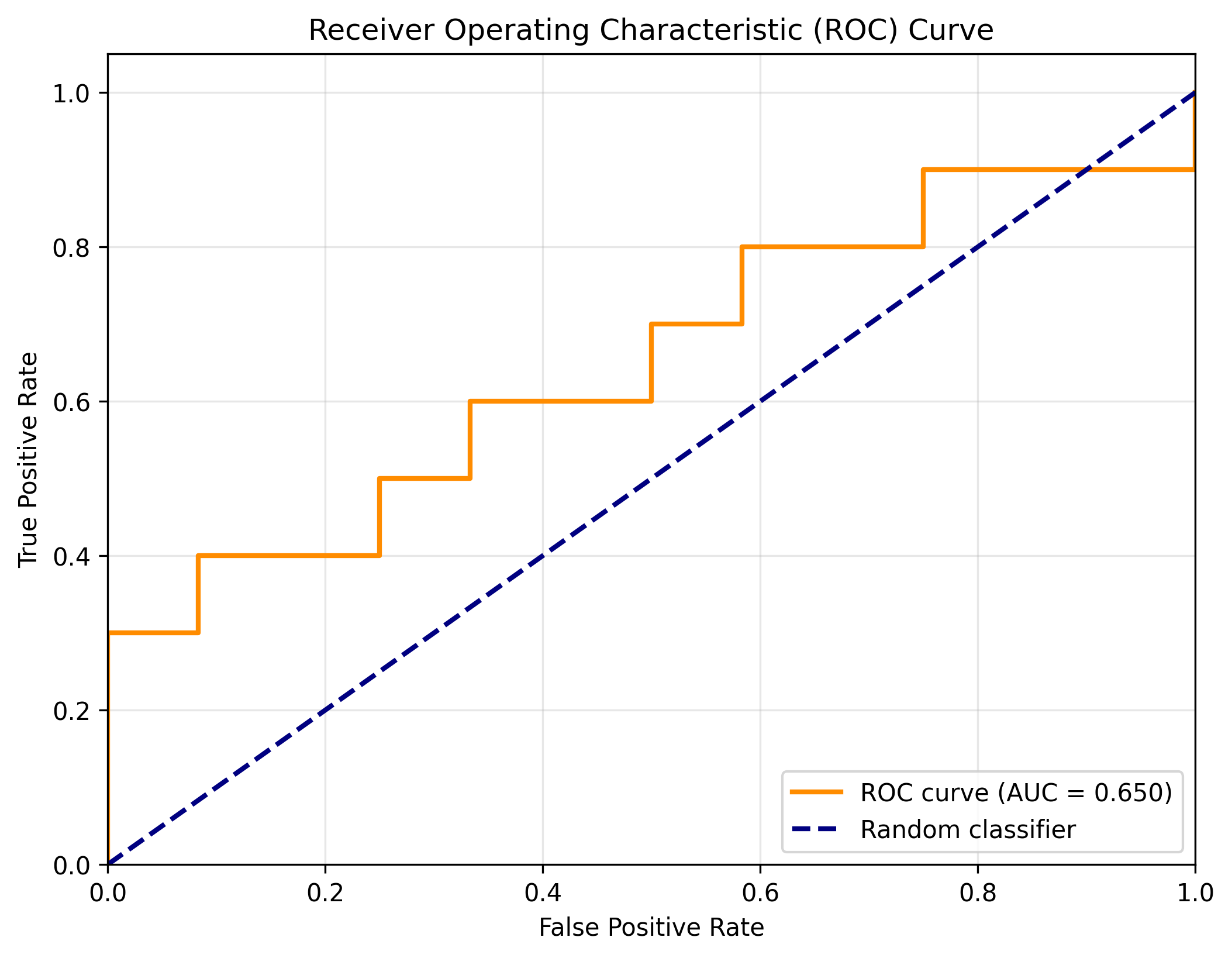
Figure 4: EE-CNN exhibits rapid convergence and stable validation performance with minimal overfitting over 50 epochs.
On the 450-image held-out test set, the EE-CNN achieves:
- Accuracy: 98.89%
- Recall: 99.11%
- Precision: 97.83%
- F1-score: 98.46%
- High-Confidence Accuracy (confidence >0.8): 99.46%
- FPR: 1.78%
- FNR: 0.89%
Failure modes cluster around images with motion blur, heavy prior compression, reflective surfaces, and high-end OLED recaptures at ideal orientation/lighting.
Edge filter visualizations (Figure 5) confirm the model's discriminative focus: compared to originals, recaptured images show significant moiré, periodic grid artifacts, and spatial sharpness degradation in Sobel and Laplacian responses.
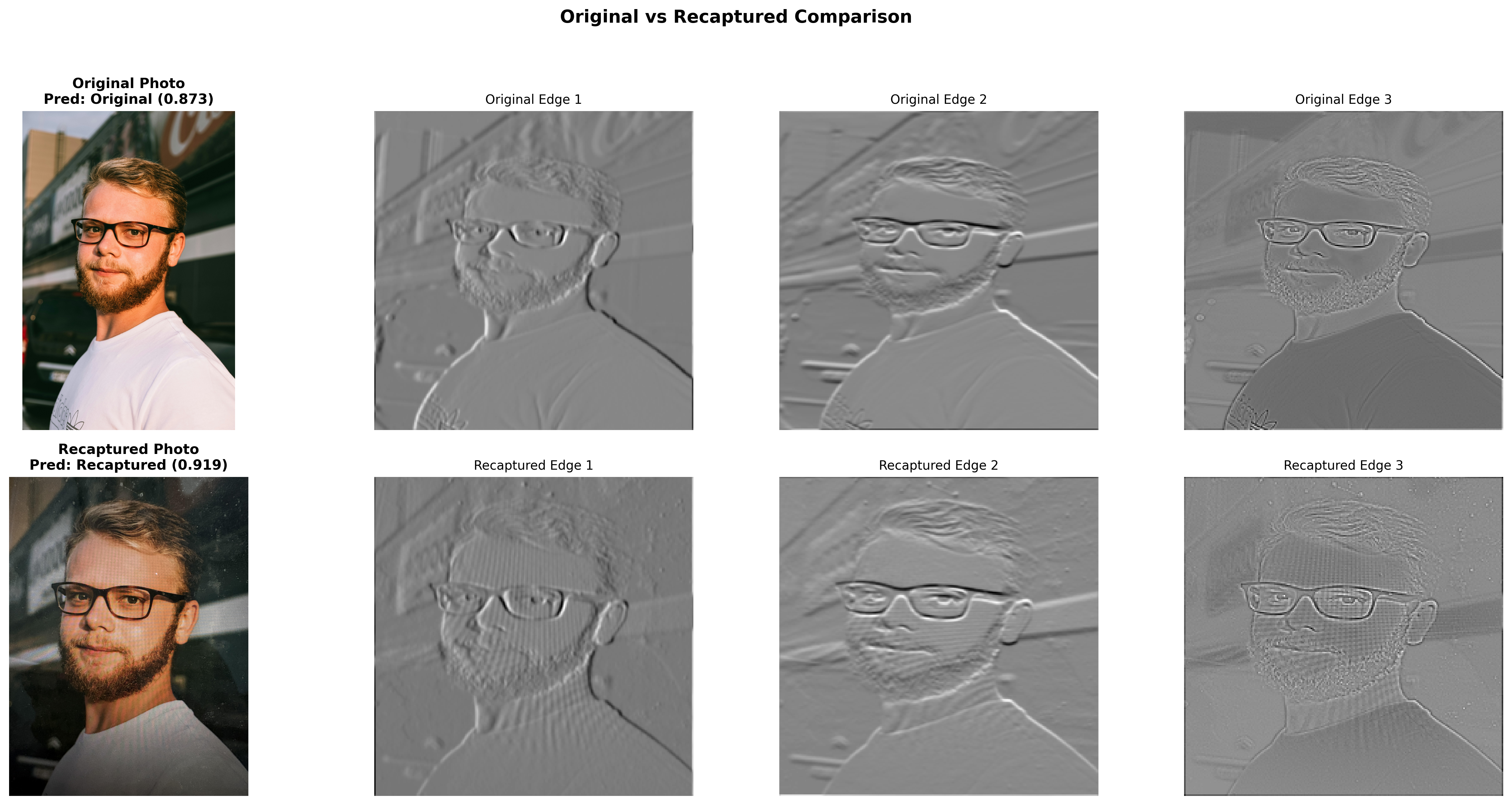
Figure 5: Edge detection responses—original (top) vs. recaptured (bottom). Recaptured images display moiré, grid interference, and sharpness inconsistencies.
EE-CNN substantially outperforms a matched-parameter ResNet-18 baseline in both raw accuracy (+4.67 pp) and computational efficiency (34% faster inference).
Security, Robustness, and Privacy Discussion
The architecture is resilient against common post-processing evasions (Gaussian blur, contrast enhancement, rotation), with minimal degradation (<3%) in detection accuracy due to robust data augmentation and focus on persistent, pipeline-induced artifacts. JPEG recompression also fails to bypass detection due to the model's spatial-domain edge focus.
API-level controls enforce mandatory validation, with client-provided authentication and active rate limiting to prevent black-box threshold probing.
False positives remain low; borderline cases are routed for manual review or require additional EXIF/metadata cross-checks. Retraining queues further minimize persistent error cases due to environmental variance or device bias.
The architecture preserves privacy—images are processed transiently and are not subject to extraneous biometric or identity extraction.
Implications and Outlook
This work fills a critical application-layer gap in privacy-preserving mobile communication systems by providing a functionally effective, on-device approach to a fundamentally analog attack. The practical integration of deep recapture detection and enforcement enables zero-trust policy enforcement without reliance on server infrastructure, user compliance, or post-incident forensics. The conceptual IMI-layer opens a direction for embedding robust, privacy-preserving traceability within native client architectures, inspired by recent advances in deep watermarking.
The strong empirical results on device and environmental diversity suggest high operational viability. However, detection reliability degrades for professional recapture settings or adversarially optimized conditions, indicating a fundamental limitation when recapture artifacts are minimized or eliminated by improved hardware. Extensions are needed towards frequency-domain feature augmentation, multi-modal fusion, adversarial robustness certification, and continual dataset expansion.
Conclusion
The proposed on-device EE-CNN framework for mitigating S-RAHA achieves high detection, enforcement, and scalability metrics, while empirically demonstrating substantial gains over established deep vision baselines. By coupling detection with enforcement and conceptual traceability, this work establishes a technical baseline for embedding recaptured content prevention into privacy-critical mobile platforms. The provided SecureChatDate prototype validates practical deployment potential, with future work indicated in widening dataset coverage, advancing forensic payload mechanisms, and formal adversarial risk assessments.
(2604.12178)