- The paper presents a joint analysis using Keck/KCWI IFU data and HST lensing to measure a near-isothermal mass-density slope (γ ≈ 2.04) with sub-6% MST uncertainty.
- The study employs Jeans Anisotropic Modeling in both spherical and axisymmetric frameworks to effectively break the mass-sheet and mass-anisotropy degeneracies.
- The findings underscore that high-quality spatially resolved kinematics are crucial for precision cosmology, enhancing the reliability of H0 inferences from strong lensing.
Spatially Resolved Kinematics of SLACS Lens Galaxies: Breaking Degeneracies with Lensing and Dynamical Models
Introduction and Context
The measurement of the Hubble constant (H0) remains a central challenge in precision cosmology due to persistent and statistically significant tension between early- and late-universe probes. Strong lensing time-delay systems offer a cosmology-independent, one-step route to infer H0, but their constraining power critically depends on accurate modeling of the lens galaxy mass profiles. The key obstacles are the mass-sheet degeneracy (MSD) inherent to lensing and the mass-anisotropy degeneracy (MAD) that plagues dynamical modeling.
This work presents an analysis of 14 early-type galaxies (ETGs) from the SLACS survey, for which high-resolution Keck/KCWI integral-field unit (IFU) data allow spatially resolved stellar kinematics. These data are combined with HST lensing to jointly break MSD and MAD and enable direct constraints on the intrinsic mass profile slope and the MST rescaling factor λint, evaluating the validity and limitation of power-law assumptions and spherical versus axisymmetric model approximations for the lens population.
Methodology
Data and Kinematic Extraction
The study utilizes spatially resolved kinematic maps from Keck/KCWI IFU spectroscopy for 14 SLACS lenses at z∼0.15–$0.35$. Reliable determination of line-of-sight velocity dispersion fields is achieved using the Penalized Pixel-Fitting (pPXF) algorithm, with error budgets incorporating formal, systematic, and spatially correlated uncertainties. This robust kinematic extraction is necessary since a 1% bias in the measured dispersion propagates to a 2% error in the inferred H0.
Dynamical and Lensing Model Framework
The 2D kinematic maps are fit using the Jeans Anisotropic Modeling (JAM) formalism. Mass models adopt a power-law elliptical surface mass density, parameterized by the logarithmic slope γ (where ρ∝r−γ), the Einstein radius θE as normalization, and axis ratio q. A central black hole is included. The full mass profile undergoes both internal (galaxy-intrinsic) and external (LOS) MSTs, with H00 modeled as a free parameter, while the external convergence is fixed to values from independent LOS studies.
Models are constructed under both spherical and axisymmetric symmetry. For axisymmetry, spherically and cylindrically aligned velocity anisotropy prescriptions are tested. Orbital anisotropy priors are informed by high-S/N local ETGs, with most SLACS lenses kinematically classified as slow rotators and hence expected to be nearly isotropic within one H01. The axisymmetric models fit the intrinsic axis ratio H02 to encode inclination effects and deprojection uncertainties.
The best-fit models and uncertainties are sampled via MCMC and compared using the Bayesian Information Criterion (BIC).
Main Results
Joint Constraints on Mass Profile and MST
Joint dynamical+lensing modeling yields a mean total mass density slope of H03 with intrinsic scatter H04, in excellent agreement with earlier SLACS lensing-only and TDCOSMO analyses. This validates the near-isothermal power-law as a robust first-order description for the composite density profile of lensing ETGs.
The internal MST parameter is robustly constrained: joint models achieve mean uncertainty in H05 of 5.8%, improved from 8.2% with kinematics alone, thus confirming the efficacy of combining lensing and kinematics to break the principal degeneracies. The sample mean H06 is fully consistent with the absence of a significant MST bias, a critical result for the reliability of time-delay cosmography.
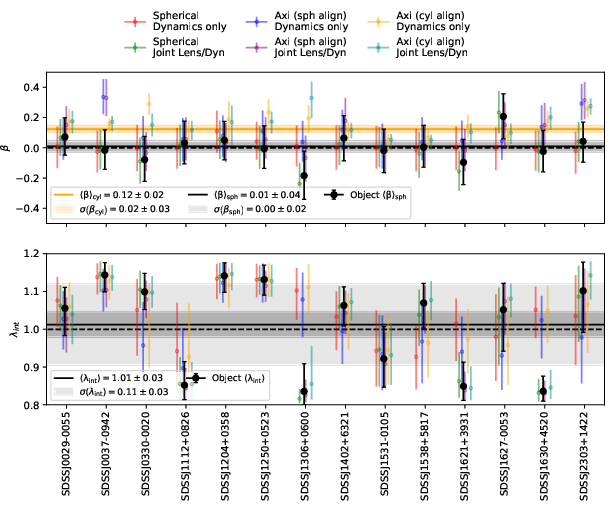
Figure 1: Sample-level summary of joint-model constraints on anisotropy and MST parameter H07 for all 14 SLACS+KCWI lenses.
Model Systematics and Spherical vs Axisymmetric Treatment
The analysis demonstrates that both spherical and axisymmetric Jeans models produce statistically consistent results for the main parameters of interest (slope, Einstein radius, anisotropy, MST parameter), with no significant trends or biases as a function of galaxy flattening within the uncertainties Figure 2. The median bias predicted for spherical vs. axisymmetric JAM by simulation studies (H081.7% in velocity dispersion) is below the precision of current data.
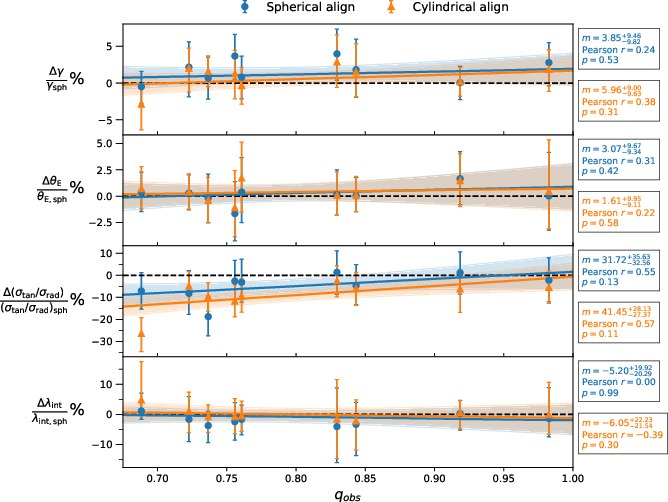
Figure 2: Percent differences in mass and anisotropy parameters for axisymmetric vs. spherical models as a function of observed axis ratio H09.
BIC model comparison reveals that spherical models are mildly preferred for most objects, but axisymmetric models with enhanced anisotropy flexibility sometimes offer equivalent likelihoods. This justifies the industry-wide use of correction factors based on projected ellipticity when only spherical models are feasible for cosmography pipelines.
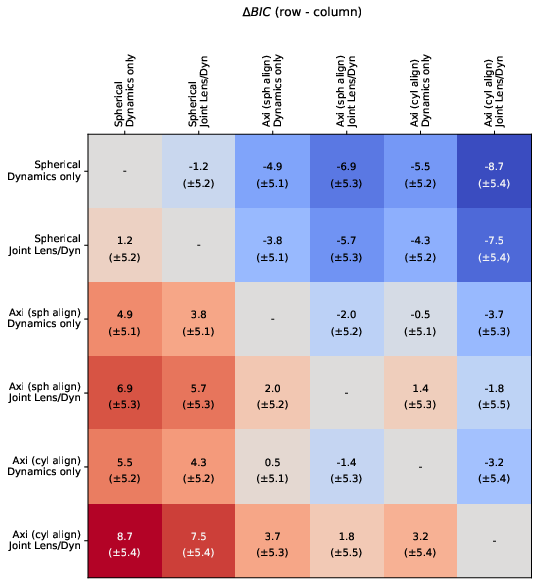
Figure 3: BIC grid comparison of dynamical and joint models for representative system SDSSJ1204+0358.
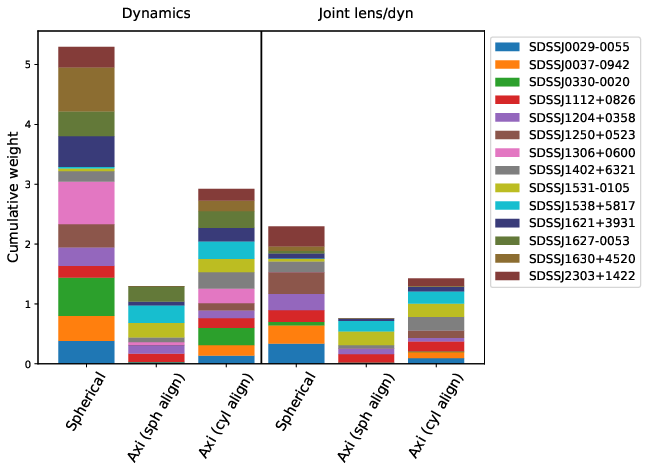
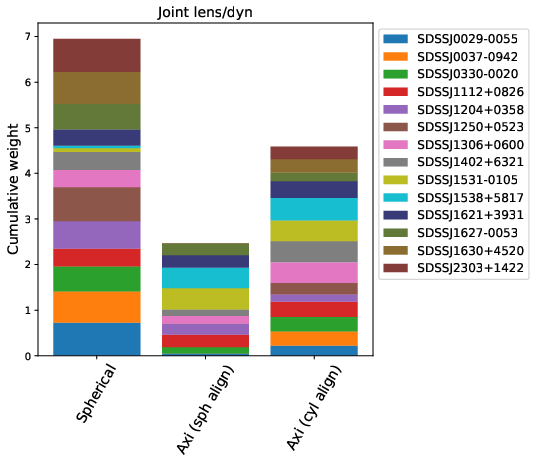
Figure 4: Cumulative BIC weights for all models across the sample, indicating individual object-level model preference distribution.
Anisotropy and Breaking the MAD
Anisotropy parameter λint0 constraints remain driven primarily by priors, underscoring that even with high-quality IFS, joint lensing+dynamics cannot independently break the MAD without strong informative priors or improved qualitative data (e.g., higher-order LOSVD). The measured anisotropy is consistent with isotropic orbits for spherically-aligned models, as expected for massive slow rotator ETGs.
Scatter in λint1 and Implications for Cosmography
Intrinsic scatter in λint2 among the sample (λint3) is significant, confirming and quantifying the non-zero deviations from the pure power-law assumption for individual lenses. This scatter is consistent with previous hierarchical analyses and is more pronounced for lenses with Einstein radii smaller than λint4, where the composite baryonic plus dark matter distribution is complex. No evidence is found for similar scatter in time-delay-lens samples, likely due to the differing radial coverage in those systems.
Implications and Future Directions
The stringent constraints on average λint5 and λint6 for the SLACS/KCWI sample validate their continued use as external calibrators for cosmographic studies, with no evidence for net bias at the current precision. However, the observed intrinsic scatter in λint7 highlights the necessity for more flexible mass models in future precision cosmology, moving beyond the pure power-law paradigm for individual systems. This will require decomposing the stellar and dark matter components and incorporating higher S/N and resolution spatially resolved kinematics, ideally out to multiple λint8.
Under the current observational limitations at intermediate redshift, reliance on local ETG anisotropy priors remains a necessity for breaking the joint MSD/MAD degeneracies. Direct tests of possible redshift evolution in the anisotropy profile, as will be possible with next-generation facilities (e.g., ELT/ELT-IFS), are a high priority to further reduce cosmological systematics.
Conclusion
This work provides definitive evidence that, for the SLACS sample of lensing ETGs, the near-isothermal power-law is sufficient for ensemble cosmological studies, and the MSD can be broken with sub-6% precision per lens using joint spatially resolved kinematics and HST lensing. Intrinsic lens-to-lens scatter in MST response highlights the imperative for flexible models in the era of percent-level λint9 precision. Both spherical and axisymmetric JAM models are statistically consistent, supporting current methodological assumptions. The findings clarify the limits and reliability of strong lensing + dynamics pipelines and chart the path towards a robust, bias-controlled cosmological inference from galaxy-scale lensing (2604.12155).
References
The above essay is based on "Spatially Resolved Kinematics of SLACS Lens Galaxies. II: Breaking Degeneracies with Lensing and Dynamical Models" (2604.12155).